Page 31 of 183
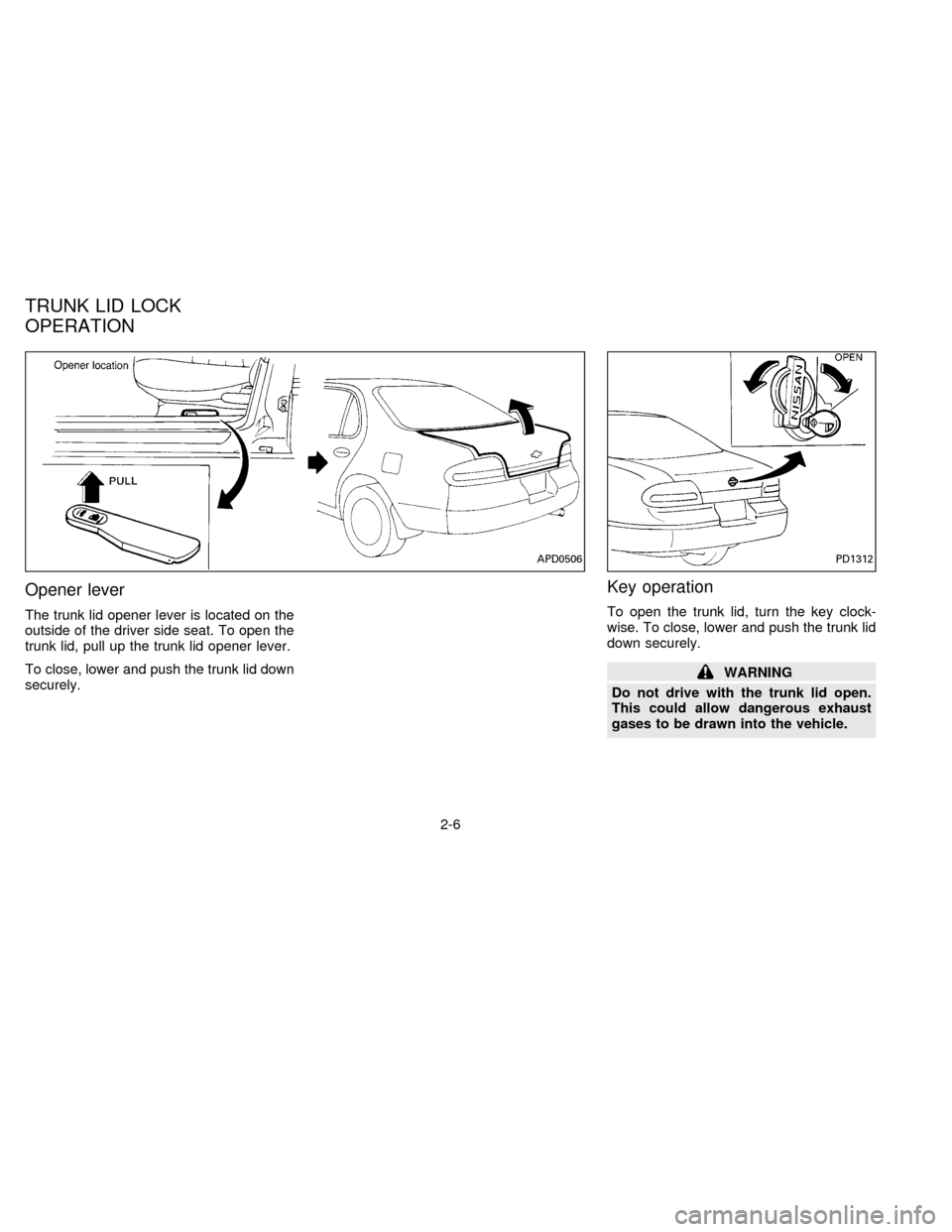
Opener lever
The trunk lid opener lever is located on the
outside of the driver side seat. To open the
trunk lid, pull up the trunk lid opener lever.
To close, lower and push the trunk lid down
securely.
Key operation
To open the trunk lid, turn the key clock-
wise. To close, lower and push the trunk lid
down securely.
WARNING
Do not drive with the trunk lid open.
This could allow dangerous exhaust
gases to be drawn into the vehicle.
APD0506PD1312
TRUNK LID LOCK
OPERATION
2-6
ZX
Page 34 of 183
SEAT ADJUSTMENT
WARNING
cDo not adjust the driver's seat while
driving. The seat may move sud-
denly and could cause loss of con-
trol of the vehicle.
cAfter adjustment, gently rock in the
seat to make sure it is securely
locked.
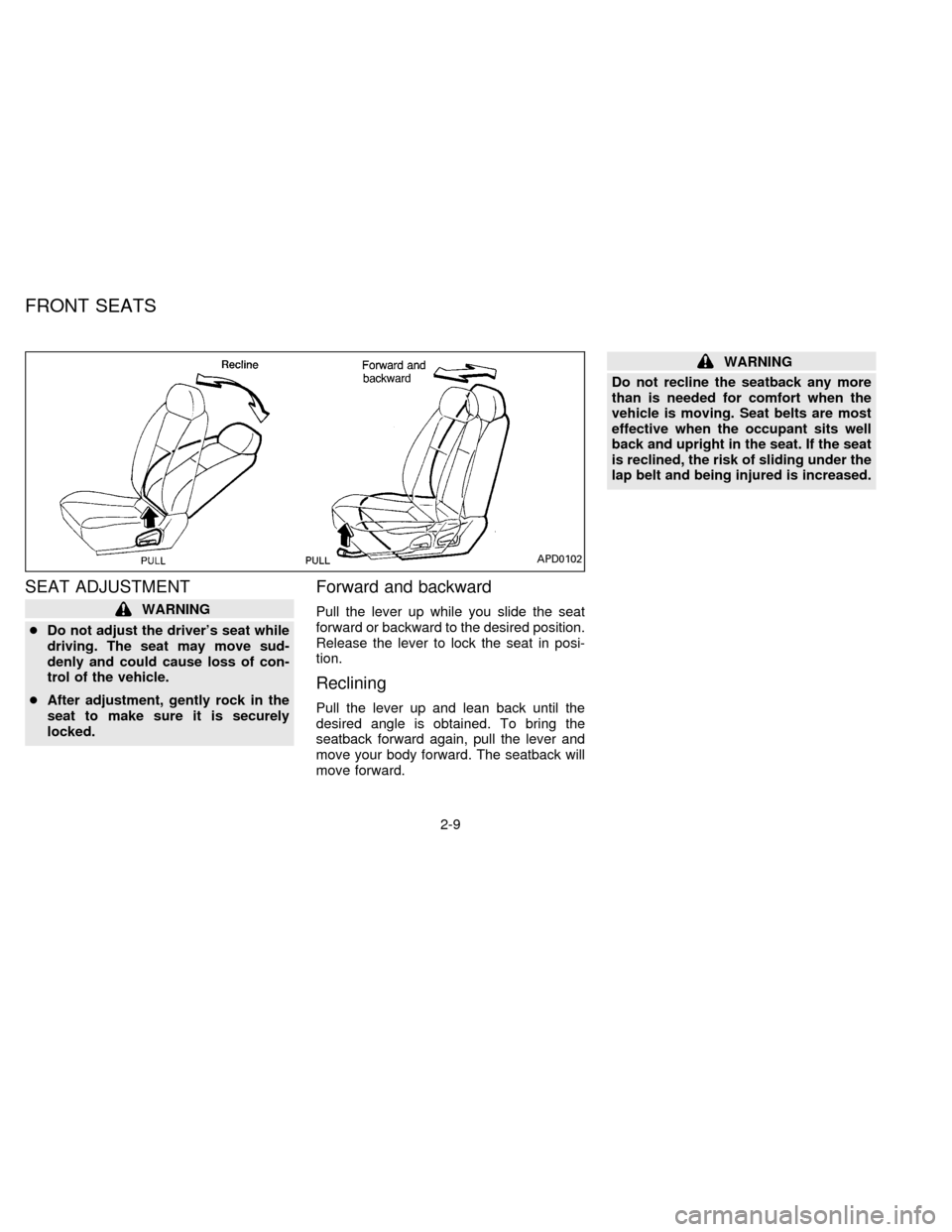
Forward and backward
Pull the lever up while you slide the seat
forward or backward to the desired position.
Release the lever to lock the seat in posi-
tion.
Reclining
Pull the lever up and lean back until the
desired angle is obtained. To bring the
seatback forward again, pull the lever and
move your body forward. The seatback will
move forward.
WARNING
Do not recline the seatback any more
than is needed for comfort when the
vehicle is moving. Seat belts are most
effective when the occupant sits well
back and upright in the seat. If the seat
is reclined, the risk of sliding under the
lap belt and being injured is increased.
APD0102
FRONT SEATS
2-9
ZX
Page 35 of 183
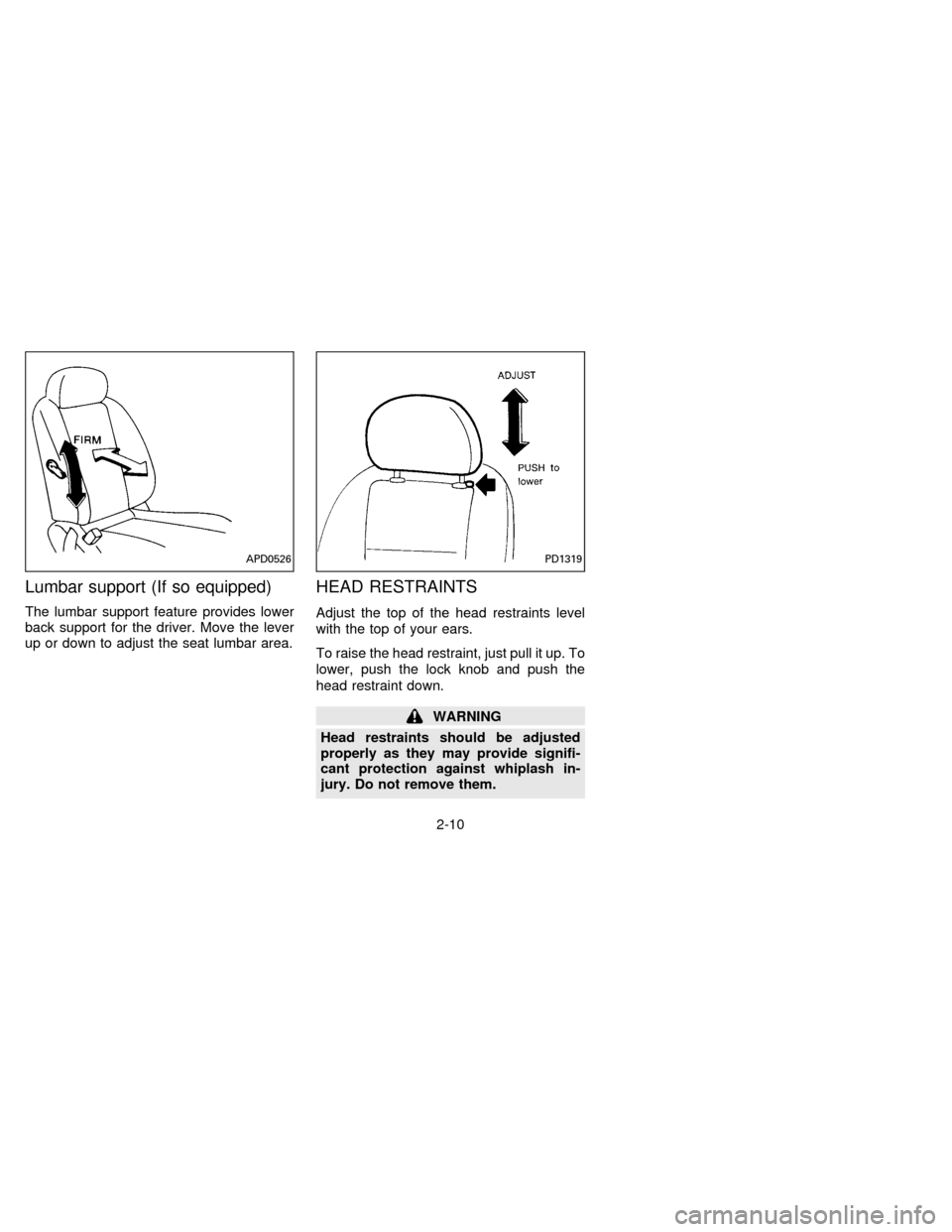
Lumbar support (If so equipped)
The lumbar support feature provides lower
back support for the driver. Move the lever
up or down to adjust the seat lumbar area.
HEAD RESTRAINTS
Adjust the top of the head restraints level
with the top of your ears.
To raise the head restraint, just pull it up. To
lower, push the lock knob and push the
head restraint down.
WARNING
Head restraints should be adjusted
properly as they may provide signifi-
cant protection against whiplash in-
jury. Do not remove them.
APD0526PD1319
2-10
ZX
Page 37 of 183
This Supplemental Restraint System sec-
tion contains important information concern-
ing the driver and passenger air bags. The
Supplemental Restraint System Air Bag can
help reduce impact force to the driver and to
the front passenger in certain frontal colli-
sions. The air bags are designed tosupple-
mentthe crash protection provided by the
driver and front passenger seat belts and
arenot a substitutefor them. The seat
belts should always be correctly worn and
the driver and front passenger seated a
suitable distance from the steering wheel
and instrument panel. (See ``Seat belts'' for
instructions and precautions on seat belt
usage.)
The supplemental air bags will operate
only when the ignition switch is in the
``ON'' or ``START'' position.
WARNING
The supplemental air bags ordinarily
will not inflate in the event of a side
impact, rear impact, roll over, or lower
severity frontal collision; so always
wear your seat belts to help reduce the
risk or severity of injury in various
kinds of accidents.
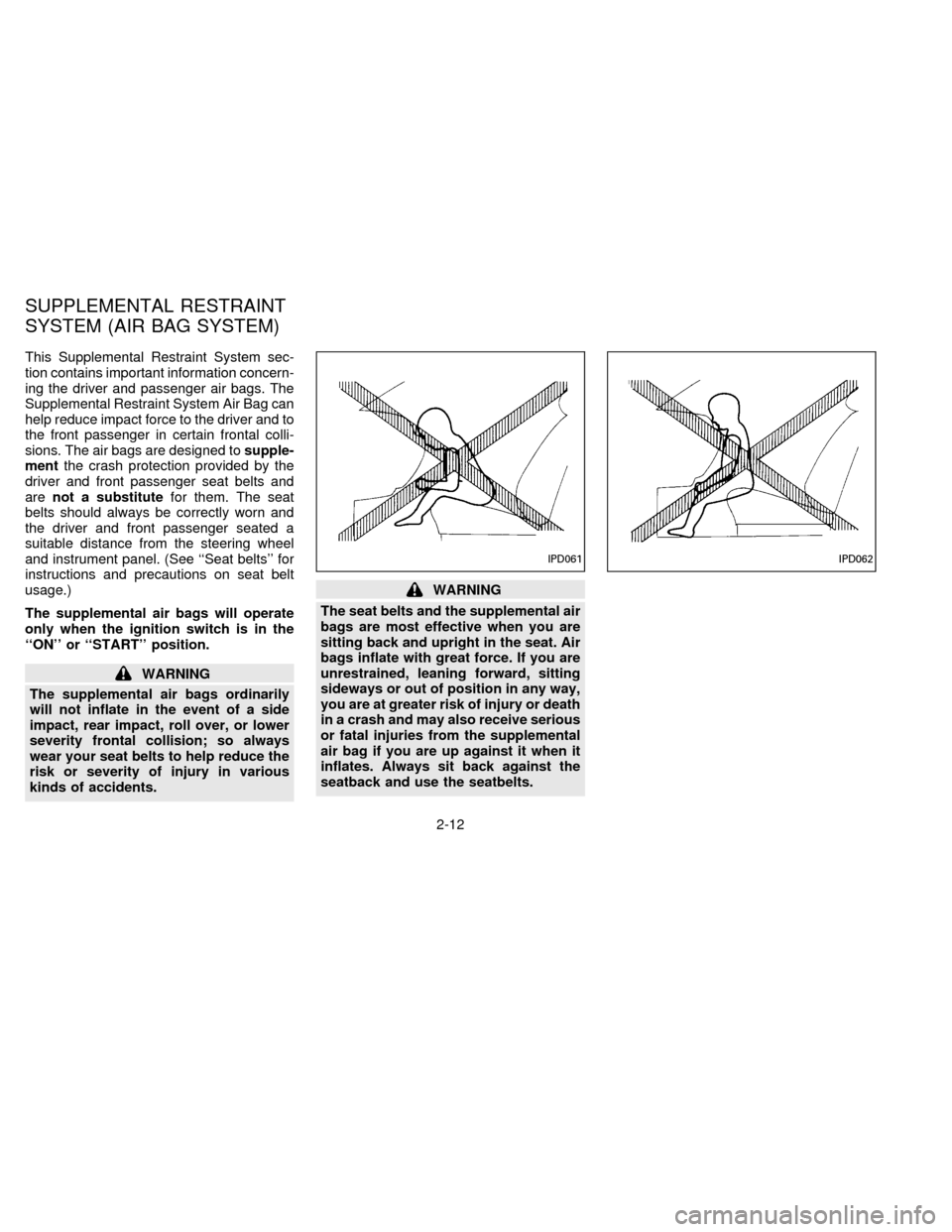
WARNING
The seat belts and the supplemental air
bags are most effective when you are
sitting back and upright in the seat. Air
bags inflate with great force. If you are
unrestrained, leaning forward, sitting
sideways or out of position in any way,
you are at greater risk of injury or death
in a crash and may also receive serious
or fatal injuries from the supplemental
air bag if you are up against it when it
inflates. Always sit back against the
seatback and use the seatbelts.
IPD062IPD061
SUPPLEMENTAL RESTRAINT
SYSTEM (AIR BAG SYSTEM)
2-12
ZX
Page 38 of 183
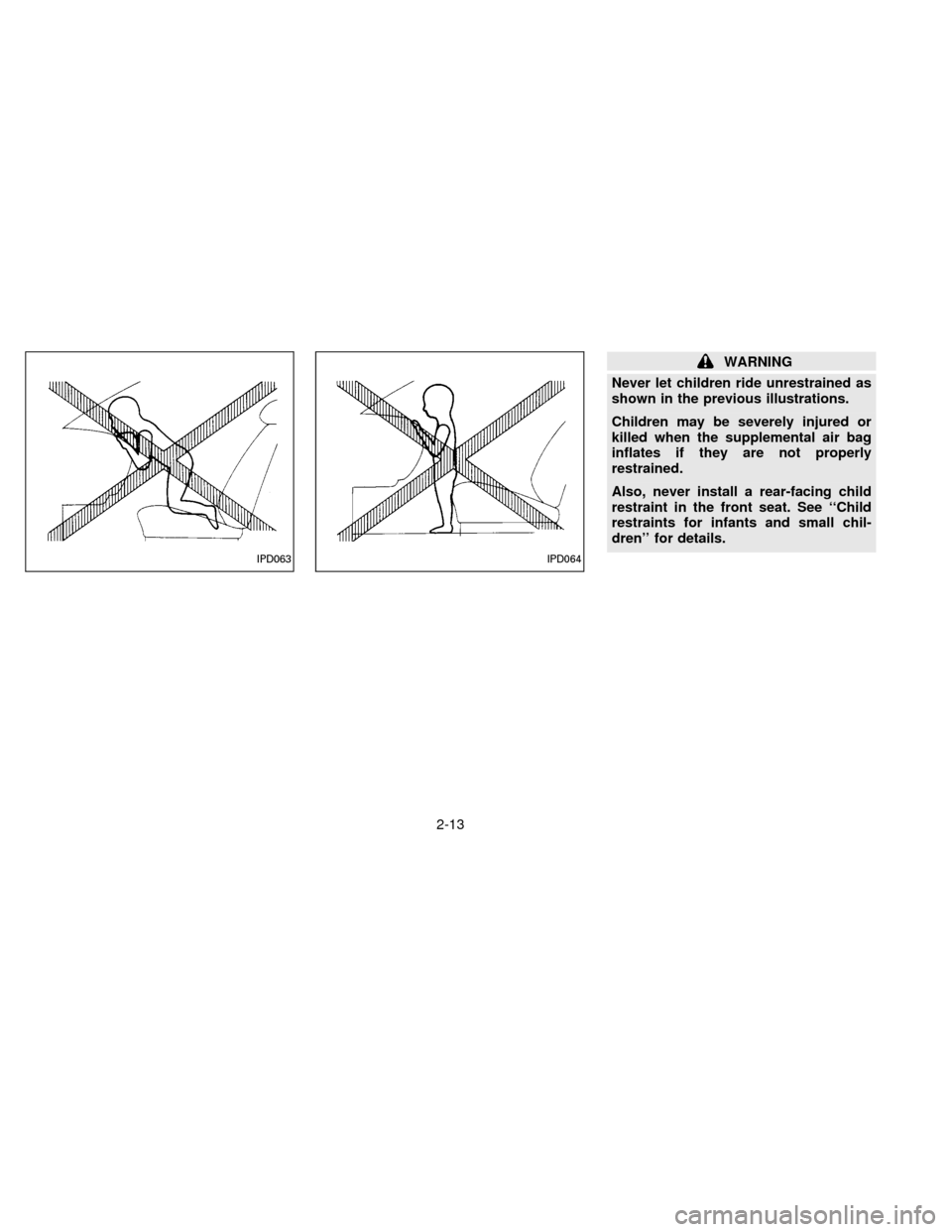
WARNING
Never let children ride unrestrained as
shown in the previous illustrations.
Children may be severely injured or
killed when the supplemental air bag
inflates if they are not properly
restrained.
Also, never install a rear-facing child
restraint in the front seat. See ``Child
restraints for infants and small chil-
dren'' for details.
IPD063IPD064
2-13
ZX
Page 39 of 183
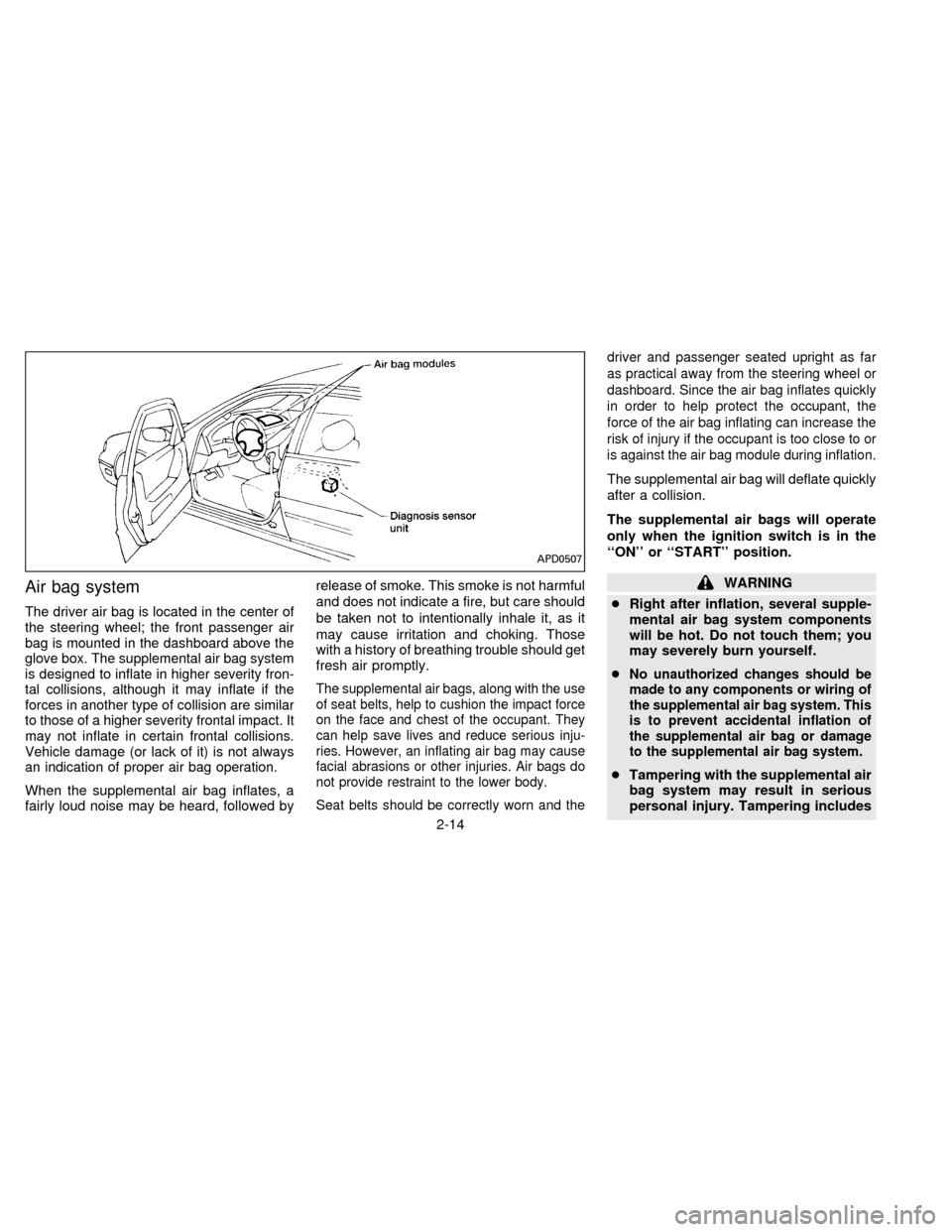
Air bag system
The driver air bag is located in the center of
the steering wheel; the front passenger air
bag is mounted in the dashboard above the
glove box. The supplemental air bag system
is designed to inflate in higher severity fron-
tal collisions, although it may inflate if the
forces in another type of collision are similar
to those of a higher severity frontal impact. It
may not inflate in certain frontal collisions.
Vehicle damage (or lack of it) is not always
an indication of proper air bag operation.
When the supplemental air bag inflates, a
fairly loud noise may be heard, followed byrelease of smoke. This smoke is not harmful
and does not indicate a fire, but care should
be taken not to intentionally inhale it, as it
may cause irritation and choking. Those
with a history of breathing trouble should get
fresh air promptly.
The supplemental air bags, along with the use
of seat belts, help to cushion the impact force
on the face and chest of the occupant. They
can help save lives and reduce serious inju-
ries. However, an inflating air bag may cause
facial abrasions or other injuries. Air bags do
not provide restraint to the lower body.
Seat belts should be correctly worn and thedriver and passenger seated upright as far
as practical away from the steering wheel or
dashboard. Since the air bag inflates quickly
in order to help protect the occupant, the
force of the air bag inflating can increase the
risk of injury if the occupant is too close to or
is against the air bag module during inflation.
The supplemental air bag will deflate quickly
after a collision.
The supplemental air bags will operate
only when the ignition switch is in the
``ON'' or ``START'' position.
WARNING
cRight after inflation, several supple-
mental air bag system components
will be hot. Do not touch them; you
may severely burn yourself.
c
No unauthorized changes should be
made to any components or wiring of
the supplemental air bag system. This
is to prevent accidental inflation of
the supplemental air bag or damage
to the supplemental air bag system.
cTampering with the supplemental air
bag system may result in serious
personal injury. Tampering includes
APD0507
2-14
ZX
Page 40 of 183
changes to the steering wheel and
the instrument panel assembly by
placing material over the steering
wheel pad and above the dashboard,
or by installing additional trim mate-
rial around the supplemental air bag
system.
cDo not place any objects on the
steering wheel pad or on the instru-
ment panel. Also, do not place any
objects between any occupant and
the steering wheel or instrument
panel. Such objects may become
dangerous projectiles and cause in-
jury if the air bag inflates.
cWork around and on the supplemen-
tal air bag system should be done by
an authorized NISSAN dealer. Instal-
lation of electrical equipment should
also be done by an authorized NIS-
SAN dealer. The yellow SRS wiring
should not be modified or discon-
nected. Unauthorized electrical test
equipment and probing devices
should not be used on the supple-
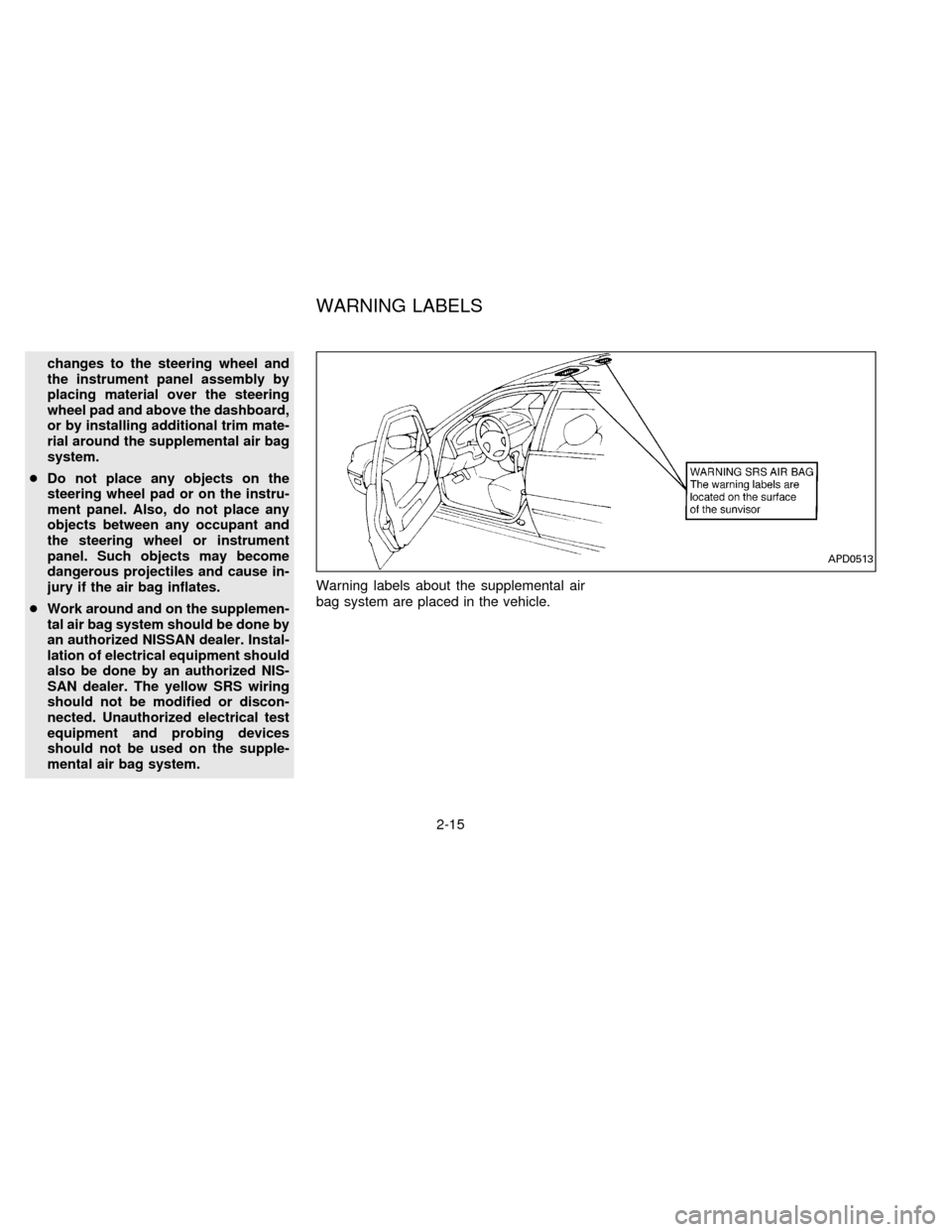
mental air bag system.Warning labels about the supplemental air
bag system are placed in the vehicle.
APD0513
WARNING LABELS
2-15
ZX
Page 41 of 183
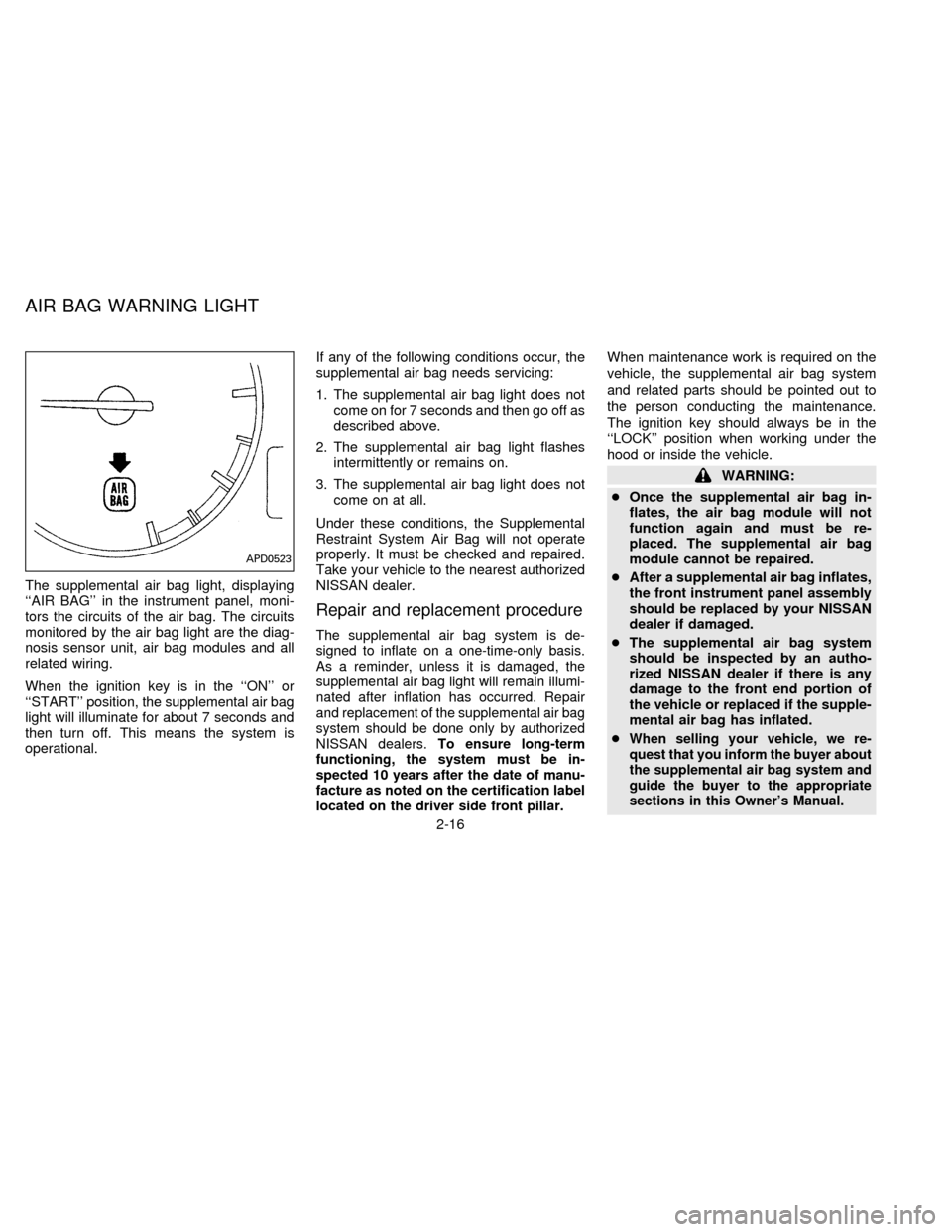
The supplemental air bag light, displaying
``AIR BAG'' in the instrument panel, moni-
tors the circuits of the air bag. The circuits
monitored by the air bag light are the diag-
nosis sensor unit, air bag modules and all
related wiring.
When the ignition key is in the ``ON'' or
``START'' position, the supplemental air bag
light will illuminate for about 7 seconds and
then turn off. This means the system is
operational.If any of the following conditions occur, the
supplemental air bag needs servicing:
1. The supplemental air bag light does not
come on for 7 seconds and then go off as
described above.
2. The supplemental air bag light flashes
intermittently or remains on.
3. The supplemental air bag light does not
come on at all.
Under these conditions, the Supplemental
Restraint System Air Bag will not operate
properly. It must be checked and repaired.
Take your vehicle to the nearest authorized
NISSAN dealer.
Repair and replacement procedure
The supplemental air bag system is de-
signed to inflate on a one-time-only basis.
As a reminder, unless it is damaged, the
supplemental air bag light will remain illumi-
nated after inflation has occurred. Repair
and replacement of the supplemental air bag
system should be done only by authorized
NISSAN dealers.To ensure long-term
functioning, the system must be in-
spected 10 years after the date of manu-
facture as noted on the certification label
located on the driver side front pillar.
When maintenance work is required on the
vehicle, the supplemental air bag system
and related parts should be pointed out to
the person conducting the maintenance.
The ignition key should always be in the
``LOCK'' position when working under the
hood or inside the vehicle.
WARNING:
cOnce the supplemental air bag in-
flates, the air bag module will not
function again and must be re-
placed. The supplemental air bag
module cannot be repaired.
cAfter a supplemental air bag inflates,
the front instrument panel assembly
should be replaced by your NISSAN
dealer if damaged.
cThe supplemental air bag system
should be inspected by an autho-
rized NISSAN dealer if there is any
damage to the front end portion of
the vehicle or replaced if the supple-
mental air bag has inflated.
c
When selling your vehicle, we re-
quest that you inform the buyer about
the supplemental air bag system and
guide the buyer to the appropriate
sections in this Owner's Manual.
APD0523
AIR BAG WARNING LIGHT
2-16
ZX