1996 NISSAN ALTIMA stop start
[x] Cancel search: stop startPage 104 of 183
or more or driven less than 1 mile (1.6
km).
COLD tire pressures are shown on the
tire placard affixed to the center console
lid.
cRetighten the wheel nuts when the
vehicle has been run for 600 miles
(1,000 km) after installing the alumi-
num wheel.
5. Securely store the spare tire and jacking
equipment in the vehicle.
WARNING
cAlways make sure that the spare tire
and jacking equipment are properly
secured after use. Such items can
become dangerous projectiles in an
accident or sudden stop.
The T-type spare tire and small size
spare tire are designed for emer-
gency use. See specific instructions
under the heading ``Wheels and
tires'' in the ``Do-it-yourself opera-
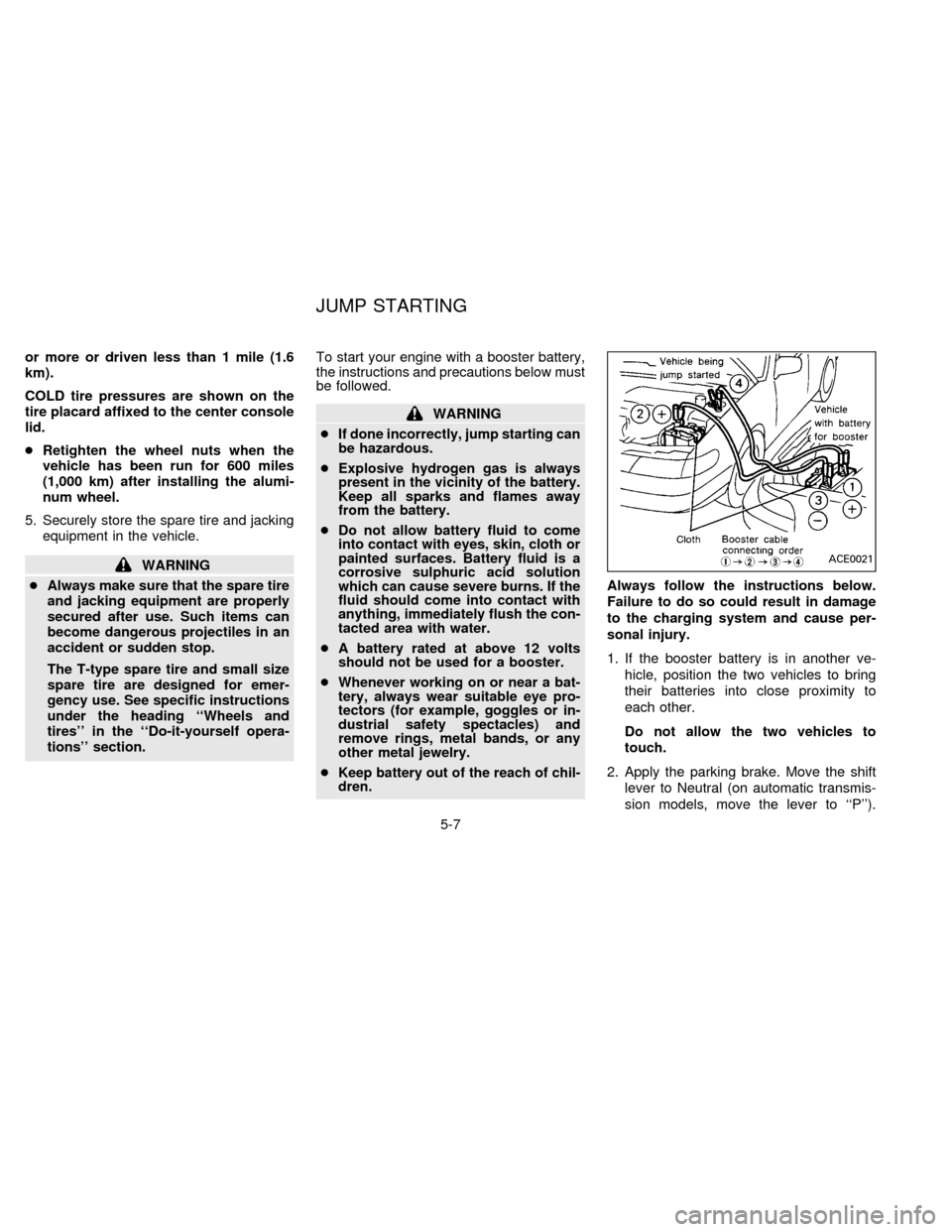
tions'' section.To start your engine with a booster battery,
the instructions and precautions below must
be followed.
WARNING
cIf done incorrectly, jump starting can
be hazardous.
cExplosive hydrogen gas is always
present in the vicinity of the battery.
Keep all sparks and flames away
from the battery.
cDo not allow battery fluid to come
into contact with eyes, skin, cloth or
painted surfaces. Battery fluid is a
corrosive sulphuric acid solution
which can cause severe burns. If the
fluid should come into contact with
anything, immediately flush the con-
tacted area with water.
cA battery rated at above 12 volts
should not be used for a booster.
cWhenever working on or near a bat-
tery, always wear suitable eye pro-
tectors (for example, goggles or in-
dustrial safety spectacles) and
remove rings, metal bands, or any
other metal jewelry.
c
Keep battery out of the reach of chil-
dren.
Always follow the instructions below.
Failure to do so could result in damage
to the charging system and cause per-
sonal injury.
1. If the booster battery is in another ve-
hicle, position the two vehicles to bring
their batteries into close proximity to
each other.
Do not allow the two vehicles to
touch.
2. Apply the parking brake. Move the shift
lever to Neutral (on automatic transmis-
sion models, move the lever to ``P'').
ACE0021
JUMP STARTING
5-7
ZX
Page 106 of 183
If your vehicle is overheating (indicated by
an extremely high temperature gauge read-
ing), or if you feel a lack of engine power,
detect abnormal noise, etc., take the follow-
ing steps:
WARNING
To avoid the danger of being scalded,
never remove the radiator cap while the
engine is still hot. When the radiator
cap is removed, pressurized hot water
will spurt out, possibly causing serious
injury.
1. Move the vehicle safely off the road,
apply the parking brake and move the
shift lever to Neutral (automatic transmis-
sion to ``P'').
Do not stop the engine.
2. Turn off the air conditioning. Open all the
windows, move the heater or air condi-
tioner temperature control to maximum
hot and fan control to high speed.
3. Get out of the vehicle. Look and listen for
steam or coolant escaping from the ra-
diator before opening the hood. Wait untilno steam or coolant can be seen before
proceeding.
4. Open the engine hood.
WARNING
If steam or water is coming from the
engine, stand clear to prevent getting
burned.
5. If engine overheating is caused by climb-
ing a long hill on a hot day, run the engine
at a fast idle (approximately 1,500 rpm)
until the temperature gauge indication
returns to normal.
6. Visually check drive belts for damage or
looseness. Also check if the cooling fan
is running. The radiator hoses and radia-
tor should not leak water.
WARNING
Be careful not to allow your hands, hair
or clothing to come into contact with,
or to get caught in, the running fan,
belts, or motor fan.
The fan motor can start at any time
when the coolant temperature is high.If coolant is leaking, the water pump
belt is missing or loose, or the cooling
fan does not run, stop the engine.
7. After the engine cools down, check the
coolant level in the reservoir tank with the
engine running. Add coolant to the res-
ervoir tank if necessary. Have your ve-
hicle repaired at the nearest NISSAN
dealer.
IF YOUR VEHICLE
OVERHEATS
5-9
ZX
Page 121 of 183

f. Wait 10 seconds before turning ignition
switch ``OFF''.
cManual air conditioning
a. Turn ignition switch ``ON'' and set tem-
perature control lever to the maximum
hot position. Wait 10 seconds then turn
switch ``OFF''.
2. Open the radiator drain plug. Open the
drain plug on the engine water pipe.
3. Open the radiator cap to drain the cool-
ant.
4. Flush the cooling system by running
fresh water through the radiator.
5. Close the radiator drain plug and the
drain plug on the engine water pipe se-
curely.
6. See the ``Technical and consumer infor-
mation'' section for cooling system ca-
pacity. Fill the radiator slowly with the
proper mixture of coolant and water. Fill
the reservoir tank up to the ``MAX'' level.
7. Open and close the air release plug to
release air. Then fill the radiator again
and install the radiator cap.8. Start the engine, and warm it up until it
reaches normal operating temperature.
Then race the engine 2 or 3 times under
no load. Watch the coolant temperature
gauge for signs of overheating.
9. Stop the engine. After it completely cools
down, refill the radiator up to the filler
opening. Fill the reservoir tank up to the
``MAX'' level.
10. Open and close the air release plug to
release air. Then fill the radiator again
and install the radiator cap.11. Check the radiator drain plug and the
drain plug on the engine water pipe for
any sign of leakage, tighten if neces-
sary.
DI1351DI1299
7-6
ZX
Page 134 of 183

Check the brake booster function as fol-
lows:
1. With the engine off, press and release
the brake pedal several times. When
brake pedal movement (distance of
travel) remains the same from one pedal
application to the next, continue on to
next step.
2. While depressing the brake pedal, start
the engine. The pedal height should drop
a little.
3. With the brake pedal depressed, stop the
engine. Keep the pedal depressed for
about 30 seconds. The pedal height
should not change.
4. Run the engine for one minute without
depressing the brake pedal, then turn it
off. Depress the brake pedal several
times. The pedal travel distance will de-
crease gradually with each depression
as the vacuum is released from the
booster.
If the brakes do not operate properly, see
your NISSAN dealer.Press the pedal by hand and be sure the
free travel is within the limits shown above.
If free travel is out of the range shown
above, see your NISSAN dealer.
Engine compartment
If the electrical equipment does not come
on, check for an open fuse.
1. Be sure the ignition key and the headlight
switch are ``OFF''.
2. Open the engine hood.
3. Remove the fusible link cover.
4. Remove the fuse with the fuse puller.
5. If the fuse is open, replace it with a new
fuse.
ADIO528DI1313
BRAKE BOOSTER CLUTCH PEDAL FUSES
7-19
ZX
Page 173 of 183

or other possible causes of either condi-
tion.
cAlways secure items in the trailer to
prevent load shifts while driving.
cBe certain your rear view mirrors conform
to all federal, state or local regulations. If
not, install any mirrors required for towing
before driving the vehicle.
Trailer towing tips
In order to gain skill and an understanding
of the vehicle's behavior, you should prac-
tice turning, stopping and backing up in an
area which is free from traffic. Steering
stability and braking performance will be
somewhat different than under normal driv-
ing conditions.
cAlways secure items in the trailer to
prevent load shift while driving.
cAvoid abrupt starts, acceleration or
stops.
cAvoid sharp turns or lane changes.
cAlways drive your vehicle at a moderate
speed.
cAlways block the wheels on both vehicle
and trailer when parking. Parking on a
slope is not recommended; however, ifyou must do so, and if your vehicle is
equipped with an automatic transmis-
sion, first block the wheels and apply the
parking brake, and then move the shift
lever into the ``P'' position. If you move
the shift lever to the ``P'' position before
blocking the wheels and applying the
parking brake, transmission damage
could occur.
cWhen going down a hill, shift into a lower
gear and use the engine braking effect.
When ascending a long grade, downshift
the transmission to a lower gear and
reduce speed to reduce chances of en-
gine overloading and/or overheating.
cIf the engine coolant rises to an ex-
tremely high temperature when the air
conditioning system is on, turn off the air
conditioner. Coolant heat can be addi-
tionally vented by opening the windows,
switching the fan control to high and
setting the temperature control to the
``HOT'' position.
cTrailer towing requires more fuel than
normal circumstances.
cAvoid towing a trailer for the first 500
miles (800 km).
cHave your vehicle serviced more oftenthan at intervals specified in the recom-
mended Maintenance Schedule.
cWhen making a turn, your trailer wheels
will be closer to the inside of the turn than
your vehicle wheels. To compensate for
this, make a larger than normal turning
radius during the turn.
cCrosswinds and rough roads will ad-
versely affect vehicle/trailer handling,
possibly causing vehicle sway. When
being passed by larger vehicles, be pre-
pared for possible changes in crosswinds
that could affect vehicle handling. If
swaying does occur, firmly grip the steer-
ing wheel, steer straight ahead, and im-
mediately (but gradually) reduce vehicle
speed. This combination will help stabi-
lize the vehicle. Never increase speed.
cBe careful when passing other vehicles.
Passing while towing a trailer requires
considerably more distance than normal
passing. Remember the length of the
trailer must also pass the other vehicle
before you can safely change lanes.
cTo maintain engine braking efficiency
and electrical charging performance, do
not use fifth gear (manual transmission)
9-16
ZX
Page 178 of 183

10 Index
A
Adjustment after headlamp assembly
replacement ............................................... 7-23
Air bag (See Supplemental restraint system)
Air bag warning light .................................. 2-16
Air cleaner housing filter ............................ 7-15
Air conditioner
Air conditioner (Automatic) ..................... 3-8
Air conditioner (Manual) ......................... 3-2
Air conditioner specification label .............. 9-11
Air conditioning-servicing ........................... 3-10
Air conditioning system refrigerant and
lubrication recommendations ....................... 9-6
Alarm system (See Theft warning system)
Anchor point locations ............................... 2-27
Antenna
Manual .................................................. 3-22
Power.................................................... 3-21
Anti-lock brake system ( ABS)
(If so equipped).......................................... 4-15
Anti-lock brake warning light ....................... 1-7
Ashtray (See cigarette lighter and ashtray)
Audio system
AM-FM radio with cassette player ........ 3-11
AM-FM radio with cassette player and
compact disc player.............................. 3-16Automatic
Automatic air conditioner operation ........ 3-8
Automatic power window switch .......... 1-16
Automatic transmission fluid ................... 7-9
Driving with automatic transmission ....... 4-6
B
Battery........................................................ 7-13
Before starting the engine ........................... 4-5
Belts
Inspection ............................................ 7-14
Size ......................................................... 9-7
Brake
Anti-lock brake system (ABS) .............. 4-15
Brake and clutch fluid ........................... 7-11
Brake booster ....................................... 7-19
Brake light (See stop light)
Brake pedal .......................................... 7-18
Brake warning light ................................. 1-6
Brake wear indicators ................... 1-7, 7-18
Parking brake check ............................. 7-17
Parking brake operation ....................... 4-10
Break-in schedule ...................................... 4-12
Bulb check/instrument panel ....................... 1-5
Bulb replacement ....................................... 7-24C
Capacities and recommended
fuel/lubricants ............................................... 9-2
Cassette player (See audio system)
CB radio or car phone ............................... 3-22
Check engine indicator light (See Malfunction
indicator light)
Child restraints for infants and small
children ...................................................... 2-23
Child safety rear door lock .......................... 2-4
Cigarette lighter and ashtray ..................... 1-14
Cleaning exterior and interior ...................... 6-2
Clock Ð instrument panel ......................... 1-18
Clock-radio ................................................. 3-10
Clutch pedal ............................................... 7-19
Cold weather driving cautions .................. 4-17
Compact disc (CD) player ......................... 3-20
Controls
Audio controls ............................. 3-11, 3-16
Heater and air conditioner (automatic) ... 3-8
Heater and air conditioner (manual)....... 3-2
Coolant
Capacities and recommended
fuel/lubricants.......................................... 9-2
Changing engine coolant........................ 7-5
Checking engine coolant level ............... 7-4
Engine coolant temperature gauge ........ 1-4
ZX
Page 180 of 183

H
Hazard warning flasher switch .................. 1-13
Head restraints .......................................... 2-10
Headlight and turn signal switch ............... 1-11
Headlights .................................................. 7-21
Heater and air conditioner
Heater and air conditioner controls
(automatic) .............................................. 3-8
Heater and air conditioner controls
(manual).................................................. 3-2
Hood release ............................................... 2-5
I
Ignition switch .............................................. 4-4
Indicator lights and chimes (See warning/
indicator lights and chimes)
Inside mirror ............................................... 2-31
Instrument brightness control .................... 1-12
Interior light ................................................ 1-18
J
Jump starting ............................................... 5-7
K
Key ............................................................... 2-2L
Labels
Air conditioner specification label ......... 9-11
Warning labels (for SRS) ..................... 2-15
Emission control information label........ 9-10
Engine serial number ............................. 9-9
F.M.V.S.S.certification label ................. 9-10
Vehicle identification number plate ........ 9-9
License plate
Installing front license plate .................. 9-12
Light
Air bag warning light............................. 2-16
Brake light (See stop light)
Bulb check/instrument panel .................. 1-5
Bulb replacement.................................. 7-24
Cornering light ...................................... 1-12
Front fog light switch ........................... 1-13
Headlight and turn signal switch .......... 1-11
Headlights ............................................. 7-21
Interior light ........................................... 1-18
Light bulbs ............................................ 7-21
Spotlight ................................................ 1-19
Trunk light ............................................. 1-19
Warning/indicator lights and chimes ...... 1-5
Lock
Child safety rear door lock ..................... 2-4
Door locks............................................... 2-2
Fuel filler lid lock operation .................... 2-7
Glove box ............................................... 2-5
Power door lock...................................... 2-3Power window lock switch .................... 1-15
Trunk lid lock operation .......................... 2-6
M
Maintenance
General maintenance ............................. 8-2
Inside the vehicle.................................... 8-3
Outside the vehicle ................................. 8-2
Periodic maintenance schedules ............ 8-5
Seat belt maintenance.......................... 2-23
Under the hood and vehicle ................... 8-4
Malfunction indicator light ............................ 1-7
Manual antenna ......................................... 3-22
Manual transmission
Driving with manual transmission ........... 4-8
Manual transmission fluid ....................... 8-9
Map light (See spotlight)
Meters and gauges ...................................... 1-2
Mirror
Inside mirror.......................................... 2-31
Outside mirror remote control .............. 2-30
Outside mirrors ..................................... 2-30
Vanity mirror (If so equipped) ............... 2-31
O
Octane rating (See fuel)
Odometer ..................................................... 1-3
Oil
Capacities and recommended
fuel/lubricants.......................................... 9-2
10-3
ZX
Page 181 of 183

Changing engine oil................................ 7-8
Changing engine oil filter........................ 7-9
Checking engine oil level ....................... 7-7
Engine oil ................................................ 7-7
Engine oil and oil filter recommendation. 9-4
Opener lever for trunk lid............................. 2-6
Outside mirror remote control.................... 2-30
Outside mirrors .......................................... 2-30
Overdrive switch .......................................... 4-8
Overheat
If your vehicle overheats ........................ 5-9
Owner's manuals/service manual
order form .................................................. 9-19
P
Parking
Parking brake check ............................. 7-17
Parking brake operation ....................... 4-10
Parking/parking on hills ........................ 4-14
Periodic maintenance schedules ................. 8-5
Power
Power antenna ..................................... 3-21
Power door lock...................................... 2-3
Power steering fluid .............................. 7-11
Power rear windows ............................. 1-16
Power windows..................................... 1-15
Precautions
Maintenance precautions ....................... 7-2
Precautions on seat belt usage............ 2-17
Precautions when driving ..................... 4-15
Precautions when starting and driving ... 4-2Push starting ................................................ 5-8
Q
Quick reference (See gas station information)
R
Radio
AM-FM radio with cassette player ........ 3-11
AM-FM radio with cassette player and
compact disc player.............................. 3-16
CB radio or car phone .......................... 3-22
Rear seat ................................................... 2-11
Rear window defogger switch ................... 1-10
Refrigerant recommendation ....................... 9-6
Registering your vehicle in another
country ......................................................... 9-8
Reporting safety defects (USA) ................. 9-18
S
Safety
Child safety rear door lock ..................... 2-4
Reporting safety defects (USA) ............ 9-18
Seat adjustment ........................................... 2-9
Seat belt
Precautions on seat belt usage............ 2-17
Seat belt extenders .............................. 2-23
Seat belt maintenance.......................... 2-23
Seat belt warning light ............................ 1-6Seat belts.............................................. 2-17
2-point type without retractor................ 2-21
3-point type with retractor..................... 2-19
Seats
Front seats.............................................. 2-9
Rear seats ............................................ 2-11
Service manual/owner's manual
order form .................................................. 9-19
Shifting ......................................................... 4-7
Spark plug replacement............................. 7-14
Speedometer ............................................... 1-3
Spotlight ..................................................... 1-19
SRS warning labels ................................... 2-15
Starting
Before starting the engine ...................... 4-5
Jump starting .......................................... 5-7
Precautions when starting and driving ... 4-2
Push starting........................................... 5-8
Starting the engine ................................ 4-9
Steering
Power steering fluid .............................. 7-11
Tilting steering wheel............................ 2-30
Stop light .................................................... 7-27
Sunroof ...................................................... 1-17
Supplemental restraint system
(Air bag system) ........................................ 2-12
Switch
Automatic power window switch .......... 1-16
Front fog light switch ............................ 1-13
Hazard warning flasher switch ............. 1-13
Headlight and turn signal switch .......... 1-11
Ignition switch ......................................... 4-4
10-4
ZX