1996 NISSAN ALTIMA door lock
[x] Cancel search: door lockPage 28 of 183
POWER DOOR LOCK
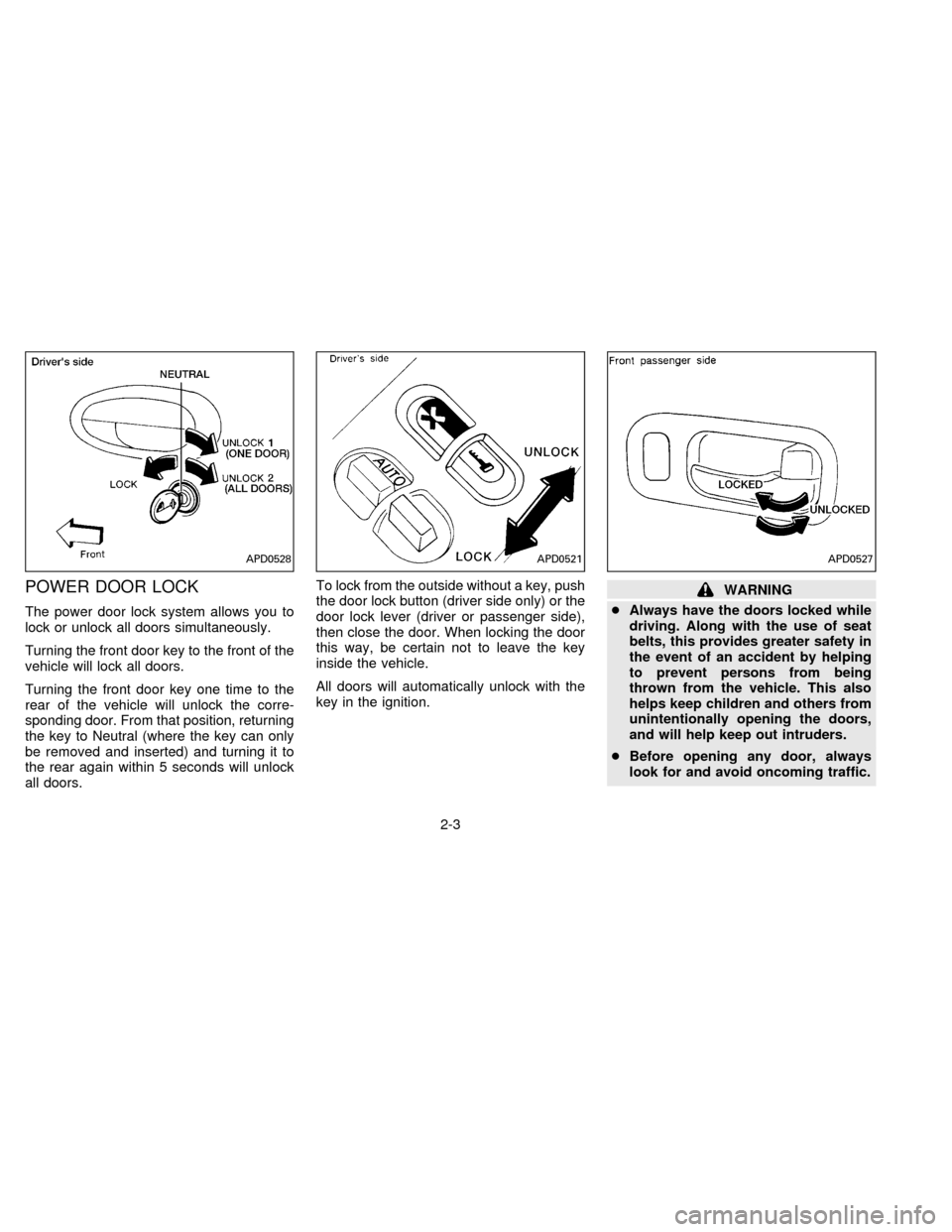
The power door lock system allows you to
lock or unlock all doors simultaneously.
Turning the front door key to the front of the
vehicle will lock all doors.
Turning the front door key one time to the
rear of the vehicle will unlock the corre-
sponding door. From that position, returning
the key to Neutral (where the key can only
be removed and inserted) and turning it to
the rear again within 5 seconds will unlock
all doors.To lock from the outside without a key, push
the door lock button (driver side only) or the
door lock lever (driver or passenger side),
then close the door. When locking the door
this way, be certain not to leave the key
inside the vehicle.
All doors will automatically unlock with the
key in the ignition.
WARNING
cAlways have the doors locked while
driving. Along with the use of seat
belts, this provides greater safety in
the event of an accident by helping
to prevent persons from being
thrown from the vehicle. This also
helps keep children and others from
unintentionally opening the doors,
and will help keep out intruders.
cBefore opening any door, always
look for and avoid oncoming traffic.
APD0528APD0521APD0527
2-3
ZX
Page 29 of 183
cDo not leave children unattended in-
side the vehicle. They may inadvert-
ently activate switches.
CHILD SAFETY REAR DOOR
LOCK
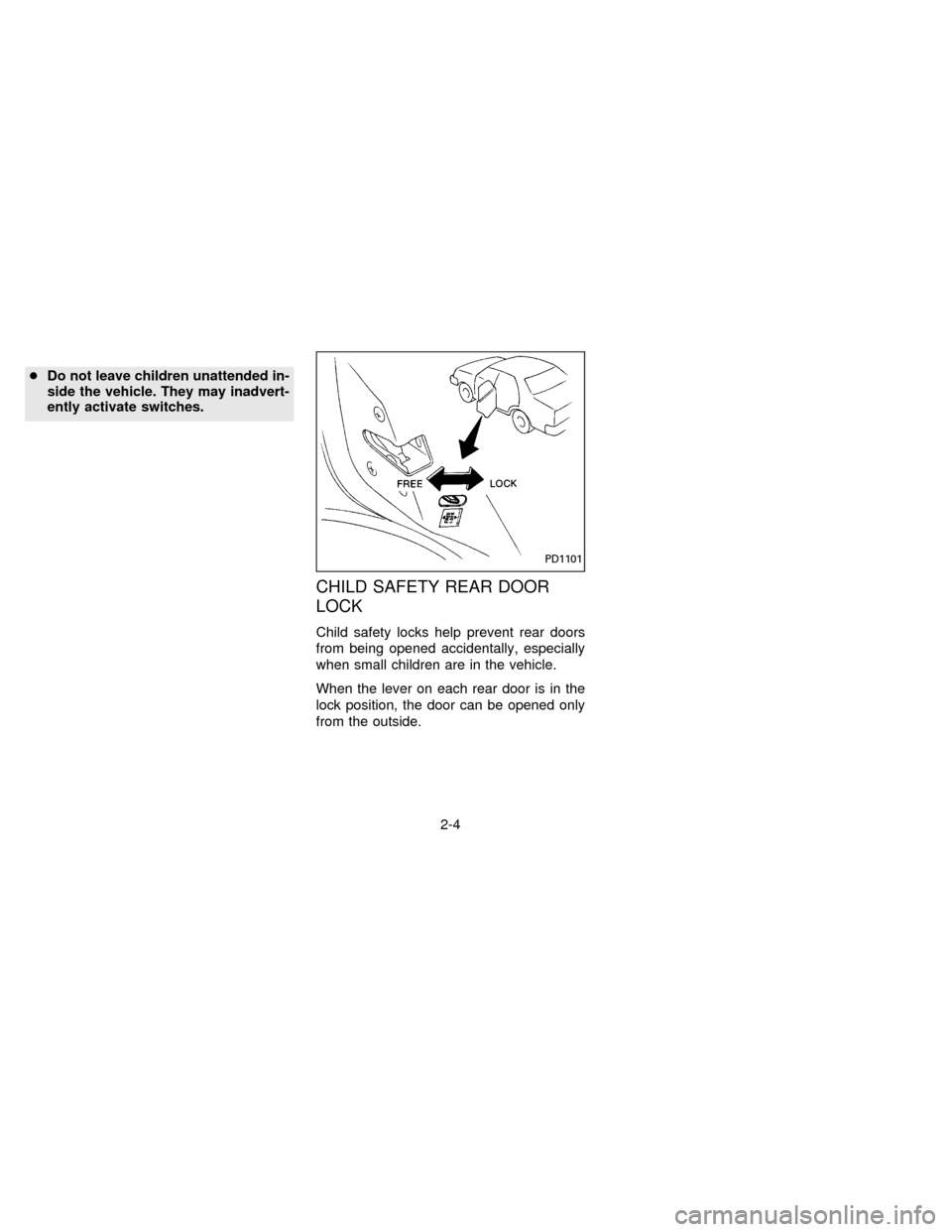
Child safety locks help prevent rear doors
from being opened accidentally, especially
when small children are in the vehicle.
When the lever on each rear door is in the
lock position, the door can be opened only
from the outside.
PD1101
2-4
ZX
Page 84 of 183
1) Move the shift lever into the ``P'' (Park)
position.
2) Turn the ignition key slightly in the ``ON''
direction.
3) Turn the key toward the ``LOCK'' posi-
tion.
4) Remove the key.
If the key is removed from the ignition
switch, the shift lever cannot be moved from
``P'' (Park).The shift lever can be moved if
the ignition switch is in the ``ACC'' posi-
tion. The shift lever can also be moved if
the ignition switch is in the ``ON'' posi-
tion and the foot brake pedal is de-
pressed.
There is an ``OFF'' position in between
``LOCK'' and ``ACC'', although it does not
show on the key cylinder. When the ignition
is in ``OFF'' the steering wheel is not locked.
In order for the steering wheel to be locked,
it must be turned about 1/8 of a turn coun-
terclockwise from the straight up position,
and the key must be removed from the
ignition.WARNING
To lock the steering wheel, remove the
key. To unlock the steering wheel, in-
sert the key and turn it gently while
rotating the steering wheel slightly
right and left.
Never remove the key while driving. If
the key is removed, the steering wheel
will lock. This may cause the driver to
lose control of the vehicle and could
result in serious vehicle damage or
personal injury.
``OFF'' (Manual transmission model) (1)
The engine can be turned off without locking
the steering wheel.
``ACC'' (Accessories) (2)
This position activates electrical accesso-
ries such as the radio when the engine is
not running.
``ON'' Normal operating position (3)
This position turns on the ignition system
and the electrical accessories.``START'' (4)
This position activates the starter motor,
which starts the engine.
cMake sure the area around the vehicle is
clear.
cMaintenance items listed here should be
checked periodically, for example, each
time you check engine oil.
cCheck that all windows and lights are
clean.
cVisually inspect tires for their appearance
and condition. Also check tires for proper
inflation.
cLock all doors.
cPosition seat and adjust head restraints.
cAdjust inside and outside mirrors.
cFasten seat belts and ask all passengers
to do likewise.
cCheck the operation of warning lights
when key is turned to the ``ON'' (3) posi-
tion.
BEFORE STARTING THE
ENGINE
4-5
ZX
Page 96 of 183

Freeing a frozen door lock
To prevent a door lock from freezing, apply
de-icer or glycerin to it through the key hole.
If the lock becomes frozen, heat the key
before inserting it into the key hole.
Anti-freeze
In the winter when it is anticipated that the
temperature will drop below 32ÉF (0ÉC),
check anti-freeze (ethylene glycol base) to
assure proper winter protection. For details,
see ``Engine Cooling System'' in the ``Do-it-
yourself operations'' section.
Battery
If the battery is not fully charged during
extremely cold weather conditions, the bat-
tery fluid may freeze and damage the bat-
tery. To maintain maximum efficiency, the
battery should be checked regularly. For
details, see ``Battery'' in the ``Do-it-yourself
operations'' section.
Draining of coolant water
If the vehicle is to be left outside without
anti-freeze, drain the cooling system by
opening the drain valves located under the
radiator and on the engine block. Refillbefore operating the vehicle. See ``Chang-
ing Engine Coolant'' in the ``Do-it-yourself
operations'' section.
Tire equipment
1. The SUMMER tires are of a tread design
to provide superior performance on dry
pavement. However, the performance of
these tires will be substantially reduced
in snowy and icy conditions. If you oper-
ate your vehicle on snowy or icy roads,
NISSAN recommends the use of MUD &
SNOW or ALL SEASON tires on all four
wheels. Please consult your NISSAN
dealer for the tire type, size, speed rating
and availability information.
2. For additional traction on icy roads, stud-
ded tires may be used. However, some
provinces and states prohibit their use.
Check local, state and provincial laws
before installing studded tires.
Skid and traction capabilities of studded
snow tires, on wet or dry surfaces, may
be poorer than that of non-studded snow
tires.3. Snow chains may be used if desired.
Make sure they are of proper size for the
tires on your vehicle and are installed
according to the chain manufacturer's
suggestions.
Use of tire chains may be prohibited accord-
ing to location. Check the local laws before
installing tire chains. When installing tire
chains, make sure they are of proper size
for the tires on your vehicle and are installed
according to the chain manufacturer's sug-
gestions.Use only SAE Class ``S'' chains.
Other types may damage your vehicle. Use
chain tensioners when recommended by
the tire chain manufacturer to ensure a tight
fit. Loose end links of the tire chain must be
secured or removed to prevent the possibil-
ity of whipping action damage to the fenders
or underbody. If possible, avoid fully loading
your vehicle when using tire chains. In ad-
dition, drive at a reduced speed. Otherwise,
your vehicle may be damaged and/or ve-
hicle handling and performance may be
adversely affected.
Never install tire chains on T-type and small
size spare tires. Do not use the chains on
dry roads.
COLD WEATHER DRIVING
CAUTIONS
4-17
ZX
Page 99 of 183
If you have a flat tire, follow the instructions
below.
Stopping the vehicle
1. Safely move the vehicle off the road
away from traffic.
2. Turn on the hazard warning flashers.
3. Park on a level surface and apply the
parking brake. Shift the manual transmis-
sion into reverse (automatic transmission
in ``P'').
4. Turn off the engine.
WARNING
cMake sure that the parking brake is
securely applied and the manual
transmission is shifted into reverse
(automatic transmission in ``P'').
cNever change tires when the vehicle
is on a slope, ice or slippery areas.
This is dangerous.
cNever change tires if oncoming traf-
fic is close to your vehicle. Wait for
professional road assistance.cRaise the hood to warn other traffic,
and to signal professional road as-
sistance personnel that you need
assistance.
cHave all passengers get out of the
vehicle and stand in a safe place,
away from traffic and clear of the
vehicle.Getting the spare tire and tools
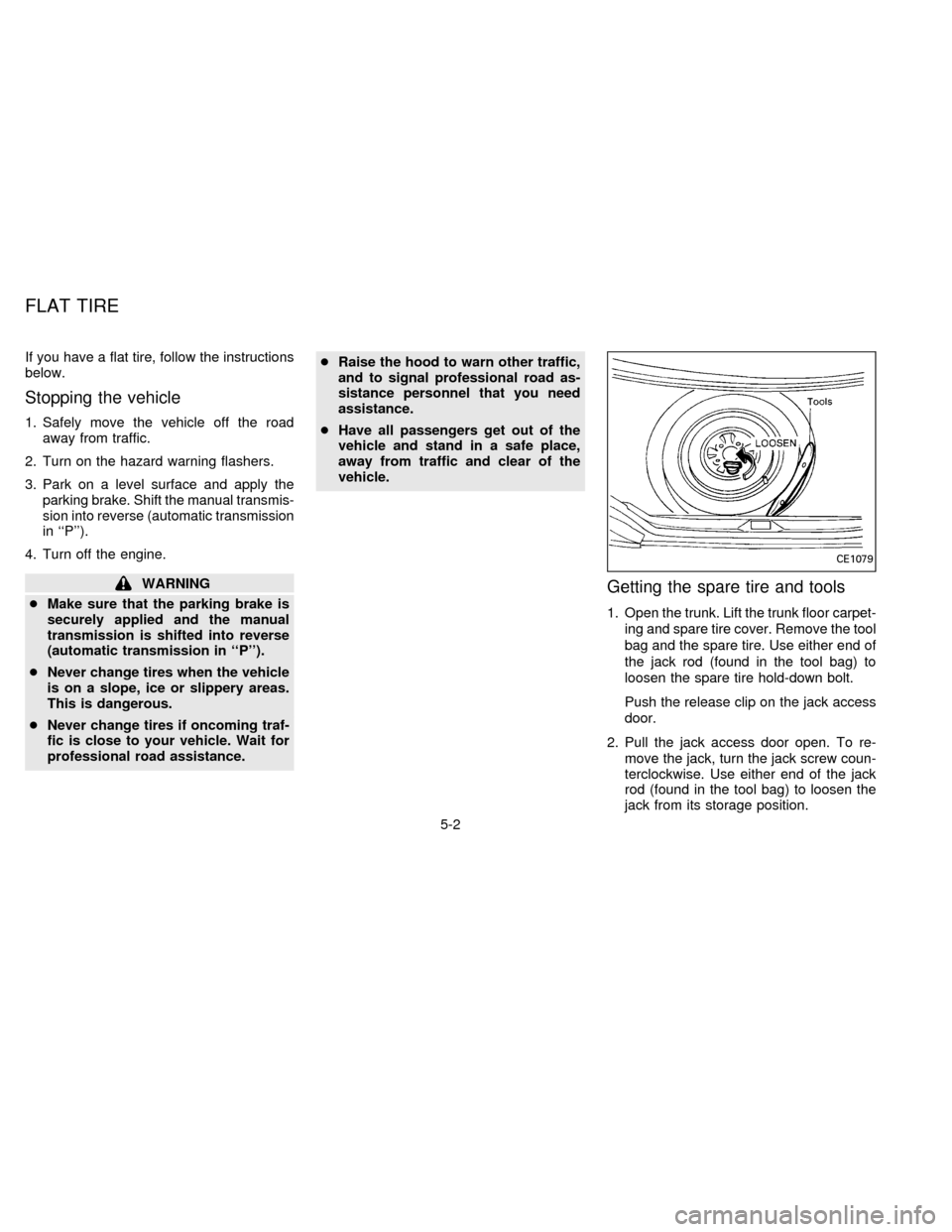
1. Open the trunk. Lift the trunk floor carpet-
ing and spare tire cover. Remove the tool
bag and the spare tire. Use either end of
the jack rod (found in the tool bag) to
loosen the spare tire hold-down bolt.
Push the release clip on the jack access
door.
2. Pull the jack access door open. To re-
move the jack, turn the jack screw coun-
terclockwise. Use either end of the jack
rod (found in the tool bag) to loosen the
jack from its storage position.
CE1079
FLAT TIRE
5-2
ZX
Page 100 of 183
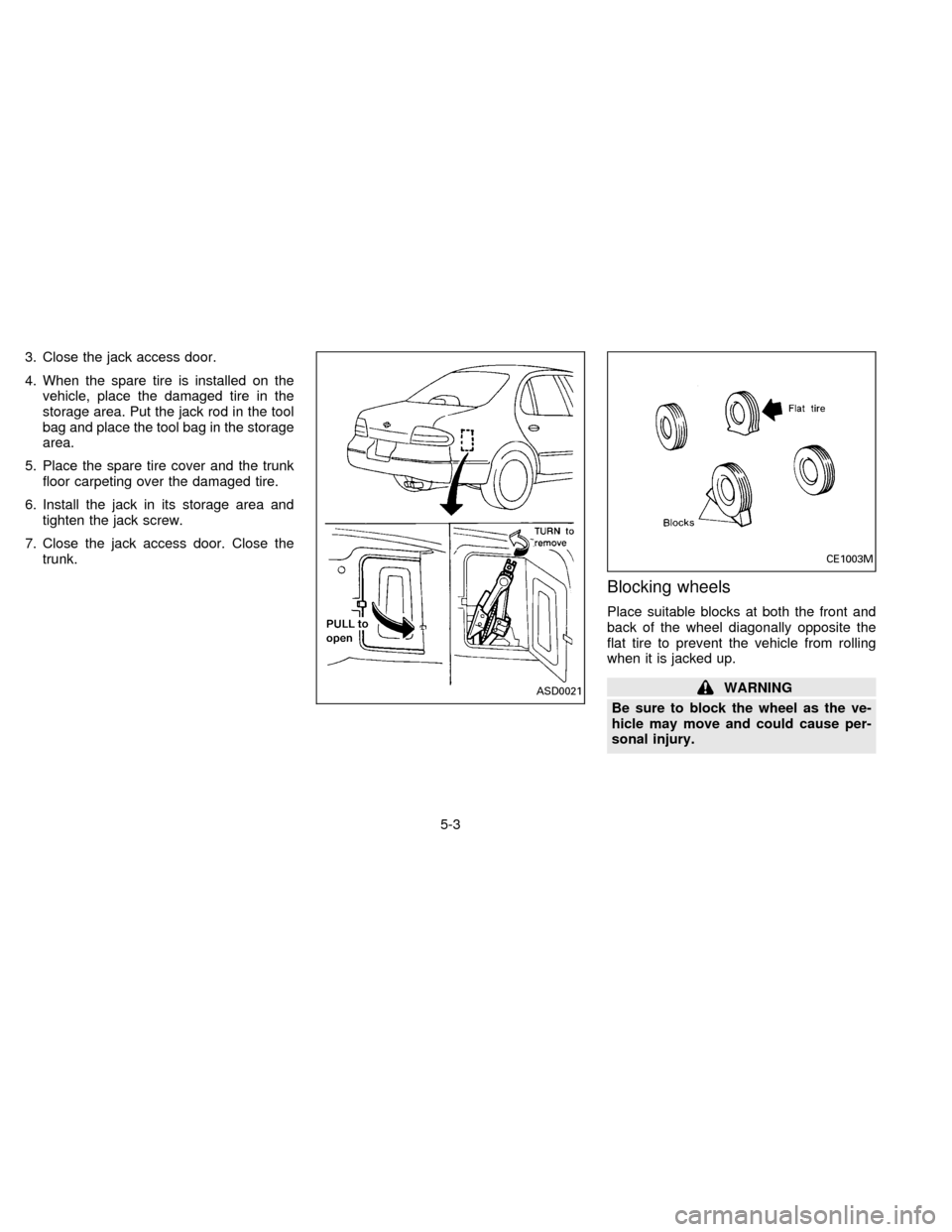
3. Close the jack access door.
4. When the spare tire is installed on the
vehicle, place the damaged tire in the
storage area. Put the jack rod in the tool
bag and place the tool bag in the storage
area.
5. Place the spare tire cover and the trunk
floor carpeting over the damaged tire.
6. Install the jack in its storage area and
tighten the jack screw.
7. Close the jack access door. Close the
trunk.
Blocking wheels
Place suitable blocks at both the front and
back of the wheel diagonally opposite the
flat tire to prevent the vehicle from rolling
when it is jacked up.
WARNING
Be sure to block the wheel as the ve-
hicle may move and could cause per-
sonal injury.ASD0021
CE1003M
5-3
ZX
Page 150 of 183

Tire rotation*Ð Tires should be rotated
every 7,500 miles (12,000 km).
Wheel alignment and balanceÐIfthe
vehicle should pull to either side while driv-
ing on a straight and level road, or if you
detect uneven or abnormal tire wear, there
may be a need for wheel alignment.
If the steering wheel or seat vibrates at
normal highway speeds, wheel balancing
may be needed.
Windshield wiper blades*Ð Check for
cracks or wear if they do not wipe properly.
Doors and engine hoodÐ Check that all
doors and the engine hood operate prop-
erly. Also ensure all latches lock securely.
Lubricate hinges, latches, rollers and links if
necessary. Make sure that the secondary
latch keeps the hood from opening when
the primary latch is released.
When driving in areas using road salt or
other corrosive materials, check lubrication
frequently.
Lights*Ð Make sure the headlights, stop
lights, tail lights, turn signal lights, and other
lights are all operating properly and installed
securely. Also check headlight aim.INSIDE THE VEHICLE
The maintenance items listed here should
be checked on a regular basis, such as
when performing periodic maintenance,
cleaning the vehicle, etc.
Warning lights and chimesÐ Make sure
that all warning lights and buzzers/chimes
are operating properly.
Windshield wiper and washer*Ð Check
that the wipers and washer operate properly
and that the wipers do not streak.
Windshield defrosterÐ Check that the air
comes out of the defroster outlets properly
and in sufficient quantity when operating the
heater or air conditioner.
Steering wheelÐ Check for changes in
the steering conditions, such as excessive
freeplay, hard steering or strange noises.
SeatsÐ Check seat position controls such
as seat adjusters, seatback recliner, etc. to
ensure they operate smoothly and that all
latches lock securely in every position.
Check that the head restraints move up and
down smoothly and that the locks (if so
equipped) hold securely in all latched posi-
tions.Seat beltsÐ Check that all parts of the seat
belt system (for example, buckles, anchors,
adjusters and retractors) operate properly
and smoothly, and are installed securely.
Check the belt webbing for cuts, fraying,
wear or damage.
Accelerator pedalÐ Check the pedal for
smooth operation and make sure the pedal
does not catch or require uneven effort.
Keep the floor mats away from the pedal.
Clutch pedal*Ð Make sure the pedal
operates smoothly and check that it has the
proper free travel.
BrakesÐ Check that the brakes do not pull
the vehicle to one side when applied.
Brake pedal*Ð Check the pedal for
smooth operation and make sure it has the
proper distance under it when depressed
fully. Check the brake booster function. Be
certain to keep floor mats away from the
pedal.
Parking brake*Ð Check that the lever has
the proper travel and confirm that your
vehicle is held securely on a fairly steep hill
with only the parking brake applied.
8-3
ZX
Page 178 of 183

10 Index
A
Adjustment after headlamp assembly
replacement ............................................... 7-23
Air bag (See Supplemental restraint system)
Air bag warning light .................................. 2-16
Air cleaner housing filter ............................ 7-15
Air conditioner
Air conditioner (Automatic) ..................... 3-8
Air conditioner (Manual) ......................... 3-2
Air conditioner specification label .............. 9-11
Air conditioning-servicing ........................... 3-10
Air conditioning system refrigerant and
lubrication recommendations ....................... 9-6
Alarm system (See Theft warning system)
Anchor point locations ............................... 2-27
Antenna
Manual .................................................. 3-22
Power.................................................... 3-21
Anti-lock brake system ( ABS)
(If so equipped).......................................... 4-15
Anti-lock brake warning light ....................... 1-7
Ashtray (See cigarette lighter and ashtray)
Audio system
AM-FM radio with cassette player ........ 3-11
AM-FM radio with cassette player and
compact disc player.............................. 3-16Automatic
Automatic air conditioner operation ........ 3-8
Automatic power window switch .......... 1-16
Automatic transmission fluid ................... 7-9
Driving with automatic transmission ....... 4-6
B
Battery........................................................ 7-13
Before starting the engine ........................... 4-5
Belts
Inspection ............................................ 7-14
Size ......................................................... 9-7
Brake
Anti-lock brake system (ABS) .............. 4-15
Brake and clutch fluid ........................... 7-11
Brake booster ....................................... 7-19
Brake light (See stop light)
Brake pedal .......................................... 7-18
Brake warning light ................................. 1-6
Brake wear indicators ................... 1-7, 7-18
Parking brake check ............................. 7-17
Parking brake operation ....................... 4-10
Break-in schedule ...................................... 4-12
Bulb check/instrument panel ....................... 1-5
Bulb replacement ....................................... 7-24C
Capacities and recommended
fuel/lubricants ............................................... 9-2
Cassette player (See audio system)
CB radio or car phone ............................... 3-22
Check engine indicator light (See Malfunction
indicator light)
Child restraints for infants and small
children ...................................................... 2-23
Child safety rear door lock .......................... 2-4
Cigarette lighter and ashtray ..................... 1-14
Cleaning exterior and interior ...................... 6-2
Clock Ð instrument panel ......................... 1-18
Clock-radio ................................................. 3-10
Clutch pedal ............................................... 7-19
Cold weather driving cautions .................. 4-17
Compact disc (CD) player ......................... 3-20
Controls
Audio controls ............................. 3-11, 3-16
Heater and air conditioner (automatic) ... 3-8
Heater and air conditioner (manual)....... 3-2
Coolant
Capacities and recommended
fuel/lubricants.......................................... 9-2
Changing engine coolant........................ 7-5
Checking engine coolant level ............... 7-4
Engine coolant temperature gauge ........ 1-4
ZX