1996 CHRYSLER VOYAGER reset
[x] Cancel search: resetPage 350 of 1938
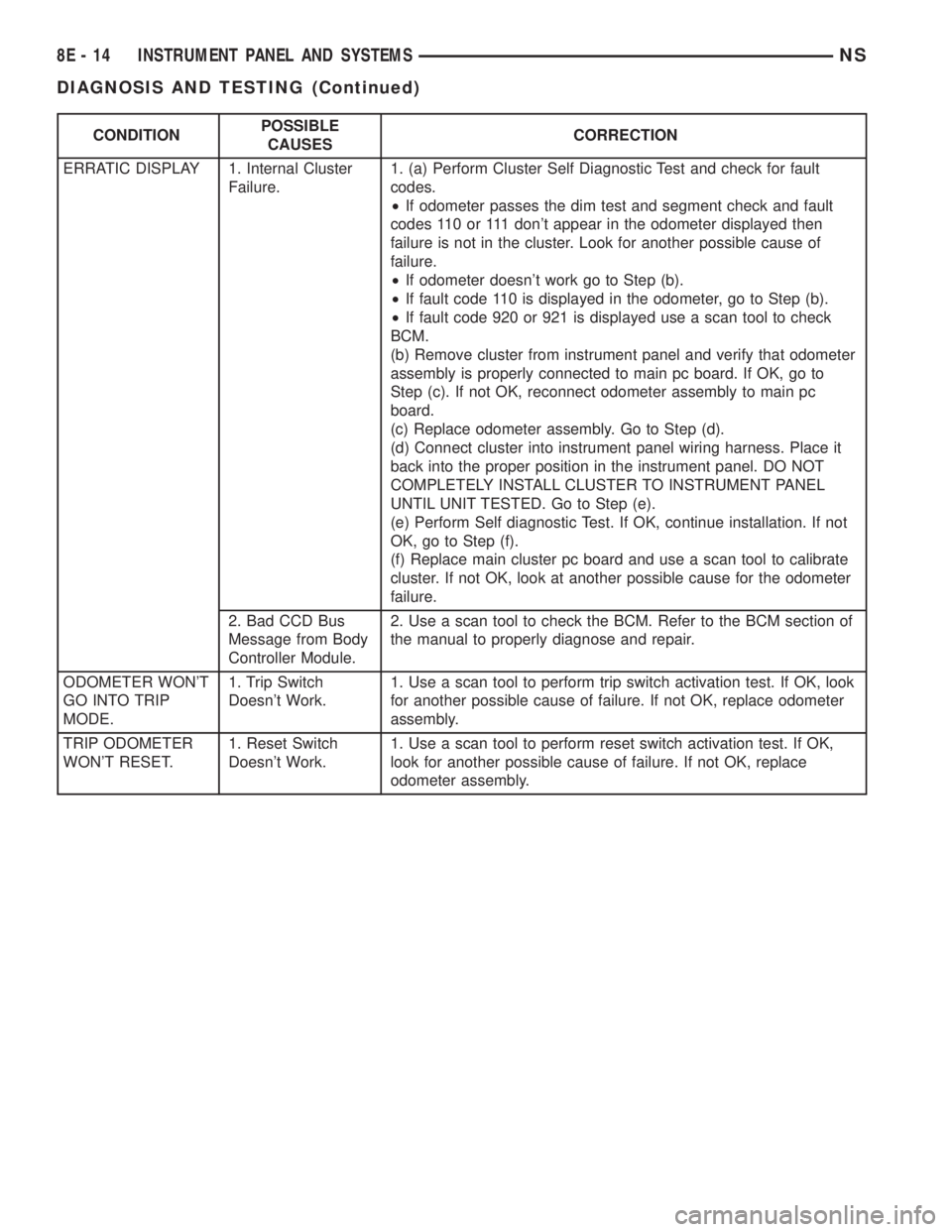
CONDITIONPOSSIBLE
CAUSESCORRECTION
ERRATIC DISPLAY 1. Internal Cluster
Failure.1. (a) Perform Cluster Self Diagnostic Test and check for fault
codes.
²If odometer passes the dim test and segment check and fault
codes 110 or 111 don't appear in the odometer displayed then
failure is not in the cluster. Look for another possible cause of
failure.
²If odometer doesn't work go to Step (b).
²If fault code 110 is displayed in the odometer, go to Step (b).
²If fault code 920 or 921 is displayed use a scan tool to check
BCM.
(b) Remove cluster from instrument panel and verify that odometer
assembly is properly connected to main pc board. If OK, go to
Step (c). If not OK, reconnect odometer assembly to main pc
board.
(c) Replace odometer assembly. Go to Step (d).
(d) Connect cluster into instrument panel wiring harness. Place it
back into the proper position in the instrument panel. DO NOT
COMPLETELY INSTALL CLUSTER TO INSTRUMENT PANEL
UNTIL UNIT TESTED. Go to Step (e).
(e) Perform Self diagnostic Test. If OK, continue installation. If not
OK, go to Step (f).
(f) Replace main cluster pc board and use a scan tool to calibrate
cluster. If not OK, look at another possible cause for the odometer
failure.
2. Bad CCD Bus
Message from Body
Controller Module.2. Use a scan tool to check the BCM. Refer to the BCM section of
the manual to properly diagnose and repair.
ODOMETER WON'T
GO INTO TRIP
MODE.1. Trip Switch
Doesn't Work.1. Use a scan tool to perform trip switch activation test. If OK, look
for another possible cause of failure. If not OK, replace odometer
assembly.
TRIP ODOMETER
WON'T RESET.1. Reset Switch
Doesn't Work.1. Use a scan tool to perform reset switch activation test. If OK,
look for another possible cause of failure. If not OK, replace
odometer assembly.
8E - 14 INSTRUMENT PANEL AND SYSTEMSNS
DIAGNOSIS AND TESTING (Continued)
Page 375 of 1938

SELF DIAGNOSTIC TEST
With the ignition switch in the OFF position,
depress the TRIP and RESET buttons. While holding
the TRIP and RESET button turn the ignition switch
ON. Continue to hold the TRIP and RESET buttons
until the word CODE appears in the odometer win-
dows (about five seconds). If a problem exists, the
system will display diagnostic trouble codes. If no
problem exists the code 999 (End Test) will momen-
tarily appear.
DIM TEST
When CHEC-0 is displayed in the odometer win-
dow, the cluster's vacuum fluorescent (VF) displays
will dim down. If the VF display brightness does not
change, a problem exists in the cluster.
CLUSTER CALIBRATION TABLE
Speedometer Calibration Point
1 ...........................0Km/h (0 mph)
2 .........................40Km/h (20 mph)
3 .........................80Km/h (55 mph )
4 ........................120Km/h (75 mph)
Tachometer Calibration Point
1 ...................................0rpm
2 ................................1000 rpm
3 ................................3000 rpm
4 ................................4000 rpm
Fuel Gauge Calibration Point
1 ...............................Empty (E)
2 ................................1/8Filled
3 ................................1/4Filled
4..................................Full (F)
Temp Gauge Calibration Point
1 .................................Cold (C)
2 ..............................LowNormal
3 .............................High Normal
4 ..................................Hot(H)
Fig. 3 Headlamp Switch Test
INSTRUMENT CLUSTER DTC CHART
DTC DESCRIPTION
110 Memory Fault in cluster
111 Calibration fault in cluster
921 Odometer fault from BCM
940 No tachometer messages from BCM
NS/GSINSTRUMENT PANEL AND SYSTEMS 8E - 3
DIAGNOSIS AND TESTING (Continued)
Page 403 of 1938

AUDIO SYSTEMS
CONTENTS
page page
GENERAL INFORMATION
INTRODUCTION......................... 1
DESCRIPTION AND OPERATION
ANTENNA.............................. 1
CHOKEÐINFINITY SPEAKERS.............. 2
INTERFERENCE ELIMINATION.............. 1
NAME BRAND SPEAKER RELAY............ 3
RADIO IGNITION INTERFERENCE........... 2
RADIOS................................ 1
REMOTE RADIO SWITCHES................ 3
DIAGNOSIS AND TESTING
ANTENNA.............................. 3AUDIO SYSTEM......................... 4
RADIO................................. 4
REMOTE RADIO SWITCHES................ 6
REMOVAL AND INSTALLATION
ANTENNA EXTENSION CABLE.............. 7
ANTENNA MAST AND CABLE LEAD......... 7
D±PILLAR SPEAKER.................... 10
FRONT DOOR SPEAKER................... 9
INSTRUMENT PANEL SPEAKER............. 8
QUARTER PANEL SPEAKER............... 10
RADIO/TAPE/CD PLAYER.................. 8
REMOTE RADIO SWITCHES................ 9
GENERAL INFORMATION
INTRODUCTION
Operating instructions for the factory installed
audio systems can be found in the Owner's Manual
provided with the vehicle.
NS vehicles are equipped with an Ignition Off
Draw (IOD) fuse in the power distribution center
located in the engine compartment. After the IOD
fuse or battery has been disconnected, the radio sta-
tion sets and clock will require resetting.
DESCRIPTION AND OPERATION
ANTENNA
All models use a fixed-length stainless steel rod-
type antenna mast, installed at the right front fender
of the vehicle. The antenna mast is connected to the
center wire of the coaxial antenna cable, and is not
grounded to any part of the vehicle.
To eliminate static, the antenna base must have a
good ground. The coaxial antenna cable shield (the
outer wire mesh of the cable) is grounded to the
antenna base and the radio chassis.
The antenna coaxial cable has an additional dis-
connect, located near the right end of the instrument
panel. This additional disconnect allows the instru-
ment panel assembly to be removed and installed
without removing the radio.
The factory-installed Electronically Tuned Radios
(ETRs) automatically compensate for radio antenna
trim. Therefore, no antenna trimmer adjustment isrequired or possible when replacing the receiver or
the antenna.
INTERFERENCE ELIMINATION
Some components used on the vehicles are
equipped with a capacitor to suppress radio fre-
quency interference/static.
Capacitors are mounted in various locations inter-
nal to the generator, instrument cluster and wind-
shield wiper motor.
To eliminate radio interference, ground straps are
used in different areas of the vehicle. These ground
circuits should be securely tightened to assure good
metal to metal contact. The ground straps conduct
very small high frequency electrical signals to ground
and require clean surface contact area. The radio
ground is supplied from the instrument panel har-
ness and is attached to the rear of the radio. Some
engines have other ground straps to eliminate fur-
ther radio interference:
²Radio chassis to instrument panel structure
²Engine to dash panel
²Engine to chassis
²A/C h valve to dash panel
Radio resistance type spark plug cables in the high
tension circuit of the ignition system complete the
interference suppression. Faulty or deteriorated
spark plug wires should be replaced.
RADIOS
Available factory-installed radio receivers for this
model include an AM/FM/cassette (RAS sales code),
an AM/FM/cassette/5-band graphic equalizer with CD
changer control feature (RBN sales code), an AM/FM/
NSAUDIO SYSTEMS 8F - 1
Page 406 of 1938

TEST 2
Test 2 checks the antenna for an open circuit as
follows:
(1) Unplug the antenna coaxial cable connector
from the radio chassis.
(2) Connect one ohmmeter test lead to the tip of
the antenna mast. Connect the other test lead to the
center pin of the antenna coaxial cable connector.
(3) Continuity should exist (the ohmmeter should
only register a fraction of an ohm). High or infinite
resistance indicates damage to the base and cable
assembly. Replace the faulty base and cable, if
required.
TEST 3
Test 3 checks the condition of the vehicle body
ground connection. This test should be performed
with the battery positive cable removed from the bat-
tery. Disconnect both battery cables, the negative
cable first. Reconnect the battery negative cable and
perform the test as follows:
(1) Connect one ohmmeter test lead to the vehicle
fender. Connect the other test lead to the battery
negative post.
(2) The resistance should be less than (1) ohm.
(3) If the resistance is more than (1) ohm, check
the braided ground strap connected to the engine and
the vehicle body for being loose, corroded, or dam-
aged. Repair the ground strap connection, if required.
TEST 4
Test 4 checks the condition of the ground between
the antenna base and the vehicle body as follows:(1) Connect one ohmmeter test lead to the vehicle
fender. Connect the other test lead to the outer crimp
on the antenna coaxial cable connector.
(2) The resistance should be less then (1) ohm.
(3) If the resistance is more then (1) ohm, clean
and/or tighten the antenna base to fender mounting
hardware.
AUDIO SYSTEM
WARNING: ON VEHICLES EQUIPPED WITH AIR-
BAGS, REFER TO GROUP 8M - PASSIVE
RESTRAINT SYSTEMS BEFORE ATTEMPTING ANY
STEERING WHEEL, STEERING COLUMN, OR
INSTRUMENT PANEL COMPONENT DIAGNOSIS OR
SERVICE. FAILURE TO TAKE THE PROPER PRE-
CAUTIONS COULD RESULT IN ACCIDENTAL AIR-
BAG DEPLOYMENT AND POSSIBLE PERSONAL
INJURY.
RADIO
If the vehicle is equipped with remote radio
switches located on the backs of the steering wheel
spokes, and the problem being diagnosed is related to
one of the symptoms listed below, be certain to check
the remote radio switches and circuits as described
in this group, prior to attempting radio diagnosis or
repair.
²Stations changing with no remote radio switch
input
²Radio memory presets not working properly
²Volume changes with no remote radio switch
input
²Remote radio switch buttons taking on other
functions
²CD player skipping tracks
²Remote radio switch inoperative.
For circuit descriptions and diagrams, refer to
Group 8W - Wiring Diagrams.
WARNING: ON VEHICLES EQUIPPED WITH AIR-
BAGS, REFER TO GROUP 8M - PASSIVE
RESTRAINT SYSTEMS BEFORE ATTEMPTING ANY
STEERING WHEEL, STEERING COLUMN, OR
INSTRUMENT PANEL COMPONENT DIAGNOSIS OR
SERVICE. FAILURE TO TAKE THE PROPER PRE-
CAUTIONS COULD RESULT IN ACCIDENTAL AIR-
BAG DEPLOYMENT AND POSSIBLE PERSONAL
INJURY.
CAUTION: The speaker output of the radio is a
ªfloating groundº system. Do not allow any speaker
lead to short to ground, as damage to the radio
may result.
Fig. 7 Antenna Tests
8F - 4 AUDIO SYSTEMSNS
DIAGNOSIS AND TESTING (Continued)
Page 425 of 1938

INSTALLATION
Transfer speed control cable to replacement speed
control servo. Reverse the preceding operation.
SPEED CONTROL SWITCHES
REMOVAL
(1) Release hood latch and open hood.
(2) Disconnect battery negative cable.
(3) Remove airbag/horn pad from steering wheel,
refer to Group 8M, Restraint Systems for proper pro-
cedures.
(4) Disconnect wire connector from horn switch,
airbag, and speed control switches.
(5) Remove screws holding speed control switch to
airbag/horn pad (Fig. 11).
(6) Separate speed control switch from airbag/horn
pad.
INSTALLATION
Reverse the preceding operation.
STOP LAMP SWITCH
REMOVAL
Remove the switch from the bracket by depressing
the brake pedal and rotating the switch in a counter-
clockwise direction approximately 30 degrees. Pull
the switch rearward and remove from bracket. Dis-
connect wiring harness connector.
INSTALLATION
Before installing the switch, reset the adjustable
switch plunger by pulling on the plunger head until
the plunger reaches the end of its travel. A ratchet-
ing sound will be heard during this procedure.
Connect the wiring harness to the switch. Mount
the switch into the bracket by holding the switch
with the plunger facing forward in car. There is an
index key on the switch that mates with the bracket
slot at the top of the square hole. Align key and push
switch into square hole in bracket while depressing
the brake pedal. Once the switch is seated in the
hole, rotate clockwise approximately 30 degrees to
lock into place. The switch will automatically adjust
when the pedal is released. Pull back on the pedal to
assure correct adjustment.
SPEED CONTROL CABLE
REMOVAL
(1) Release hood latch and open hood.
(2) On vehicles with 3.3/3.8 L engine, remove air
cleaner resonator. Refer to Group 14, Fuel System for
proper procedure.
(3) Disconnect throttle and speed control cable
ends from throttle body (Fig. 8).
(4) Depress lock tabs holding speed control cable
casing to cable mount bracket (Fig. 12).
(5) Remove tie wrap holding vacuum line, throttle
cable, and speed control cable together.
(6) Remove nuts holding speed control cable case
to servo.
(7) Remove cable case from servo.
(8) Remove hairpin clip holding cable end to servo
diaphragm (Fig. 12).
(9) Remove speed control cable.
INSTALLATION
Reverse the preceding operation.
POWERTRAIN CONTROL MODULE
For Removal/Installation refer to Powertrain Con-
trol Module in Group 14, Fuel Injection System.
USE THE DRB SCAN TOOL TO REPROGRAM
THE NEW PCM WITH THE VEHICLES ORIGI-
NAL IDENTIFICATION NUMBER (VIN) AND
THE ORGINAL VEHICLES MILAGE. IF THIS
Fig. 10 Speed Control Servo
Fig. 11 Speed Control Switches
NSVEHICLE SPEED CONTROL SYSTEM 8H - 9
REMOVAL AND INSTALLATION (Continued)
Page 451 of 1938

WIPER AND WASHER SYSTEMS
CONTENTS
page page
HEADLAMP WASHERS................... 1
HEADLAMP WASHERS
INDEX
page page
GENERAL INFORMATION
INTRODUCTION........................ 1
REMOVAL AND INSTALLATION
HEADLAMP WASHER NOZZLE............. 1HEADLAMP WASHER PUMP............... 2
WINDSHIELD/HEADLAMP WASHER
RESERVOIR.......................... 1
GENERAL INFORMATION
INTRODUCTION
Headlamp washers are available as a factory-in-
stalled option on this model. The headlamp washers
on this vehicle work in conjunction with the wind-
shield washers. The headlamp washers are enabled
with the headlamps ªONº and the windshield wash-
ers activated. With the windshield washers activated
the headlamp washers will spray for a preset amount
of time controlled by a relay.
The headlamp washer system utilizes a separate pump
that is attached to the windshield washer reservoir. The
headlamp washer pump feeds two nozzles that are
mounted in the front fascia of the vehicle. These nozzles
spray the headlamps when the system is activated.
REMOVAL AND INSTALLATION
WINDSHIELD/HEADLAMP WASHER RESERVOIR
Removal
(1) Remove the right headlamp assembly. Refer to
Group 8L, Lamps.
(2) Partially remove the inner fender well as
needed to gain access to the reservoir.
(3)
Disconnect the windshield washer pump, rear
washer pump and headlamp washer pump electrical con-
nectors.
(4) Disconnect the headlamp washer pump hose.(5) Partially remove the front fascia to aid in the
removal of the reservoir.
(6) Remove the reservoir mounting bolts. (Fig. 1)
(7) Slide the reservoir rearward and remove from
the vehicle.
Installation
(1) For installation, reverse the above procedures
HEADLAMP WASHER NOZZLE
Removal
(1) Remove the headlamp assembly. Refer to
Group 8L, Lamps.
(2)
Disconnect the hose at the headlamp washer nozzle.
(3) Remove the headlamp washer nozzle retaining
nuts and remove the nozzle from the front fascia.
NS/GSWIPER AND WASHER SYSTEMS 8K - 1
Page 516 of 1938
TIME-OUT PERIOD
The VTSS requires 16 consecutive seconds to time-
out and arm the alarm. If a door is key unlocked, key
fob unlocked. or the ignition is switched ON, the
VTSS will cancel out. To reset the VTSS, perform
methods A or B.
TRIGGERING THE VTSS
After the VTSS is armed, following actions will
trigger the alarm:
²Opening any door.
²Opening the hood
²Turning the ignition to the ON or unlock posi-
tion.
²The ignition switch can be turned to the acces-
sory position without triggering alarm system.
DIAGNOSIS AND TESTING
DIAGNOSTIC PROCEDURES
Refer to Group 8W, Wiring Diagrams for circuit
information and component locations. Using a scan
tool (DRB). Refer to the proper Body Diagnostic Pro-
cedures manual for test procedures.
REMOVAL AND INSTALLATION
BODY CONTROL MODULE
REMOVAL
(1) Disconnect the battery negative cable.
(2) Remove the lower steering column cover and
the knee blocker reinforcement.
(3) Disconnect the two wire connectors from the
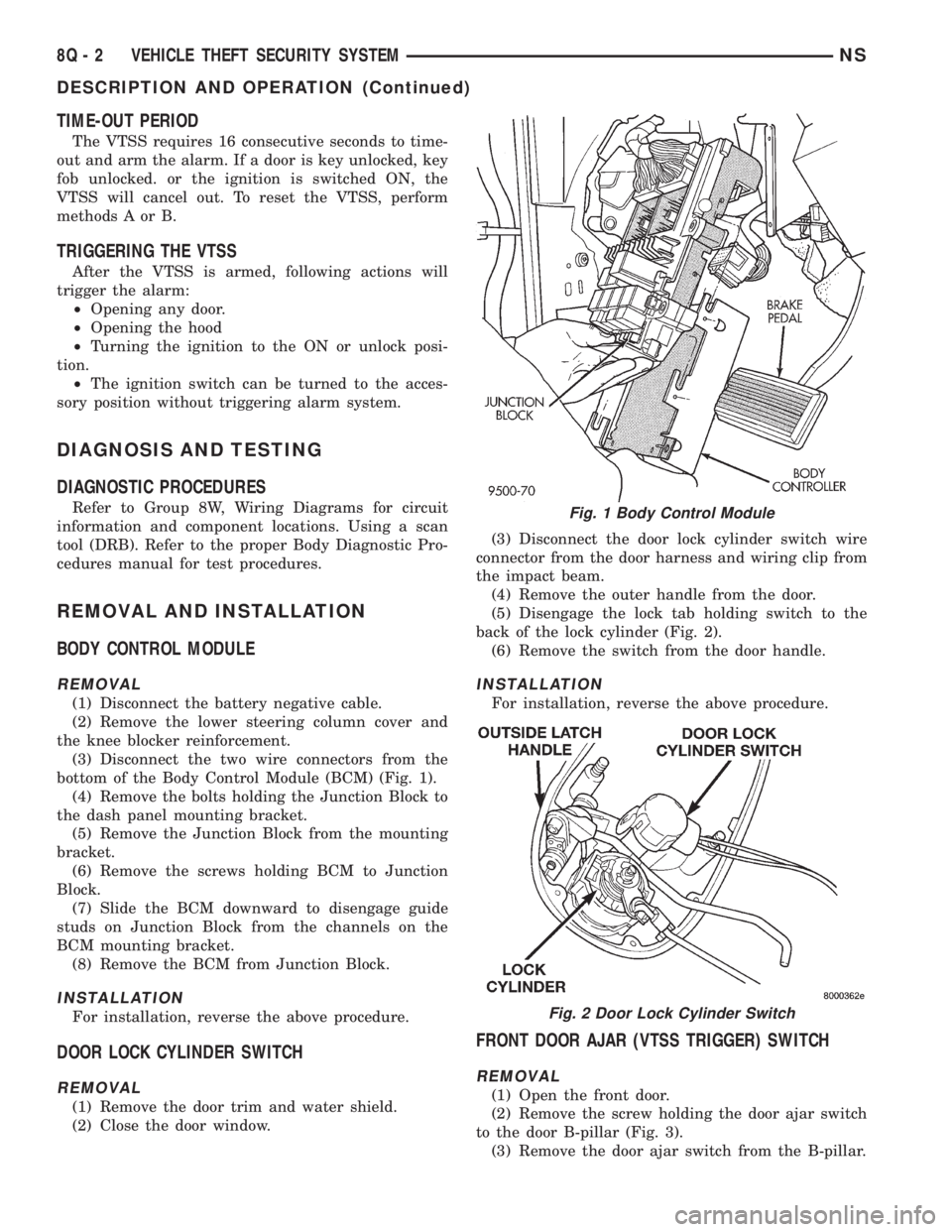
bottom of the Body Control Module (BCM) (Fig. 1).
(4) Remove the bolts holding the Junction Block to
the dash panel mounting bracket.
(5) Remove the Junction Block from the mounting
bracket.
(6) Remove the screws holding BCM to Junction
Block.
(7) Slide the BCM downward to disengage guide
studs on Junction Block from the channels on the
BCM mounting bracket.
(8) Remove the BCM from Junction Block.
INSTALLATION
For installation, reverse the above procedure.
DOOR LOCK CYLINDER SWITCH
REMOVAL
(1) Remove the door trim and water shield.
(2) Close the door window.(3) Disconnect the door lock cylinder switch wire
connector from the door harness and wiring clip from
the impact beam.
(4) Remove the outer handle from the door.
(5) Disengage the lock tab holding switch to the
back of the lock cylinder (Fig. 2).
(6) Remove the switch from the door handle.
INSTALLATION
For installation, reverse the above procedure.
FRONT DOOR AJAR (VTSS TRIGGER) SWITCH
REMOVAL
(1) Open the front door.
(2) Remove the screw holding the door ajar switch
to the door B-pillar (Fig. 3).
(3) Remove the door ajar switch from the B-pillar.
Fig. 1 Body Control Module
Fig. 2 Door Lock Cylinder Switch
8Q - 2 VEHICLE THEFT SECURITY SYSTEMNS
DESCRIPTION AND OPERATION (Continued)
Page 545 of 1938

instrument cluster for 6 seconds after the instrument
cluster receives the message from the Body Control
Module. The seat belt lamp is therefore illuminated
for 6 seconds whenever the ignition switch is moved
to run/start position.
(1) While ignition is off, the seat belt lamp will not
be illuminated.
(2) The ignition power feed status will be updated
every 250 milliseconds or on change.
(3) This lamp will be checked by the instrument
cluster for 6 seconds with every run/start cycle of the
ignition switch.
TURN SIGNAL ON CHIME
The turn signal on chime will warn the driver that
the turn signals have been left on. When the body
control module receives a turn signal input for 6.4
km (4.0 miles), vehicle speed is greater than 24 km/h
(15 mph), the chime will sound continuously until the
turn signal is turned OFF. If vehicle speed drops
below 24 km/h (15 mph) prior to the warning being
activated, the accumulated distance traveled will be
reset. The turn signal chime is not activated when
the emergency flashers are turned on. This feature
can also be disabled in EEPROM. Chime rate: 50
chimes per minute.
For the turn signal warning system to operate:
²Must have input from either the right or left
turn signal lamps. Creates a voltage change between
0 and battery voltage.
²The vehicle speed sensor sends a message to the
Powertrain Control Module that vehicle has exceeded
24 km/h (15 mph) for 6.4 km (4.0 miles).
²When the above two conditions are met, the
chime will sound. The chime will stop when no fur-
ther voltage change is detected.²If hazard warning signals are pulsing, no chime
will sound.
²If speed drops below 24 km/h (15 mph) before
the warning is issued, the warning will not be issued
and the distance counter will be reset.
²If turn signal lamps are not working properly,
the chime will not sound.
²When using the scan tool, refer to the proper
Body Diagnostic Manual for the procedure.
WARNING LAMP ANNOUNCEMENT CHIME
The warning lamp announcement chime will warn
the driver to scan the instrument cluster to observe
which warning lamp is illuminated. Whenever the
volts, low fuel, low washer/coolant level, door ajar or
gate ajar lamps are first illuminated, the chime will
sound one tone. The door/liftgate ajar warning lamp
announcement chime sounds only if the vehicle speed
is above 2 m.p.h.
Two seconds after ignition switch is turned ON or
until the seat belt warning chime ends, all warning
announcement chimes will be consolidated into one
warning announcement. This will occur 2 seconds
after the seat belt warning chime ends. If a warning
announcement should occur while another warning
chime in progress (turn signal, low oil pressure or
high speed warnings), no additional chimes will
sound after the chime in progress ends. All associ-
ated lamps will be illuminated, and the active chime
will be the warning announcement.
NSCHIME WARNING/REMINDER SYSTEM 8U - 3
DIAGNOSIS AND TESTING (Continued)