1996 CHEVROLET SUBURBAN specifications
[x] Cancel search: specificationsPage 100 of 486
Four- Wheel Drive
If your vehicle has four-wheel drive, you can send your engine’s driving
power to all four wheels for extra traction.
To get the most satisfaction out
of four-wheel drive, you must be familiar with its operation. Read the part
that follows before using four-wheel drive. You should use 2-WHEEL
HIGH (2H) for most normal driving conditions.
NOTICE:
Driving in the 4-WHEEL HIGH (4H) or &WHEEL LOW (4L)
positions for a long time on dry or wet pavement could shorten
the life of your vehicle’s drivetrain.
I NOTICE:
Changing your vehicle’s body height can damage your vehicle’s
suspension, drivetrain, or other vehicle components.
It may also
affect the way your vehicle handles, and the function of your
vehicle’s safety features. Do not change your vehicle’s height
from the original design specifications.
Transfer Case
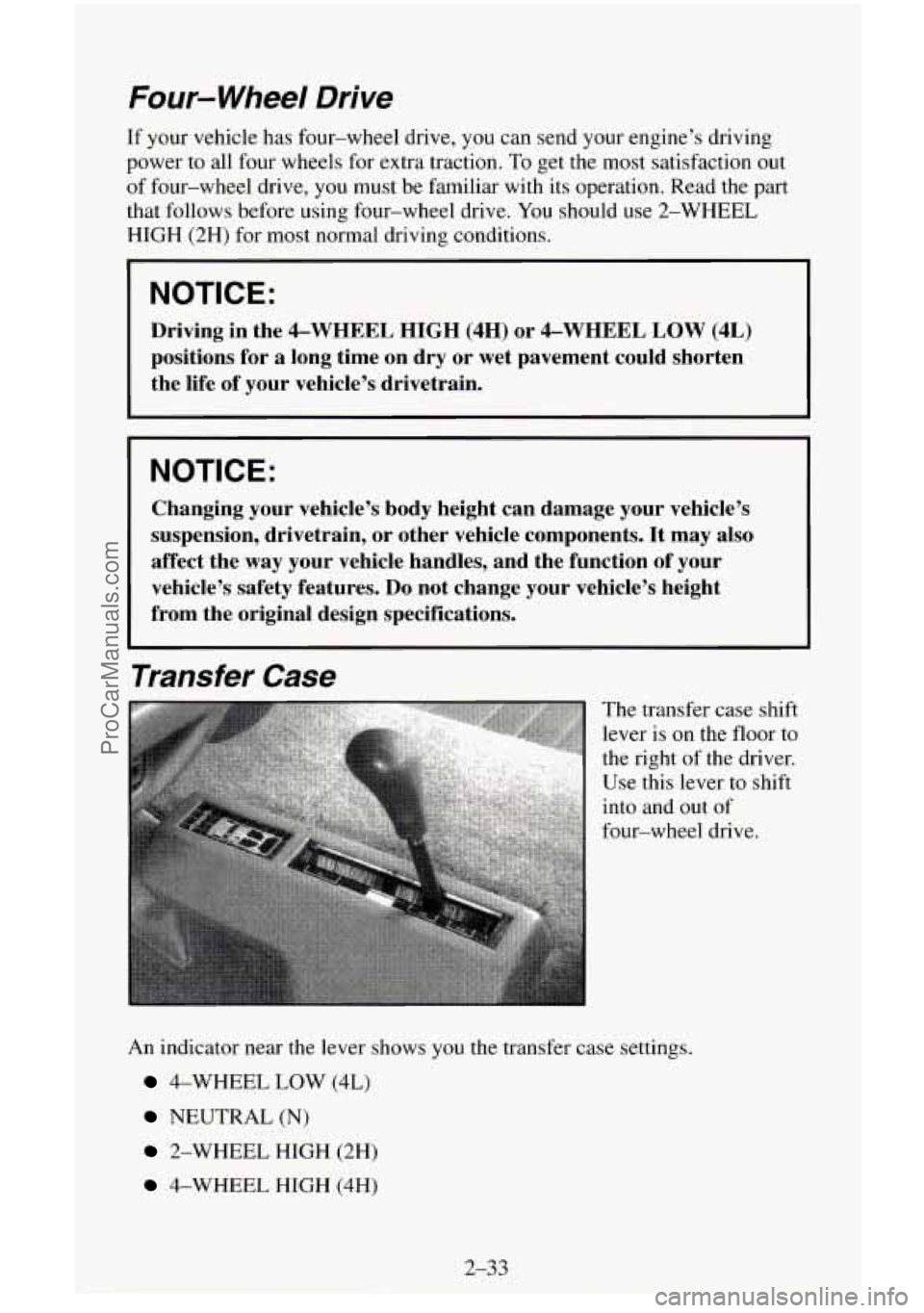
The transfer case shift
lever is on the floor to
the right of the driver.
Use this lever to shift
into and out
of
four-wheel drive.
An indicator near the lever shows you the transfer case settings.
4-WHEEL LOW (4L)
NEUTRAL (N)
2-WHEEL HIGH (2H)
4-WHEEL HIGH (4H)
2-33
ProCarManuals.com
Page 220 of 486
Loading Your Vehicle
I
PSI/KPA (COLD)
~ SEE OWNER'S MANUAL FOR ADDITIONAL INFORMATION
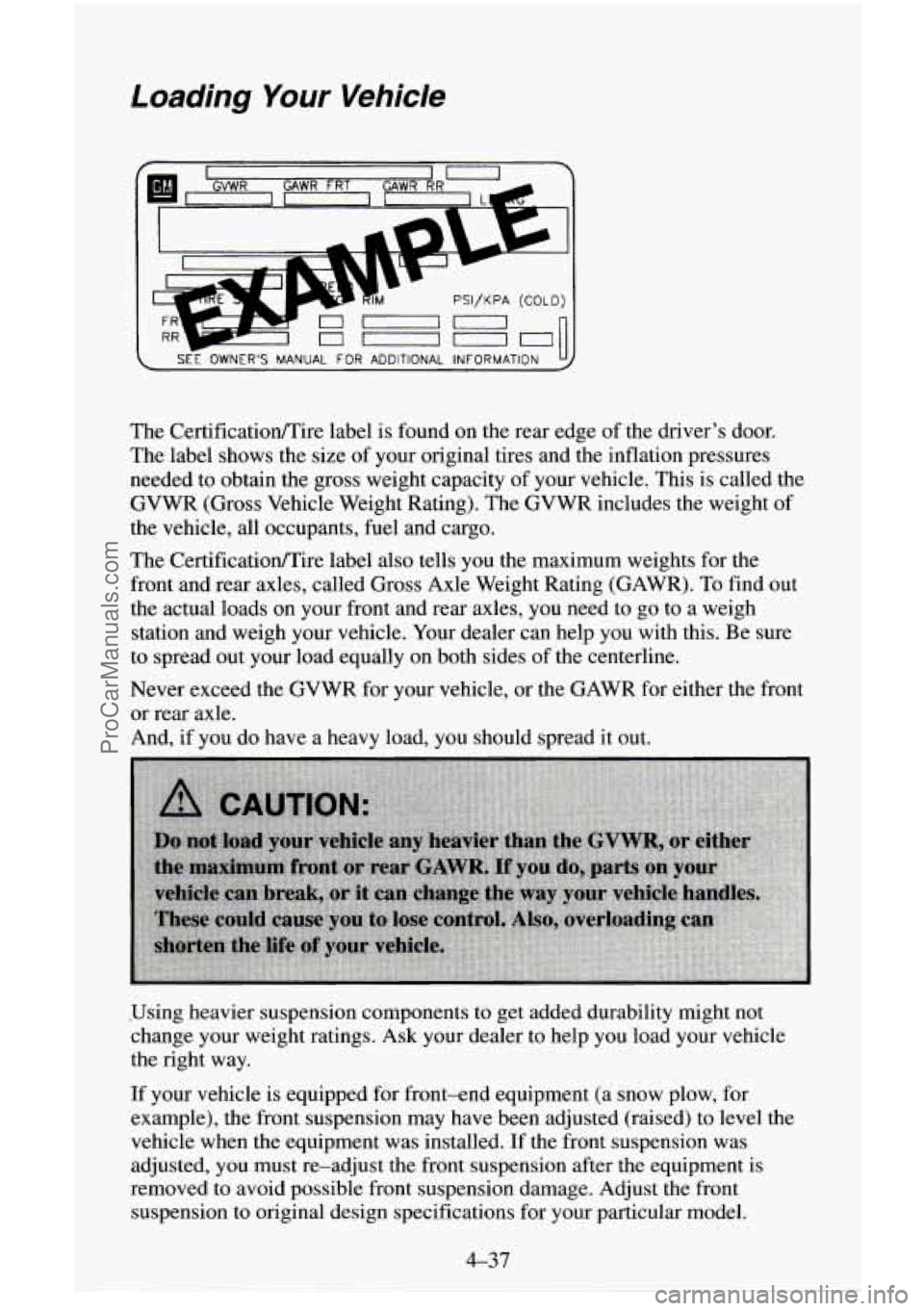
The CertificatiodTire label is found on the rear edge of the driver's door.
The label shows the size
of your original tires and the inflation pressures
needed to obtain the gross weight capacity of your vehicle. This is called the
GVWR (Gross Vehicle Weight Rating). The GVWR includes the weight of
the vehicle, all occupants, fuel and cargo.
The Certificatiodl'ire label
also tells you the maximum weights for the
front and rear axles, called Gross Axle Weight Rating (GAWR). To find
out
the actual loads on your front and rear axles, you need to go to a weigh
station and weigh your vehicle. Your dealer can help you with this. Be sure
to spread out your load equally on both sides
of the centerline.
Never exceed the GVWR
for your vehicle, or the GAWR for either the front
or rear axle.
And, if you do have a heavy load, you should spread it out.
.Using heavier suspension components to get added durability might not
change your weight ratings. Ask your dealer to help you load your vehicle
the right way.
If your vehicle is equipped for front-end equipment (a snow plow, for
example), the front suspension may have been adjusted (raised) to level the
vehicle when the equipment was installed. If the front suspension was
adjusted, you must re-adjust the front suspension after the equipment is
removed to avoid possible front suspension damage. Adjust the front
suspension
to original design specifications for your particular model.
4-37
ProCarManuals.com
Page 279 of 486
You should keep a record with all parts receipts and list the mileage and the
date
of any servi-work you perform. See “Maintenance Record” in the
Index.
NOTICE:
If you try to do your own service work without knowing enough
about it, your vehicle could be damaged.
Maintenance Schedule
Section 7 of this manual, “Scheduled Maintenance Services”, explains the
maintenance your
new vehicle needs, and when it should be done. It also
has a form that
you can use to record the maintenance work done on your
vehicle. Be sure
to read this information.
Fuel (Gasoline Engine)
If your vehicle has a diesel engine, see “Diesel Fuel Requirements and Fuel
System”
in this Section. For vehicles with gasoline engines, please read this.
Use regular unleaded gasoline rated at 87 octane or higher. It should meet
specifications ASTM D48 14
in the United States and CGSB 3.5-92 in
Canada. These fuels should have the proper additives, so you should not
have to add anything to the fuel.
In
the United States and Canada, it’s easy to be sure you get the right kind
of gasoline (unleaded). You’ll see UNLEADED right on the pump. And
only unleaded nozzles will fit into your vehicle’s filler neck.
6-2
ProCarManuals.com
Page 292 of 486
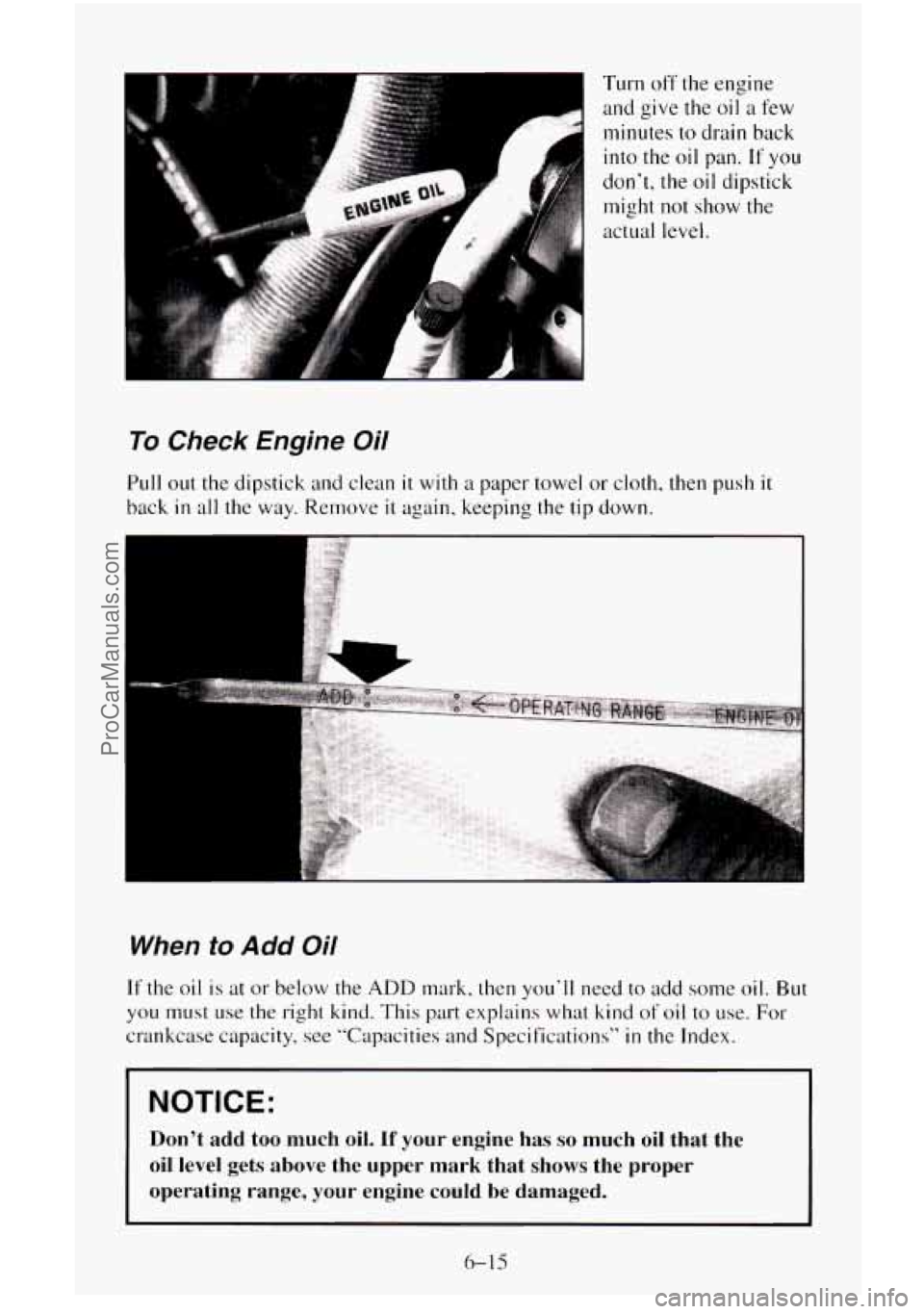
Turn off the engine
and give the oil
a few
minutes
to drain back
into the oil pan.
If you
don’t, the oil dipstick
might not show the
actual level.
To Check Engine Oil
Pull out the dipstick and clean it with a paper towel or cloth, then push it
back in all the way. Remove it again, keeping the tip down.
When to Add Oil
If the oil is at or below the ADD mark, then you’ll need to add some oil. But
you must use the right kind. This part explains what kind of oil to use. For
crankcase capacity, see “Capacities and Specifications” in the Index.
NOTICE:
Don’t add too much oil. If your engine has so much oil that the
oil level gets above the upper mark that shows the proper
operating range,
your engine could be damaged.
6-15
ProCarManuals.com
Page 298 of 486
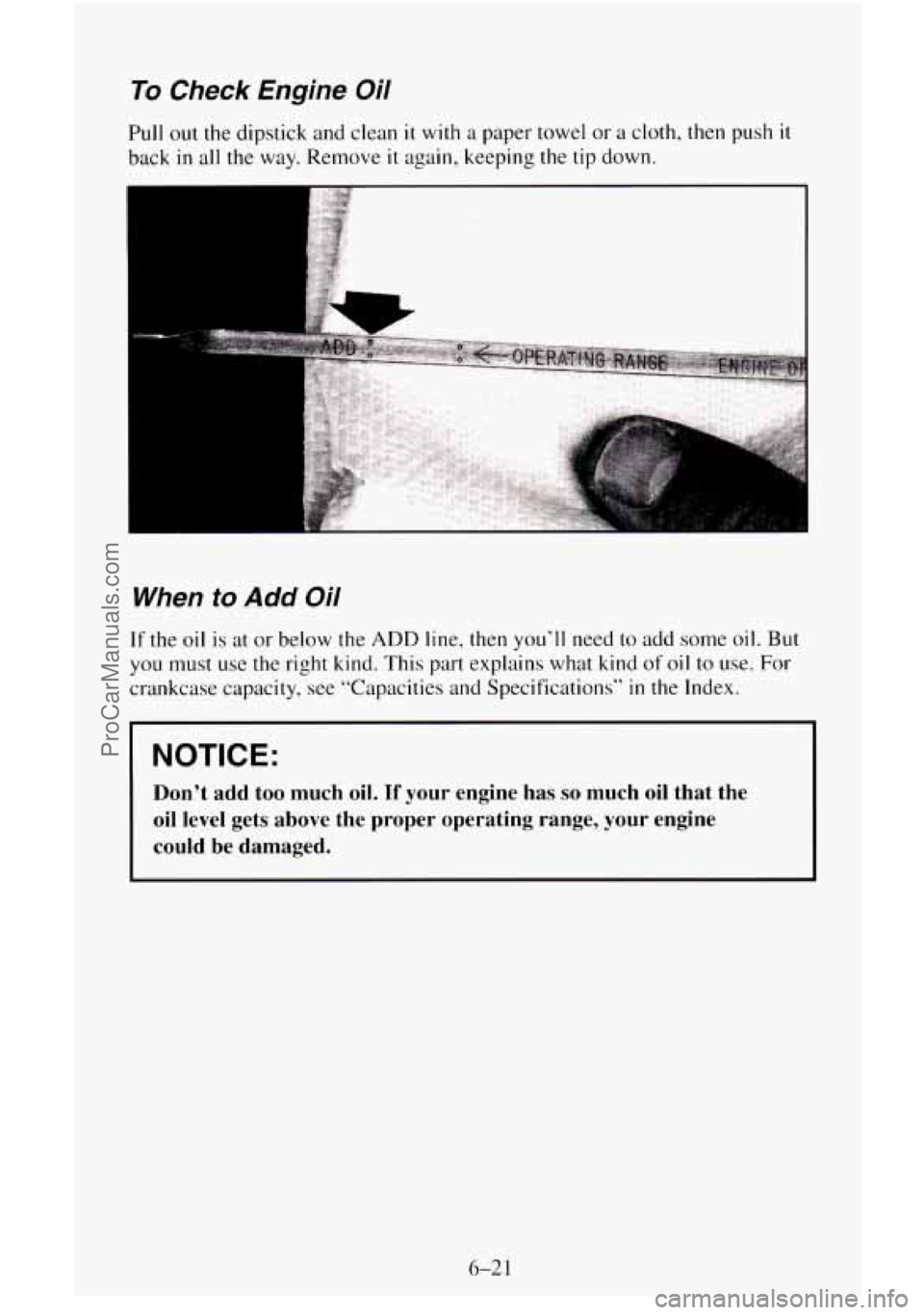
To Check Engine Oil
Pull out the dipstick and clean it with a paper towel or a cloth, then push it
back in all the way. Remove it again, keeping the tip down.
When to Add Oil
If the oil is at or below the ADD line, then you’ll need to add some oil. But
you must use
the right kind. This part explains what kind of oil to use. For
crankcase capacity, see “Capacities and Specifications” in the Index.
NOTICE:
Don’t add too much oil. If your engine has so much oil that the
oil level gets above the proper operating range, your engine
could be damaged.
6-21
ProCarManuals.com
Page 349 of 486
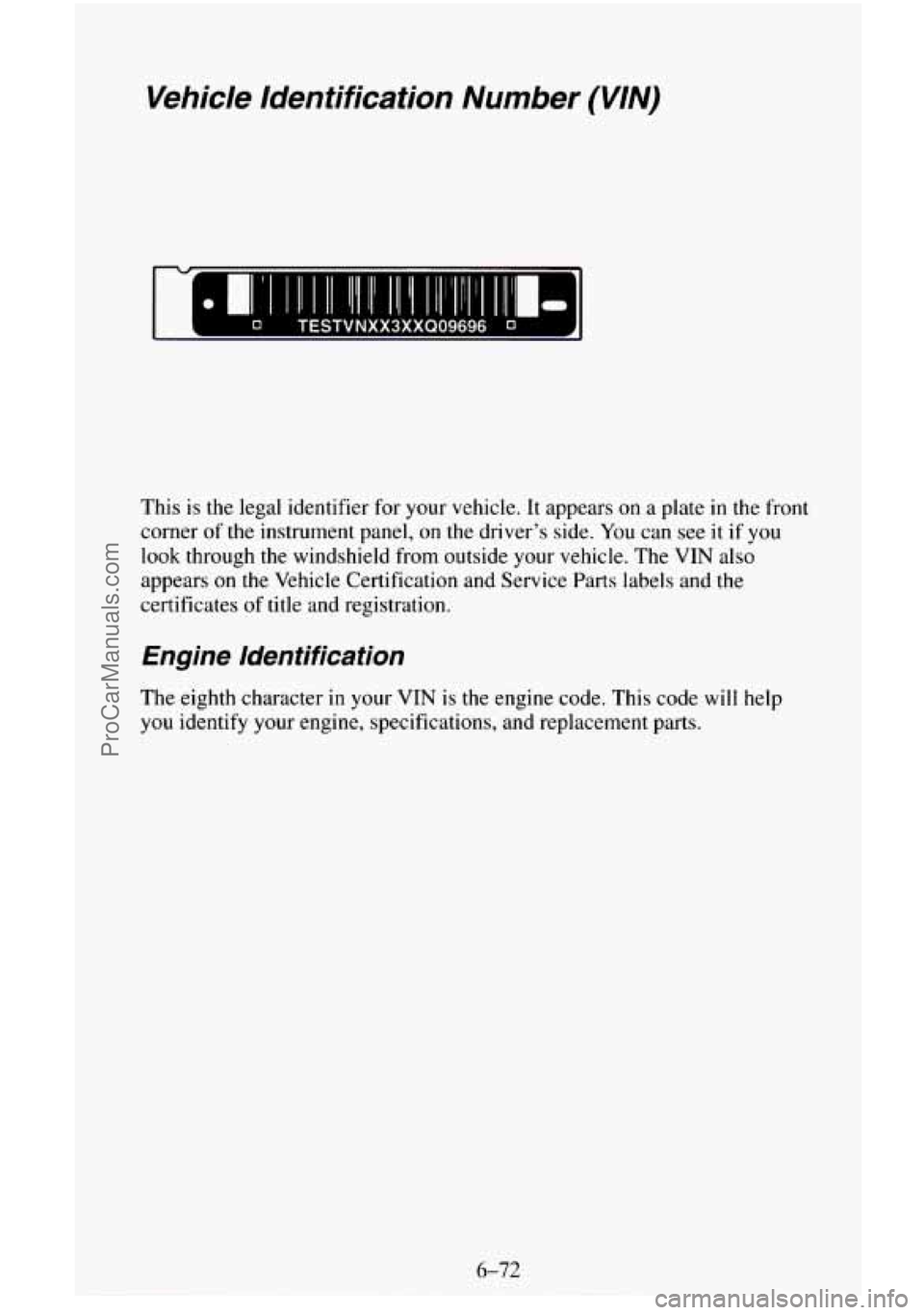
Vehicle Identification Number (VIN)
This is the legal identifier for your vehicle. It appears on a plate in the front
corner
of the instrument panel, on the driver’s side. You can see it if you
look through the windshield from outside your vehicle. The VIN also
appears
on the Vehicle Certification and Service Parts labels and the
certificates of title and registration.
Engine Identification
The eighth character in your VIN is the engine code. This code will help
you identify your engine, specifications, and replacement parts.
6-72
ProCarManuals.com
Page 404 of 486
Maintenance Schedule I - Gasoline Engines Heavy
Duty Emissions
(Continued)
0 Adjust timing to underhood label specifications. Inspect the inside and
outside of the distributor cap and rotor for cracks, carbon tracking and
corrosion. Clean or replace as needed.
An Emission Control Service.
This is a Noise Emission Control Service.
0 If your vehicle has a thermostatically controlled air cleaner, inspect all
hoses and ducts for proper hook-up. Be sure the valve works properly.
An Emission Control Service. This is a Noise Emission Control
Service.
Inspect accessory drive (serpentine) belt for cracks, fraying and wear
and check belt for proper tension. Adjust or replace belt as needed.
An
Emission Control Service.
0 Inspect shields and underhood insulation for damage or looseness.
Adjust or replace
as required. This is a Noise Emission Control
Service. Applicable only to vehicles sold in the United States.
0 Check the air intake system installation to assure that gaskets are
properly sealed and that all hose connections, fasteners and other
components are tight. Also check to be sure that the air cleaner housing
is properly seated, the cover fits tightly and the wing nuts are tight.
Tighten connections and fasteners or replace damaged parts as
necessary.
This is a Noise Emission Control Service. Applicable only
to vehicles sold in the United States.
0 If your engine has a thermostatically controlled cooling fan, inspect all
hoses and ducts for proper hook-up (or every
12 months, whichever
occurs first). Be sure the valve works properly.
This is a Noise
Emission Control Service. Applicable only to vehicles sold in the
United States.
DATE SERVICED BY: ACTUAL MILEAGE I
ProCarManuals.com
Page 410 of 486
Maintenance Schedule I - Gasoline Engines Heavy
Duty Emissions
48,000 Miles (80 000 km)
0
0
0
0
0
0
Change engine oil and filter (or every 3 months, whichever occurs
first).
An Emission Control Service.
Lubricate the front suspension, king pin bushings, steering linkage,
transmission shift linkage, transfer case shift linkage, parking brake
cable guides, rear driveline center splines, front axle propshaft splines,
brake pedal springs and clutch pedal springs.
Ball joints and king pin
bushings should
not be lubricated unless their temperature is 10” F
(-12” C), or higher. When weather is cold, let the ball joints and king
pin bushings warm up before lubrication or
they could be damaged.
Perform each
of the listed lubrication service items at this mileage
interval (or every 12 months, whichever occurs first).
Check readfront axle fluid level and add fluid
as needed. Check
constant velocity joints and axle seals for leaking.‘””
Drain, flush and refill the cooling system with new coolant (or every
24
months, whichever occurs first). See “Engine Coolant’’ in the Index for
what to use.
An Emission Control Service.
Also inspect the hoses and replace them if they are cracked, swollen or
deteriorated. Tighten all hose clamps (except constant tension clamps).
Remove debris and clean the outside of the radiator and air
conditioning condenser. Wash the radiator neck.
To ensure proper
operation, pressure test the radiator and cap.
Replace air cleaner filter. Replace filter more often under dusty
conditions.
An Emission Control Service.
For 2-Wheel Drive vehicles only: Clean and repack the front wheel
bearings (or at each brake relining, whichever occurs first).
Replace
fuel filter. Replace filter sooner if it is clogged.?
Adjust timing
to underhood label specifications. Inspect the inside and
outside
of the distributor cap and rotor for cracks, carbon tracking and
corrosion. Clean or replace
as needed. An Emission Control Service.
This is a Noise Emission Control Service.
If your vehicle has a thermostatically controlled air cleaner, inspect all
hoses and ducts for proper hook-up. Be sure the valve works properly.
An Emission Control Service. This is a Noise Emission Control
Service.
(Continued)
7-47
ProCarManuals.com