Page 150 of 375
Downloaded from www.Manualslib.com manuals search engine I A CAUTION:
Turning or driving across steep hills can be
dangerous. You could lose traction, slide
sideways, and possibly roll over. You could be
seriously injured or killed. When driving up hills,
always
try to go straight up.
0 Ease up on your speed as you approach the top of
the hill.
Attach a flag to the vehicle to make you more visible
to approaching traffic on trails or hills.
0 Sound the horn as you approach the top of the hill to
let opposing traffic know you're there.
Use your headlamps even during the day. They make
you more visible to oncoming traffic.
I L, CA JTION:
Driving to the top (crest) of a hill at full speed can
cause an accident. There could be
a drop-off,
embankment, cliff, or even another vehicle. You
could be seriously injured or killed.
As you near
the top
of a hill, slow down and stay alert.
Page 159 of 375
Downloaded from www.Manualslib.com manuals search engine Here are some tips on night driving. Driving at Night
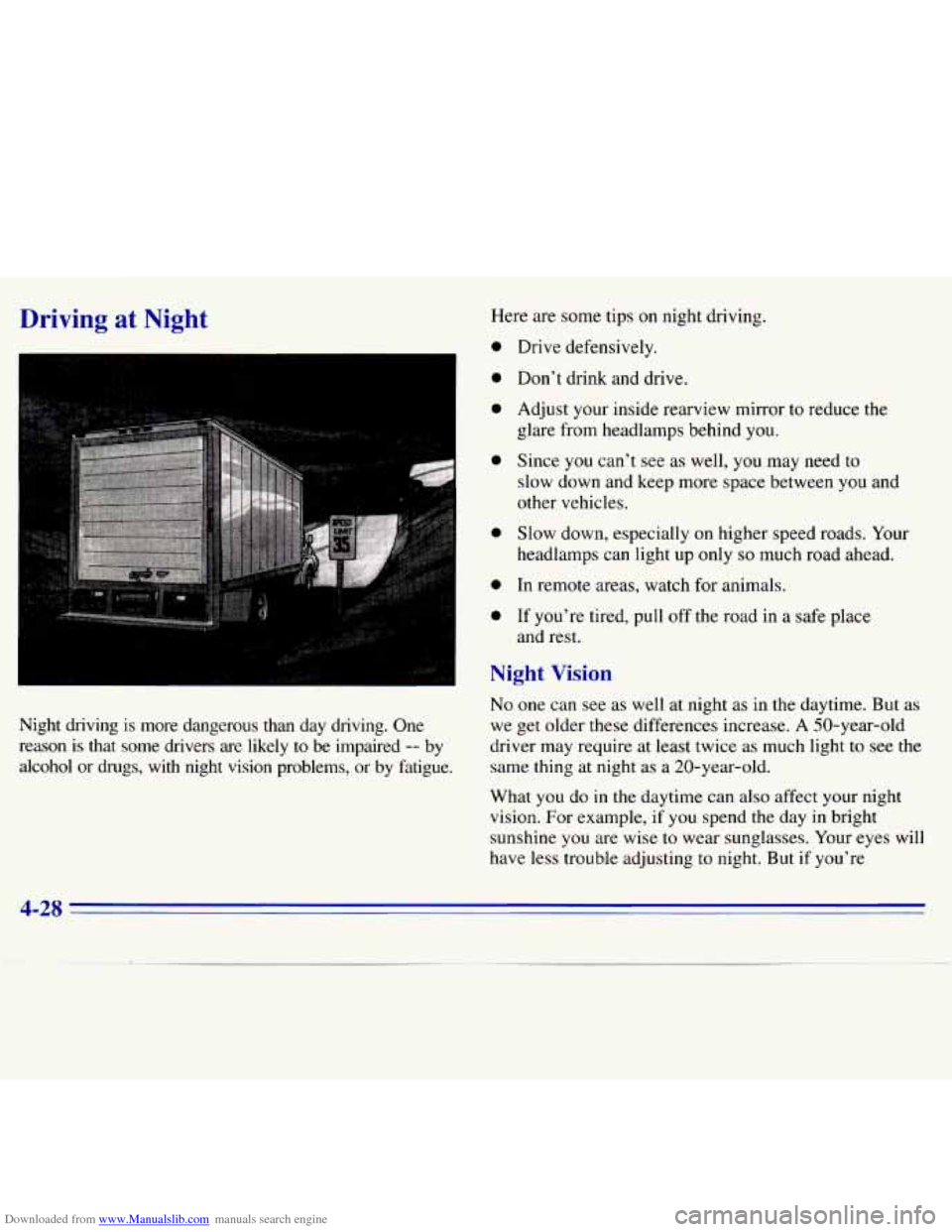
Night driving is more dangerous than day driving. One
reason is that some drivers are likely
to be impaired -- by
alcohol or drugs, with night vision problems, or by fatigue.
0
0
0
0
0
0 0
Drive defensively.
Don’t drink and drive.
Adjust your inside rearview mirror to reduce the
glare from headlamps behind
you.
Since you can’t see as well, you may need to
slow down and keep more space between
you and
other vehicles.
Slow down, especially on higher speed roads. Your
headlamps can light up only
so much road ahead.
In remote areas, watch for animals.
If you’re tired, pull
off the road in a safe place
and rest.
Night Vision
No one can see as well at night as in the daytime. But as
we get older these differences increase. A 50-year-old
driver may require at least twice as much light to see the
same thing at night as a 20-year-old.
What you do
in the daytime can also affect your night
vision. For example, if
you spend the day in bright
sunshine you are wise to wear sunglasses. Your eyes will
have less trouble adjusting to night. But if you’re
4-28
Page 160 of 375
Downloaded from www.Manualslib.com manuals search engine driving, don’t wear sunglasses at night. They may cut
down
on glare from headlamps, but they also make a lot
of things invisible.
You can be temporarily blinded by approaching lights.
It can take
a second or two, or even several seconds, for
your eyes to readjust to the dark. When you are faced
with severe glare (as from a driver who doesn’t lower
the high beams, or a vehicle
with misaimed headlamps),
slow down a little. Avoid staring directly into the
approaching lights.
Keep your windshield and all the glass on your vehicle
clean
-- inside and out. Glare at night is made much
worse by dirt on the glass. Even the inside of the glass
can build up a
film caused by dust. Dirty glass makes
lights dazzle and flash more than clean glass would,
making the pupils of your eyes contract repeatedly.
Remember that your headlamps light up
far less of a
roadway when you are in a turn or curve. Keep your
eyes moving; that way, it’s easier to pick out dimly
lighted objects. Just as your headlamps should be
checked regularly for proper aim,
so should your eyes
be examined regularly. Some drivers suffer from night
blindness
-- the inability to see in dim light -- and
aren’t even aware of
it.
Driving in Rain and on Wet Roads
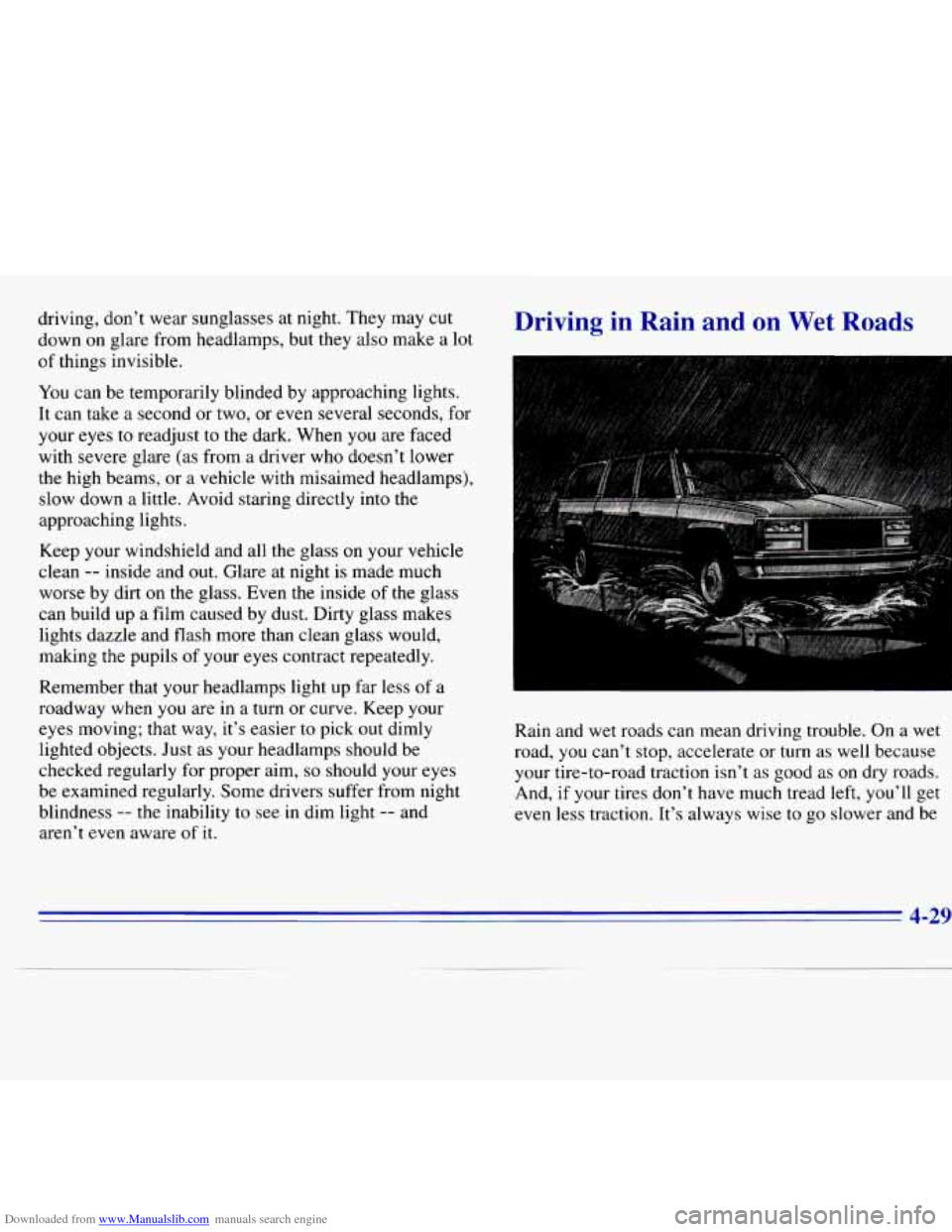
Rain and wet roads can mean driving trouble. On a wet
road, you can’t stop, accelerate or
turn as well because
your tire-to-road traction isn’t as good as on dry roads.
And,
if your tires don’t have much tread left, you’ll get
even less traction. It’s always wise to go slower and be
4-29
Page 171 of 375
Downloaded from www.Manualslib.com manuals search engine -
Snow can trap exhaust gases under your vehicle.
This can cause deadly
CO (carbon monoxide) gas
to get inside.
CO could overcome you and kill
you. You can’t see it
or smell it, so you might not
know it is in your vehicle. Clear away snow from
around the base of your vehicle, especially any
that
is blocking your exhaust pipe. And check
around again from time to time to be sure snow
doesn’t collect there.
Open a window just a little on the side
of the
vehicle that’s away from the wind. This will help
keep
CO out.
Run your engine only as long as you must. This saves
fuel. When you
run the engine, make it go a little faster
than just idle. That
is, push the accelerator slightly. This
uses less fuel for the heat that you get and
it keeps the
battery charged.
You will need a well-charged battery to
restart the vehicle, and possibly for signaling later
on
with your headlamps. Let the heater run for awhile.
Then, shut the engine off and close the window almost
all the way
to preserve the heat. Start the engine again
and repeat this only when you feel really uncomfortable
from the cold.
But do it as little as possible. Preserve the
fuel as long as you can.
To help keep warm, you can get
out of the vehicle and
do some fairly vigorous exercises
every
half hour or so until help comes.
4-40
Page 262 of 375
Downloaded from www.Manualslib.com manuals search engine Headlamps
Sealed Beam Lamps
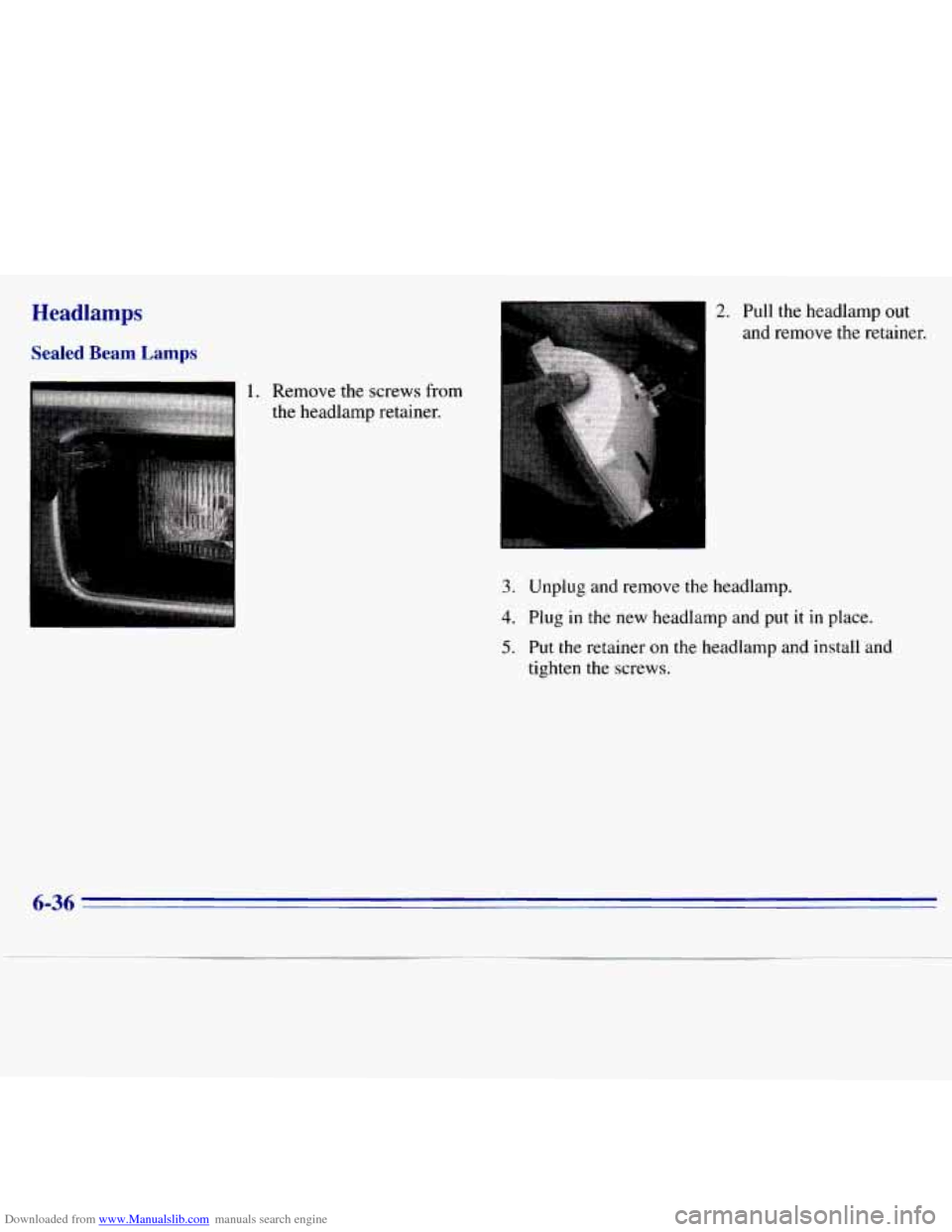
1. Remove the screws from
the headlamp retainer.
2. Pull the headlamp out
and remove the retainer.
3. Unplug and remove the headlamp.
4. Plug in the new headlamp and put it in place.
5. Put the retainer on the headlamp and install and
tighten the screws.
6-36
Page 263 of 375
Downloaded from www.Manualslib.com manuals search engine Composite Headlamps
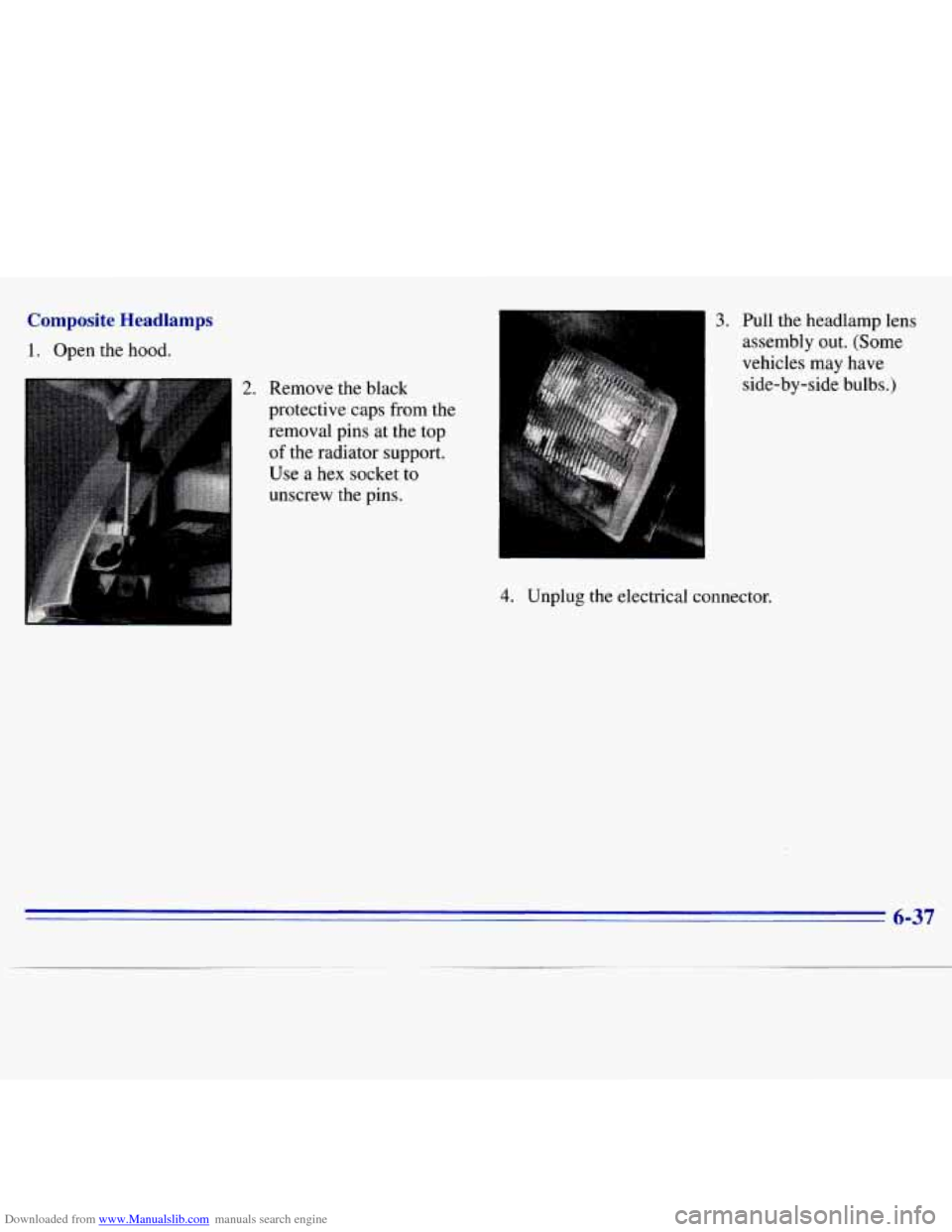
1. Open the hood.
2. Remove the black
protective caps from the
removal pins at the top
of the radiator support.
Use a hex socket to
unscrew the pins.
3. Pull the headlamp lens
I
assembly out. (Some
vehicles may have
4. Unplug the electrical connector.
6-37
Page 264 of 375
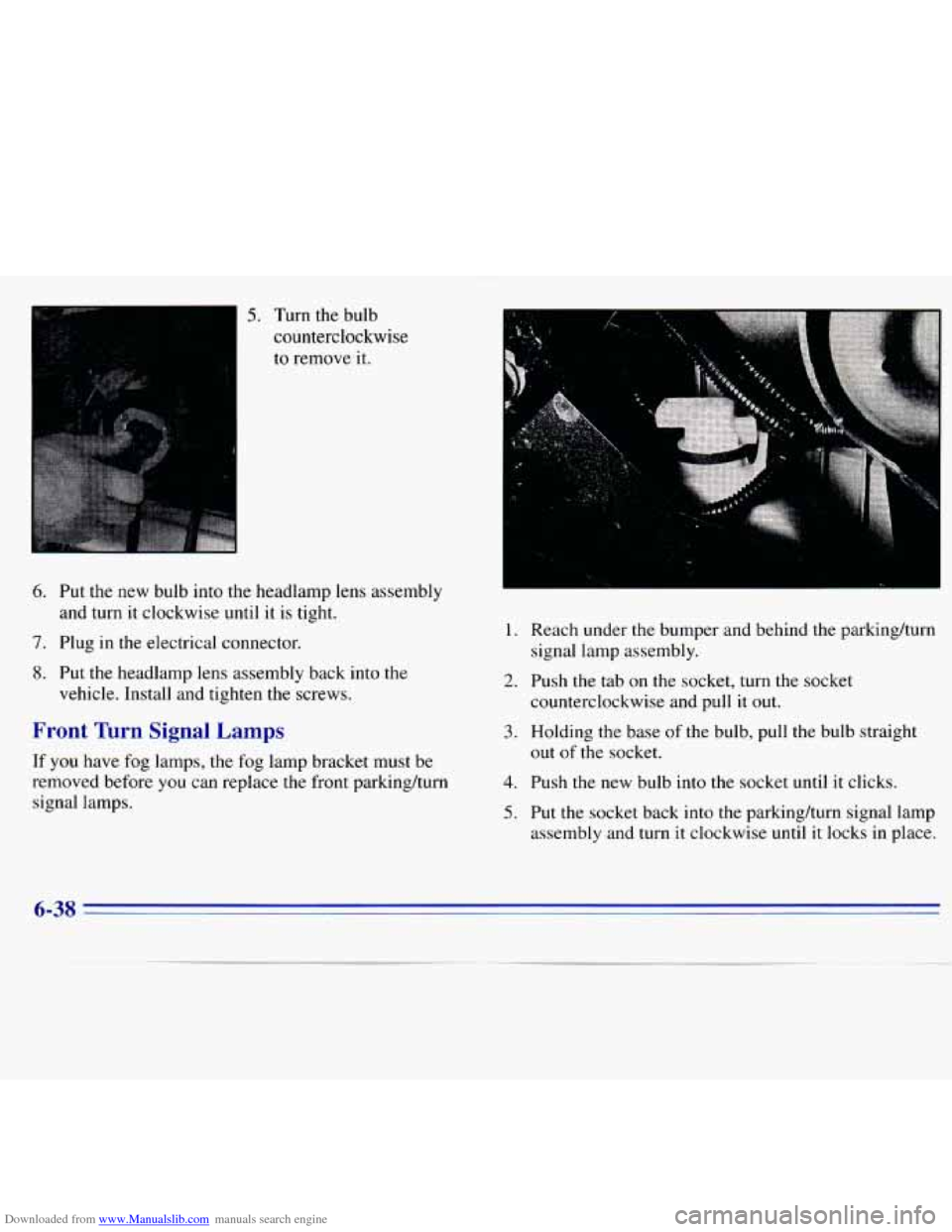
Downloaded from www.Manualslib.com manuals search engine 5. Turn the bulb
counterclockwise
to remove it.
6. Put the new bulb into the headlamp lens assembly
and turn it clockwise until
it is tight.
7. Plug in the electrical connector.
8. Put the headlamp lens assembly back into the
vehicle. Install and tighten the screws.
Front Turn Signal Lamps
If you have fog lamps, the fog lamp bracket must be
removed before
you can replace the front parkinghum
signal lamps.
1. Reach under the bumper and behind the parkinghrn
signal lamp assembly.
2. Push the tab on the socket, turn the socket
counterclockwise and pull
it out.
3. Holding the base of the bulb, pull the bulb straight
out
of the socket.
4. Push the new bulb into the socket until it clicks.
5. Put the socket back into the parkinghrn signal lamp
assembly and
turn it clockwise until it locks in place.
6-38
Page 277 of 375
Downloaded from www.Manualslib.com manuals search engine Your dealer will know the kind of wheel you need.
Each new wheel should have the same load carrying
capacity, diameter, width, offset and be mounted the same way as the one it replaces.
If you need
to replace any of your wheels, wheel bolts
or wheel nuts, replace them only with new
GM original
equipment parts. This way, you will be sure
to have the
right wheel, wheel bolts and wheel nuts for your model.
Using the wrong replacement wheels, wheel bolts
or wheel nuts on your vehicle can be dangerous.
It could affect the braking and handling
of your
vehicle, make your tires lose air and make
you lose control.
You could have a collision in
which you or others could be injured. Always
use the correct wheel, wheel bolts and wheel
nuts for replacement.
NOTICE:
The wrong wheel can also cause problems with
bearing life, brake cooling, speedometer/odometer
calibration, headlamp aim, bumper height, vehicle
ground clearance and tire or tire chain clearance
to the body and chassis,
See “Changing a Flat Tire” in the Index for more
information.
sed Replacement
7 keels
Putting
a used wheel on your vehicle is
dangerous. You can’t know how it’s been used or
how many miles it’s been driven, It could fail
suddenly and cause an accident.
If you have to
replace a wheel, use
a new GM original
equipment wheel.
6-51