1996 CHEVROLET S10 Power
[x] Cancel search: PowerPage 82 of 375
Downloaded from www.Manualslib.com manuals search engine I b CAUTION:
-
It can be dangerous to get out of your vehicle if
the shift lever
is not fully in PARK (P) with the
parking brake firmly set. Your vehicle can roll.
Don’t leave your vehicle when the engine
is
running unless you have to. If you’ve left the
engine running, the vehicle can move suddenly.
You or others could be injured.
To be sure your
vehicle won’t move, even when you’re on fairly
level ground, always set your parking brake and
move the shift lever
to PARK (P). !
If you have four-wheel drive with a manual transfer case
shift lever and your transfer case is in NEUTRAL (N),
your vehicle will be free to roll, even if your shift lever
is in PARK
(P). So, be sure the transfer case is in a drive
gear
-- not in NEUTRAL (N). Always set your parking
brake. Follow the proper steps to be sure your vehicle
won’t move. See “Shifting Into PARK
(P)” in the Index.
If you’re pulling a trailer, see “Towing a Trailer’’ in
the Index.
Windows
Manual Windows
Turn the hand crank on each door to raise or lower your
m&ual side door windows.
Power Windows (Option)
If you have the optional power windows, the controls
are on each of the side doors. Your power windows will
only work when the ignition has been turned to RUN.
The driver’s door has a switch for the passenger’s
window as well.
2-3 1
Page 94 of 375
Downloaded from www.Manualslib.com manuals search engine Mirrors
Inside DayNight Rearview Mirror
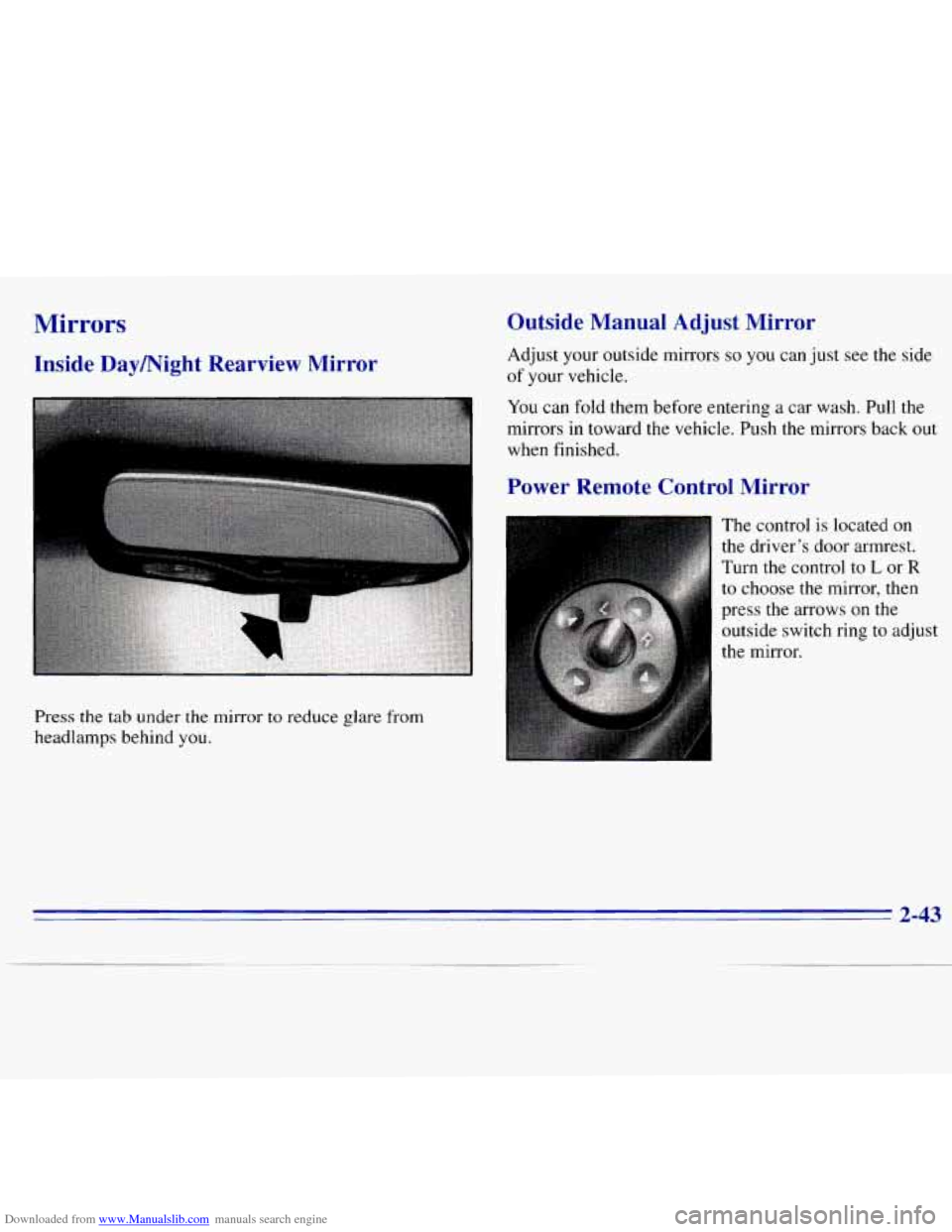
Press the tab under the mirror to reduce glare from
headlamps behind you.
Outside Manual Adjust Mirror
Adjust your outside mirrors so you can just see the side
of your vehicle.
You can fold them before entering a car wash. Pull the
mirrors in toward the vehicle. Push the mirrors back out
when finished.
Power Remote Control Mirror
The control is located on
the driver's door armrest.
Turn the control to
L or R
to choose the mirror, then
press
the arrows on the
outside switch ring
to adjust
the mirror.
2-43
Page 98 of 375
Downloaded from www.Manualslib.com manuals search engine Illuminated Visor Vanity Mirror (Option)
I
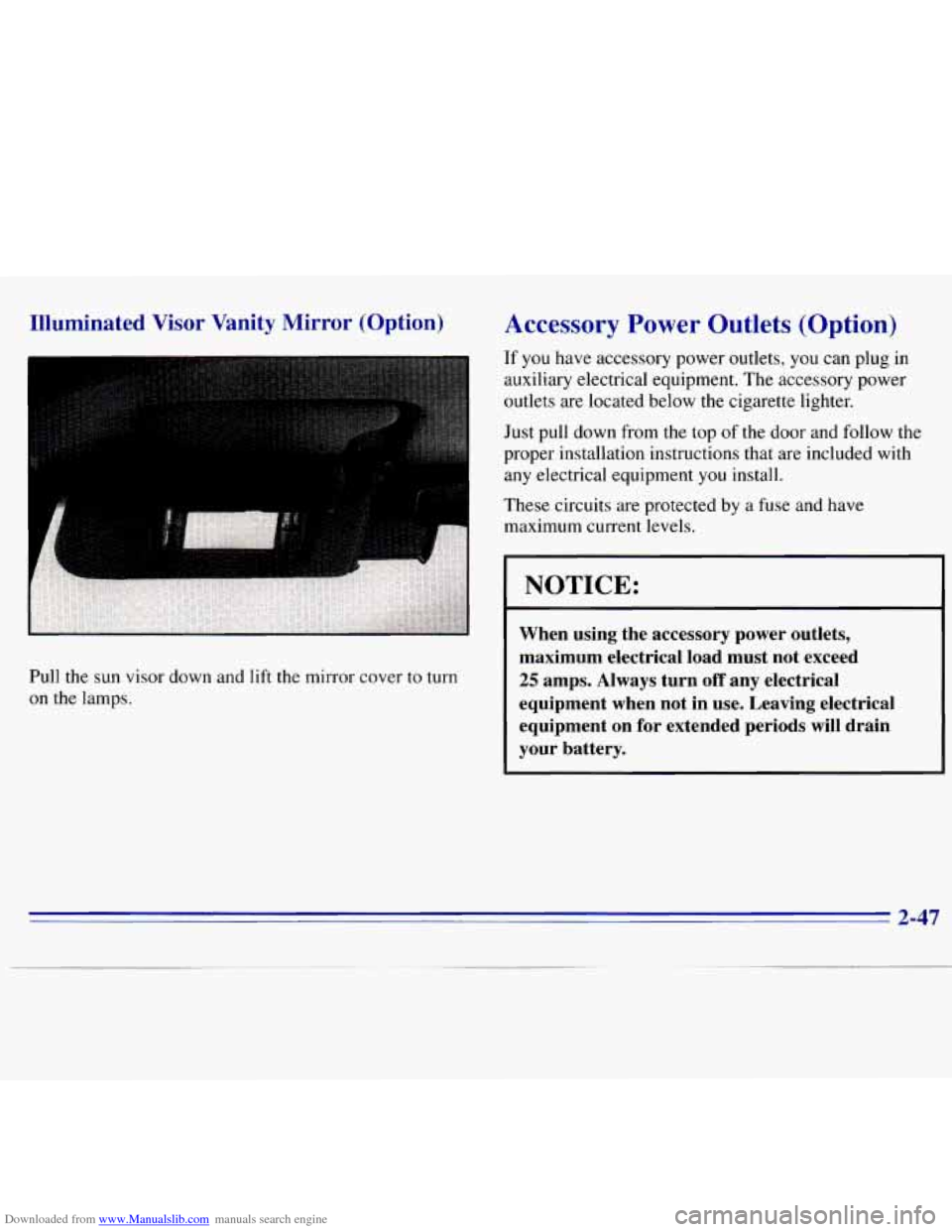
Pull the sun visor down and lift the mirror cover to turn
on the lamps.
Accessory Power Outlets (Option)
If you have accessory power outlets, you can plug in
auxiliary electrical equipment. The accessory power
outlets are located below the cigarette lighter.
Just pull down from the top of the door and follow the
proper installation instructions that are included with
any electrical equipment you install.
These circuits are protected by a fuse and have
maximum current levels.
NOTICE:
When using the accessory power outlets,
maximum electrical load must not exceed
25 amps. Always turn off any electrical
equipment when not in use. Leaving electrical
equipment on for extended periods
will drain
your battery.
2-47
Page 100 of 375
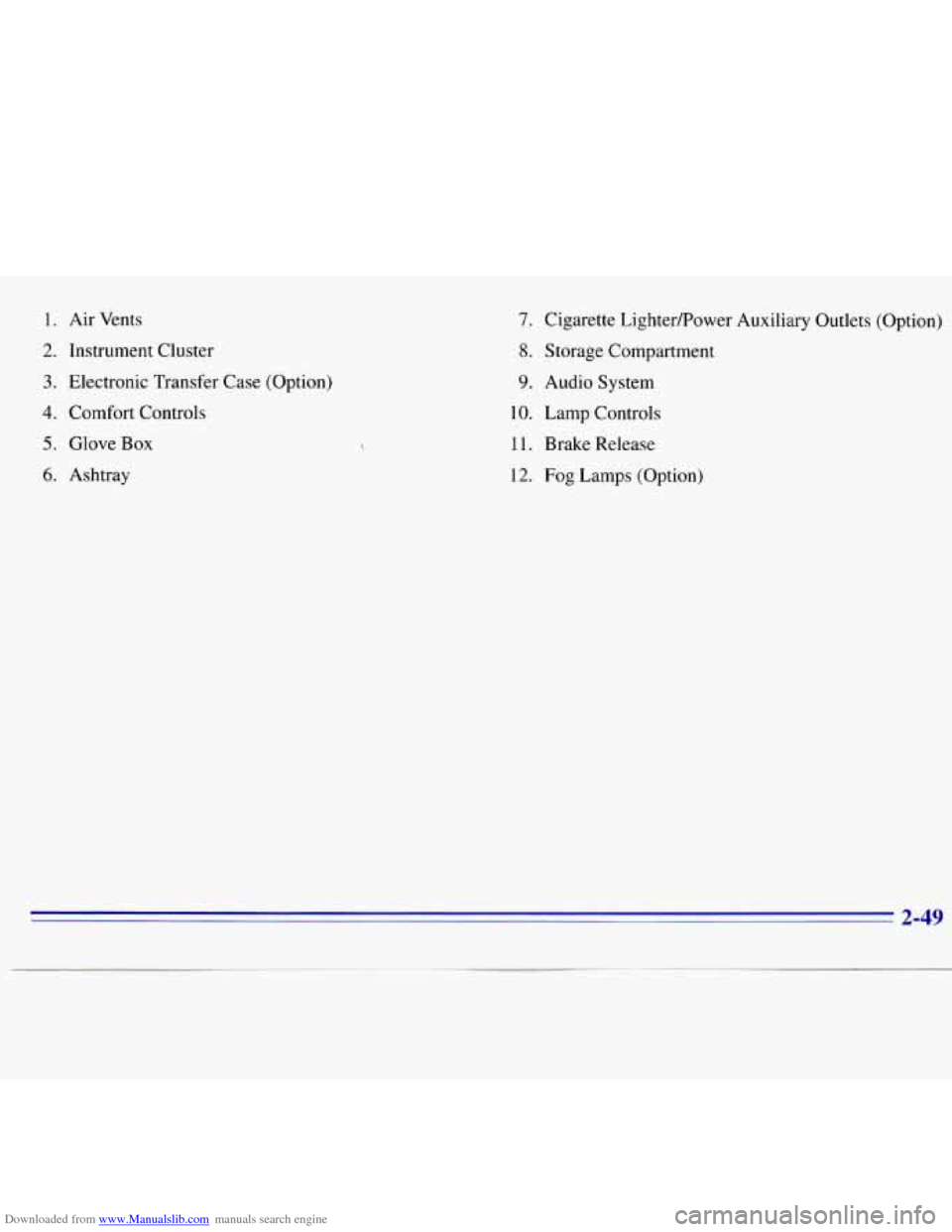
Downloaded from www.Manualslib.com manuals search engine 1. Air Vents
2. Instrument Cluster
3. Electronic Transfer Case (Option)
4. Comfort Controls
5. Glove Box
6. Ashtray
7. Cigarette LightedPower Auxiliary Outlets (Option)
8. Storage Compartment
9. Audio System
10. Lamp Controls
11. Brake Release
12. Fog Lamps (Option)
2-49
Page 103 of 375
Downloaded from www.Manualslib.com manuals search engine Speedometer and Odometer
Your speedometer lets you see your speed in both miles
per hour (mph) and kilometers per hour (km/h).
Your odometer shows how far your vehicle has been
driven, in either miles (used in the United States) or
kilometers (used in Canada).
Your odometer is tamper resistant. It will show
silver lines between the numbers if someone tries to
turn it back.
‘You may wonder what happens if your vehicle needs a
new odometer installed. If the new one can be set to the
mileage total of the old odometer, then it
must be. But if
it can’t, then it’s set at zero, and a label must be put on
the driver’s door
to show the old mileage reading when
the new odometer was installed.
Trip Odometer
The trip odometer can tell you how far your vehicle has
been driven since you last set the trip odometer to zero.
To set the trip odometer to zero, press the button near
the readout.
Tachometer (Option)
The tachometer displays the engine speed in revolutions
per minute
(rpm).
Each tachometer has a dlrrerent limit depending on the
powertrain
in your vehicle. The tachometer has three
areas: normal operating range, red warning range and
red danger range.
Normal operating range shows your engine speed during
normal driving conditions. For example, when
the
needle points to 2, it means the engine is running at
2,000 revolutions per minute (rpm). The tachometer
needle will vary all the time that the engine is running.
The red warning range tells you that your engine speed
is reaching its upper limits. Don’t drive very long with
the tachometer
in the red warning range. If you have a
manual transmission, shift to a higher gear as soon as
possible.
If. you have an automatic transmission, lift
your foot off of
the accelerator pedal.
The red danger range tells you that your engine speed is
at its upper limits.
You should immediately shift to a
higher gear, or lift your foot off of the accelerator pedal.
NOTICE:
Do not operate the engine with the tachometer in
the red range,
or engine damage will occur. I
2-52
Page 106 of 375
Downloaded from www.Manualslib.com manuals search engine Voltmeter
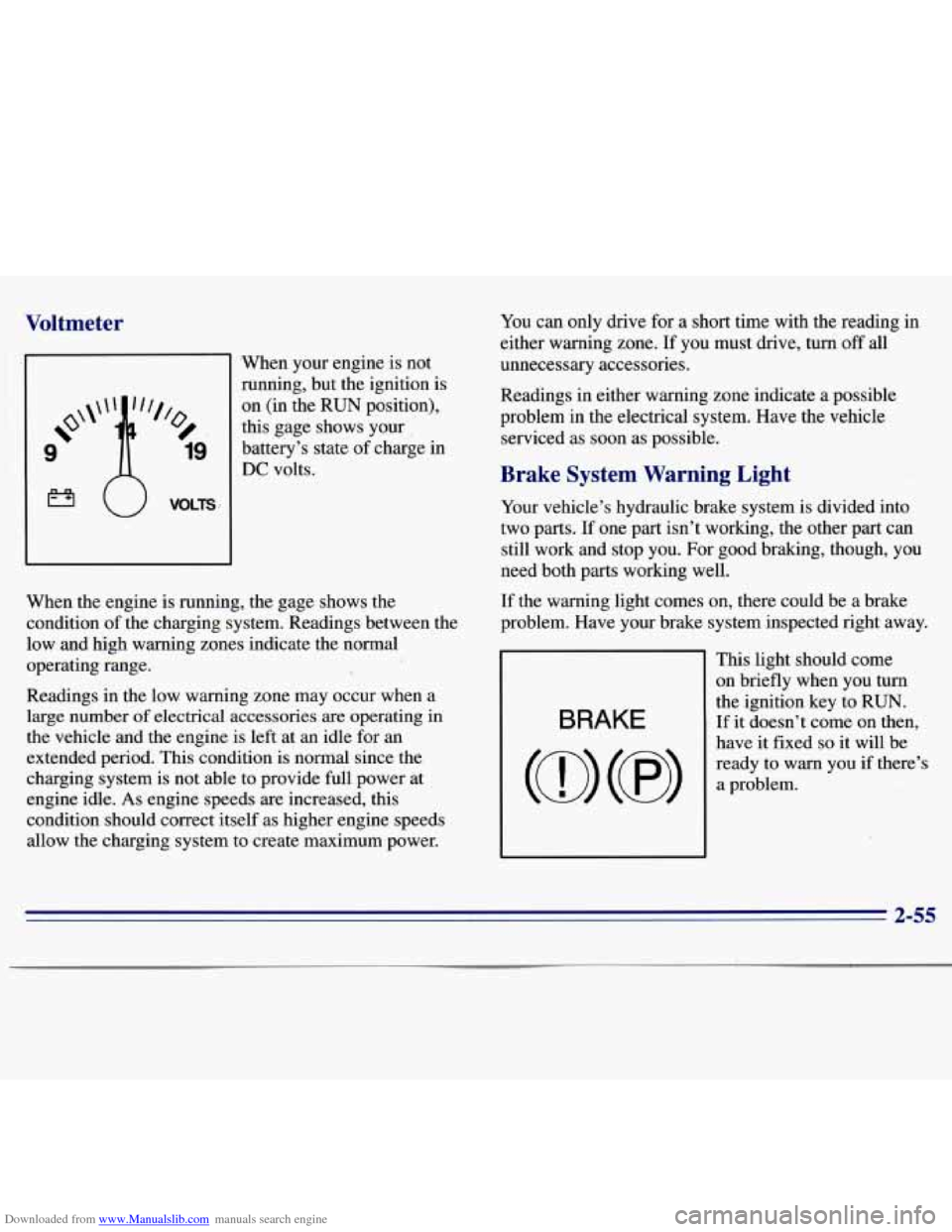
‘When your engine is not
ninning, but the ignition
is
on (in the RUN position),
this gage shows your
battery’s state of charge in
DC volts. You
can only drive for a short time with the reading in
either warning zone.
If you must drive, turn off all
unnecessary accessories.
Readings in either warning zone indicate a possible
problem
in the electrical system. Have the vehicle
serviced as soon as possible.
Brake System Warning Light
When the engine is running, the gage shows the
condition of the charging system. Readings between the
low and high warning zones indicate the normal
operating range.
Readings in the low warning zone may occur when a
large number
of electrical accessories are operating in
the vehicle and the engine
is left at an idle for an
extended period. This condition is normal since the
charging system is not able to provide full power at
engine idle. As engine speeds are increased, this
condition should correct itself as higher engine speeds
allow the charging system to create maximum power. Your
vehicle’s hydraulic brake system is divided into
two parts.
If one part isn’t working, the other part can
still work and stop you. For good braking, though, you
need both parts working well.
If the warning light comes on, there could be a brake
problem. Have your brake system inspected right away.
This light should come
on briefly when you turn
the ignition key to RUN.
If it doesn’t come on then, BRAKE
have it fixed so it will be
ready to
warn you if there’s
2-55
Page 116 of 375
Downloaded from www.Manualslib.com manuals search engine Temperature Knob
The upper knob regulates the temperature of the air
coming through the system. Turn the knob clockwise for warmer
air. Turn the knob counterclockwise for cooler air.
Mode Knob
The lower knob allows you to choose the direction of
air delivery.
OFF: This setting turns the system off. Some outside air
will still enter the vehicle whenever the vehicle is
moving forward.
MAX NC: This setting provides maximum cooling
with the least amount of work. MAX A/C recirculates
much
of the air inside your vehicle so it cools quickly.
A/C: This setting cools the air entering your vehicle and
directs it through the instrument panel outlets.
+# BI-LEVEL A/C: Air is delivered through the heater
floor outlets
as well as the instrument panel outlets.
+e
/J VENT: This setting directs airflow through the
instrument panel outlets. The air conditioning
compressor is not working when VENT is selected.
+’ HEATER: This setting directs warmed air through
the heater floor outlets and windshield defroster outlets.
+e
0
w.
+’ BLEND: Airflow is divided equally between the
heater floor outlet and the windshield defroster outlets.
DEFROST: This setting directs most air through
the windshield defroster
outlets and some through the
heater outlets.
Air Conditioning (Option)
On hot days, open the windows long enough to let hot
inside air escape. This reduces the time
it takes for your
vehicle to cool down. Then keep your windows closed
for the air conditioner to work its best.
For quick cool-down
on very hot days, use MAX A/C
with the temperature knob turned counterclockwise. This
setting should be used to keep odors and/or dust from
entering the vehicle. For normal cooling on hot days, use
A/C with the temperature knob turned counterclockwise.
On
cool but sunny days, use BI-LEVEL A/C to deliver
warm air to the floor and cooler air to the instrument
panel outlets.
If you have the “VORTEC”
4300 engine, when the air
conditioner is on, you may sometimes notice slight
changes in your vehicle’s engine speed and power. This
is normal because the system is designed to cycle the
compressor on and
off to keep the desired temperature.
3-3
Page 125 of 375
Downloaded from www.Manualslib.com manuals search engine AM-FM Stereo with Compact Disc
Player (Option)
Playing the Radio
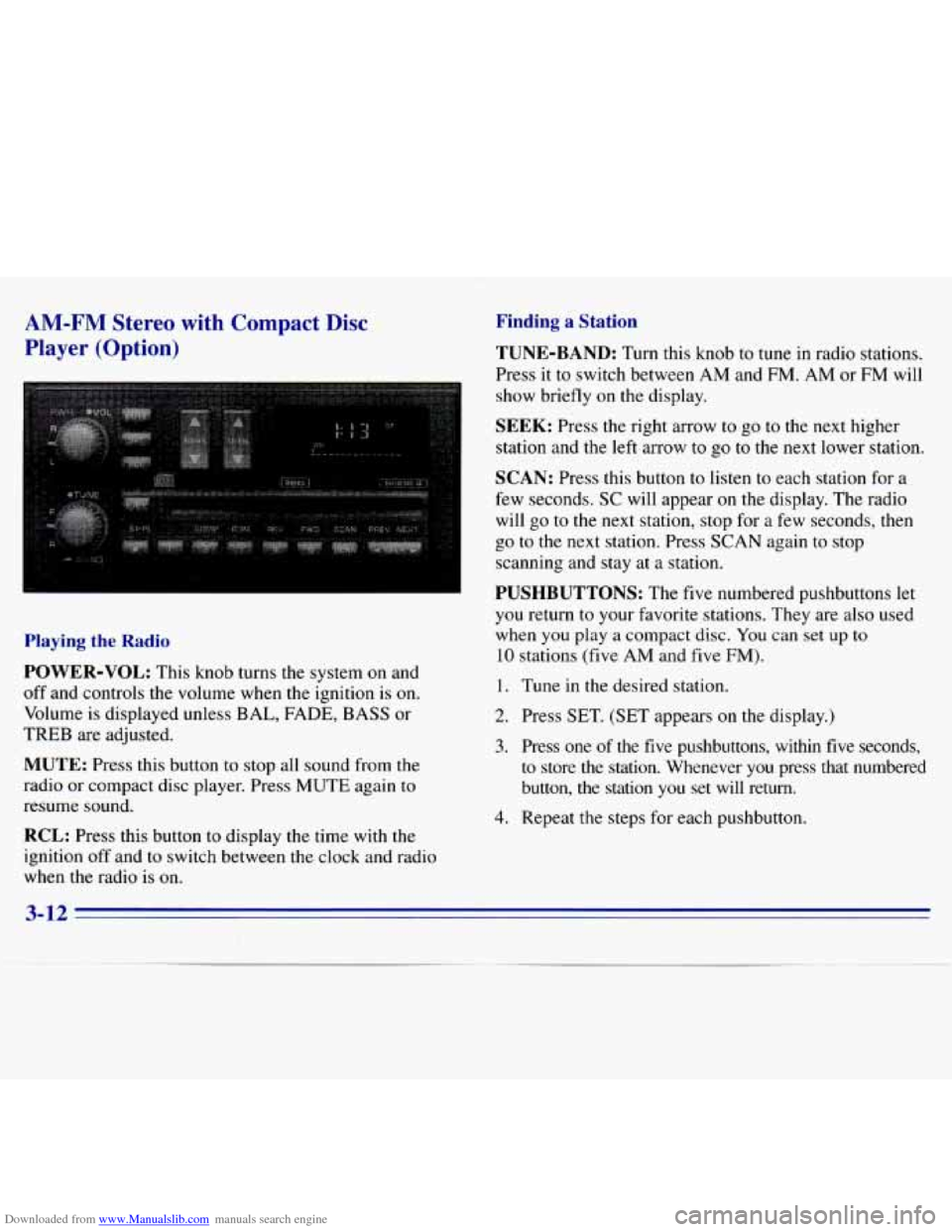
POWER-VOL: This knob turns the system on and
off and controls the volume when the ignition is on.
Volume is displayed unless BAL, FADE, BASS or
TREB are adjusted.
MUTE: Press this button to stop all sound from the
radio or compact disc player. Press MUTE again to
resume sound.
RCL: Press this button to display the time with the
ignition off and
to switch between the clock and radio
when the radio is
on.
Finding a Station
TUNE-BAND: Turn this knob to tune in radio stations.
Press it to switch between
AM and FM. AM or FM will
show briefly on the display.
SEEK: Press the right arrow to go to the next higher
station and the
left arrow to go to the next lower station.
SCAN: Press this button to listen to each station for a
few seconds.
SC will appear on the display. The radio
will
go to the next station, stop for a few seconds, then
go to the next station. Press
SCAN again to stop
scanning and stay at
a station.
PUSHBUTTONS: The five numbered pushbuttons let
you return to your favorite stations. They are also used
when you play a compact disc. You can set up
to
10 stations (five AM and five FM).
1. Tune in the desired station.
2. Press SET. (SET appears on the display.)
3. Press one of the five pushbuttons, within five seconds,
to store
the station. Whenever you press that numbered
button, the station
you set will return.
4. Repeat the steps for each pushbutton.
3-12