Page 234 of 375
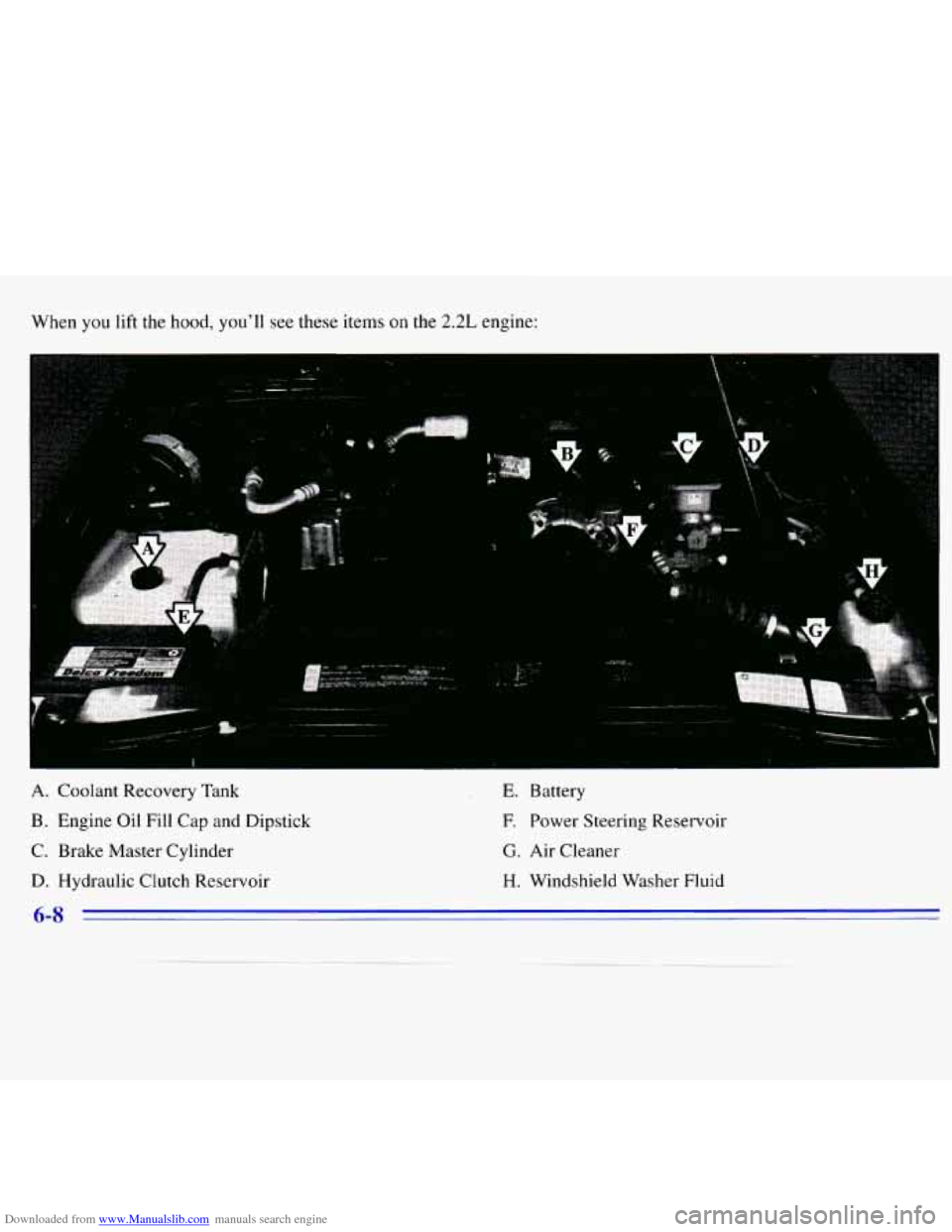
Downloaded from www.Manualslib.com manuals search engine When you lift the hood, you'll see these items on the 2.2L engine:
A. Coolant Recovery Tank
E. Battery
B. Engine Oil Fill Cap and Dipstick E Power Steering Reservoir
C. Brake Master Cylinder G. Air Cleaner
D. Hydraulic Clutch Reservoir H. Windshield Washer Fluid
6-8
Page 235 of 375
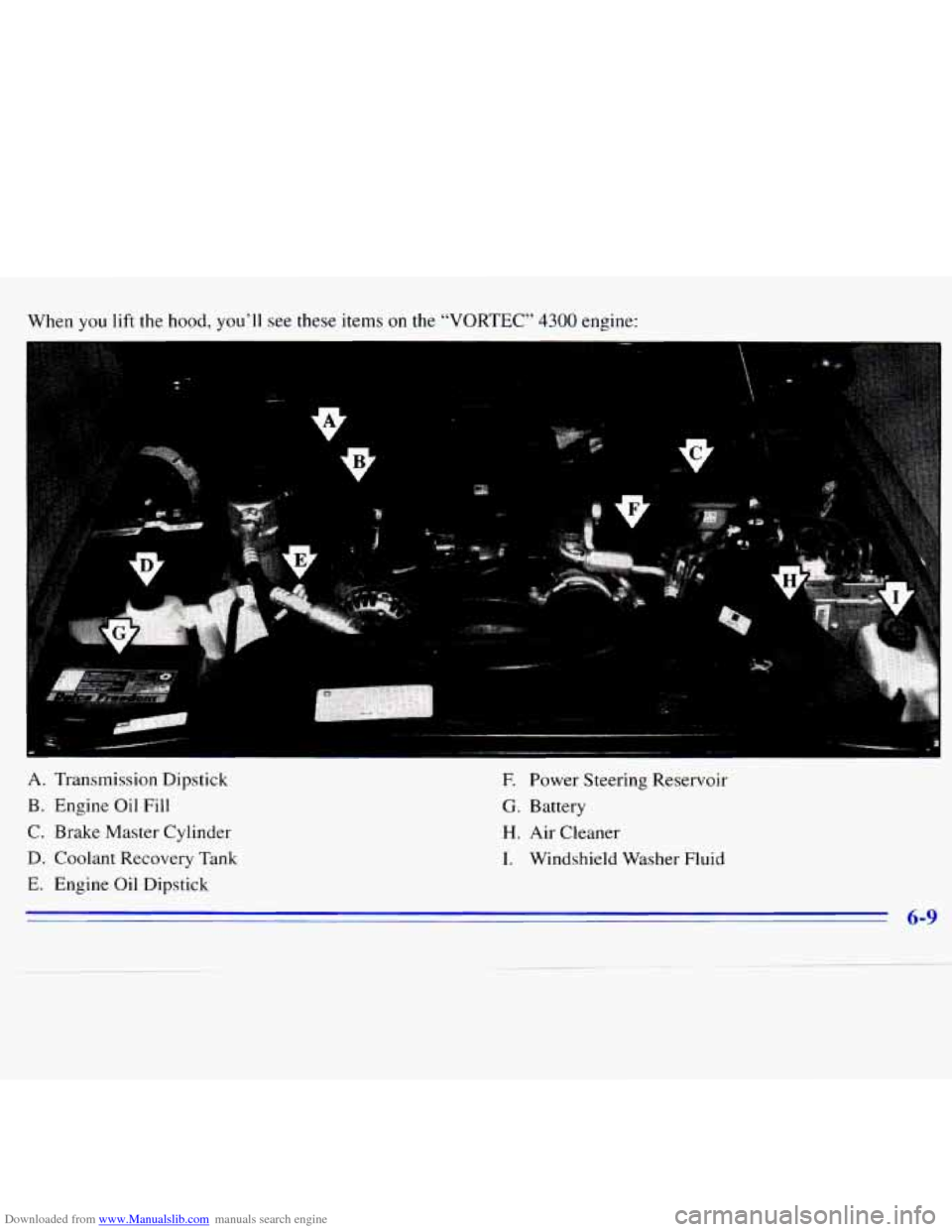
Downloaded from www.Manualslib.com manuals search engine When you lift the hood, you’ll see these items on the “VORTEC” 4300 engine:
V
I. Transmission Dipstick
3. Engine Oil Fill
2. Brake Master Cylinder
1. Coolant Recovery Tank
:. Engine Oil Dipstick
6-9
E Power Steering Reservoir
G. Battery
H. Air Cleaner
I. Windshield Washer Fluid
Page 255 of 375
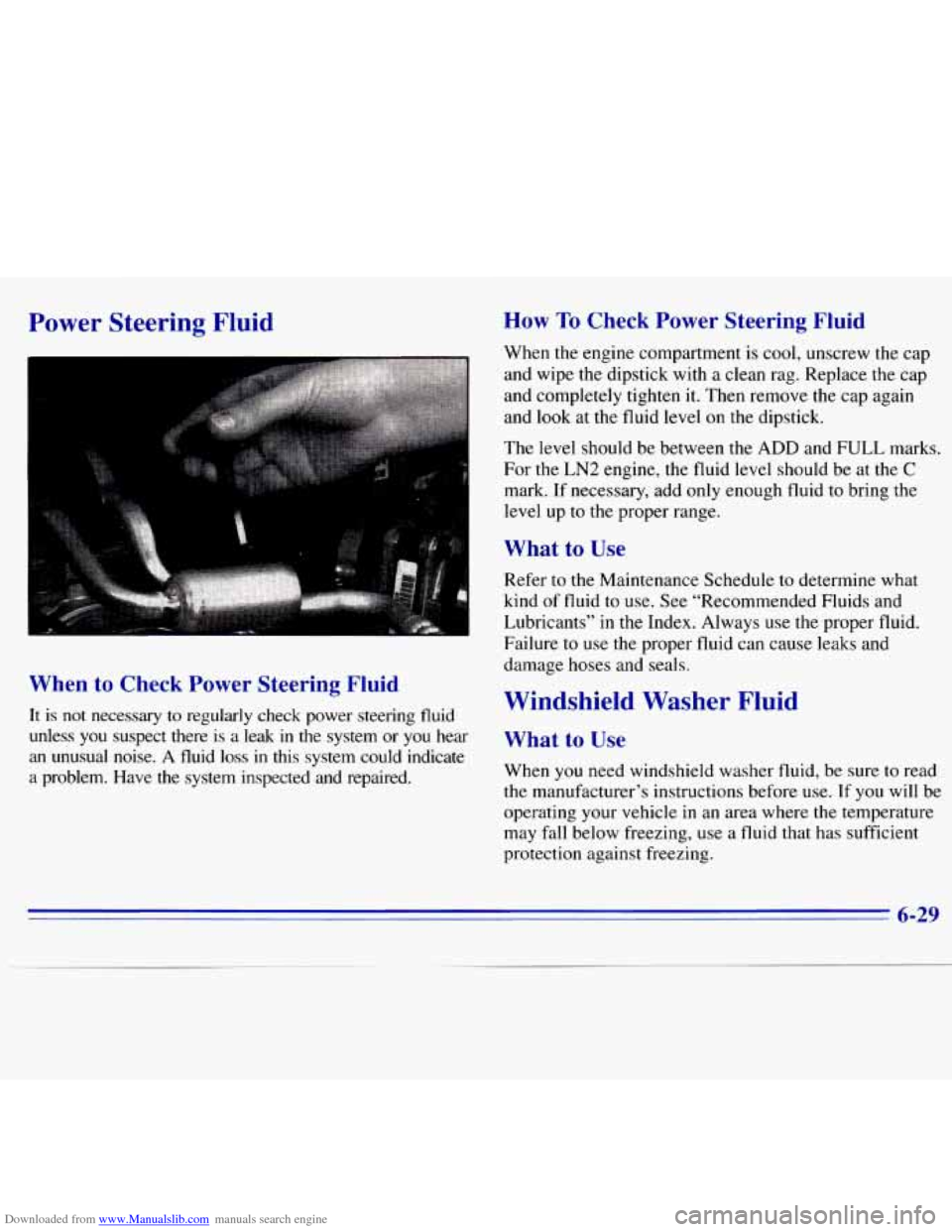
Downloaded from www.Manualslib.com manuals search engine Power Steering Fluid How To Check Power Steering Fluid
When the engine compartment is cool, unscrew the cap
and wipe the dipstick with a clean rag. Replace the cap
and completely tighten it. Then remove the cap again
and
look at the fluid level on the dipstick.
The level should be between the
ADD and FULL marks.
For the
LN2 engine, the fluid level should be at the C
mark. If necessary, add only enough fluid to bring the
level up
to the proper range.
What to Use
Refer to the Maintenance Schedule to determine what
kind of fluid
to use. See “Recommended Fluids and
Lubricants” in the Index. Always use the proper fluid.
Failure to
use the proper fluid can cause leaks and
damage hoses and seals.
Windshield Washer Fluid
What to Use
When you need windshield washer fluid, be sure to read
the manufacturer’s instructions before use. If you will be
operating your vehicle
in an area where the temperature
may fall below freezing, use a fluid that has sufficient
protection against freezing.
When to Check Power Steering Fluid
It is not necessary to regularly check power steering fluid
unless you suspect there is a leak
in the system or you hear
an unusual noise.
A fluid loss in this system could indicate
a problem. Have
the system inspected and repaired.
6-29
Page 288 of 375
Downloaded from www.Manualslib.com manuals search engine Electrical System
Add-on Electrical Equipment
NOTICE:
Don’t add anything electrical to your vehicle
unless you check with your dealer first. Some
electrical equipment can damage your vehicle
and the damage wouldn’t be covered by your
warranty. Some add-on electrical equipment can
keep other components from working as they
should.
Your vehicle has an air bag system. Before attempting to
add anything electrical
to your vehicle, see “Servicing
Your Air Bag-Equipped Vehicle” in the Index.
Headlamps
The headlamp wiring is protected by an internal circuit
breaker. An electrical overload will cause the lamps to
go on and
off, or in some cases to remain off. If this
happens, have your headlamp wiring checked right away.
Windshield Wipers
The windshield wiper motor is protected by a circuit
breaker and a fuse. If the motor overheats due
to heavy
snow, etc., the wiper will stop until the motor cools. If
the overload is caused by some electrical problem, be
sure to get it fixed.
Power Windows and Other Power Options
Circuit breakers protect the power windows and other
power accessories. When the current load is too heavy,
the circuit breaker opens and closes, protecting the
circuit until the problem is fixed
or goes away.
6-62
Page 290 of 375
Downloaded from www.Manualslib.com manuals search engine FuseKircuit Usage Breaker
A
B
1
Power Door Locks, Power Seat, Power
Seat Lumbar, Remote Keyless Entry
Power Windows
Stoplamps, Hazard Lamps, Chime,
Center High-Mounted Stoplamp Relay,
Center High-Mounted Stoplamp
3
4
5
6
FuseKircuit Usage
Breaker
2 Dome Lamps, Visor Vanity Mirror,
Cigarette Lighter, Inside Rearview
Mirror Lamp, Overhead Console
Lamps, Glove
Box Lamp, Horns, Horn
Relay, IP Courtesy Lamps, Power
Outside Rearview Mirror, Illuminated
Entry Module
Parking Lamps, License Plate Lamps,
Electric Shift Transfer Case Module,
Underhood Lamp, Ashtray Lamp,
Door Switch Lamp
Alternator Field, A/C Compressor
Relay, Cluster Chime Module, DRL
Relay Coil, Four-Wheel-Drive
Indicator Lamp, DRL Module,
Transfer Case Control Module Ignition, SIR Redundant Ignition,
RKE Ignition
Oxygen Sensor Heater, Exhaust Gas
Recirculation, Cam Sensor, CANN.
Purge, MAS
Blower Motor, Temperature Door
Motor,
HI Blower Relay Coil
6-64
Page 291 of 375
Downloaded from www.Manualslib.com manuals search engine Fuse/Circuit Usage Breaker
7 Power Auxiliary Outlets, Assembly
Line Diagnostic Link
8
9
10
11
12
13
14
15
Not Used
PCMNCM Battery,
ABS Battery, Fuel
Pump (LN2)
PCM/VCM Ignition, Injectors, Crank
Sensor, Coil Driver Module
Radio, Inside Rearview Mirror
Map Lamp
DRAC, Anti-Lock Braking System,
Clock, Radio, Battery,
CD Player
VCM
IGN-3
A/C Compressor Battery Feed
Daytime Running Lamps,
Fog Lamps,
Fog Lamp Relay
Fuse/Circuit Usage Breaker
16
17
19
20 21
22
24 Turn
Signals and Back-up
Lamps, Brake-Transmission
Shift Interlock Solenoid
Windshield Washer, Windshield Wiper Motor
Electric Shift Transfer Case
Crank Signal, Air Bag System
Cluster Illumination,
Radio Illumination, Heater
Lamp, Four- Wheel-Drive
Illumination, Chime Module,
Fog Lamp Illumination
Air Bag System
PRNDL Power, 4L60E Automatic
Transmission
6-65
Page 292 of 375
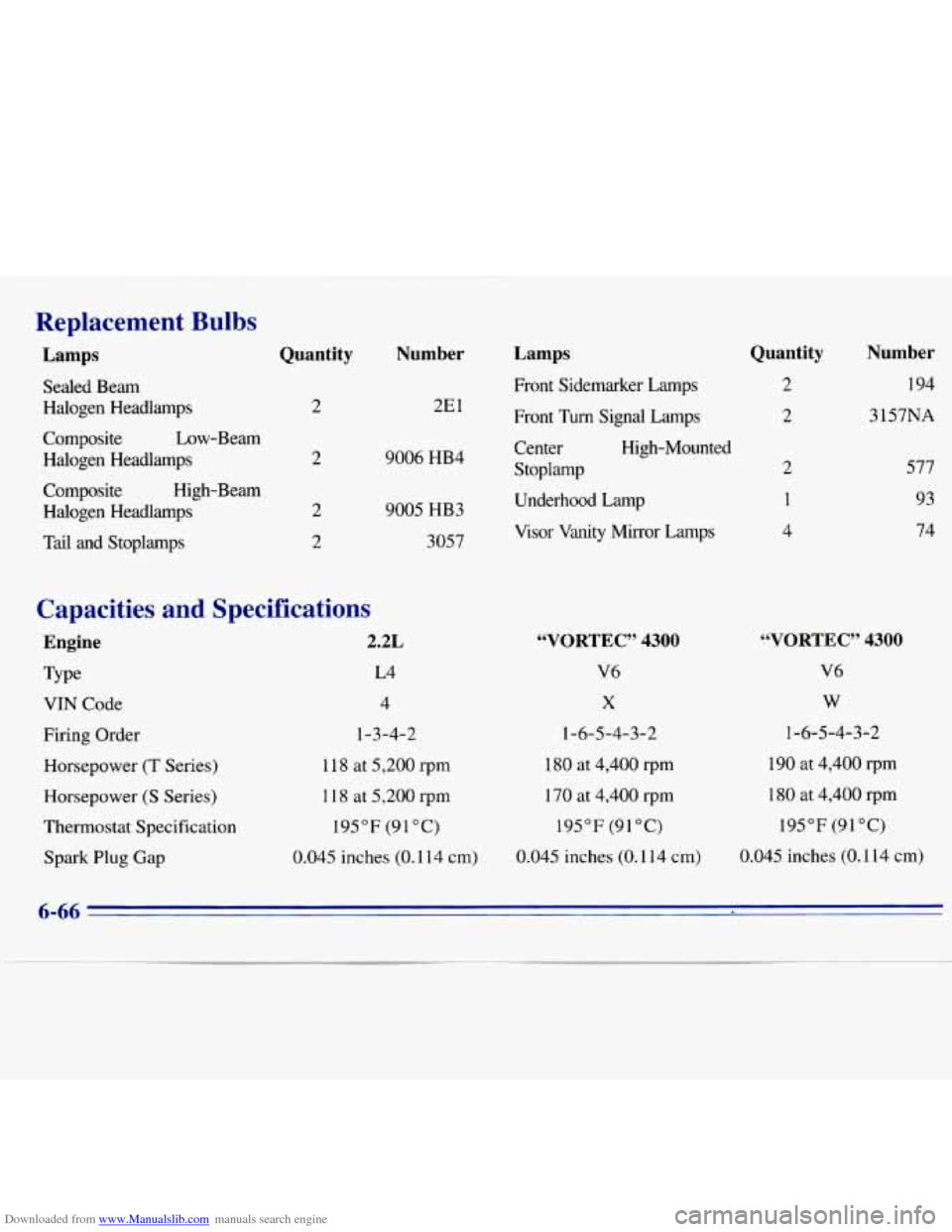
Downloaded from www.Manualslib.com manuals search engine Replacement Bulbs
Lamps
Sealed Beam Halogen Headlamps
Composite Low-Beam
Halogen Headlamps Composite High-Beam
Halogen Headlamps
Tail and Stoplamps
Quantity
2
2
2
2
Number
2El
9006 HB4
9005 HB3 3057
Capacities and Specifications
Type L4
Engine 2.2L
VIN Code 4
Firing Order 1-3-4-2
Horsepower
(T Series) 1 18 at 5,200 rpm
Horsepower
(S Series) 1 18 at 5,200 rpm
Thermostat Specification 195°F (91°C)
Spark
Plug Gap 0.045 inches
(0.1 14 cm)
Lamps
Front Sidemarker Lamps
Front Turn Signal Lamps
Center High-Mounted
Stoplamp
Underhood Lamp
Visor Vanity Mirror Lamps
“VORTEC” 4300
V6
X
1-6-5-4-3-2
180 at 4,400 rpm
170
at 4,400 rpm
195°F (91°C)
0.045 inches (0.114 cm)
Quantity
2
2
Number
194
3 157NA
577 93
74
“VORTEC” 4300
V6
W
1-6-5-4-3-2
190 at 4,400 rpm
180 at 4,400 rpm
195°F (91 “C)
0.045 inches (0.1 14 cm)
6-66
Page 347 of 375

Downloaded from www.Manualslib.com manuals search engine Part C: Periodic Maintenance
Inspections
Listed below are inspections and services which should
be perfowed at least twice a year (for instance, each
spring and fall). You should let your GM dealer’s
service department or other qualified service center do
these
jobs. Make sure any necessary repairs are
completed at once.
Proper procedures to perform these services may be
found in a service manual. See “Service and Owner
Publications’’ in the Index.
Steering and Suspension Inspection
Inspect the front and rear suspension and steering
system for damaged, loose or missing parts, signs of
wear or lack of lubrication. Inspect the power steering
lines and hoses for proper hook-up, binding, leaks,
cracks, chafing, etc.
Exhaust System Inspection
Inspect the complete exhaust system. Inspect the body near
the exhaust system. Look for broken, damaged, missing or
out-of-position parts
as well as open seams, holes, loose
connections or other conditions which could cause a heat
build-up in the floor pan or could let exhaust fumes into
the vehicle. See “Engine Exhaust” in the Index.
Radiator and Heater Hose Inspection
Inspect the hoses and have them replaced if they are
cracked, swollen or deteriorated; Inspect all pipes,
fittings and clamps; replace as needed.
Throttle Linkage Inspection
Inspect the throttle linkage for interference or binding,
and for damage or missing parts. Replace parts as
needed. Replace any cables that have high effort or
excessive wear.
Do not lubricate accelerator and cruise
control cables.
7-51