1996 CHEVROLET CORVETTE Fluid
[x] Cancel search: FluidPage 2 of 386
Downloaded from www.Manualslib.com manuals search engine n
The 1996 Corvette Owner’s Manual
Seats and Restraint Systems ............................................................... 1-1
This section tells you how to use your seats and safety belts properly. It also explains the air bag system.
Features and Controls .................................................................. 2-1
This section explains how to start and operate your Corvette.
Comfort Controls and Audio Systems ..................................................... 3-1
This section tells you how to adjust the ventilation and comfort controls and how to operate your
audio system.
Here you’ll find helpful information and tips about the road and how to drive under different conditions.
YourDrivingandtheRoad .............................................................. 4-1
ProblemsontheRoad .................................................................. 5-1
This section tells you what to do if you have a problem while driving, such as a flat tire or overheated
engine, etc.
Service and Appearance Care.. .......................................................... 6-1
Maintenanceschedule .................................................................. 7-1
Customer Assistance Information ........................................................ 8-1
Here the manual tells you how to keep your Corvette running properly and looking good.
This section tells you when to perform vehicle maintenance and what fluids and lubricants to use.
This section tells you how to contact Chevrolet for assistance and how to get service and owner publications.
It also gives you information on “Reporting Safety Defects” on page
8-9.
Index ........................................................................\
......... 9-1
Here’s an alphabetical listing of almost every subject in this manual. You can use it to quickly find
something you want to read.
i
Page 81 of 386
Downloaded from www.Manualslib.com manuals search engine Windshield Washer
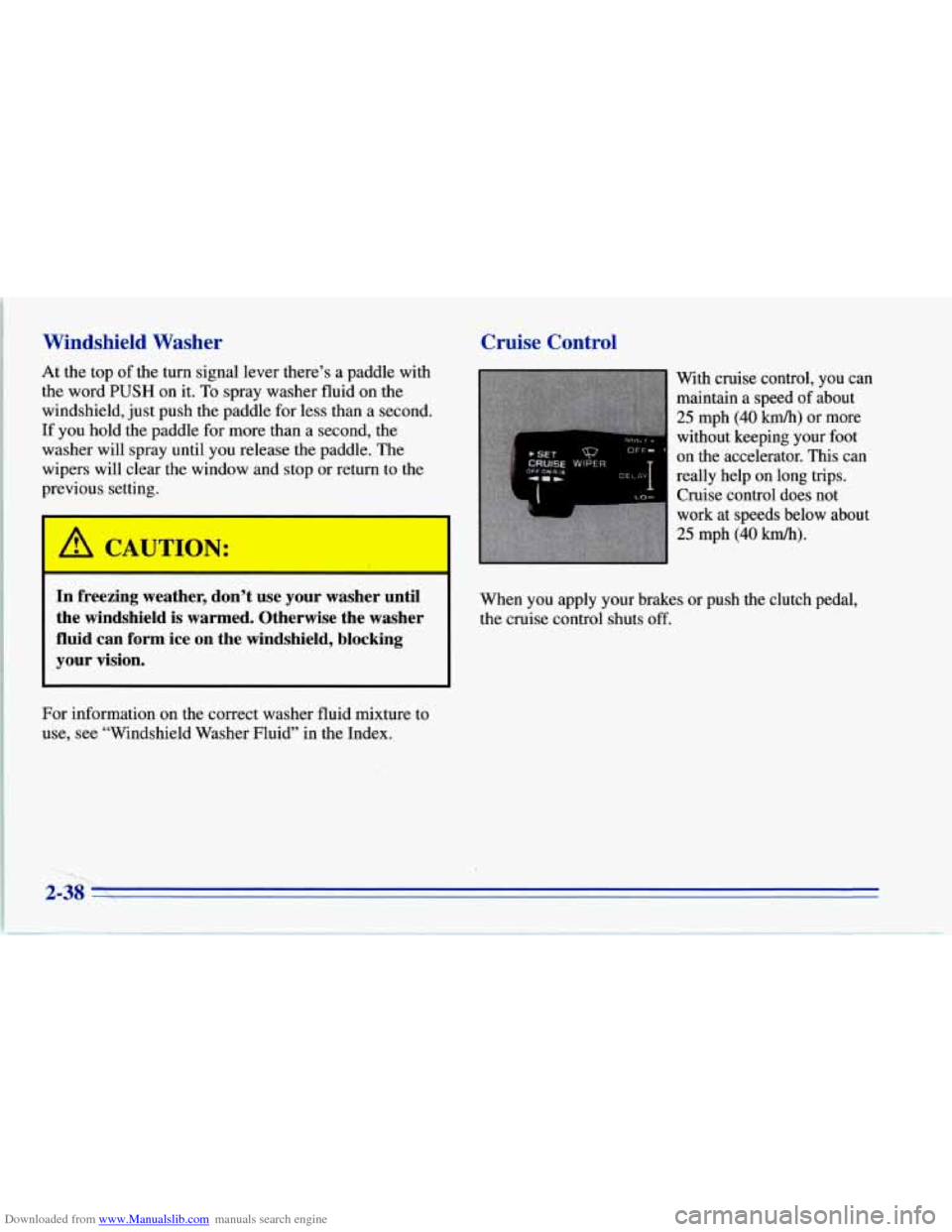
At the top of the turn signal lever there’s a paddle with
the word
PUSH on it. To spray washer fluid on the
windshield, just push the paddle for less than a second.
If you hold the paddle for more than a second, the
washer will spray until you release the paddle. The
wipers will clear the window and stop
or return to the
previous setting.
c
In freezing weather, don’t use your washer until
the windshield is warmed. Otherwise the washer
fluid can form ice on the windshield, blocking
your vision.
For information on the correct washer fluid mixture to
use, see “Windshield Washer Fluid” in the Index.
Cruise Control
t LU-
With cruise control, you can
maintain a speed of about
25 mph (40 km/h) or more
without keeping your foot
on the accelerator. This can
really help on long trips.
Cruise control does not
work at speeds below about
25 mph (40 km/h).
When you apply your brakes or push the clutch pedal,
the cruise control shuts
off.
Page 136 of 386
Downloaded from www.Manualslib.com manuals search engine Security Light Check Gauges Light
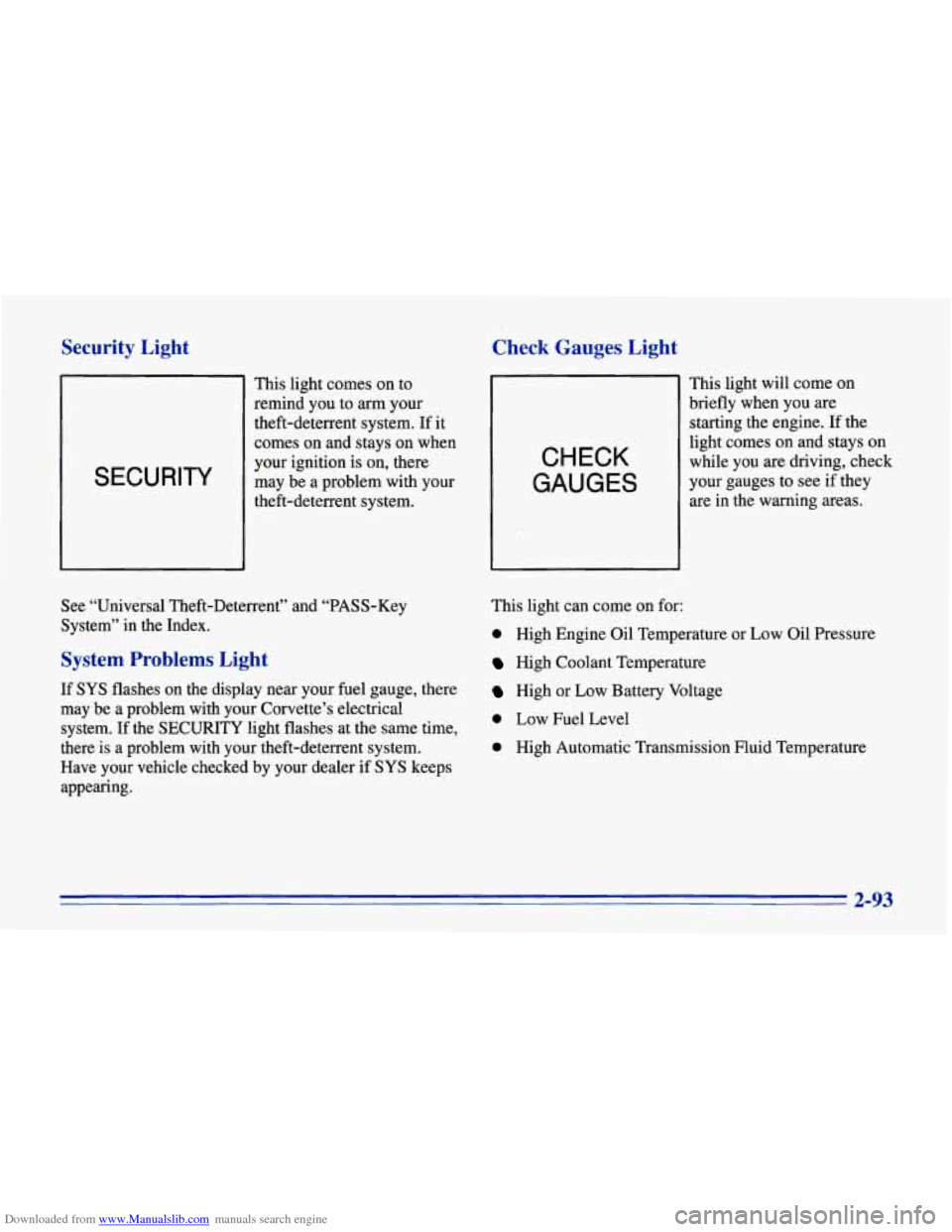
SECURITY
This light comes on to
remind you to
arm your
theft-deterrent system. If it
comes on and stays on when
your ignition is on, there
may be a problem with your
theft-deterrent system.
CHECK
GAUGES
This light will come on
briefly when you are
starting the engine.
If the
light comes on and stays on
while you are driving, check
your gauges to see if they
are in the warning areas.
See “Universal Theft-Deterrent” and “PASS-Key
System” in the Index.
System Problems Light
If SYS flashes on the display near your fuel gauge, there
may be a problem with your Corvette’s electrical
system. If the
SECURITY light flashes at the same time,
there is
a problem with your theft-deterrent system.
Have your vehicle checked by your dealer
if SYS keeps
appearing. This
light can come on for:
0 High Engine Oil Temperature or Low oil Pressure
High Coolant Temperature
High or Low Battery Voltage
0 Low Fuel Level
0 High Automatic Transmission Fluid Temperature
2-93
Page 140 of 386
Downloaded from www.Manualslib.com manuals search engine Automatic Transmission Fluid Temperature Reading
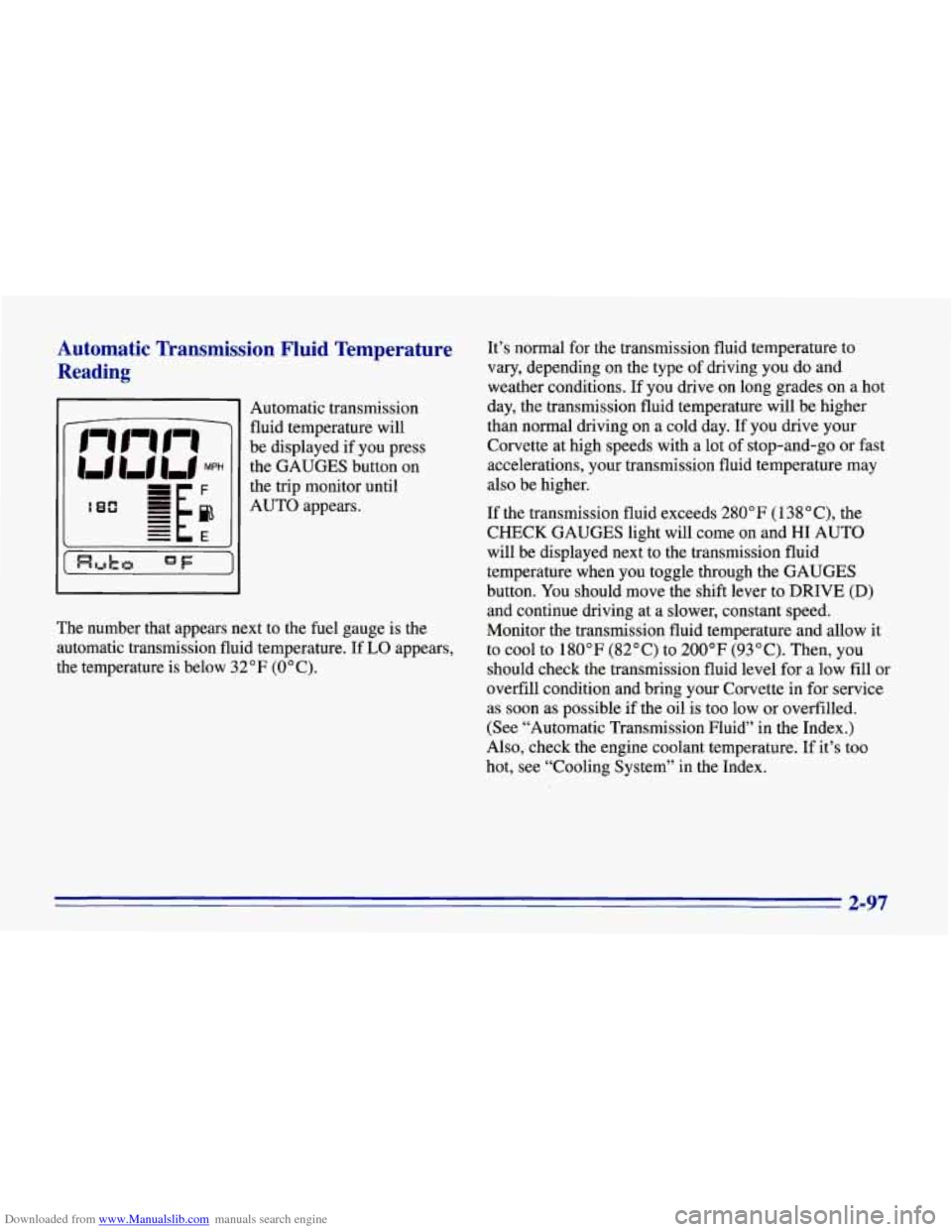
Automatic transmission
fluid temperature will
be displayed if you press
the GAUGES button on
the trip monitor until
AUTO appears.
The number that appears next to the fuel gauge is the
automatic transmission fluid temperature. If
LO appears,
the temperature is below 32°F (0°C). It’s
normal for the transmission fluid temperature to
vary, depending on the type
of driving you do and
weather conditions. If you drive on long grades on a hot
day, the transmission fluid temperature will be higher
than normal driving on a cold day. If you
drive your
Corvette at high speeds with a lot of stop-and-go or fast
accelerations, your transmission fluid temperature may
also be higher.
If the transmission fluid exceeds
280” F (1 38 “C), the
CHECK GAUGES light will come on and HI AUTO
will be displayed next to the transmission fluid
temperature when you toggle through the GAUGES
button. You should move the shift lever to DRIVE
(D)
and continue driving at a slower, constant speed.
Monitor the transmission fluid temperature and allow it
to cool to 180°F (82°C) to 200°F (93°C). Then, you
should check the transmission fluid level for a low fill or
overfill condition and bring your Corvette in for service
as soon as possible if the oil is too low or overfilled.
(See “Automatic Transmission Fluid” in the Index.)
Also, check the engine coolant temperature. If it’s too
hot, see “Cooling System” in the Index.
2-97
Page 178 of 386
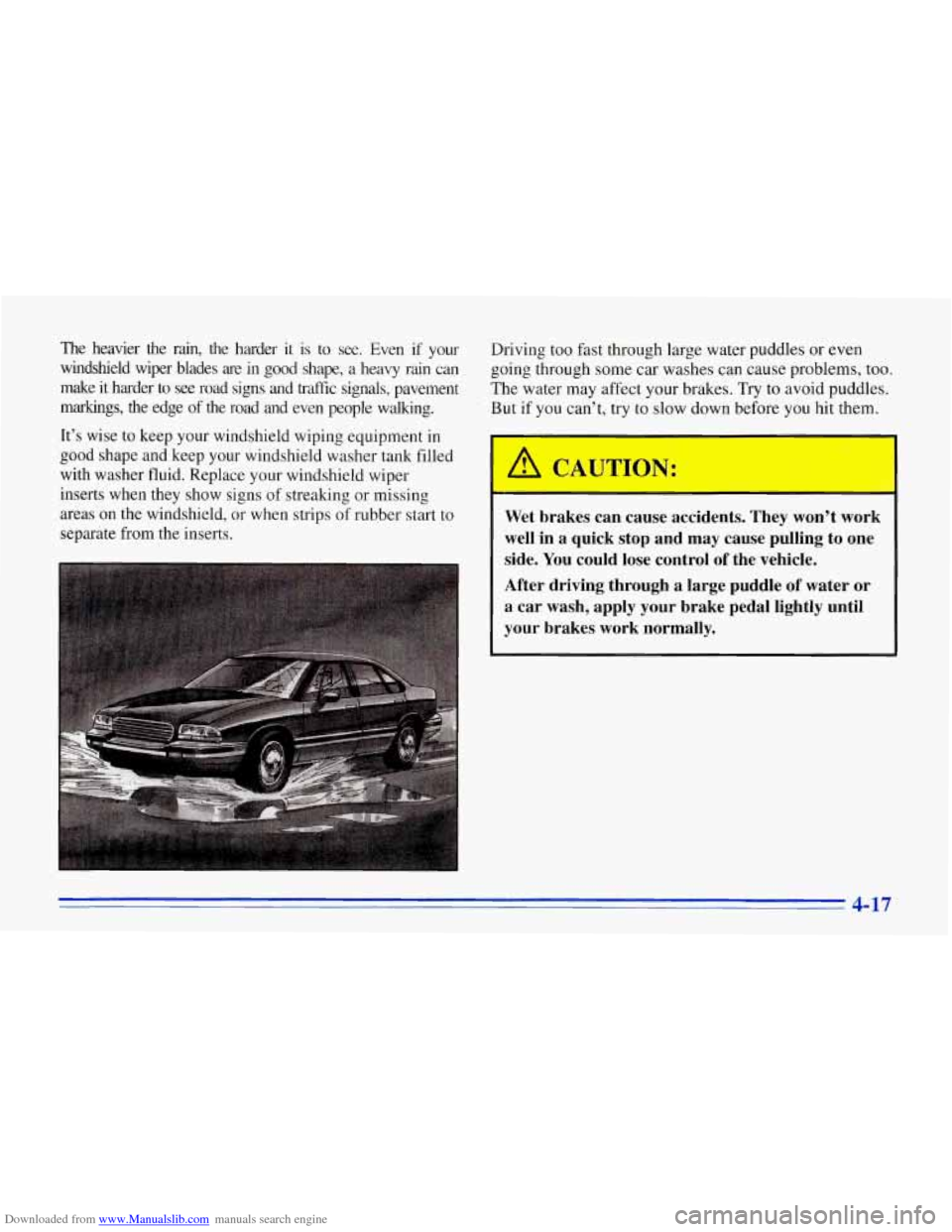
Downloaded from www.Manualslib.com manuals search engine The heavier the rain, the harder it is to see. Even if your Driving too fast through large water puddles or even
windshield wiper blades are in good shape, a heavy rain can
going through some car washes can cause problems, too.
make it harder to
see road signs and traffic signals, pavement The water may affect your brakes. Try to avoid puddles.
markings, the edge
of the road and even people walking. But if you can’t, try to slow down before you hit them.
It’s wise to keep your windshield wiping equipment in
good shape and keep your windshield washer tank filled
with washer fluid. Replace your windshield wiper
inserts when they show signs of streaking
or missing
areas on the windshield, or when strips of rubber start to
separate from the inserts.
I
Wet brakes can cause accidents. They won’t work
well in a quick stop and may cause pulling to one
side. You could lose control of the vehicle.
After driving through a large puddle of water or a car wash, apply your brake pedal lightly until
~ 1 your brakes work normally.
Page 182 of 386
Downloaded from www.Manualslib.com manuals search engine Once you are moving on the freeway, make certain you
allow a reasonable following distance. Expect to move
slightly slower at night.
When you want to leave the freeway, move to the proper
lane well in advance.
If you miss your exit, do not,
under any circumstances, stop and back up. Drive on to
the next exit.
The exit ramp can be curved, sometimes quite sharply.
The exit speed is usually posted. Reduce your speed according to your speedometer,’ not
to your sense of motion. After driving for any distance
at higher speeds, you may tend to think you
are going
slower than you actually are.
Before Leaving on a Long Trip
Make sure you’re ready. Try to be well rested. If you
must start when you’re not fresh
-- such as after a day’s
work
-- don’t plan to make too many miles that first part
of the journey. Wear comfortable clothing and shoes you
can easily drive in.
Is your vehicle ready for a long trip? If you keep it
serviced and maintained, it’s ready to go. If it needs
service, have it done before starting out. Of course,
you’ll find experienced and able service experts in
Corvette dealerships all across North America. They’ll
be ready and willing to help if you need it.
Here are some things you can check before a trip:
0
0
0
0
0
0
0
Windshield Washer Fluid: Is the reservoir full?
Are all windows clean inside and outside?
Wiper Blades: Are they in good shape?
Fuel, Engine Oil, Other Fluids: Have you checked
all levels?
Lamps: Are they all working? Are the lenses clean?
Tires: They are vitally important to a safe,
trouble-free trip. Is the tread good enough
for
long-distance driving? Are the tires all inflated to the
recommended pressure?
Weather Forecasts: What’s the weather outlook
along your route? Should you delay your trip a short
time to avoid a major storm system?
Maps: Do you have up-to-date maps?
4-21 ,
Page 184 of 386
Downloaded from www.Manualslib.com manuals search engine If you drive regularly in steep country, or if you’re
planning to visit there, here are some tips that can make
your trips safer and more enjoyable.
0
0 Keep your vehicle in good shape. Check all fluid
levels and also the brakes, tires, cooling system and
transmission. These parts can work hard on
mountain roads.
Know how to
go down hills. The most important
thing to know is this: let your engine do some of the
slowing down. Shift
to a lower gear when you go
down a steep or long hill.
I
If you don’t shift down, your brakes could get so
hot that they wouldn’t work well. You would then
have poor braking or even none going down a hill.
You could crash. Shift down to let your engine
assist your brakes on a steep downhill slope.
’ A CAUTION:
I
Coasting downhill in NEUTRAL (N) or with the
ignition
off is dangerous. Your brakes will have to
do all the work of slowing down. They could get
so
hot that they wouldn’t work well. You would then
have poor braking or even none going down a
hill.
You could crash. Always have your engine running
and your vehicle
in gear when you go downhill.
Know how to go uphill. You may want to shift down
to a lower gear. The lower gears help cool your engine
and transmission, and you can climb the
hill better.
Stay in your own lane when driving on two-lane
roads in hills or mountains. Don’t swing wide or cut
across the center of the road. Drive at speeds that let
you stay in your own lane.
something
in your lane, like a stalled car or an accident,
As you go over the top of a hill, be alert. There could be
0 You may see highway signs on mountains that warn of
special problems. Examples are long grades, passing or
no-passing zones, a falling rocks area or windmg
roads. Be
alert to these and take appropriate action.
4-23
Page 185 of 386
Downloaded from www.Manualslib.com manuals search engine Winter Driving
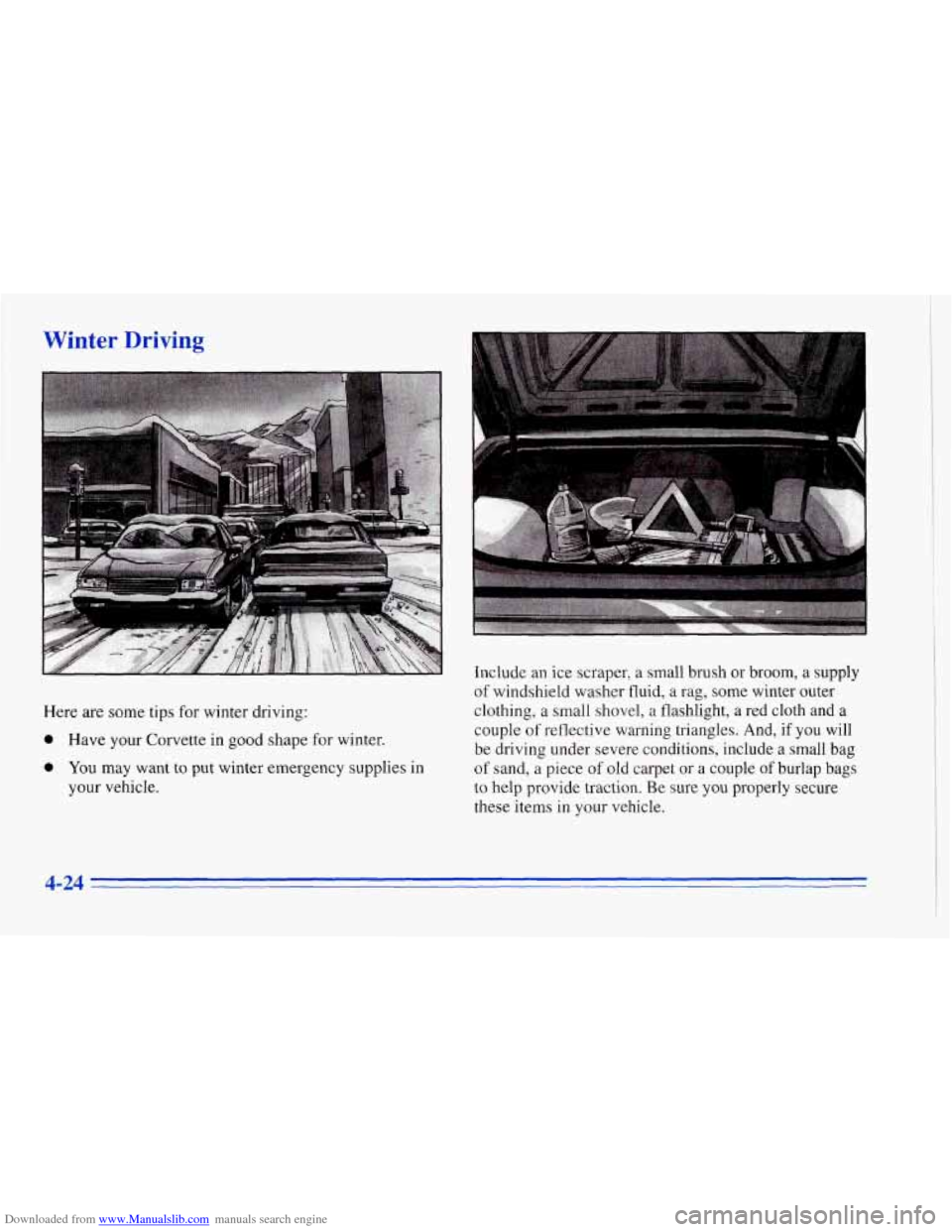
Here are some tips for winter driving:
0 Have your Corvette in good shape for winter.
0 You may want to put winter emergency supplies in
your vehicle. Include
an ice scraper, a small brush or broom,
a supply
of windshield washer
fluid, a rag, some winter outer
clothing, a small shovel, a flashlight, a red cloth and a
couple of reflective warning triangles. And,
if you will
be driving under severe conditions, include a small bag
of sand, a piece of old carpet or a couple of burlap bags
to help provide traction. Be sure you properly secure
these items in your vehicle.
4-24