Page 195 of 386
Downloaded from www.Manualslib.com manuals search engine Be sure the battery has enough water. You don’t
need to add water to the Delco Freedom@ battery
installed in every new
GM vehicle. But if a battery
has filler caps, be sure the right amount of fluid
is
there. If it is low, add water to take care of that
first.
If you don’t, explosive gas could be present.
Battery fluid contains acid that can burn you.
Don’t get
it on you. If you accidentally get it in
your eyes
or on your skin, flush the place with
water and get medical help immediately.
5. Check that the jumper cables don’t have loose or
missing insulation. If they do,
you could get a shock.
The vehicles could be damaged, too.
Fans or other moving engine parts can injure you
badly. Keep your hands away from moving parts
once the engines are running.
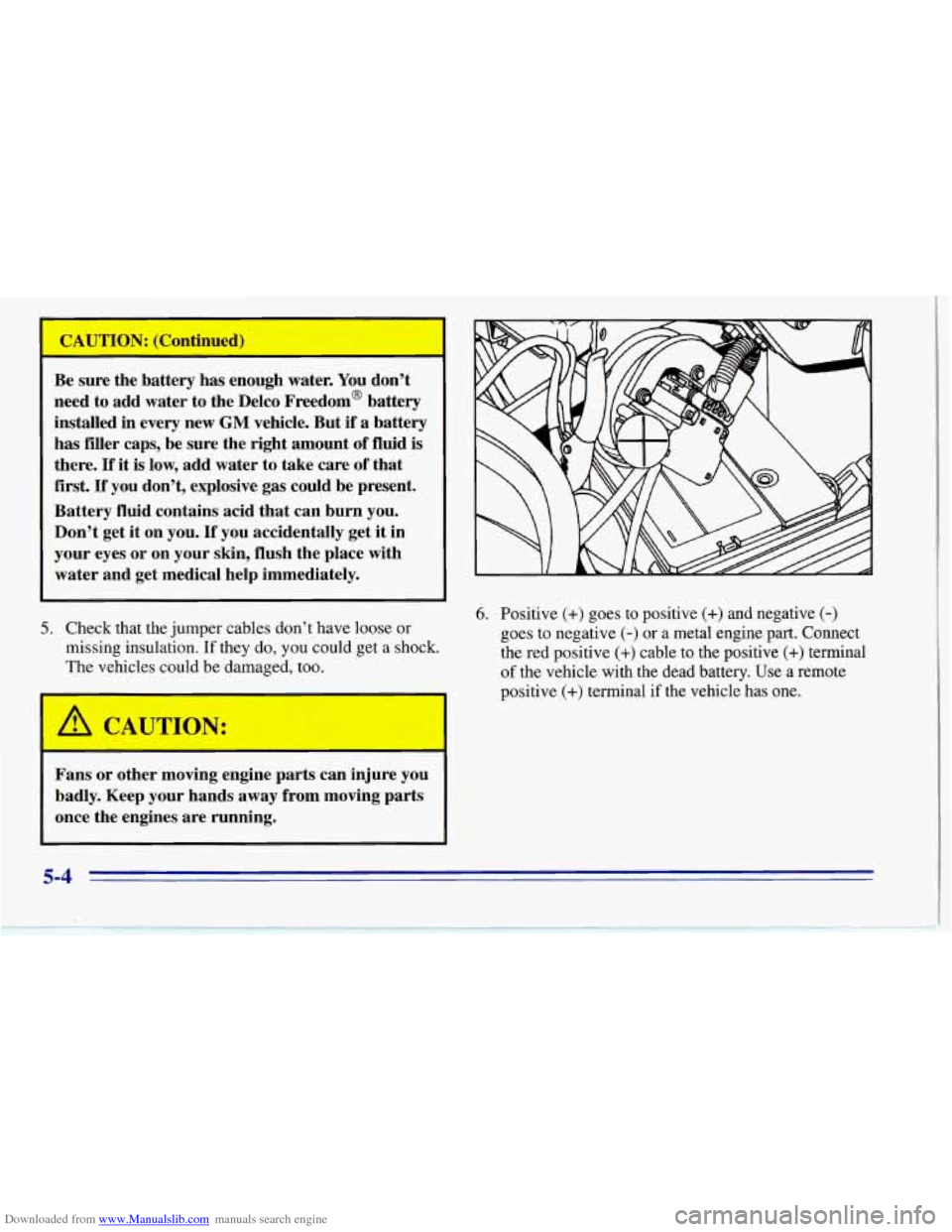
6. Positive (+) goes to positive (+) and negative (-)
goes to negative (-) or a metal engine part. Connect
the red positive
(+) cable to the positive (+) terminal
of the vehicle with the dead battery. Use a remote
positive
(+) terminal if the vehicle has one.
Page 232 of 386
Downloaded from www.Manualslib.com manuals search engine e Section 6 Service and Appearance Care
Here you will find information about the care of your
Corvette. This section begins with service and fuel
information, and then it shows how to check important
fluid and lubricant levels. There is also technical
information about your vehicle, and a part devoted to its
appearance care.
Service
Your Corvette dealer knows your vehicle best and wants
you to be happy with it. We hope you’ll go to your
dealer for all your service needs. You’ll get genuine GM
parts and GM-trained and supported service people. We
hope you’ll want to keep your GM vehicle all GM.
Genuine GM parts have one
of these marks:
n
Delco
6-1
Page 239 of 386
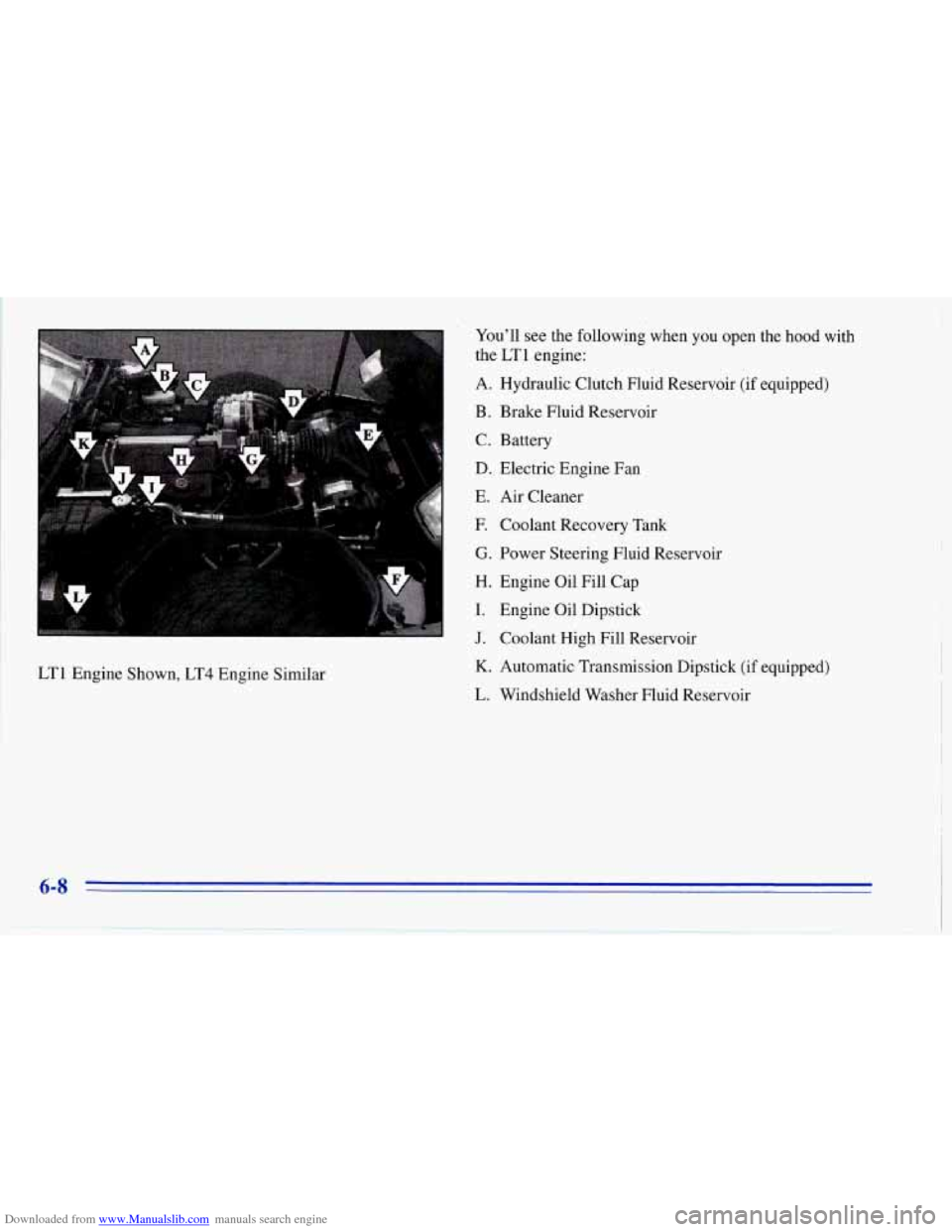
Downloaded from www.Manualslib.com manuals search engine LT1 Engine Shown, LT4 Engine Similar You’ll
see the following when you open the hood with
the
LT1 engine:
A. Hydraulic Clutch Fluid Reservoir
(if equipped)
B. Brake Fluid Reservoir
C. Battery
D. Electric Engine Fan
E. Air Cleaner
E Coolant Recovery Tank
G. Power Steering Fluid Reservoir
H. Engine Oil Fill Cap
I. Engine Oil Dipstick
J. Coolant High Fill Reservoir
K. Automatic Transmission Dipstick (if equipped)
L. Windshield Washer Fluid Reservoir
6-8
Page 240 of 386
Downloaded from www.Manualslib.com manuals search engine I
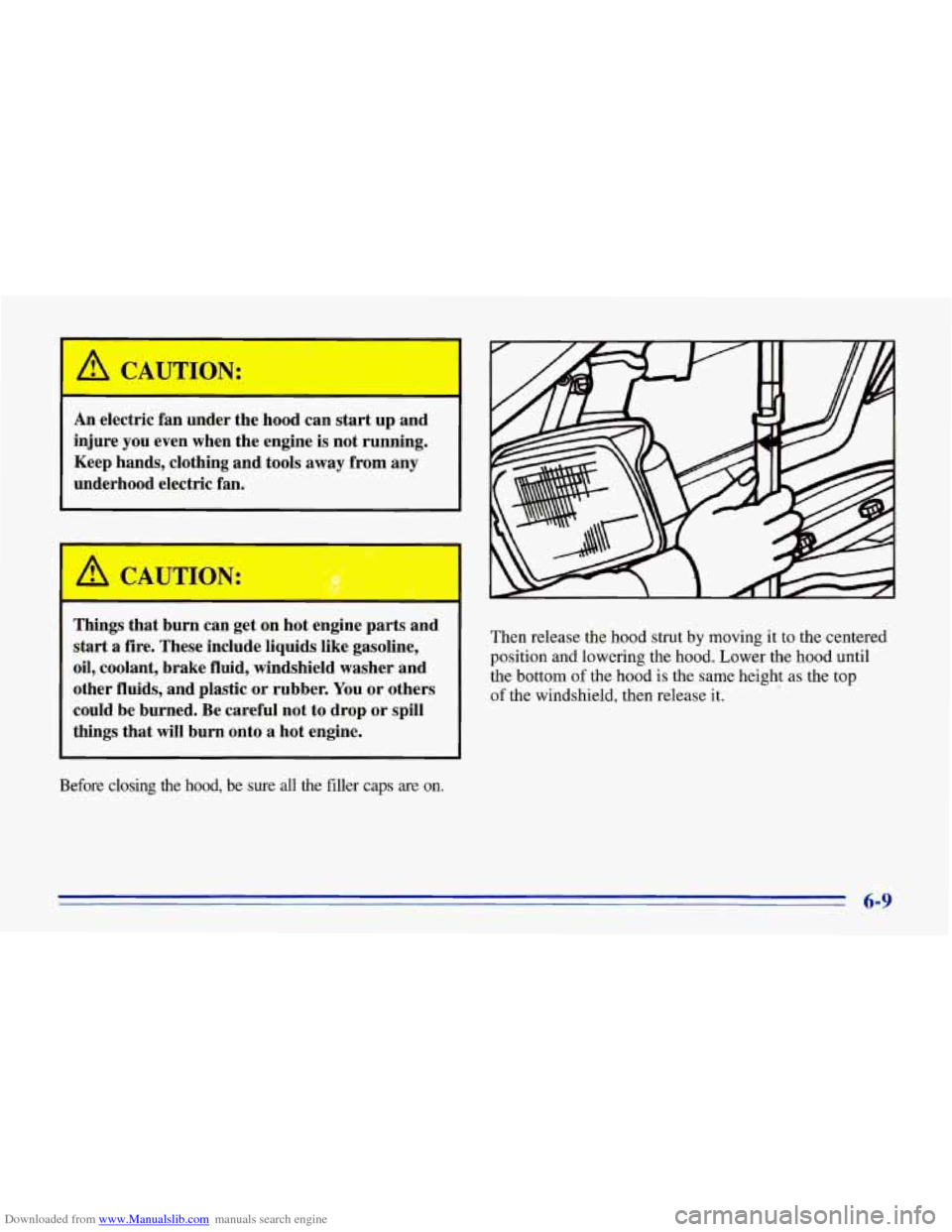
An electric fan under the hood can start up and
injure you even when the engine is not running.
Keep hands, clothing and tools away from any
underhood electric fan.
Things that burn can get on hot engine parts and
start a fire. These include liquids like gasoline,
oil, coolant, brake fluid, windshield washer and
other fluids, and plastic or rubber. You or others
could be burned. Be careful not to drop or spill
things that will burn onto
a hot engine.
Before closing the hood, be sure all the filler caps are
on.
Then release the hood strut by moving it to the centered
position and lowering the hood. Lower the hood until
the bottom
of the hood is the same height as the top
of the windshield, then release it.
6-9
Page 249 of 386
Downloaded from www.Manualslib.com manuals search engine Automatic Transmission Fluid
When to Check and Change
A good time to check your automatic transmission fluid
level is when the engine oil is changed.
Change both the fluid and filter every
15,000 miles
(25 000 km) if the vehicle is mainly driven under one or
more of these conditions:
In heavy city traffic where the outside temperature
In hilly or mountainous terrain.
Uses such as found in taxi, police or delivery service.
If you do not use your vehicle under any of these
conditions, change the fluid and filter at
100,000 miles
(166 000 km).
See “Scheduled Maintenance Services” in the Index.
How to Check
Because this operation can be a little difficult, you
may choose to have this done at your Corvette
dealership Service Department.
regularly
reaches 90
OF (32 O C) or higher.
If you do it yourself, be sure to follow all the instructions
here, or you could get
a false reading on the dipstick.
I NOTICE:
Too much or too little fluid can damage your
transmission.
Too much can mean that some of
the fluid could come out and fall on hot engine
parts or exhaust system parts, starting a fire. Be
sure to get an accurate reading if you check your
transmission fluid.
Wait at least 30 minutes before checking the
transmission fluid level if you have been driving:
0 When outside temperatures are above 90°F (32°C).
0 At high speed for quite a while.
In heavy traffic -- especially in hot weather.
To get the right reading, the fluid should be at normal
operating temperature, which is
180°F to 200°F
(82°C to 93°C).
Page 250 of 386
Downloaded from www.Manualslib.com manuals search engine Checking lkansmission Fluid Hot
Get the vehicle warmed up by driving about 15 miles
(24
km) when outside temperatures are above 50°F
(10°C). You may have to drive longer to bring the fluid
to 180°F to 200°F (82°C to 93°C) in colder outside
temperatures. See “Automatic Transmission Fluid
Temperature Reading” in the Index.
Checking Transmission Fluid Cold
A cold check is made after the vehicle has been sitting
for eight hours or more with the engine
off and is used
only as a reference. Let the engine run at idle for five
minutes
if outside temperatures are 50°F (10°C) or
more. If it’s colder than 50°F (lO”C), you may have to
idle the engine longer. Should the fluid level be low
during a cold.check, you
must perform a hot check
before adding fluid. This will give you a more accurate
reading of the fluid level.
Checking the Fluid Hot or Cold
0 Park your vehicle on a level place. Keep the engine
0 With the parking brake applied, place the shift lever
running.
in
PARK (P).
0 With your foot on the brake pedal, move the shift
lever through each gear range, pausing for about
three seconds in each range. Then, position the shift lever in, PARK
(P) .
Let the engine run at idle for three minutes or more.
6-19
Page 251 of 386
Downloaded from www.Manualslib.com manuals search engine I
Then, without shutting off the engine, follow these
steps:
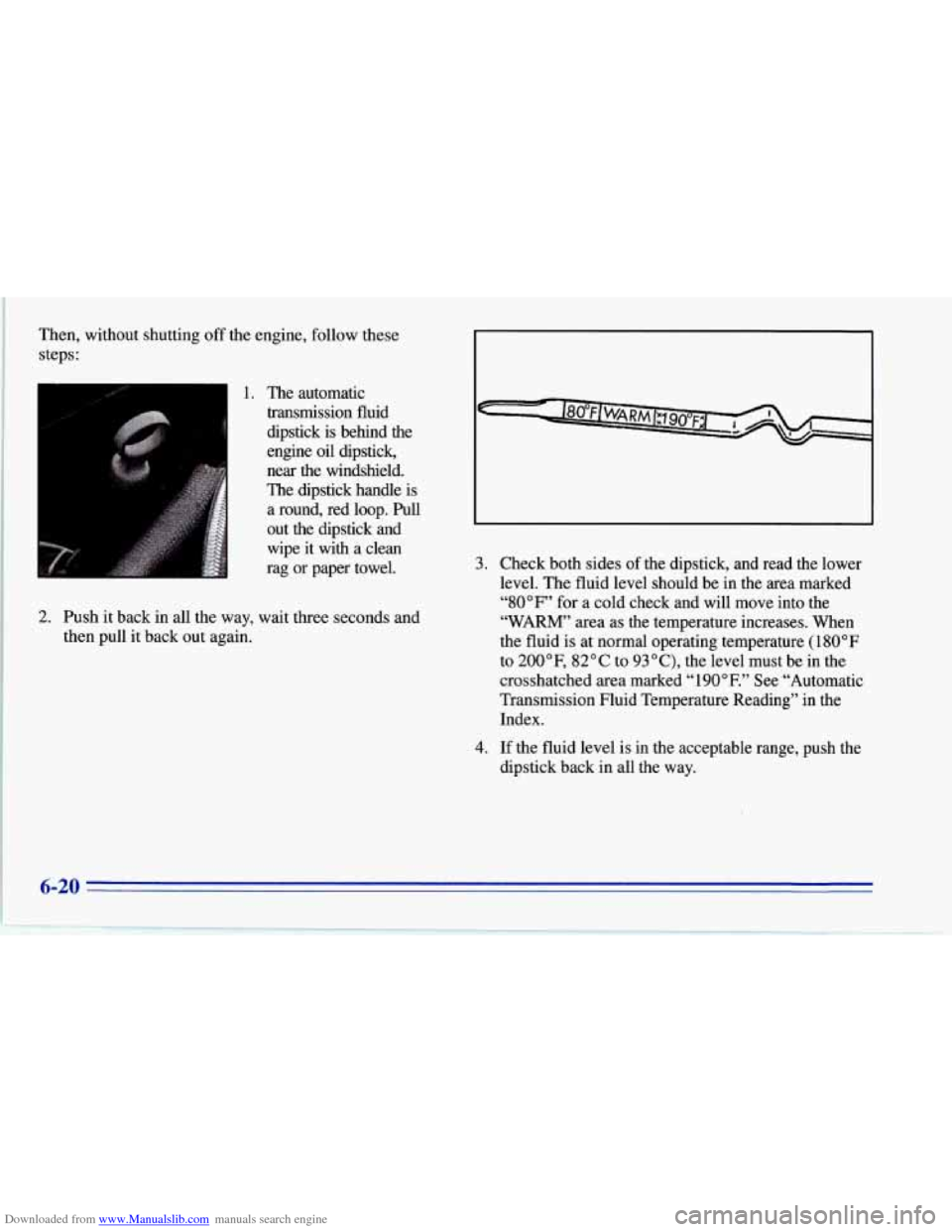
1. The automatic
transmission fluid dipstick is behind the
engine oil dipstick,
ne&- the windshield.
The dipstick handle is a round, red loop.
Pull
out the dipstick and wipe it with a clean
rag or paper towel.
2. Push it back in all the way, wait three seconds and
then pull it back out again. 3.
Check both sides
of the dipstick, and read the lower
level. The fluid level should be in the area marked
“80°F” for a cold check and will move into the
“WARM” area as the temperature increases. When
the fluid
is at normal operating temperature (180°F
to 200”F, 82°C to 93”C), the level must be in the
crosshatched area marked
“ 190°F.’’ See “Automatic
Transmission Fluid Temperature Reading” in the
Index.
4. If the fluid level is in the acceptable range, push the
dipstick back in all the way.
6-20
Page 252 of 386
Downloaded from www.Manualslib.com manuals search engine How to Add Fluid
Refer to the Maintenance Schedule to determine what
kind of transmission fluid to use. See “Recommended
Fluids and Lubricants” in the Index.
Add fluid only after checking the transmission fluid
HOT.
(A COLD check is used only as a reference.) If
the fluid level is low, add only enough of the proper
fluid to bring the level up to the
HOT area for a hot
check. It doesn’t take much fluid, generally less than a
pint
(0.5 L). Don’t overfill. We recommend you use only
fluid labeled DEXRON@-111, because fluid with that
label is made especially for your automatic transmission.
Damage caused by fluid other than DEXRON-I11 is not
covered by your new vehicle warranty.
0 After adding fluid, recheck the fluid level as
described under “How to Check.”
When the correct fluid level is obtained, push the
dipstick back in all the way.
Manual Transmission Fluid
When to Check
A good time to have it checked is when the engine oil is
changed. However, the fluid in your manual
transmission doesn’t require changing.
How to Check
Because this operation can be difficult, you may
choose to have
this done at your Corvette dealership
Service Department.
If you do it yourself, be sure to follow all the
instructions here, or you could get a false reading.
NOTICE:
Too much or too little fluid can damage your
transmission.
Too much can mean that some of
the fluid could come out and fall on hot engine
parts or exhaust system parts, starting a fire. Be
sure to get an accurate reading
if you check your
transmission fluid.
Check the fluid level only when your engine is off, the
vehicle is parked on a level place and the transmission
is
cool enough for you to rest your fingers on the
transmission case.
6-21