1996 CHEVROLET CORVETTE fuel type
[x] Cancel search: fuel typePage 133 of 386
Downloaded from www.Manualslib.com manuals search engine Engine Oil Temperature Gauge
320
OIL TEMP OF
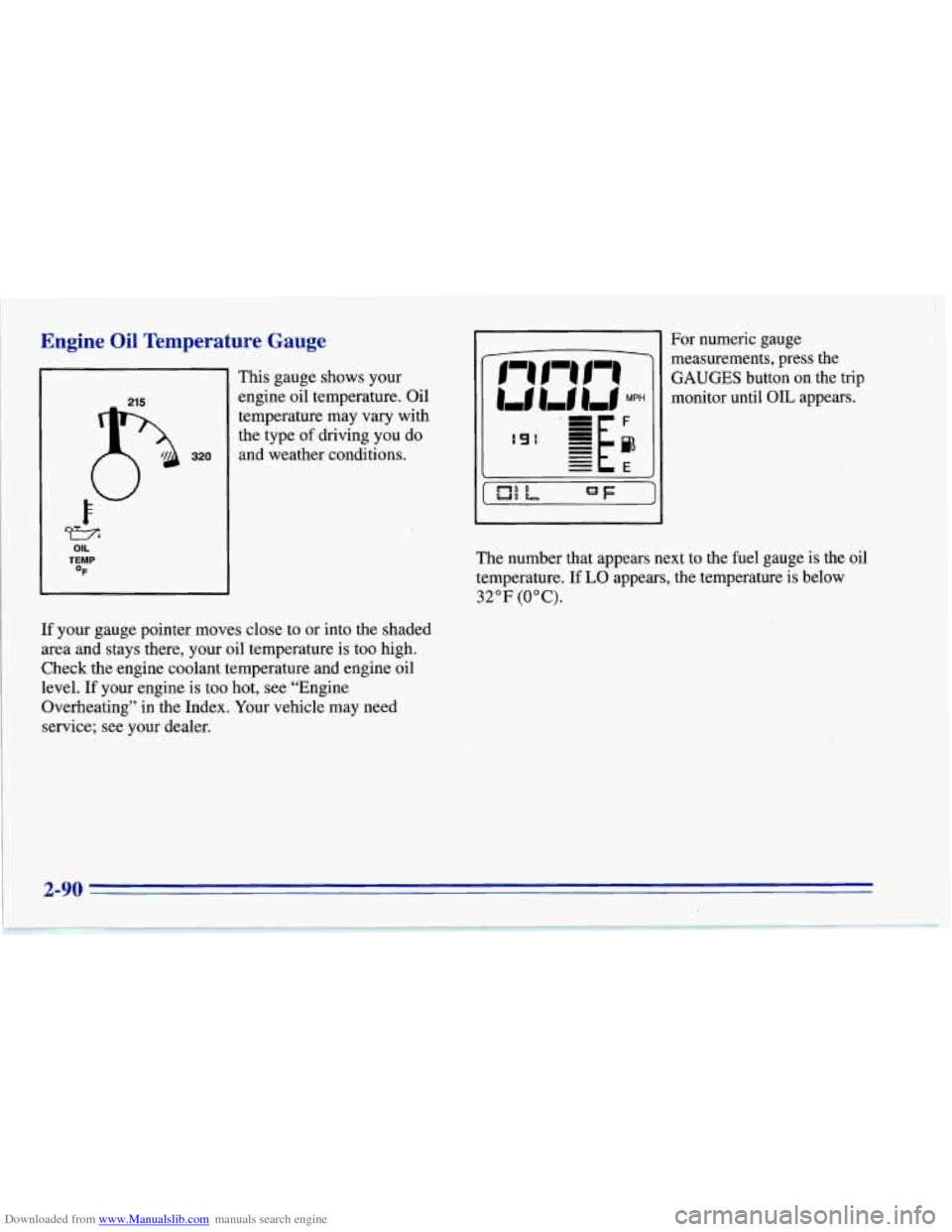
This gauge shows your
engine oil temperature. Oil
temperature may vary with
the type
of driving you do
and weather conditions.
If your gauge pointer moves close to or into the shaded
area and stays there, your oil temperature is too high.
Check the engine coolant temperature and engine oil
level.
If your engine is too hot, see “Engine
Overheating” in the Index. Your vehicle may need
service; see your dealer.
I,
For numeric gauge
measurements, press the GAUGES button on the trip
monitor until
OIL appears.
The number that appears next to the fuel gauge is the oil
temperature.
If LO appears, the temperature is below
32°F (OOC).
2-90
Page 140 of 386
Downloaded from www.Manualslib.com manuals search engine Automatic Transmission Fluid Temperature Reading
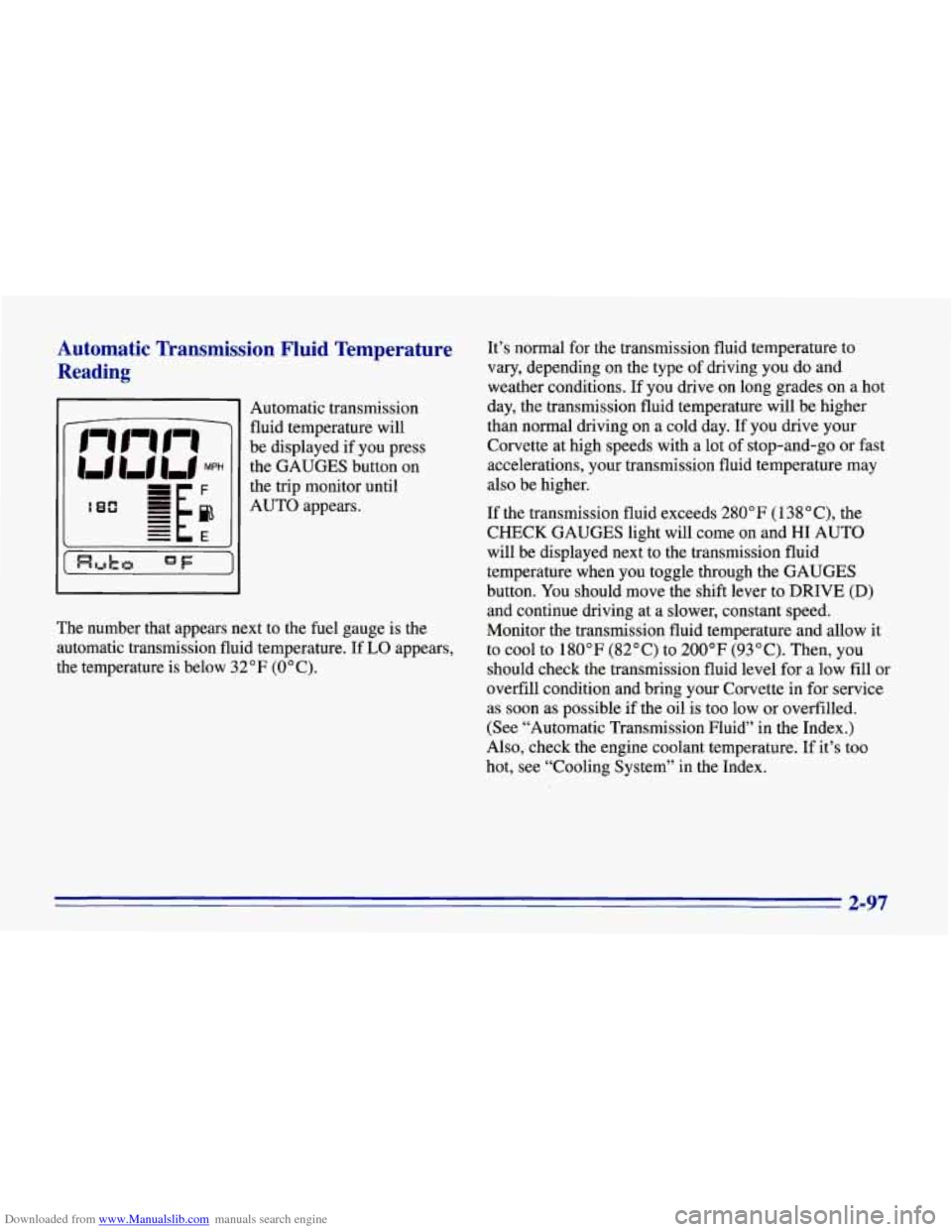
Automatic transmission
fluid temperature will
be displayed if you press
the GAUGES button on
the trip monitor until
AUTO appears.
The number that appears next to the fuel gauge is the
automatic transmission fluid temperature. If
LO appears,
the temperature is below 32°F (0°C). It’s
normal for the transmission fluid temperature to
vary, depending on the type
of driving you do and
weather conditions. If you drive on long grades on a hot
day, the transmission fluid temperature will be higher
than normal driving on a cold day. If you
drive your
Corvette at high speeds with a lot of stop-and-go or fast
accelerations, your transmission fluid temperature may
also be higher.
If the transmission fluid exceeds
280” F (1 38 “C), the
CHECK GAUGES light will come on and HI AUTO
will be displayed next to the transmission fluid
temperature when you toggle through the GAUGES
button. You should move the shift lever to DRIVE
(D)
and continue driving at a slower, constant speed.
Monitor the transmission fluid temperature and allow it
to cool to 180°F (82°C) to 200°F (93°C). Then, you
should check the transmission fluid level for a low fill or
overfill condition and bring your Corvette in for service
as soon as possible if the oil is too low or overfilled.
(See “Automatic Transmission Fluid” in the Index.)
Also, check the engine coolant temperature. If it’s too
hot, see “Cooling System” in the Index.
2-97
Page 234 of 386
Downloaded from www.Manualslib.com manuals search engine Fuel
If you have the 5.7L Code 5 engine, use premium
unleaded gasoline rated at
91 octane or higher.
If you have the 5.7L Code
P engine, use premium
unleaded gasoline rated at 91 octane or higher for best
performance. You may use middle grade
or regular
unleaded gasolines, but your vehicle may not accelerate
as well.
At a minimum, the gasoline you use should meet
specifications ASTM D4814 in the United States and
CGSB 3.5-M93
in Canada. Improved gasoline
specifications have been developed by the American
Automobile Manufacturers Association (AAMA) for
better vehicle performance and engine protection.
Gasolines meeting the AAMA specification could
provide improved driveability and emission control
system protection compared to other gasolines.
Be sure the posted octane for premium is at least 91
(at least 89 for middle grade and
87 for regular). If the
octane is less than 87, you may get a heavy knocking
noise when you drive. If it’s bad enough, it can damage
your engine.
If you’re using fuel rated at the recommended octane or
higher and you still hear heavy knocking, your engine
needs service. But don’t worry if you hear
a little
pinging noise when you’re accelerating or driving up a
hill. That’s normal, and you don’t have to buy a higher
octane fuel to get rid of pinging, It’s the heavy, constant
knock that means you have a problem.
If your vehicle
is certified to meet California Emission
Standards (indicated on the underhood tune-up label),
it
is designed to operate on fuels that meet California
specifications. If such fuels are not available in states
adopting California emissions standards, your vehicle
will operate satisfactorily on fuels meeting federal
specifications, but emission control system performance
may be affected. The malfunction indicator lamp on
your instrument panel may turn on and/or your vehicle
may fail a smog-check test. If this occurs, return to your
authorized Corvette dealer for diagnosis to determine
the cause of failure. In the event it is determined that the
cause of the condition is the type of fuels used, repairs
may not be covered by your warranty.
6-3
Page 237 of 386
Downloaded from www.Manualslib.com manuals search engine /rl CAUTION:
If you get gasoline on yourself and then
something ignites it, you could be badly burned.
Gasoline can spray out on you
if you open the
,fuel filler cap too quickly. This spray can happen
if your tank is nearly full, and is more likely in
hot weather. Open the fuel filler cap slowly and
wait for any “hiss” noise to stop. Then unscrew
the cap all the way.
Be careful not to spill gasoline. Clean gasoline from
painted surfaces as soon as possible. See “Cleaning the
Outside of Your Corvette” in the Index. When you put
the cap back
on, turn it to the right until
you hear at least three clicks. Make sure
you fully install
the cap. The diagnostic system can determine
if the fuel
cap has been left
off or improperly installed. This would
allow fuel to evaporate into the atmosphere. See
“Malfunction Indicator Lamp” in the Index.
NOTICE:
If you need a new cap, be sure to get the right
type. Your dealer can get one for you.
If you get
the wrong type, it may not fit or have proper
. venting, and your fuel tank and emissions system
might be damaged.
6-6
sr
Page 279 of 386
Downloaded from www.Manualslib.com manuals search engine If a tire goes flat, you won’t need to stop on the side of
the road to change the tire.
You can just keep on driving.
The shorter the distance you drive and the slower the
speed, the greater the chance that the tire will not have
to be replaced. If you drive on a deflated EMT for
distances of
50 miles (80 km) or less and at speeds of
55 mph (90 km/h) or less, there is a good chance that the
tire can be repaired. The tire can operate effectively with
no air pressure for up to 200 miles (320 km) at speeds
up to
55 mph (90 km/h), but the tire would then have to
be replaced. Also remember: When a tire is filled with
air, it provides a cushion between the road and the
wheel. Because you do not have this cushion when
driving on a deflated tire, try to avoid potholes that
could damage your wheel and require replacement of it.
Some road hazards can damage a
tire beyond repair. This
damage could occur before you’ve driven on the tire in a
deflated condition. Whenever a tire has been damaged, or
if you’ve driven any distance on a deflated
EMT, check
with a Goodyear EMT Service Center to determine
whether the tire can be repaired or should be replaced. To
maintain your vehicle’s extended mobility feature,
all
replacement tires must be Extended Mobility Tires.
See the Goodyear Extended Mobility Tire Owner’s
Manual and Limited Warranty supplied with your
Corvette for additional information.
Inflation -- Tire Pressure
The Tire-Loading Information label, which is on
the rear edge of the driver’s door, shows the correct
inflation pressures for your tires when they’re cold.
“Cold” means your vehicle has been sitting for at least
three hours or driven no more than
1 mile (1.6 km).
For competitive driving or high-speed driving (over
150 mph or 240 km/h), make sure your tires are inflated
to 35 psi
(240 kPa). When you end this type of driving,
reduce the cold inflation pressures (if necessary) to those
listed on the Tire-Loading Information label.
I NOTICE:
Don’t let anyone tell you that underinflation or
overinflation is all right. It’s not. If your tires
don’t have enough air (underinflation), you can get the following:
0 Too much flexing
Too much heat
0 Tire overloading
0 Bad wear
0 Bad handling
Bad fuel economy.
NOTICE: (Continued)
Page 305 of 386

Downloaded from www.Manualslib.com manuals search engine Capacities and Specifications
Type ................................................................... V8
VIN Engine Code
LT1
................................................................... P
LT4 .................................................................... 5
Fuel Delivery ............................... Sequential Multiport Fuel Injection (SFI)
Valve Arrangement ............................................. Overhead Valve
Piston Displacement. ............................................ 350 CID (5.7L)
Bore
.................................................. 4.00 inches (101.6 mm)
Stroke .................................................. 3.48 inches (88.39 mm)
Compression Ratio LTl
............................................................. 10.5: 1
LT4 ................................................ .......... 10.67: 1
LT1, ................................................................. 300
LT4
................................................................. 330
Firing Order
................................................... 1-8-4-3-6-5-7-2
Thermostat Temperature Specification
............................... 180°F (82°C)
Horsepower
6-74