Page 159 of 386
Downloaded from www.Manualslib.com manuals search engine Understanding Radio Reception
FM, Stereo
FM stereo will give you the best sound. But FM signals
will reach only about
10 to 40 miles (16 to 65 km). Tall
buildings or hills can interfere with FM signals, causing
the sound to come and go.
AM
The range for most AM stations is greater than for FM,
especially at night. The longer range, however, can
cause stations to interfere with each other.
AM can pick
up noise from things like storms and power lines. Try
reducing the treble to reduce this noise if you ever get it,
Tips About Your Audio System
Hearing damage from loud noise is almost undetectable
until it is too late. Your hearing can adapt to higher
volumes
of sound. Sound that seems normal can be loud
and harmful to your hearing. Take precautions by
adjusting the volume control on your radio to a safe
sound level before your hearing adapts to it. To
help avoid hearing loss or damage:
Adjust the volume control to the lowest setting.
Increase volume slowly until you hear comfortably
and clearly.
NOTICE:
Before you add any sound equipment to your
vehicle
-- like a tape player, CB radio, mobile
telephone or two-way radio
-- be sure you can add
what you want.
If’ you can, it’s very important to
do it properly. Added sound equipment may
interfere with the operation of your vehicle’s
engine, Delco radio or other systems, and even
damage them. Your vehicle’s systems may
interfere with the operation of sound equipment
that has been added improperly.
So, before adding sound equipment, check with
your dealer and be sure to check Federal rules
covering mobile radio and telephone units.
I
3-18
Page 161 of 386
Downloaded from www.Manualslib.com manuals search engine Power Antenna Mast Care
Your power antenna will look its best and work well if it’s
cleaned fiom time to
@e. To clean the antenna mast:
1. Turn on the ignition and radio to raise the antenna.
2. Dampen a clean cloth with mineral spirits or
3. Wipe the cloth over the mast sections, removing
4. Wipe dry with a clean cloth.
5. Make the antenna go up and down by turning the
radio
or ignition off and on.
6. Repeat if necessary.
equivalent solvent.
any
dirt.
NOTICE:
Don’t lubricate the power antenna. Lubrication
could damage it.
NOTICE:
Before entering an automatic car wash, turn off
your radio to make the power antenna go down.
This will prevent the mast from possibly getting
damaged.
If the antenna dqes not go down when
you turn the radio
off, it may be damaged or
need to be cleaned. In either case, lower the
antenna
by hand by carefully pressing the
I antenna down.
If the mast portion of your antenna is damaged, you can
easily replace it.
See your dealer for a replacement kit
and follow the instructions in the kit.
Page 194 of 386
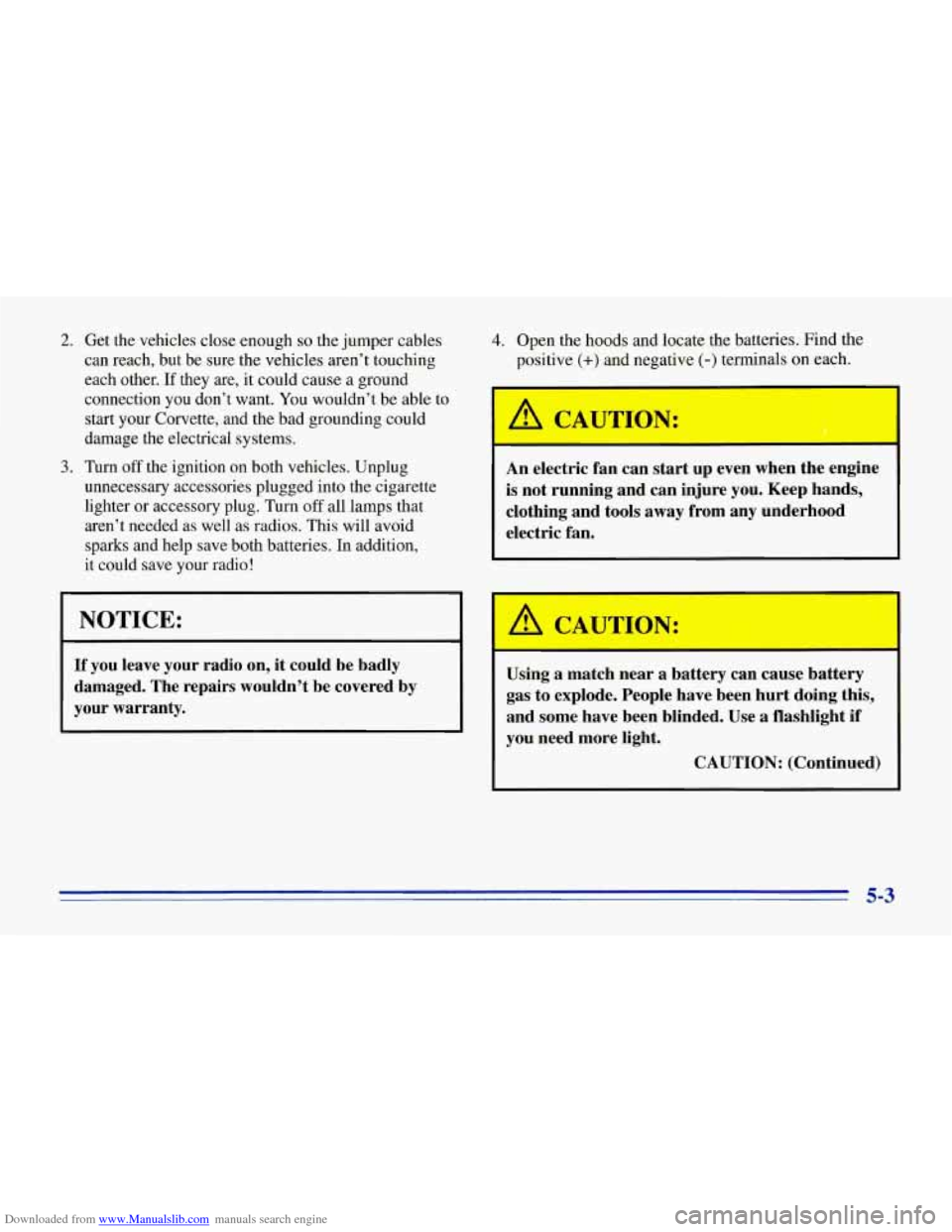
Downloaded from www.Manualslib.com manuals search engine 2. Get the vehicles close enough so the jumper cables
can reach, but be sure the vehicles aren’t touching
each other.
If they are, it could cause a ground
connection you don’t want.
You wouldn’t be able to
start your Corvette, and the bad grounding could
damage the electrical systems.
3. Turn off the ignition on both vehicles. Unplug
unnecessary accessories plugged into the cigarette
lighter or accessory plug. Turn
off all lamps that
aren’t needed as well as radios. This will avoid
sparks and help save both batteries.
In addition,
it could save your radio!
I NOTICE:
4. Open the hoods and locate the batteries. Find the
positive
(+) and negative (-) terminals on each.
An electric fan can start up even when the engine
is not running and can injure you. Keep hands,
clothing and tools away from any underhood
electric fan.
I
If you leave your radio on, it could be badly
damaged. The repairs wouldn’t be covered by
your warranty. Using
a match near a battery can cause battery
gas to explode. People have been hurt doing this,
and some have been blinded. Use a flashlight
if
you need more light.
CAUTION: (Continued)
5-3
Page 226 of 386
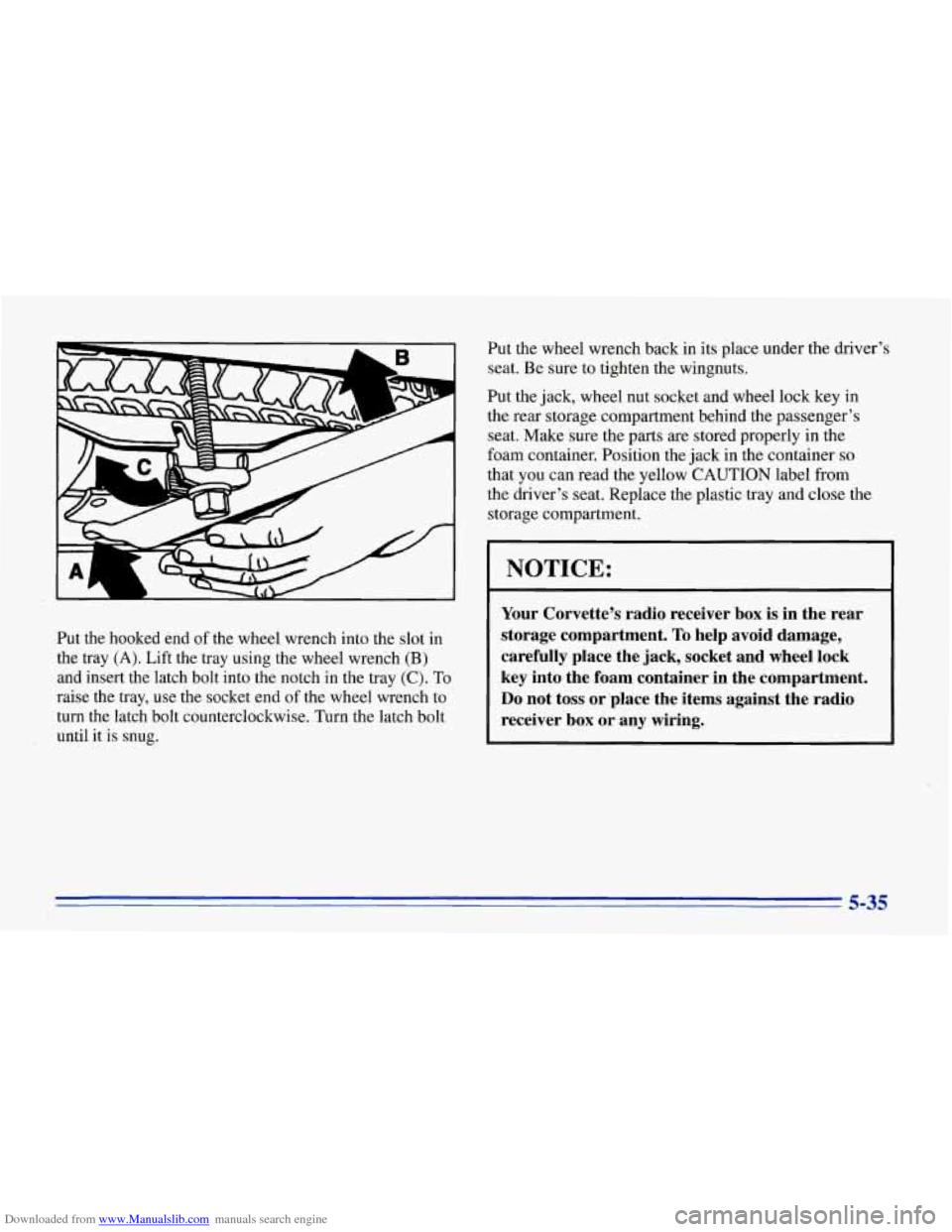
Downloaded from www.Manualslib.com manuals search engine Put the hooked end of the wheel wrench into the slot in
the tray
(A). Lift the tray using the wheel wrench (B)
and insert the latch bolt into the notch in the tray (C). To
raise the tray, use the socket end of the wheel wrench to
turn the latch bolt counterclockwise. Turn the latch bolt
until it is snug. Put
the wheel wrench back in its place under the driver’s
seat. Be sure to tighten the wingnuts.
Put the jack, wheel nut socket and wheel lock
key in
the rear storage compartment behind the passenger’s
seat. Make sure the
parts are stored properly in the
foam container. Position the jack in the container
so
that you can read the yellow CAUTION label from
the driver’s seat. Replace the plastic tray and close the
storage compartment.
I NOTICE: I
Your Corvette’s radio receiver box is in the rear
storage compartment.
To help avoid damage,
carefully place the jack, socket and wheel lock
key into the foam container in the compartment.
Do not toss or ‘place the items against the radio
receiver
box or any wiring.
5-35
Page 229 of 386

Downloaded from www.Manualslib.com manuals search engine Put the jack, wheel nut socket and wheel lock key in the
rear storage compartment behind the passenger’s seat.
Make sure the parts are stored properly in the foam
container. Position the jack in the container
so that you
can read the yellow CAUTION label fromthe driver’s
seat. Replace the plastic tray and close the storage
compartment.
NOTICE:
Your Corvette’s radio receiver box is in the rear
storage compartment.
To help avoid damage,
carefully place the jack, socket and wheel lock
key into the foam container in the compartment.
Do not toss or place the items against the radio
receiver box or any wiring.
Compact Spare Tire (If So Equipped)
Although the compact spare tire was fully inflated when
your vehicle was new, it can lose air after a time. Check
the’inflation pressure regularly. It should be
60 psi
(420 Wa).
After installing the compact spare on your vehicle, you should stop as soon as possible and make sure your spare
tire is correctly inflated. The compact spare is made to
perform well at posted speed limits for distances up to
3,000 miles (5 OOO km), so you can finish your trip and
have your full-size tire repaired or replaced where you
want.
Of course, it’s best to replace your spare with a
full-size tire as soon
as you can. Your spare will last
longer and
be in good shape in case you need it again.
When the compact spare is installed, your
vehicle’s handling capabilities will be reduced
during severe maneuvers.
If you drive too fast,
you could lose control
of your vehicle. You or
others could be injured. Don’t drive over
55 mph
(90 km/h) when the compact spare is installed.
5-38
Page 296 of 386
Downloaded from www.Manualslib.com manuals search engine Fuses and Circuit Breakers
The wiring circuits in your vehicle are protected from
short circuits by a combination of maxi-fuses,
mini-fuses and circuit breakers. This greatly reduces
the chance
of fires caused by electrical problems.
Look at the silver-colored band inside the fuse. If the
band is broken or melted, replace the fuse.
Be sure you
replace a bad fuse with a new one of the identical size
and rating.
If you ever have a problem
on the road and don’t have
a spare fuse,
you can borrow one that has the same
amperage. Just pick some feature of your vehicle that
you can get along without
-- like the radio or cigarette
lighter
-- and use its fuse, if it is the correct amperage.
Replace it as soon as you can.
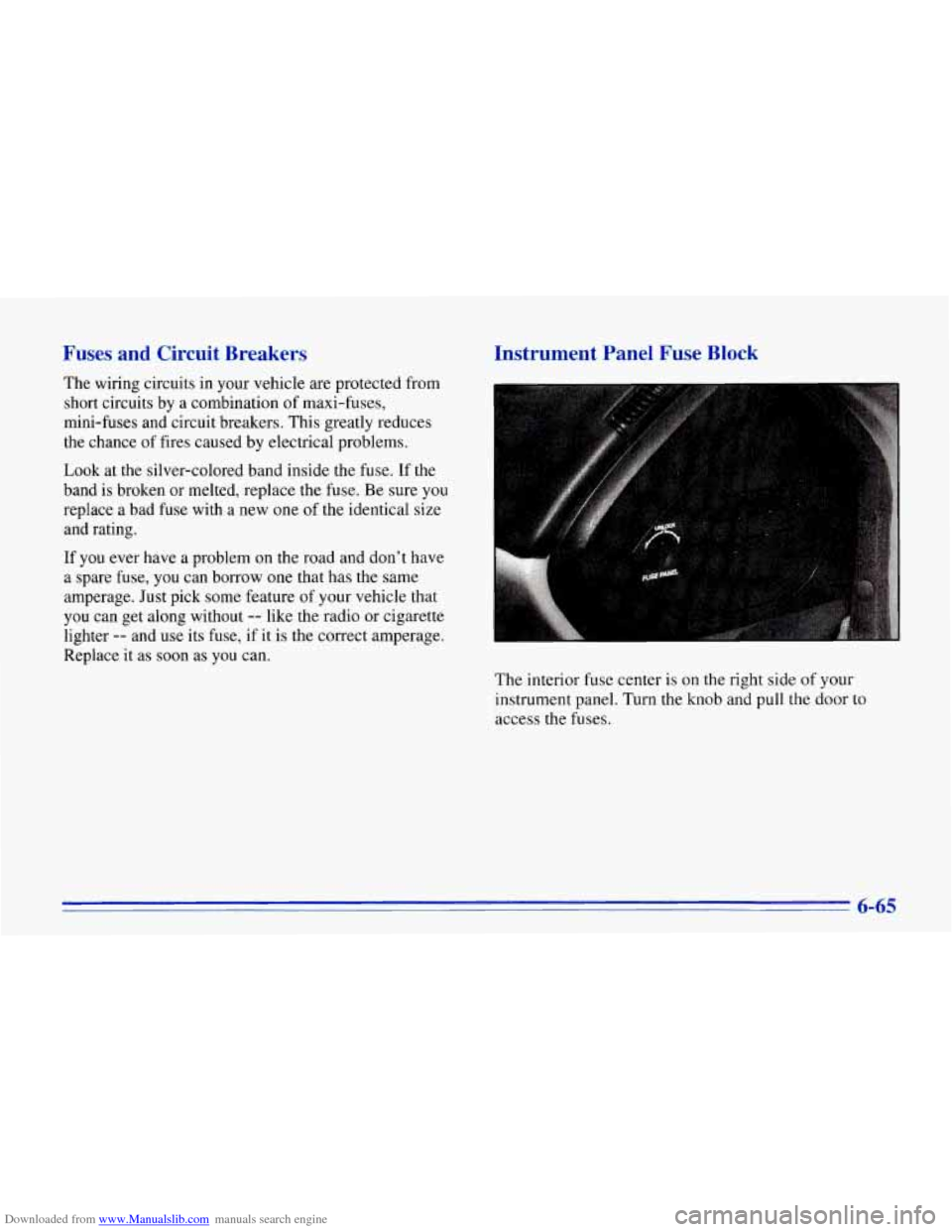
Instrument Panel Fuse Block
The interior fuse center is on the right side of your
instrument panel. Turn the knob and pull the door
to
access the fuses.
6-65
Page 298 of 386
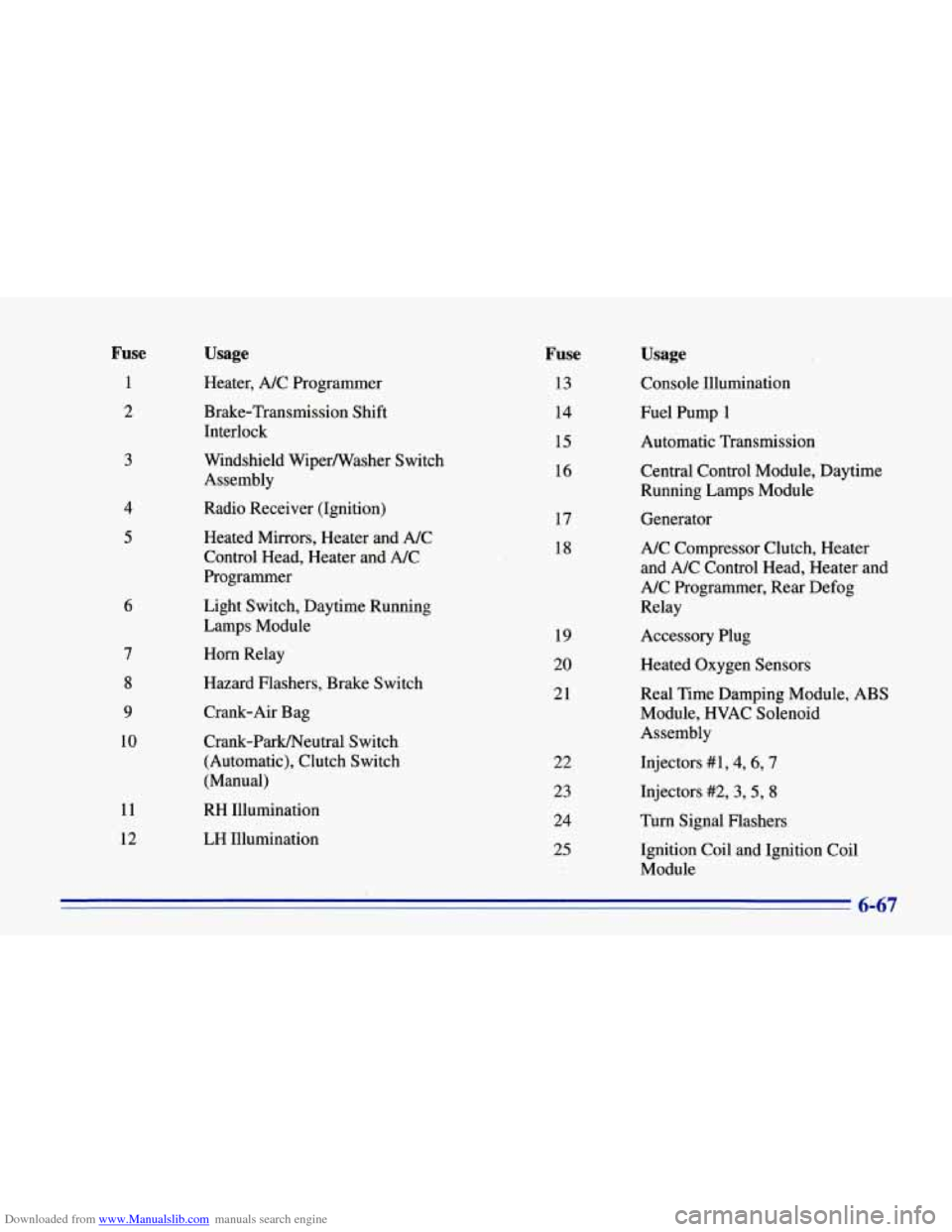
Downloaded from www.Manualslib.com manuals search engine Fuse
1
2
3
4
5
6
7
8
9
10
11
12
Usage
Heater, A/C Programmer
Brake-Transmission Shift
Interlock
Windshield WiperNasher Switch
Assembly
Radio Receiver (Ignition)
Heated Mirrors, Heater
and A/C
Control Head, Heater and A/C
Programmer
Light Switch, Daytime Running
Lamps Module
Horn Relay
Hazard Flashers, Brake Switch
Crank-Air Bag
Crank-Park/Neutral Switch
(Automatic), Clutch Switch
(Manual)
Usage
Console Illumination
Fuel Pump
1
Automatic Transmission
Central Control Module, Daytime
Running Lamps Module
Generator
A/C .Compressor Clutch, Heater
and A/C Control Head, Heater and
A/C Programmer, Rev Defog
Relay
Accessory Plug
Heated Oxygen Sensors
Real Time Damping Module, ABS
Module, HVAC Solenoid
Assembly
Injectors
#1,4,6,7
Injectors #2,3,5, 8
Turn Signal Flashers
Ignition Coil and Ignition Coil
Module
ti47
RH Illumination
LH Illumination
Fuse
13
14
15
16
17
18
19
20
21
22
23 24
25
Page 299 of 386
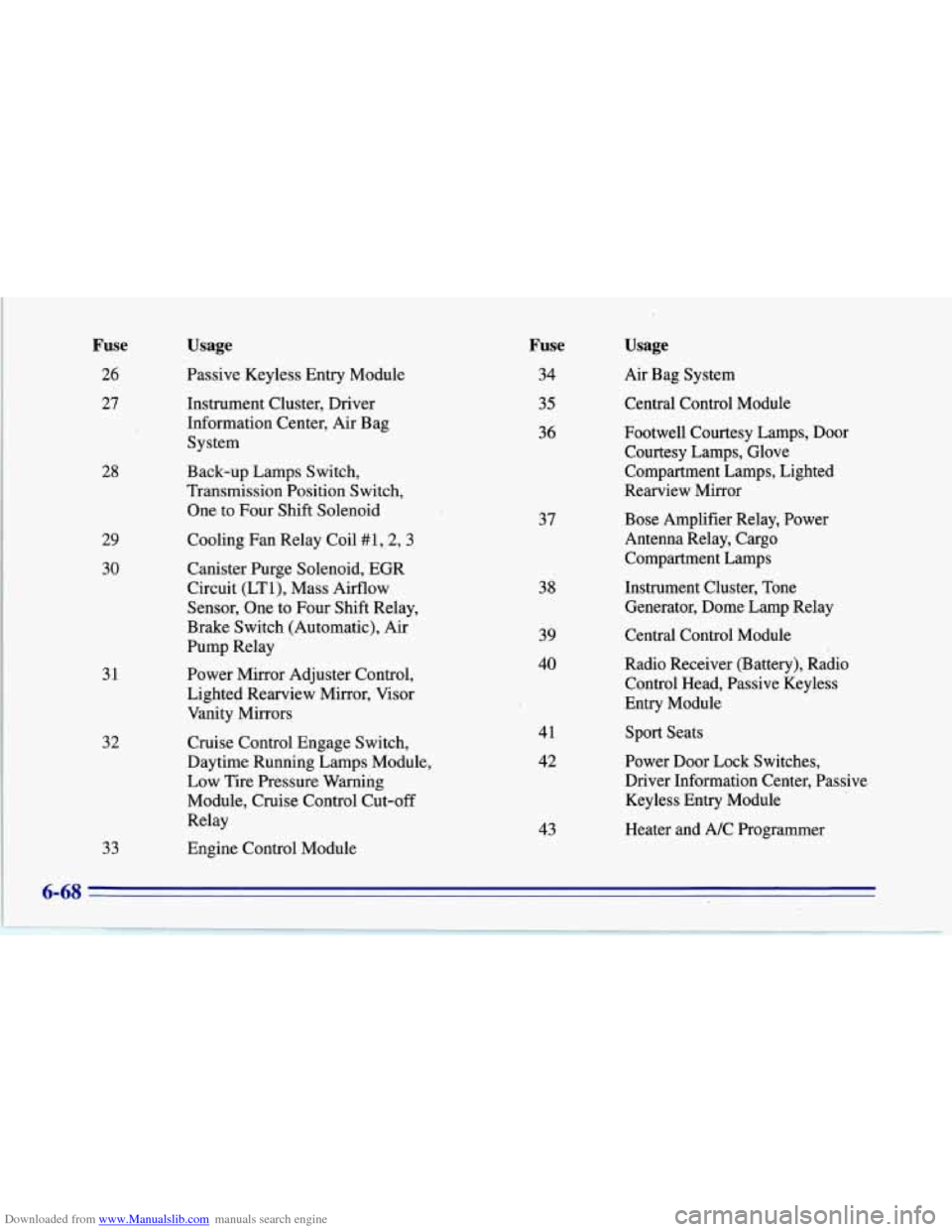
Downloaded from www.Manualslib.com manuals search engine Fuse
26 27
28
29
30
31
32
33
Usage
Passive Keyless Entry Module
Instrument Cluster, Driver
Information Center, Air Bag System
Back-up Lamps Switch,
Transmission Position Switch,
One to Four Shift Solenoid
Cooling Fan Relay Coil #1
, 2,3
Canister Purge Solenoid, EGR
Circuit (LTl), Mass Airflow
Sensor, One to Four Shift Relay,
Brake Switch (Automatic), Air
Pump Relay
Power Mirror Adjuster Control,
Lighted Rearview Mirror, Visor
Vanity Mirrors
Cruise Control Engage Switch,
Daytime Running Lamps Module,
Low Tire Pressure Warning
Module, Cruise Control Cut-off
Relay
Engine Control Module
Fuse
34
35
36
37
38
39
40
41 42
43
Usage
Air Bag System
Central Control Module
Footwell Courtesy Lamps, Door Courtesy Lamps, Glove
Compartment Lamps, Lighted
Rearview Mirror
Bose Amplifier Relay, Power
Antenna Relay, Cargo Compartment Lamps
Instrument Cluster, Tone
Generator, Dome Lamp Relay
Central Control Module
Radio Receiver (Battery), Radio
Control Head, Passive Keyless
Entry Module
Sport Seats
Power Door Lock Switches,
Driver Information Center, Passive Keyless Entry Module
Heater and A/C Programmer
6-68