1996 CHEVROLET CAVALIER ignition
[x] Cancel search: ignitionPage 186 of 372
Downloaded from www.Manualslib.com manuals search engine If you drive regularly in steep country, or if you’re
planning to visit there, here are some tips that can make
your trips safer and
more enjoyable.
0 Keep your vehicle in good shape. Check all fluid
levels and also the brakes, tires, cooling system and
transaxle. These parts can work hard on mountain
roads.
0 Know how to go down hills. The most important
thing to know is this: let your engine do some
of the
slowing down. Shift to a lower gear when you go
down
a steep or long hill.
If you don’t
shift down, your brakes could get so
hot that they wouldn’t work well. You would then
have poor braking or even none going down
a hill.
You could crash. Shift down to let your engine
assist your brakes
on a steep downhill slope.
I
Coasting downhill in NEUTRAL (N) or with the
ignition off is dangerous. Your brakes will have to
do all the work of slowing down. They could get so
hot that they wouldn’t work well. You would then
have poor braking or even none going down
a hill.
You could crash. Always have your engine running
and your vehicle in gear when
you go downhill.
0
0
e
e
Know how to go uphill. You may want to shift down
to a lower gear. The lower gears help cool your engine
and transaxle, and you can climb the hill better.
Stay in your own lane when driving on two-lane
roads in hills
or mountains. Don’t swing wide or cut
across the center
of the road. Drive at speeds that let
you stay in your own lane.
As you go over the top of a hill, be alert. There could be
something in your lane, like a stalled car or an accident.
You may see highway signs on mountains that warn of
special problems. Examples are long grades, passing or
no-passing zones, a falling rocks area or winding
roads. Be alert to these and take appropriate action.
4-24
Page 191 of 372
Downloaded from www.Manualslib.com manuals search engine Run your engine only as long as you must. This saves
fuel. When you run the engine, make it.go a little faster
than just idle. That is, push the accelerator slightly. This
uses less fuel for the heat that you get and it keeps the
battery charged.
You will need a well-charged battery to
restart the vehicle, and possibly for signaling later
on
with your headlamps. Let the heater run for awhile.
Then, shut the engine off and close the window almost
all the way
to preserve the heat. Start the engine again
and repeat this only when you feel really uncomfortable
from the cold. But do it as little as possible. Preserve the
fuel as long as you can.
To help keep warm, you can get
out of the vehicle and do some fairly vigorous exercises
every half hour or
so until help comes.
Recreational Vehicle Towing
You can tow your vehicle behind another vehicle for use
at your destination. Be sure
to use the proper towing
equipment designed for recreational towing. Follow the
instructions for the towing equipment.
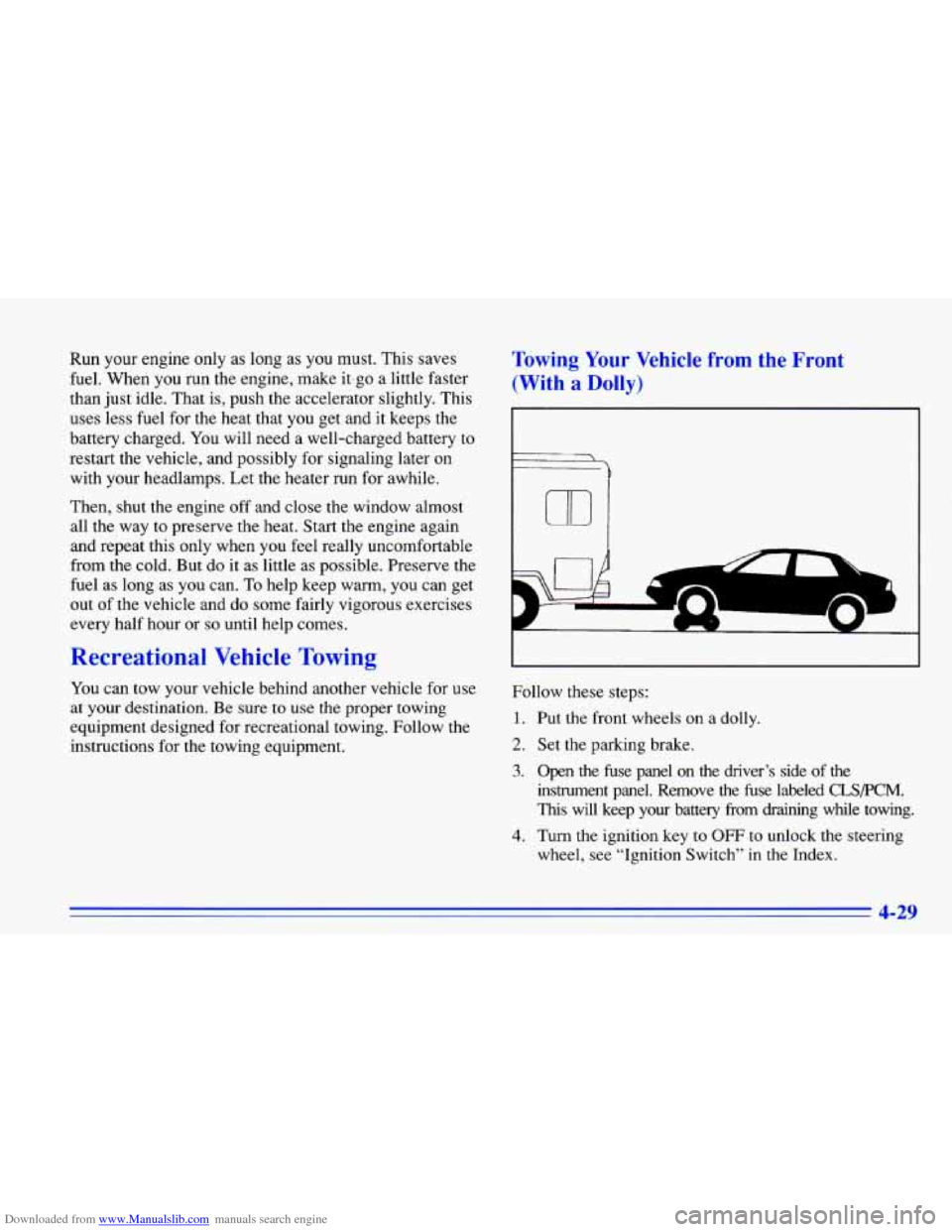
Towing Your Vehicle from the Front
(With a Dolly)
€
7
m
Follow these steps:
1. Put the front wheels on a dolly.
2. Set the parking brake.
3. Open the fuse panel on the driver’s side of the
instrument panel. Remove the fuse labeled
CLSPCM.
This will keep your battery from draining while towing.
4. Turn the ignition key to OFF to unlock the steering
wheel, see “Ignition Switch’’ in the Index.
4-29
Page 192 of 372
Downloaded from www.Manualslib.com manuals search engine 5. Clamp the steering wheel in a straight-ahead position
6. Release the parking brake.
When you
are finished towing, make sure you replace
the CLS/PCM fuse in the instrument panel fuse block.
with a clamping device designed for towing.
Towing Your Vehicle from the Front
(Four-Speed Automatic
or Five-Speed
Manual Transaxles Only)
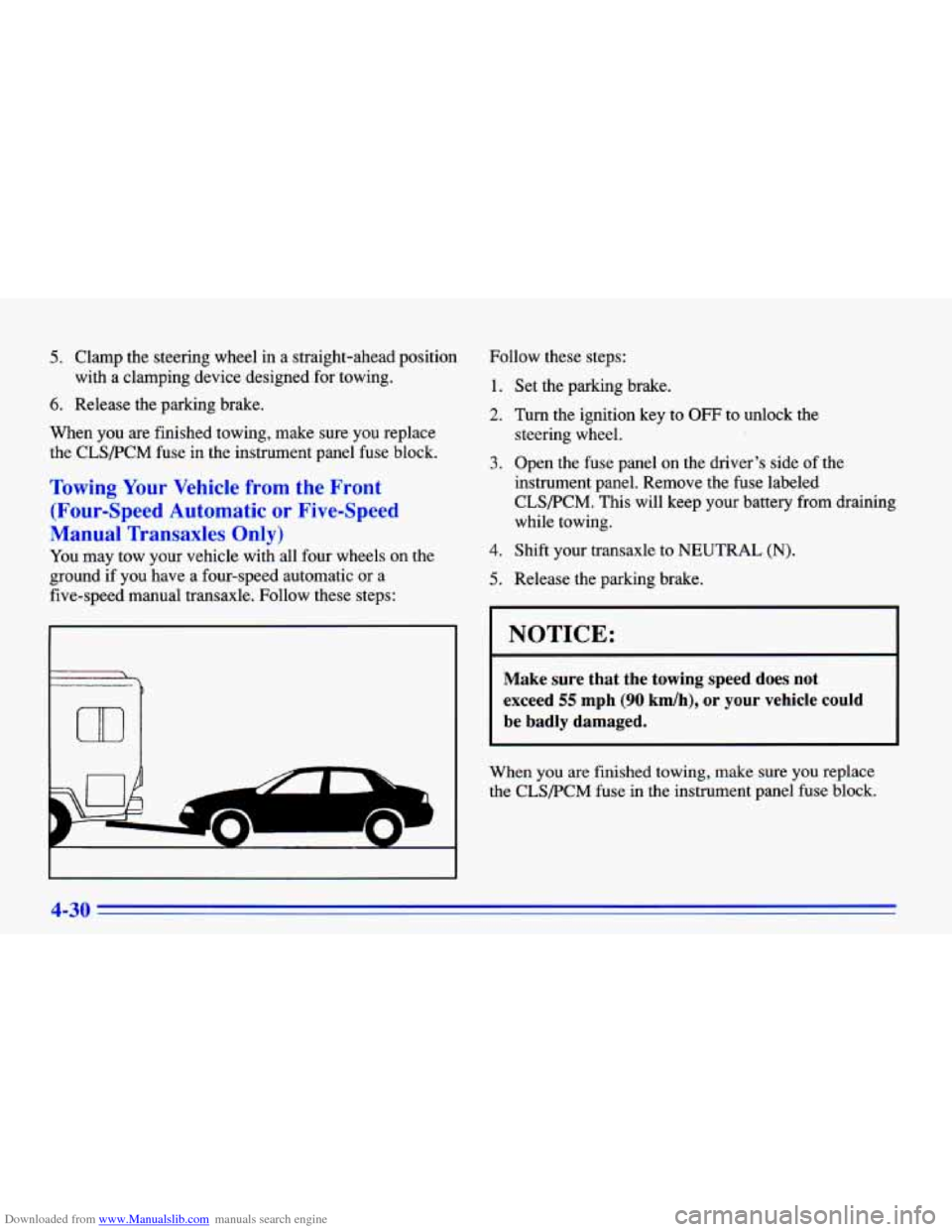
You may tow your vehicle with all four wneels on the
ground
if you have a four-speed automatic or a
five-speed manual transaxle. Follow these steps:
r
m
.
*-
Follow these steps:
1. Set the parking brake.
2. Turn the ignition key to OFF to unlock the
3. Open the fuse panel on the driver’s side of the
instrument panel. Remove the fuse labeled
CLS/PCM. This will keep your battery from draining
while towing. steering wheel.
4. Shift your transaxle to NEUTRAL (N).
5. Release the parking brake.
NOTICE:
Make sure that the towing speed does not
exceed
55 mph (90 km/h), or your vehicle could
be badly damaged.
When you are finished towing, make sure you replace
the CLS/PCM fuse in the instrument panel fuse block.
4-30
Page 207 of 372
Downloaded from www.Manualslib.com manuals search engine 2. Get the vehicles close enough so the jumper cables
can reach, but be sure the vehicles aren’t touching
each other. If they are, it could cause
a ground
connection you don’t want. You wouldn’t be able to
start your Chevrolet, and the bad grounding could
damage the electrical systems.
You could be injured if the vehicles roll. Set the
parking brake firmly on each vehicle. Put an
automatic transaxle in
PARK (P) or a manual
transaxle in
NEUTRAL (N).
3. Turn off the ignition on both vehicles. Unplug
unnecessary accessories plugged into the cigarette
lighter.
Turn off all lamps that aren’t needed as well
as radios. This will avoid sparks and help save both
batteries. In addition, it could save your ra&o.
NOTICE:
If you leave your radio on, it could be badly
damaged. The repairs wouldn’t be covered by
your warranty.
4. Open the hoods and locate the batteries.
An electric fan can start up even when the engine
is not running and can injure you. Keep hands,
clothing and tools away from any underhood
electric fan.
5. Find the positive (+) and negative (-) terminals on
each battery.
5-3
Page 212 of 372
Downloaded from www.Manualslib.com manuals search engine -- IO Iontinut I I
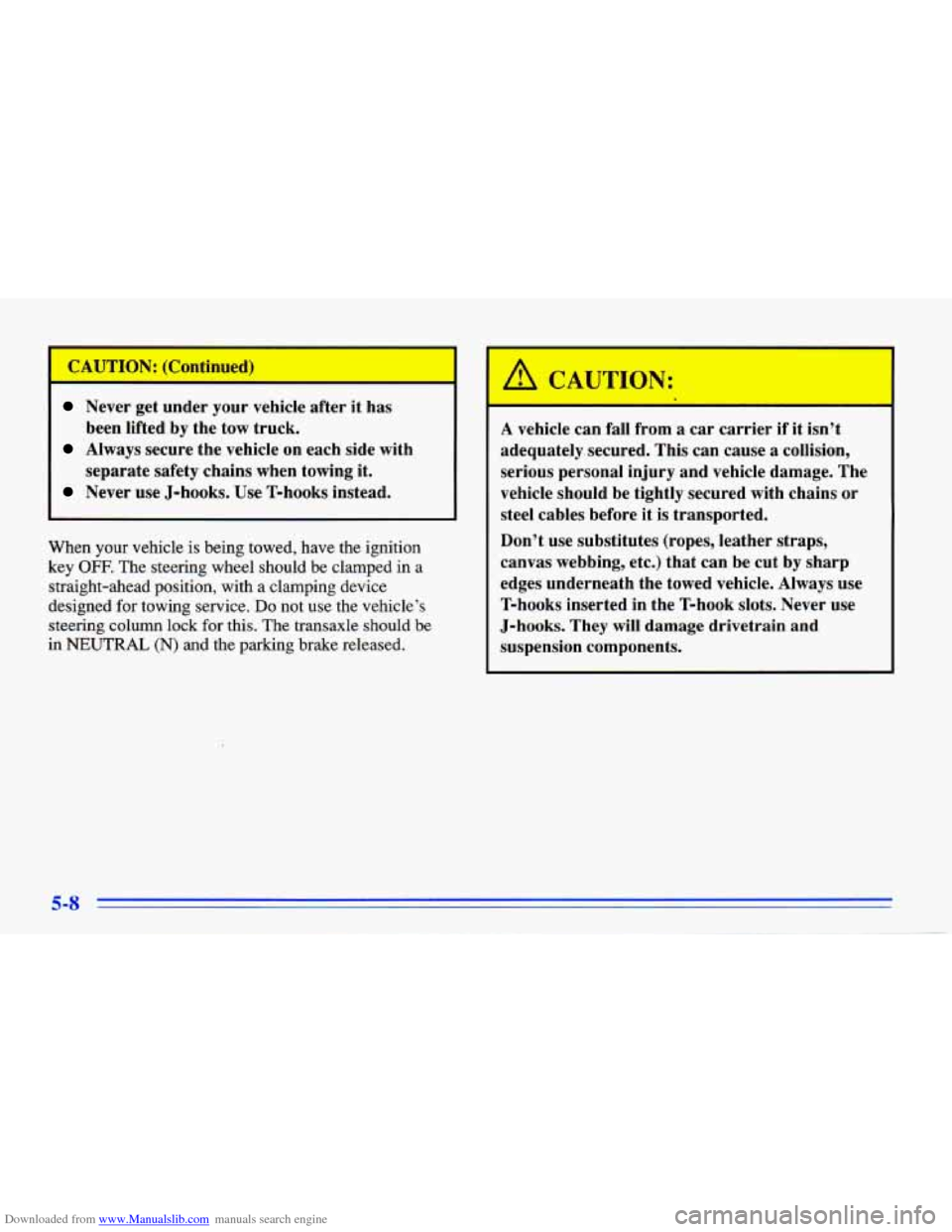
Never get under your vehicle after it has
been lifted by the tow truck.
Always secure the vehicle on each side with
separate safety chains when towing it.
Never use J-hooks. Use T-hooks instead.
When
your vehicle is being towed, have the ignition
key OFF. The steering wheel should be clamped in a
straight-ahead position, with a clamping device
designed
for towing service. Do not use the vehicle’s
steering column lock for this. The transaxle should be
in
NEUTRAL (N) and the parking brake released.
A CAUTION:
I
A vehicle can fall from a car carrier if it isn’t
adequately secured. This can cause
a collision,
serious personal injury and vehicle damage. The
vehicle should be tightly secured with chains or
steel cables before it is transported.
Don’t
use substitutes (ropes, leather straps,
canvas webbing, etc.) that can be cut by sharp
edges underneath the towed vehicle. Always use
T-hooks inserted in the T-hook slots. Never use
J-hooks. They will damage drivetrain and
suspension components.
5-8
Page 293 of 372
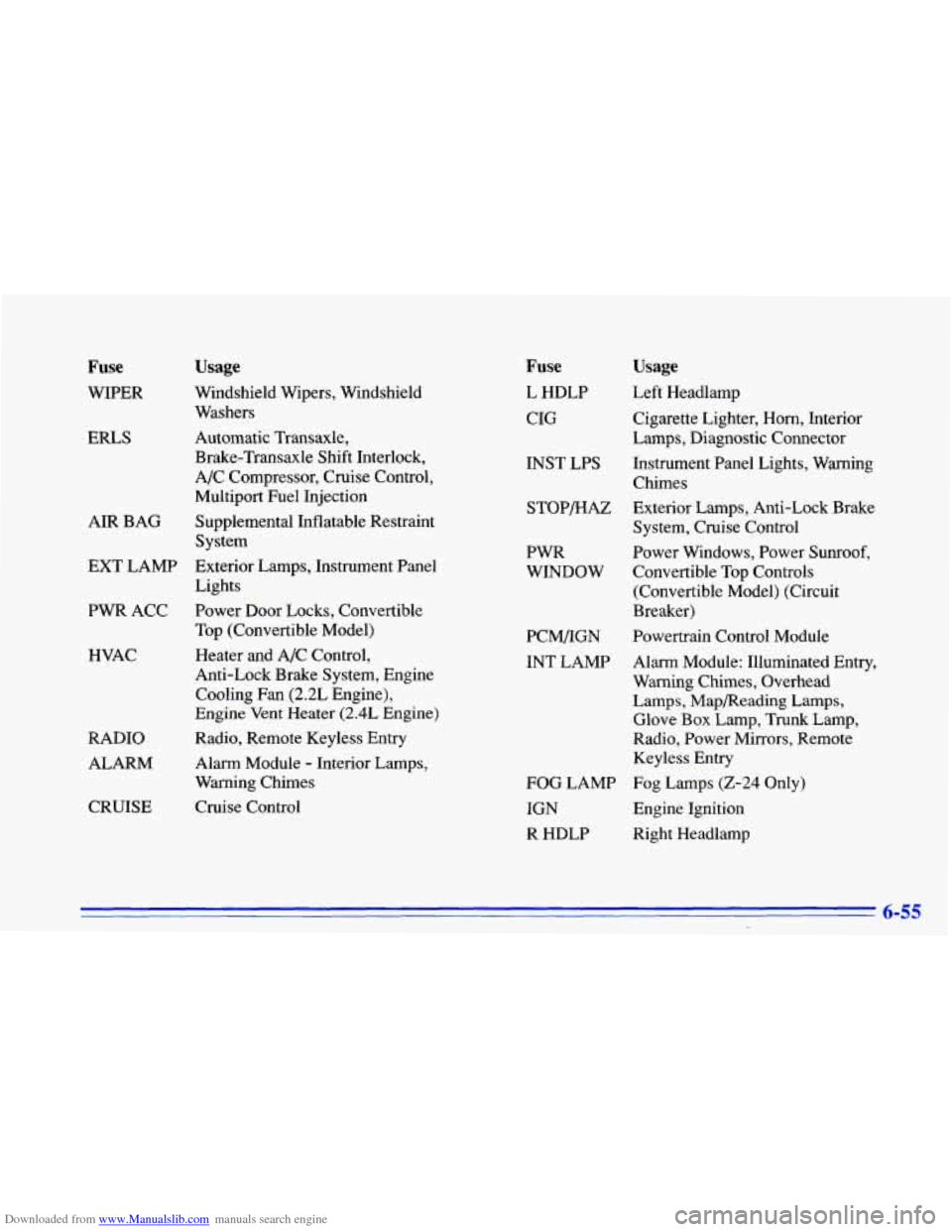
Downloaded from www.Manualslib.com manuals search engine Fuse Usage
WIPER Windshield Wipers, Windshield Washers
ERLS Automatic Transaxle,
Brake-Transaxle Shift Interlock,
A/C Compressor, Cruise Control, Multiport Fuel Injection
AIR BAG Supplemental Inflatable Restraint
EXT LAMP Exterior Lamps, Instrument Panel
PWR ACC Power Door Locks, Convertible System
Lights
Top (Convertible Model)
HVAC
RADIO ALARM
CRUISE Heater and
A/C Control,
Anti-Lock Brake System, Engine Cooling Fan (2.2L Engine),
Engine Vent Heater
(2.4L Engine)
Radio, Remote Keyless Entry
Alarm Module
- Interior Lamps,
Warning Chimes
Cruise Control
Fuse
L HDLP
CIG
INST LPS
STOP/HAZ
PWR
WINDOW
PCM/IGN
INT LAMP
FOG LAMP
IGN
R HDLP
Usage
Left Headlamp
Cigarette Lighter,
Horn, Interior
Lamps, Diagnostic Connector
Instrument Panel Lights, Warning Chimes
Exterior Lamps, Anti-Lock Brake
System, Cruise Control
Power Windows, Power
Sunroof,
Convertible Top Controls (Convertible Model) (Circuit
Breaker)
Powertrain Control Module
Alarm Module: Illuminated Entry,
Warning Chimes, Overhead
Lamps, Mapmeading Lamps,
Glove Box Lamp,
Trunk Lamp,
Radio, Power Mirrors, Remote
Keyless Entry
Fog Lamps (2-24 Only)
Engine Ignition
Right Headlamp
6-55
Page 294 of 372
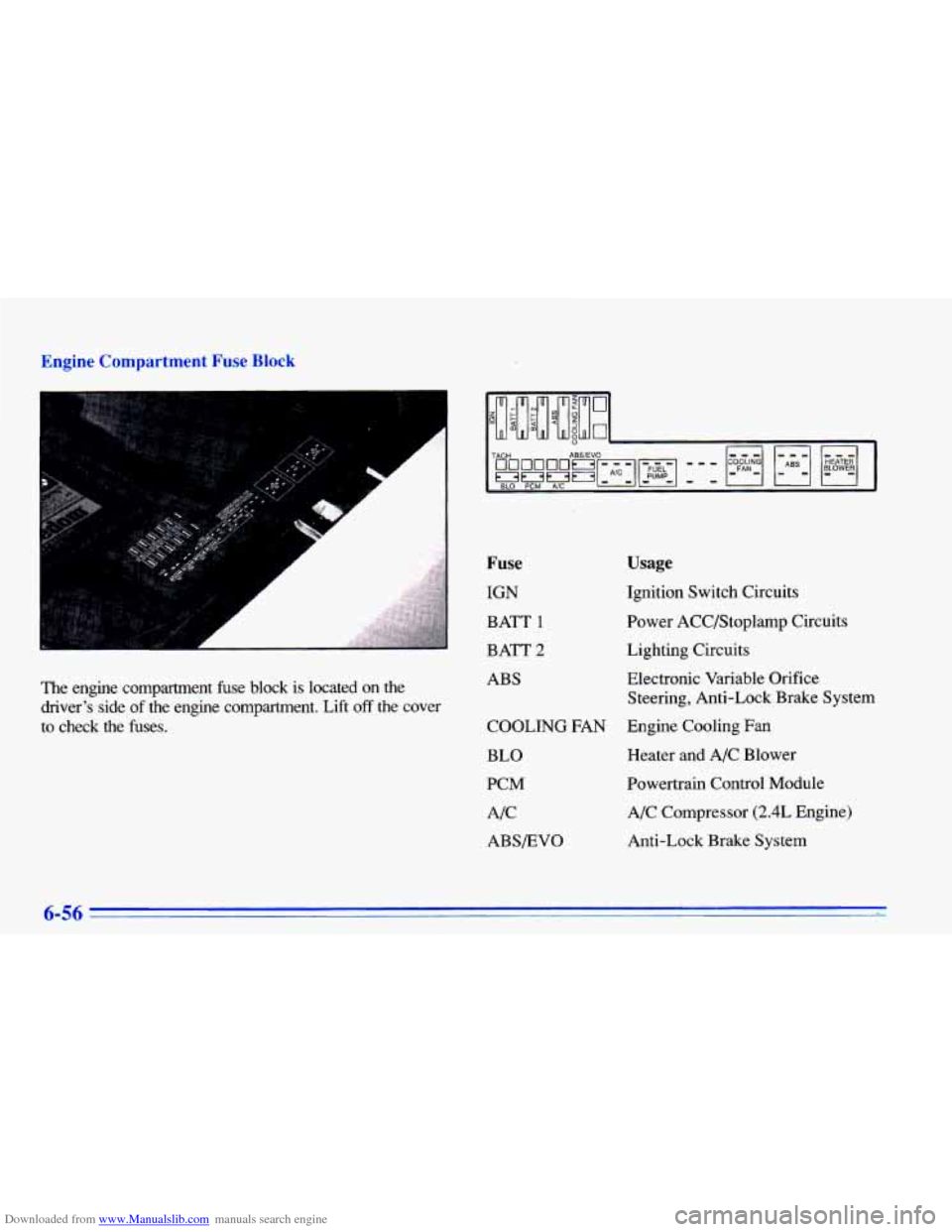
Downloaded from www.Manualslib.com manuals search engine Engine Compartment Fuse Block
J
The engine compartment fuse block is located on the
driver’s side of the engine compartment. Lift off the cover
to check the fuses.
Fuse
IGN
BATT
1
BATT 2
ABS
Usage
Ignition Switch Circuits
Power ACC/Stoplamp Circuits Lighting Circuits
Electronic Variable Orifice
Steering, Anti-Lock Brake System
COOLING
FAN Engine Cooling Fan
BLO Heater and A/C Blower
PCM Powertrain Control Module
A/C A/C Compressor
(2.4L Engine)
ABS/EVO Anti-Lock Brake System
6-56
Page 364 of 372
Downloaded from www.Manualslib.com manuals search engine Ignition Switch ................................ 2-10
Illuminated Entry
............................... 2-42
Inflation. Tire
.................................. 6-37
Inside Daymight Rearview Mirror
................. 2-43
Inspections
Brakesystem
................................ 7-42
Exhaust Systems
............................. 7-42
Front-Wheel-Drive Axle Boot
.................. 7-42
Front-Wheel-Drive Axle Seal
................... 7-42
Radiator and Heater Hose
...................... 7-42
Steering
.................................... 7-42
Suspension
.................................. 7-42
Throttle Linkage
.............................. 7-42
Instrument Panel
............................... 2-60
Brightness Control
............................. 2-4 1
Cleaning
.................................... 6-46
Cluster
................................ 2-62. 2-63
FuseBlock
.................................. 6-54
Interior Lamps
................................. 2-41
Jack. Tire
.................................... 5-21
Jump Starting
................................... 5-2
Key Lock Cylinders Service
..................... 7-39
Key Release Button
............................. 2- 11
Keyless Entry System ............................ 2-5
Keys .......................................... 2-1 Labels
.................................. 4.31. 6.52
Certification
................................. 4-32
CertificationEire
............................. 4-31
Service Parts Identification
..................... 6-52
Tire-Loading Information
...................... 4-31
Vehicle Identification Number
................... 6-52
Lamps
........................................ 2-39
Fog
........................................ 2-41
Interior
..................................... 2-41
On Reminder ................................ 2-39
Latches. Seatback
................................ 1-4
Leaving Your Vehicle
............................. 2-5
Leaving Your Vehicle with the Engine Running ....... 2-25
Lighter
....................................... 2-47
Lights Air Bag Readiness
....................... 1-20. 2-66
Anti-Lock Brake System Warning
............ 2-68. 4-6
Brake System Warning
......................... 2-67
Charging System
............................. 2-66
CheckEngine
................................ 2-71
CheckGages
................................ 2-75
CheckOil
.................................... 2-74
Enhanced Traction System Active
............ 2-69. 4-8
Enhanced Traction System Warning Light
..... 2-68. 4-9
ETS Active
.............................. 2-69. 4-8
ETS Warning
............................. 2-68. 4-9
Interior
..................................... 2-41
Low Coolant Warning
......................... 2-70
9-6