1996 CHEVROLET BLAZER oil pressure
[x] Cancel search: oil pressurePage 11 of 392
Downloaded from www.Manualslib.com manuals search engine Vehicle Symbols
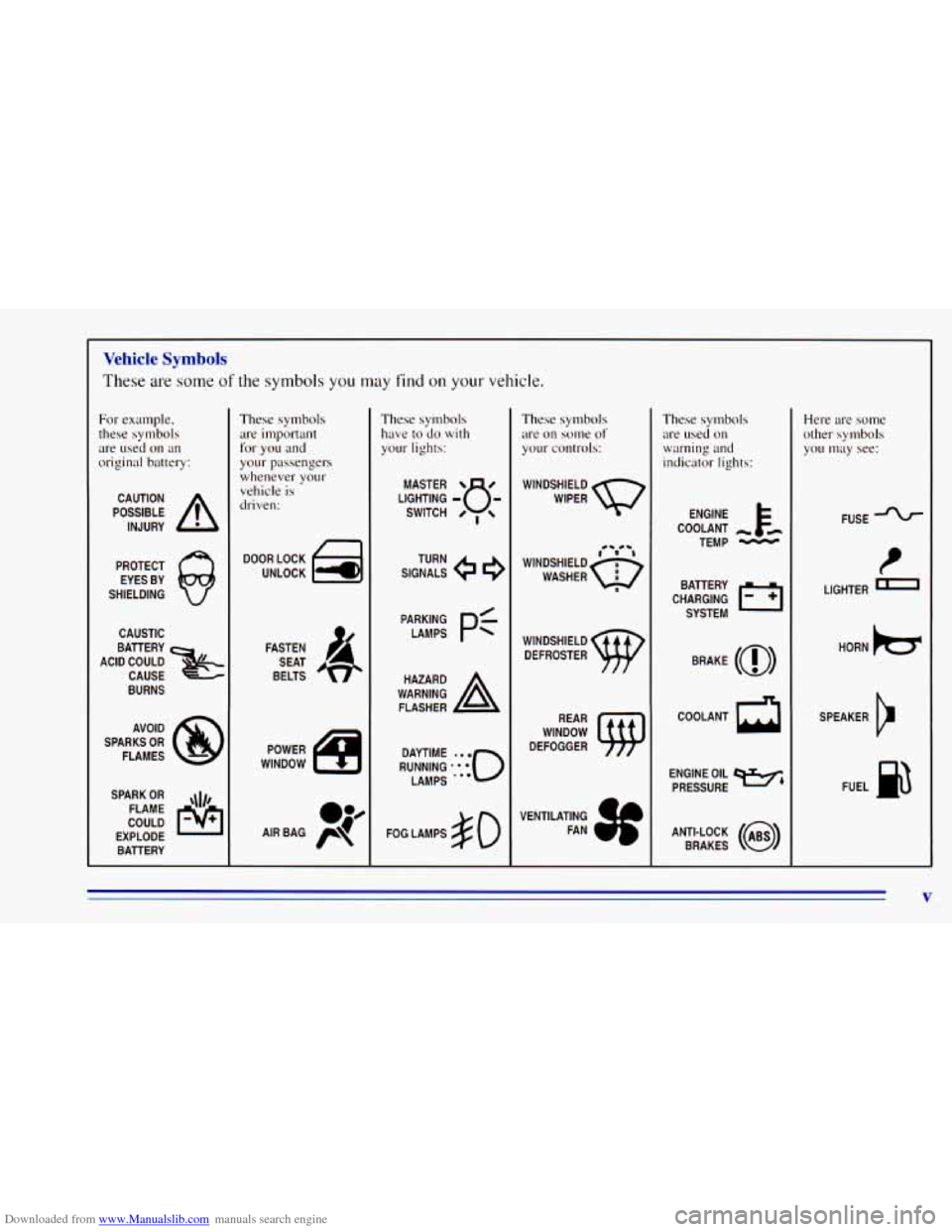
These are some of the symbols you may find on your vehicle.
For example,
these symbols
are used on an
original battery:
POSSIBLE A
CAUTION
INJURY
PROTECT EYES BY
SHIELDING
CAUSTIC
BURNS AVOID
SPARKS
OR
FLAMES
SPARK
OR ,\I/,
COULD pq
FLAME
EXPLODE BATTERY
These symbols
are important
for you and
your passengers
whenever your
vehicle is
driven:
DOOR LOCK
FASTEN SEAT
BELTS
These symbols have to do
with
your lights:
SIGNALS e
TURN
FOG LAMPS
# 0
These symbols
are on some
of
yo11r controls:
WINDSHIELD
WIPER
These symbols are used on
warning and
indicator lights:
COOLANT -
TEMP -
CHARGING I-1
BATTERY
SYSTEM
BRAKE
(0)
COOLANT a
ENGINE OIL e,
PRESSURE
ANTI-LOCK
(a)
BRAKES
Here are some
other symbols
you
may see:
FUSE -%-
I
LIGHTER I
HORN )cr
SPEAKER
b
FUEL siE3
V
Page 130 of 392
Downloaded from www.Manualslib.com manuals search engine Engine Oil Pressure Gage
OIL 0-
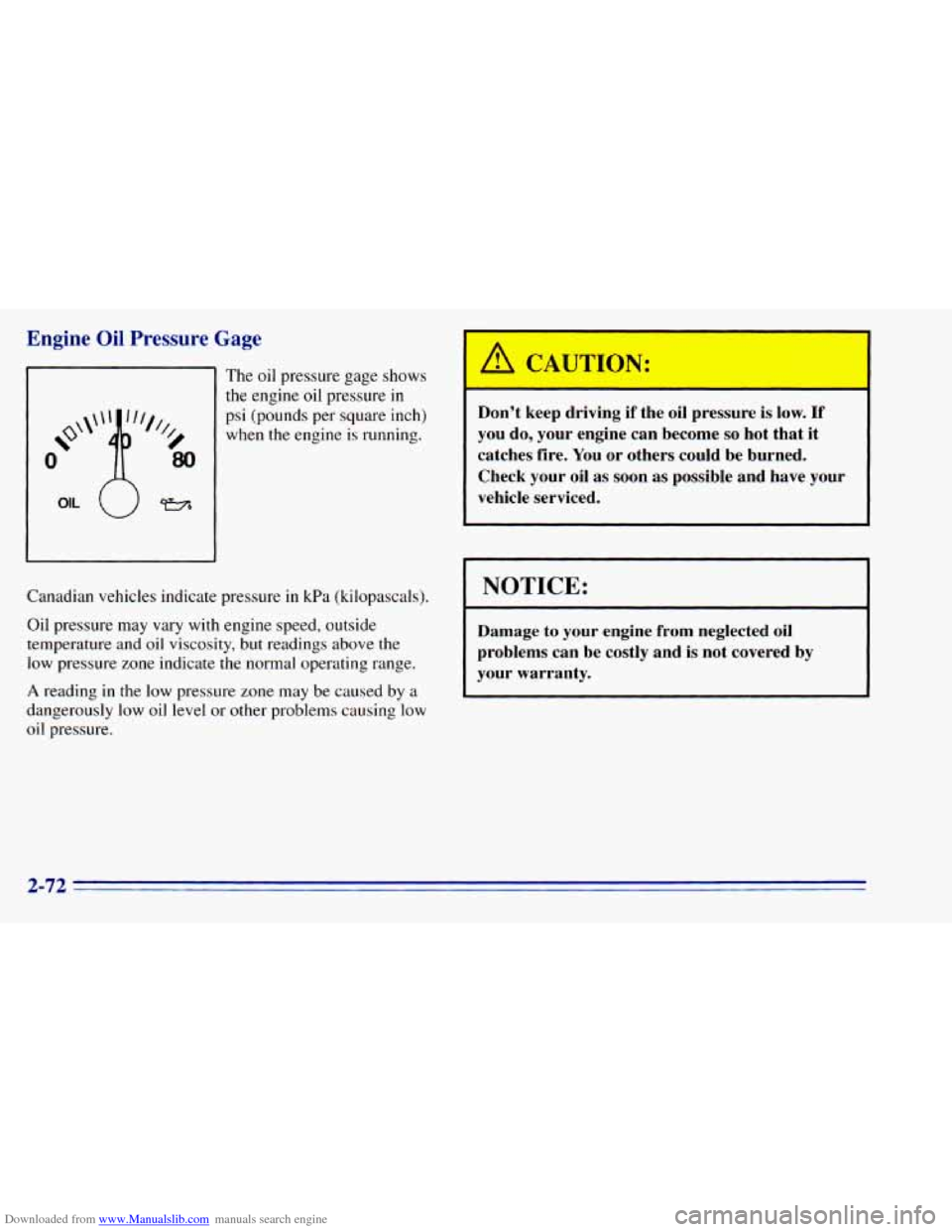
The oil pressure gage shows
the engine oil pressure in
psi (pounds per square inch)
when the engine
is running.
Canadian vehicles indicate pressure in kPa (kilopascals).
Oil pressure may vary with engine speed, outside
temperature
and oil viscosity, but readings above the
low pressure zone indicate the normal operating range.
A reading in the low pressure zone may be caused by a
dangerously
low oil level or other problems causing low
oil pressure.
CAUTION:
Don't keep driving if the oil pressure is low. If
you do, your engine can become so hot that it
catches fire. You or others could be burned.
Check your oil as soon as possible and have your
vehicle serviced.
NOTICE:
Damage to your engine from neglected oil
problems can be costly and is not covered by
your warranty.
2-72
Page 132 of 392
Downloaded from www.Manualslib.com manuals search engine Check Gages Light
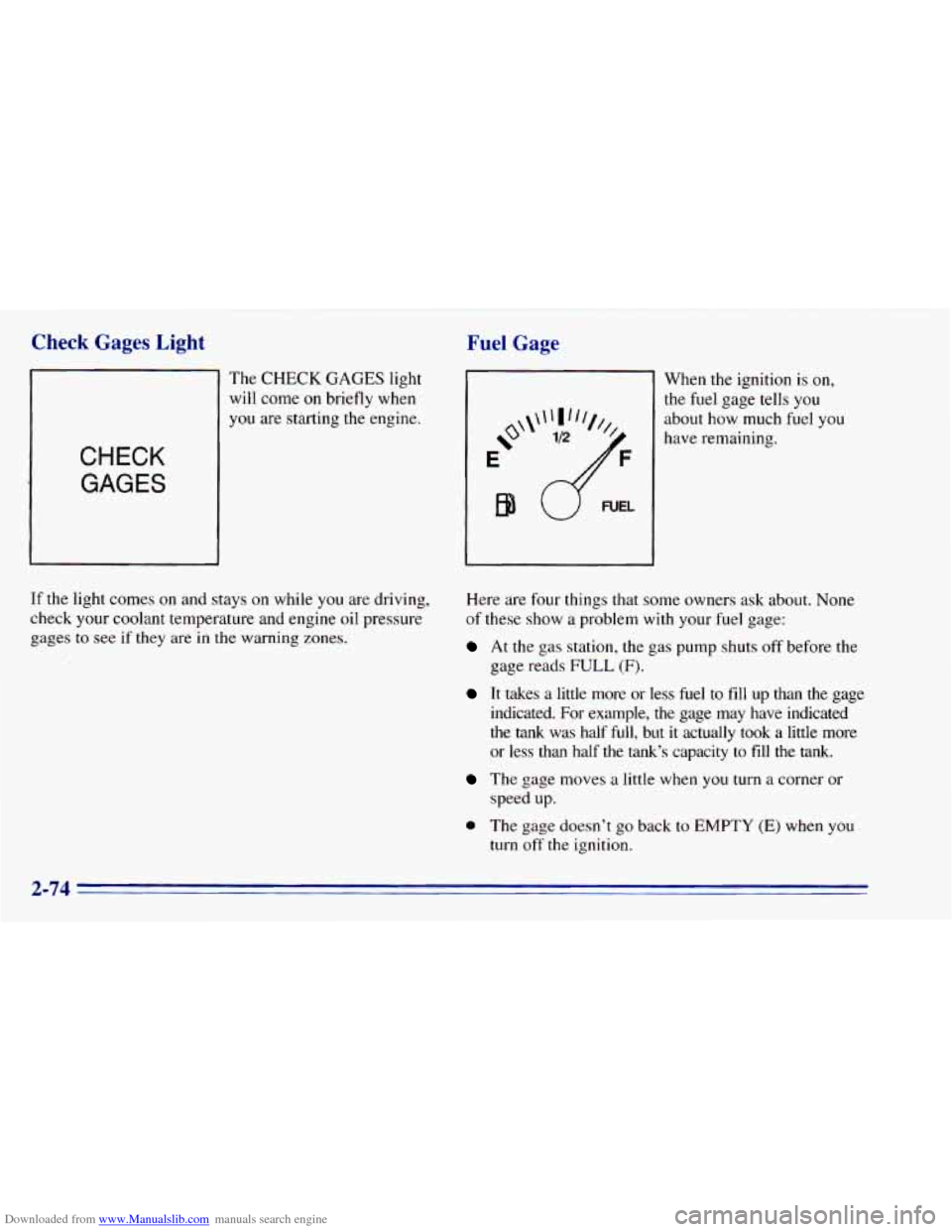
The CHECK GAGES light
will
come on briefly when
you are starting the engine.
CHECK
GAGES
If the light comes on and stays on while you are driving,
check your coolant temperature and engine oil pressure
gages to
see if they are in the warning zones.
Fuel Gage
e'
E
B9
When the ignition is on,
the fuel gage tells you
about how much fuel you
have remaining,
Here are four things that some owners ask about. None
of these show a problem with
your fuel gage:
At the gas station, the gas pump shuts off before the
gage reads
FULL (F).
It takes a little more or less fuel to fill up than the gage
indicated.
For example, the gage may have indicated
the tank was half
full, but it actually took a little more
or less than half the tank's capacity to fill the tank.
The gage moves a little when you turn a corner or
speed up.
0 The gage doesn't go back to EMPTY (E) when you
turn off the ignition,
2-74
Page 191 of 392
Downloaded from www.Manualslib.com manuals search engine Here are some things you can check before a trip:
0
a
0
0
0
0
0
Windshield Washer Fluid: Is the reservoir full?
Are all windows clean inside and outside?
Wiper Blades: Are they in good shape?
Fuel, Engine Oil, Other Fluids: Have you checked
all levels?
Lamps: Are they all working? Are the lenses clean?
Tires: They are vitally important to a safe,
trouble-free trip.
Is the tread good enough for
long-distance driving? Are the tires all inflated to the
recommended pressure?
Weather Forecasts: What’s the weather outlook
along your route? Should you delay your trip a short
time
to avoid a major storm system?
Maps: Do you have up-to-date maps?
Highway Hypnosis
Is there actually such a condition as “highway hypnosis”?
Or is
it just plain falling asleep at the wheel? Call it
highway hypnosis, lack of awareness,
or whatever.
There is something about an easy stretch
of road with the
same scenery, along with the hum of the tires on the road,
the drone
of the engine, and the rush of the wind against
the vehicle that can make
you sleepy. Don’t let it happen
to you!
If it does, your vehicle can leave the road in less
than n second, and you could crash and be injured.
What can
you do about highway hypnosis‘? First, be
aware that it can happen.
Then here are some tips:
0
0
0
Make sure your vehicle is well ventilated, with a
comfortably cool interior.
Keep your eyes moving. Scan the road ahead and
to
the sides. Check your mirrors and your instruments
frequently.
If
you get sleepy, pull off the road into a rest, service
or parking area and take a nap, get some exercise, or
both. For safety, treat drowsiness on the highway
as
an emergency.
4-37
Page 225 of 392
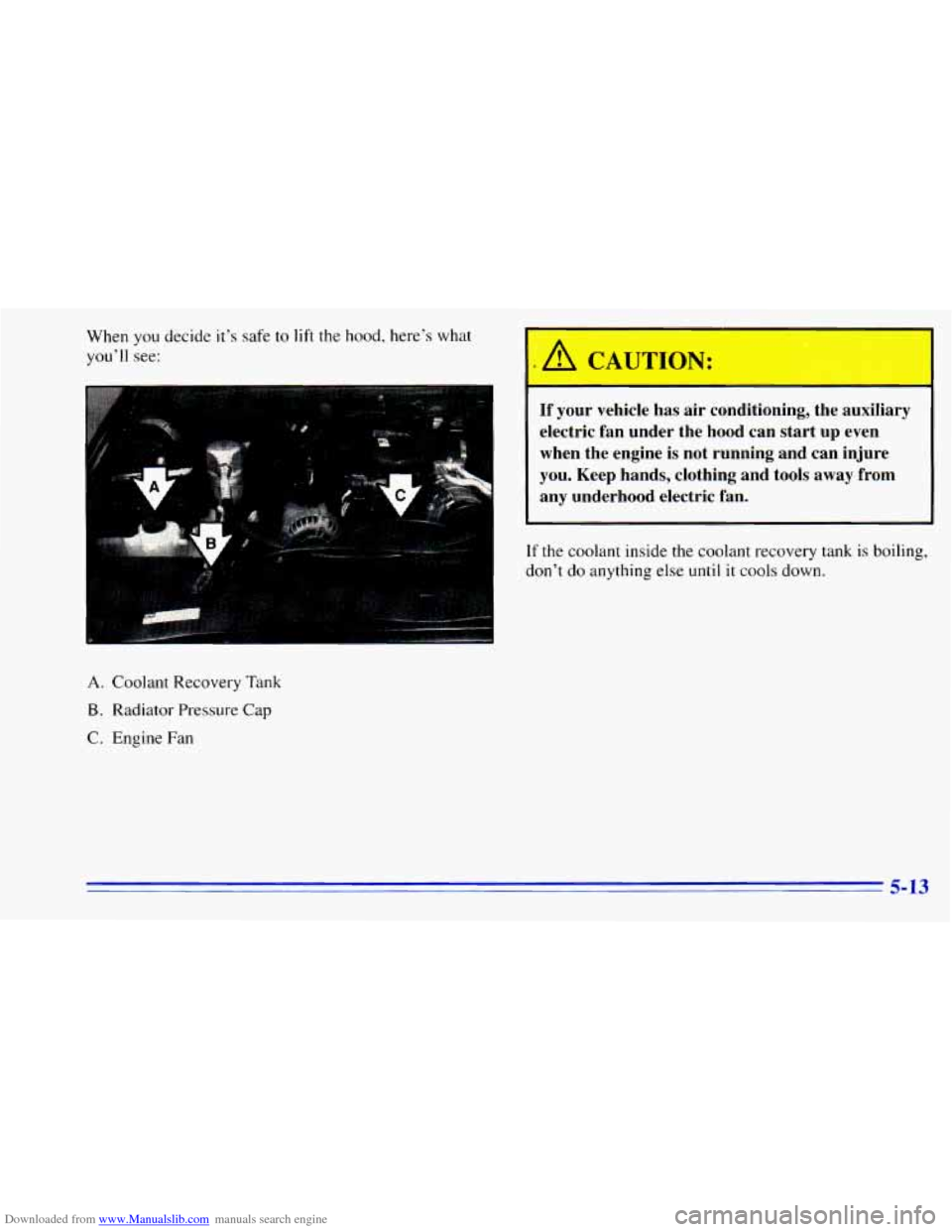
Downloaded from www.Manualslib.com manuals search engine When you decide it's safe to lift the hood, here's what
you'll see:
A. Coolant Recovery Tank
B. Radiator Pressure Cap
C. Engine Fan
If your vehicle has air conditioning, the auxiliary
electric fan under the hood can start up even
when the engine is not running and can injure
you. Keep hands, clothing and tools away from
any underhood electric fan.
If the coolant inside the coolant recovery tank is boiling,
don't
do anything else until it cools down.
5-13
Page 257 of 392
Downloaded from www.Manualslib.com manuals search engine Before closing the hood, be sure all the filler caps are on
properly. Then lift the hood
to relieve pressure on the
hood prop.
Remove the hood prop
from the slot in the hood and
return the prop to
its retainer.
Then just pull the hood down firmly
to close. It will
latch when dropped from
10 to12 inches (25 to 30 cm)
without pressing
on the hood.
Engine Oil
It’s a good idea to check your engine oil every time you
get fuel. In order to get an accurate reading, the oil must
be warm and the vehicle must be on level ground.
The oil dipstick is
a
yellow ring.
Turn
off the engine and
give the oil a few minutes
to drain back into the oil
pan.
If you don’t, the oil
dipstick might not show
the actual level.
Checking Engine Oil
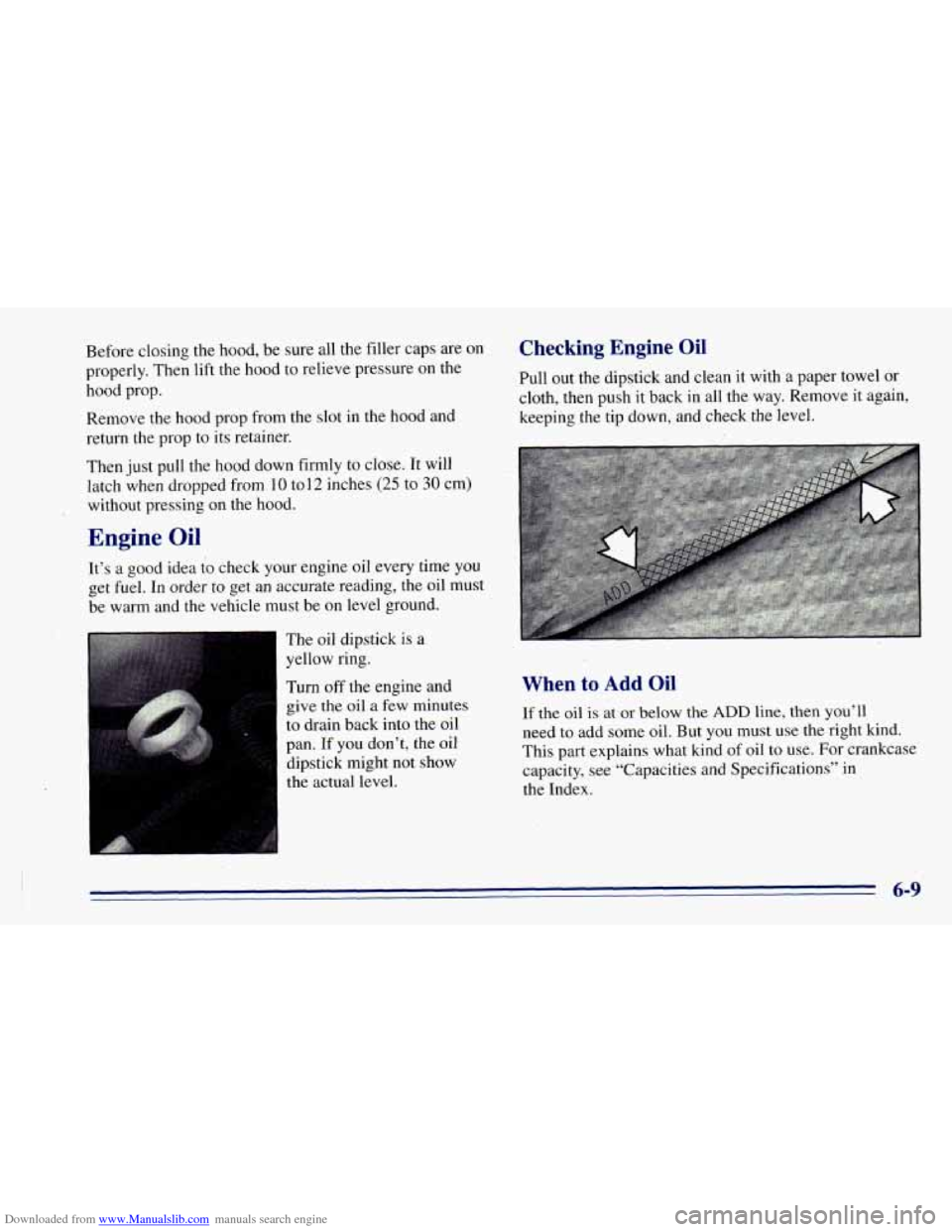
Pull out the dipstick and clean it with a paper towel or,
cloth, then push it back in all the way. Remove it again,
keeping the tip down, and check the level.
When to Add Oil
If the oil is at or below the ADD line, then you’ll
need to add some oil. But you must use the right kind.
This part explains what kind of
oil to use. For crankcase
capacity, see “Capacities and Specifications” in
the Index.
6-9
Page 298 of 392
Downloaded from www.Manualslib.com manuals search engine Using Solvent-Type Cleaner on Fabric
First, see if you have to use solvent-type cleaner at all.
Some spots and stains will clean off better with just
water and mild soap.
If
you need to use a solvent:
Gently scrape excess soil from the trim material with a
clean, dull knife or scraper. Use very little cleaner, light
pressure
and clean cloths (preferably cheesecloth).
Cleaning should start at the outside of the stain,
.. “featheri-ng” tgward the center. Keep changing to a
clean section
of the cloth.
When you clean a stain from tdbric, immediately
dry the area with a blow dryer
to help prevent a
cleaning ring.
Fabric Protection
Your vehicle has upholstery and carpet that has been
treated with Scotchgard” Fabric Protector, a
3M
product. It protects fabrics by repelling oil and water,
which are
the carriers of most stains. Even with this
protection,
you still need to clean your upholstery and
carpet often
to keep it looking new.
Further information
on cleaning is available by calling
1-800-433-3296 (in Minnesota, 1-800-642-6 167).
Special Cleaning Problems
Greasy or Oily Stains
Stains caused by grease, oil, butter, margarine, shoe
polish, coffee with cream, chewing gum, cosmetic
creams, vegetable oils, wax crayon, tar and asphalt can
be removed as follows:
0 Carefully scrape off excess stain.
0 Follow the solvent-type instructions described
earlier.
Shoe polish, wax crayon, tar and asphalt will stain
if left on a vehicle’s seat fabric. They should be
removed as soon as possible. Be careful, because
the cleaner will dissolve them and may cause them
to spread.
Non-Greasy Stains
Stains caused by catsup, coffee (black), egg, fruit, fruit
juice, milk, soft drinks, wine, vomit, urine and blood can
be removed as follows:
J
Carefully scrape off excess stain, then sponge the
soiled area
with cool water.
If a stain remains, follow the foam-type instructions
described earlier.
6-50
Page 301 of 392
Downloaded from www.Manualslib.com manuals search engine Cleaning the Outside of Your Vehicle
The paint finish on your vehicle provides beauty, depth
of color, gloss retention and durability.
Washing Your Vehicle
The best way to preserve your vehicle’s finish is to
keep it clean by washing it often with lukewarm or
cold water.
Don’t wash your vehicle in the direct rays of the sun.
Don’t
use strong soaps or chemical detergents. Use
liquid hand, dish or car washing (mild detergent) soaps.
Don’t use cleaning agents that are petroleum based, or
that contain acid or abrasives. All cleaning agents
should be flushed promptly and not allowed to dry on
the surface, or they could stain. Dry the finish
with a
soft, clean chamois or a
100% cotton towel to avoid
surface scratches and water spotting.
High pressure car washes may cause water to enter
your vehicle.
Finish Care
Occasional waxing or mild polishing of your vehicle by
hand may be necessary
to remove residue from the paint
finish. You can get GM-approved cleaning products
from your dealer. (See “Appearance Care
and Materials’’
in the Index.),
Your vehicle
has a “basecoatklearcoat” paint finish.
The clearcoat gives more depth
and gloss to the
colored basecoat. Always use waxes and polishes that
are non-abrasive and made for a basecoatklearcoat
paint finish.
I NOTICE:
Machine compounding or aggressive polishing on
a basecoatklearcoat paint finish may
dull the
finish or leave swirl marks.
Foreign materials such as calcium chloride and other
salts, ice melting agents, road oil and tar, tree sap, bird
droppings, chemicals from industrial chimneys, etc. can
damage your vehicle’s finish
if they remain on painted
surfaces. Wash the vehicle as soon as possible.
If
6-53