1996 CHEVROLET BLAZER key
[x] Cancel search: keyPage 235 of 392
Downloaded from www.Manualslib.com manuals search engine Turn the wheel wrench counterclockwise to lower the
spare tire. Keep turning the wheel wrench until the spare
tire can be pulled
out from under the vehicle.
When the tire has been completely lowered,
tilt the
retainer at
the end of the cable and pull it through the
wheel opening. Pull the tire out from under
the vehicle.
I NOTICE:
I
To help avoid vehicle damage, do not drive the
vehicle before the cable
is restored.
If you have an inside-mounted spare tire, the tire must
be removed
in order to have access to the jack storage. The
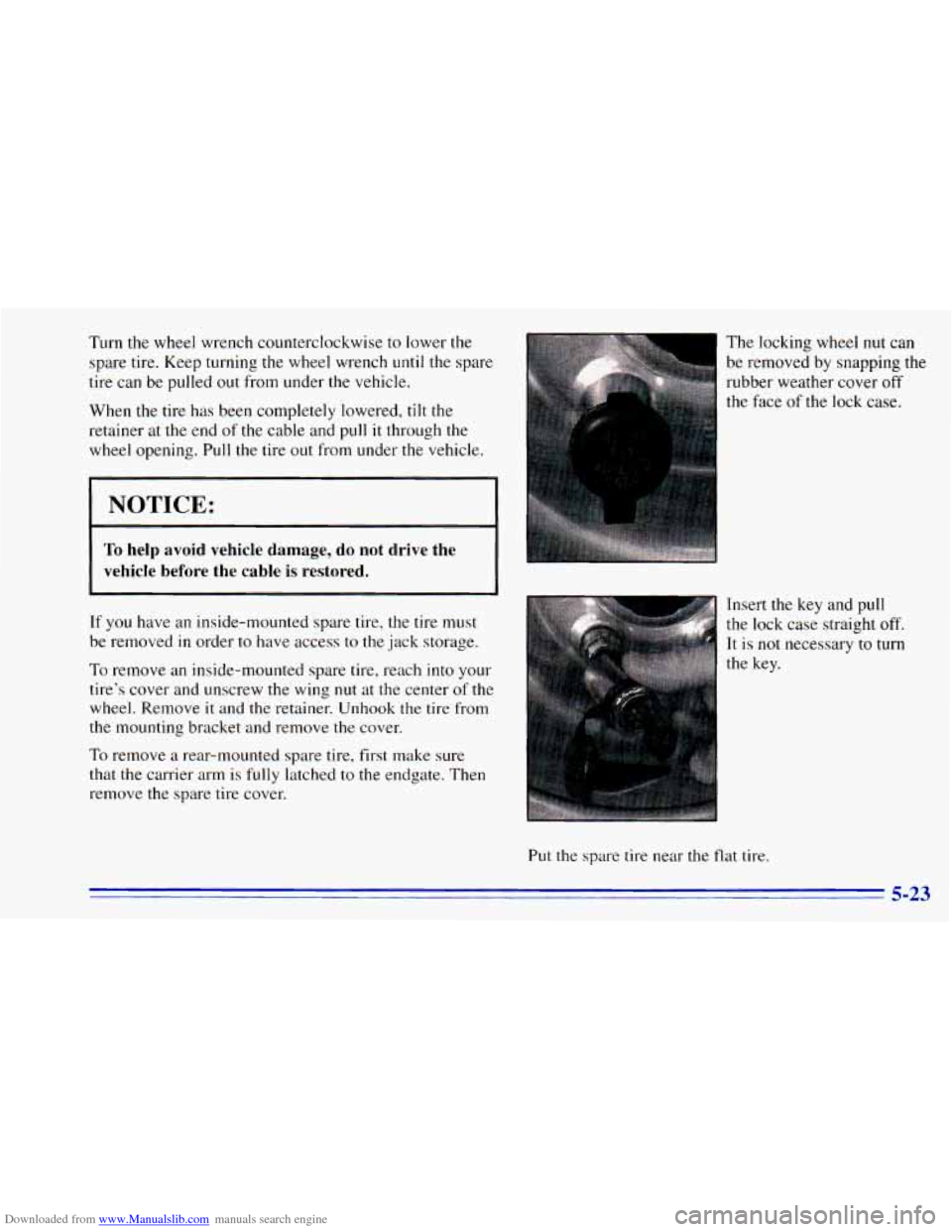
locking wheel nut can
be removed by snapping
the
rubber weather cover off
the face
of the lock case.
Insert the key and pull
the lock case straight off.
It is
not necessary to turn
To remove an inside-mounted spare tire, reach into your
tire’s cover and unscrew
the wing nut at the center of the
wheel. Remove
it and the retainer. Unhook the tire from
the mounting bracket and remove
the cover.
To remove a rear-mounted spare tire, first make sure
that the carrier arm
is fully latched to the endgate. Then
remove the spare tire cover.
Put the spare tire near the flat tire.
5-23
Page 243 of 392
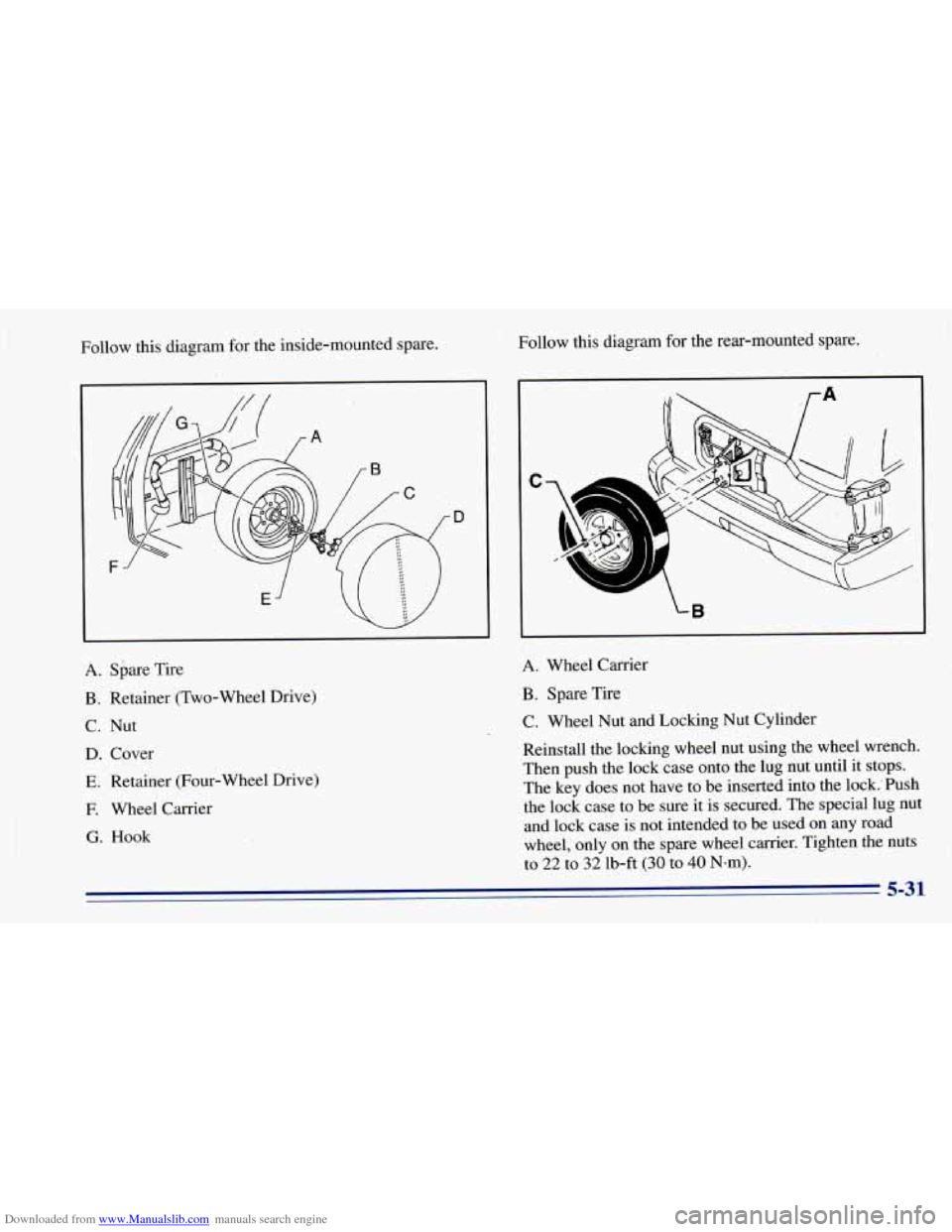
Downloaded from www.Manualslib.com manuals search engine Follow this diagram for the inside-mounted spare.
D
A. Spare Tire
B. Retainer (Two-Wheel Drive)
C. Nut
D. Cover
E. Retainer (Four-wheel Drive)
E Wheel Carrier
G. Hook Follow this diagram
for the rear-mounted spare.
A. Wheel Carrier
B. Spare Tire
C. Wheel Nut and Locking Nut Cylinder
Reinstall the locking wheel nut using the wheel wrench.
Then push the lock case onto the lug nut until it stops.
The key does not have to be inserted into. the 1ock:Push
the lock case
to be sure it is secured. The special lug nut
and lock case is not intended to be used on
any road
wheel, only on the spare wheel carrier. Tighten the nuts
to
22 to 32 lb-ft (30 to 40 N-m).
5-31
Page 308 of 392

Downloaded from www.Manualslib.com manuals search engine FuseKircuit Usage
Breaker
1
2
3
FuseKircuit Usage
Breaker
A
B
Power Door Locks, Power Seat,
Power Seat Lumbar, Remote Keyless Entry
Power Windows 4
Stoplamps, Hazard Lamps, Chime,
Center High-Mounted Stoplamp
Relay, Center High-Mounted
Stoplamp
Dome Lamps, Cargo Lamps, Visor
Vanity Mirror, Cigarette Lighter,
Inside Rearview Mirror Lamp,
Overhead Console Lamps, Glove
Box
Lamp, Horns, Horn Relay, IP
Courtesy Lamps, Power Outside
Rearview Mirror, Liftglass Release
Motor, Illuminated Entry Module
Parking Lamps, License Plate Lamps,
Electric Shift Transfer Case Module,
Underhood Lamp, Rear Wiper,
Ashtray Lamp, Door Switch Lamp
Alternator Field, A/C Compressor
Relay, Cluster Chime Module, DRL
Relay Coil, Four-Wheel-Drive
Indicator Lamp, DRL Module, Rear
Defog Timer, Transfer Case Control
Module Ignition, SIR Redundant
Ignition, RKE Ignition
6-60
Page 360 of 392
Downloaded from www.Manualslib.com manuals search engine At Least Twice a Year
Restraint System Check
Make sure the safety belt reminder light and all your
belts, buckles, latch plates, retractors and anchorages are working properly. Look for any other loose or damaged
safety belt system parts. If
you see anything that might
keep a safety belt system from doing its job, have
it
repaired. Have any torn or frayed safety belts replaced.
Also look for any opened or broken air bag covers, and
have them repaired or replaced. (The air bag system
does not need regular maintenance.)
Manual Transmission Check
Check the transmission fluid level; add if needed.
See “Manual Transmission” in the Index.
A fluid loss
may indicate a problem. Check the system and repair
if needed.
Automatic Transmission Check
Check the transmission fluid level; add if needed. See
“Automatic Transmission” in the Index.
A fluid loss
may indicate a problem. Check the system and repair
if needed.
Hydraulic Clutch System Check
Check the fluid level in the clutch reservoir. See
“Hydraulic Clutch Fluid” in the Index.
A fluid loss in
this system could indicate a problem. Have the system
inspected and repaired at once.
At Least Once a Year
Key Lock Cylinders Service
Lubricate the key lock cylinders with the lubricant
specified in Part
D.
Body Lubrication Service
Lubricate all body door and fuel door hinges, rear
compartment hinges, latches and locks including the
glove box, console doors and
the body hood and any
moving seat hardware. Lubricate the hood safety lever
pivot and prop rod pivot. Part
D tells you what to use.
More frequent lubrication may be required when
exposed to a corrosive environment.
7-48
Page 361 of 392
Downloaded from www.Manualslib.com manuals search engine Starter Switch Check
When you are doing this check, the vehicle could
move suddenly. If it does, you or others could be
injured. Follow the steps below. Brake-Transmission Shift Interlock
(BTSI) Check
(Automatic Transmission)
1. Before you start, be sure you have enough room
around the vehicle.
2. Firmly apply both the parking brake (see “Parking
Brake” in the Index if necessary) and the regular brake.
NOTE: Do not use the accelerator pedal, and be
ready to turn
off the engine immediately if it starts.
3. On automatic transmission vehicles, try to start the
engine
in each gear. The starter should work only in
PARK (P) or NEUTRAL
(N). If the starter works in
any other position, your vehicle needs service.
On manual transmission vehicles, put the shift lever
in NEUTRAL (N), push the clutch down halfway
and try
to start the engine. The starter should work
only when
the clutch is pushed down all the way to
the floor. If the starter works when the clutch isn’t
pushed all the way down,
your vehicle needs service.
When you are doing this check, the vehicle could
move suddenly.
If it does, you or others could be
injured. Follow the steps below.
1. Before you start, be sure you have enough room
around the vehicle. It should be parked
on a
level surface.
2. Firmly apply the parking brake (see “Parking Brake”
in the Index if necessary).
NOTE: Be ready to apply the regular brake
immediately
if the vehicle begins to move.
3. With the engine off, turn the key to the RUN
position, but don’t start the engine. Without applying
the regular brake, try to move the shift lever out of
PARK (P) with normal effort. If the shift lever
moves out
of PARK (P), your vehicle’s BTSI
needs service.
7-49
Page 362 of 392
Downloaded from www.Manualslib.com manuals search engine Steering Column Lock Check While parked, and with the parking brake set, try to turn
the key to LOCK in each shift lever position.
With an automatic transmission, the key should turn
to LOCK only when the shift lever
is in PARK (P).
With a manual transmission, the key should
turn to LOCK only when the shift lever is in
REVERSE (R).
On vehicles with a key release button, try to turn the key
to LOCK without pressing the button. The key should
turn to LOCK only when
you press the key button.
On
dl vehicles, the key should come out only in LOCK.
.f
Parking Brake and Automatic Transmission
PARK
(P) Mechanism Check
/! CAUTION:
When you are doing this check, your vehicle
could begin to move. You or others could be
injured and property could be damaged, Make
sure there
is room in front of your vehicle in case
it begins to roll, Be ready to apply the regular
brake at once should the vehicle begin to move.
Park
on a fairly steep hill, with the vehicle facing
downhill. Keeping your
foot on the regular brake, set the
parking brake.
To check the parking brake: With the engine running
and transmission in
NEUTRAL (N), slowly remove
foot pressure from the regular brake pedal. Do this
until the vehicle is held by the parking brake
only.
To check the PARK (P) mechanism’s holding ability:
With the engine running, shift
to PARK (P). Then
release all brakes.
7-50
Page 366 of 392
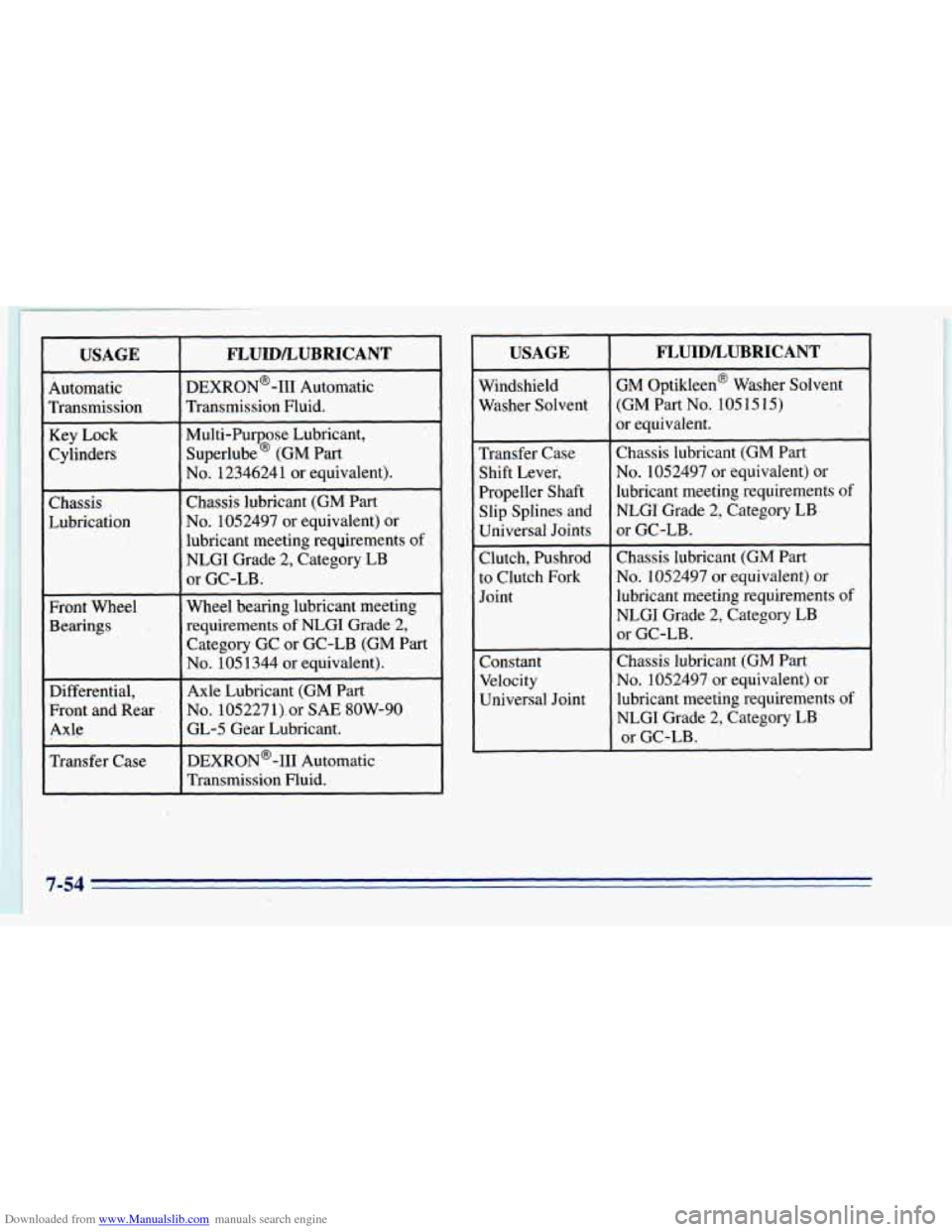
Downloaded from www.Manualslib.com manuals search engine USAGE
Automatic
Transmission
Key Lock
Cylinders
-~ ~~~
Chassis
Lubrication
Front Wheel
Bearin
Differential,
Front and Rear
Axle
FLUID/LUBRICANT
DEXRON@-I11 Automatic
Transmission Fluid.
Multi-Purpose Lubricant, Superlube
@ (GM Part
No. 12346241 or equivalent).
Chassis lubricant (GM Part
No. 1052497 or equivalent) or
lubricant meeting requirements of
NLGI Grade
2, Category LB
or GC-LB;
Wheel bearing lubricant meeting requirements of
NLGI Grade 2,
Category GC or GC-LB (GM Part
No. 105 1344 'or equivalent).
Axle Lubricant (GM Part
No. 1052271)-or
SAE 8OW-90
GL-5 Gear Lubricant.
'
DEXRON@-I11 Automatic
Transmission Fluid.
USAGE
Windshield
Washer Solvent
Transfer Case Shift Lever,
Propeller Shaft
Slip Splines and
Universal Joints
~~
Clutch, Pushrod
to Clutch Fork
Joint
Constant Velocity
Universal Joint
FLUIDILUBRICANT
GM Optikleen' Washer Solvent
(GM Part No.
1051515)
or equivalent. .
Chassis lubricant (GM Part
No. 1052497 or equivalent) or
lubricant meeting requirements of
NLGI Grade
2, Category LB
or GC-LB.
Chassis lubricant (GM Part
No. 1052497 or equivalent) or
lubricant meeting requirements of
NLGI Grade 2, Category LB
or
GC-LB.
Chassis lubricant (GM Part
No. 1052497
or equivalent) or
lubricant meeting requirements of
NLGI Grade
2, Category LB
or GC-LB.
Page 374 of 392
Downloaded from www.Manualslib.com manuals search engine Chevrolet Roadside Assistance Program
To enhance Chevrolet’s strong commitment to customer
satisfaction, Chevrolet
is excited to announce the
establishment of the Chevrolet/Geo Roadside Assistance
Center. As the owner
of a 1996 Chevrolet/Geo,
membership in Roadside Assistance is free. Roadside Assistance is available
24 hours a day,
365 days a year, by
calling 1-800-CHEV-USA
(1 -800-243-8872). This toll-free number will provide
you over-the-phone roadside assistance with minor
mechanical problems. If your problem cannot be
resolved over the phone, our advisors have access
to a
nationwide network of dealer recommended service
providers. Roadside membership is free, however some
services may incur costs.
Roadside offers two levels
of service to the customer,
Basic Care and Courtesy” Care:
0 Toll-free number, 1 -800-CHEV-USA
0 Free towing for warranty repairs
0 Basic over-the-phone technical advice
0 Available dealer services at reasonable costs (ie.,
wrecker services, locksmith/key service, glass
repair, etc.)
ROADSIDE
Courtesy” Care PROVIDES:
Roadside Basic Cure services (as outlined above)
0 FREE Non-Warranty Towing (to the closest dealer
Plus:
from a legal roadway)
8-4