1996 CHEVROLET BLAZER four wheel drive
[x] Cancel search: four wheel drivePage 197 of 392
Downloaded from www.Manualslib.com manuals search engine Run your engine only as long as you must. This saves
fuel. When
you run the engine, make it go a little faster
than just idle. That
is, push the accelerator slightly. This
uses less fuel for the heat that
you get and it keeps the
battery charged. You will need a well-charged battery
to
restart the vehicle, and possibly for signaling later on
with your headlamps. Let the heater run for awhile.
Then, shut the engine off and close the window almost
all
the way to preserve the heat. Start the engine again
and repeat this
only when you feel really uncomfortable
from the cold. But
do it as little as possible. Preserve the
fuel as long as you can. To help keep warm, you can get
out
of the vehicle and do some fairly vigorous exercises
every half hour or
so until help comes.
Recreational Vehicle Towing
(Four-wheel Drive Only)
1. Set the parking brake firmly.
2. Place an automatic transmission in PARK (P) or a
manual transmission
in FIRST (1).
3. Firmly attach the vehicle being towed to the tow
vehicle.
Do not tow the vehicle by the rear bumper
bar. Refer to the hitch manufacturer’s instructions.
4. Place the transfer case shift lever in NEUTRAL (N).
Recreational vehicle towing is not recommended for
vehicles with
the optional electronic shift transfer
case or all-wheel drive because the transfer cases
have
no neutral position.
Shifting the transfer case into NEUTRAL (N) can
cause your vehicle to roll even if the transmission
is in PARK (P), for an automatic transmission,
or if your vehicle is in gear, for a manual
transmission. This is because the transfer case
overrides the transmission.
5. Release the parking brake only after the vehicle
being towed is firmly attached to the tow vehicle.
6. Insert the ignition key into the ignition switch and
turn it
one notch forward of the LOCK position. This
places the key
in the OFF position, which unlocks
the steering column while preventing battery drain.
Unlocking the steering column will allow for proper
movement
of the front wheelshires during towing.
4-43
Page 202 of 392
Downloaded from www.Manualslib.com manuals search engine If you have an automatic transmission, you should
use DRIVE
(D) (or, as you need to, a lower gear)
when towing a trailer. Operating your vehicle
in
DRIVE (D) when towing a trailer will minimize heat
buildup and extend the life of your transmission. If
you have a manual transmission and you are towing
a trailer, it’s better not to use FIFTH (5) gear. Just
drive in FOURTH
(4) gear (or, as you need to, a
lower gear).
Three important considerations have to do with weight:
the weight of the trailer,
the weight of the trailer tongue
0 and the weight on your vehicle’s tires.
Weight of the Trailer
How heavy can a trailer safely be?
It depends on how you plan
to use your rig. For
example, speed, altitude, road grades, outside
temperature and how much your vehicle is used
to pull a
trailer are all important. And, it can also depend on any
special equipment that you have
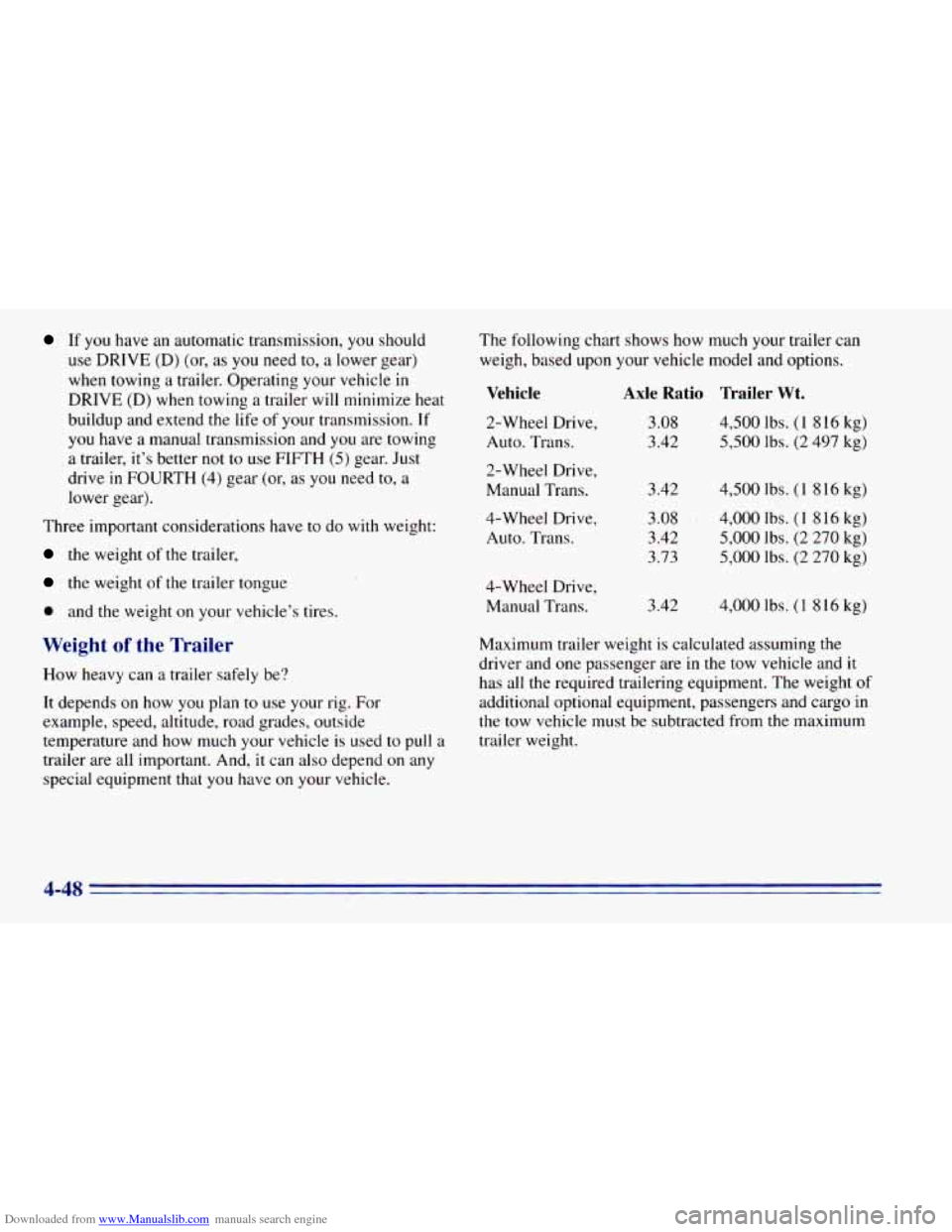
on your vehicle. The
following chart shows how much your trailer can
weigh, based upon your vehicle model and options.
Vehicle
2-Wheel Drive, Auto. Trans.
2-Wheel Drive,
Manual Trans.
4-Wheel Drive, Auto. Trans.
4-Wheel Drive, Manual Trans.
Axle Ratio Trailer Wt.
3.08
3.42
3.42 4,500
lbs. (1 816 kg)
5,500 lbs. (2 497 kg)
4,500 Ibs. (1 8 16 kg)
3.08
. 4,000 Ibs. (1 8 16 kg)
3.42
5,000 lbs. (2 270 kg)
3.73
5,000 lbs. (2 270 kg)
3.42
4,000 lbs. (1 8 16 kg)
Maximum trailer weight
is calculated assuming the
driver and one passenger are in the tow vehicle and it
has all the required trailering equipment. The weight
of
additional optional equipment, passengers and cargo in
the tow vehicle must be subtracted from the maximum
trailer weight.
4-48
Page 208 of 392
Downloaded from www.Manualslib.com manuals search engine On a long uphill grade, shift down and reduce your
speed to around
45 mph (70 kmh) to reduce the
possibility of engine and transmission overheating.
If you have
an automatic transmission, you should use
DRIVE (D) when towing
a trailer. Operating your
vehicle in DRIVE
(D) when towing a.trailer will
minimize heat buildup and extend the life of your
transmission. Or, if
you have a manual transmission,
it’s better not to use FIFTH
(5) gear, just drive in
FOURTH (4) gear (or, as you need to, a lower gear).
When towing at high altitude
on steep uphill grades,
consider the following: Engine coolant will boil at a
lower temperature than at normal altitudes. If you turn
your engine off immediately after towing at high altitude
on steep uphill grades, your vehicle may show signs
similar to engine overheating.
To avoid this, let the
engine run while parked (preferably on level ground)
with the automatic transmission in PARK
(P) (or the
manual transmission
out of gear and the parking brake
applied) for a few minutes before turning the engine off.
If
you do get the overheat warning, see “Engine
Overheating” in the Index.
Parking on Hills
You really should not park your vehicle, with a trailer
attached,
on a hill. If something goes wrong, your rig
could start to move. People can be injured, and both
your vehicle and the trailer can be damaged.
But
if you ever have to park your rig on a hill, here’s
how to
do it:
1.
2.
3.
4.
5.
6.
Apply your regular brakes, but don’t shift into
PARK
(P) yet, or into gear for a manual
transmission. Then turn your wheels into the
curb
if facing downhill or into traffic if facing uphill.
Have someone place chocks under the trailer wheels.
When the wheel chocks are
in place, release the
regular brakes
until the chocks absorb the load.
Reapply the regular brakes.
Then apply your
parking brake, and then shift into PARK (P), or
REVERSE
(R) for a manual transmission.
If
you have a four-wheel-drive vehicle with a
manual transfer case shift lever, be sure the transfer
case is
in a drive gear -- not in NEUTRAL (N).
Release the regular brakes.
4-54
Page 209 of 392
Downloaded from www.Manualslib.com manuals search engine A CAUTION:
- - -
It can be dangerous to get out of your vehicle if
the shift lever is not fully in
PARK (P) with the
parking brake firmly set. Your vehicle can roll.
If you have left the engine running, the vehicle
can move suddenly. You or others could be
injured.
To be sure your vehicle won’t move, even
when you’re on fairly level ground, use the steps
that follow.
If you have four-wheel drive with a manual
transfer case shift lever and your transfer case is
in
NEUTRAL (N), your vehicle will be free to
roll, even if your shift lever is in
PARK (P). So, be
sure the transfer case is in a drive gear
-- not in
NEUTRAL (N).
When You Are Ready to Leave After
Parking on
a Hill
1. Apply your regular brakes and hold the pedal down
while you:
0 Start your engine;
0 Shift into a gear; and
Release the parking brake.
2. Let up on the brake pedal.
3. Drive slowly until the trailer is clear of the chocks.
4. Stop and have someone pick up and store the chocks.
4-55
Page 215 of 392
Downloaded from www.Manualslib.com manuals search engine 2. Get the vehicles close enough so the jumper cables
can reach, but be sure the vehicles aren’t touching
each other.
If they are, it could cause a ground
connection
you don’t want. You wouldn’t be able to
start your vehicle, and the bad grounding could
damage the electrical systems.
You could be injured if the vehicles roll. Set the
parking brake firmly on each vehicle. Put an
automatic transmission
in PARK (P) or a manual
transmission in NEUTRAL (N). If
you have a
four-wheel-drive vehicle with a manual transfer
case shift lever, be sure the transfer case is
not in
NEUTRAL (N).
3. Turn off the ignition on both vehicles. Unplug
unnecessary accessories plugged
into the cigarette
lighter, or accessory power outlets,
if you have this
option. Turn
off all lamps that aren’t needed as well
as radios. This will avoid sparks and help save both
batteries.
In addition, it could save your radio!
NOTICE:
If you leave your radio on, it could be badly
damaged. The repair wouldn’t be covered by
your warranty.
I A CAUTION:
If your vehicle has air conditioning, the auxiliary
electric fan under the hood can
start up even
when the engine is not running and can injure
you. Keep hands, clothing and tools away from
any underhood electric fan.
5-3
Page 219 of 392
Downloaded from www.Manualslib.com manuals search engine Towing Your Vehicle
Try to have a GM dealer or a professional towing
service tow your vehicle. See “Roadside Assistance” in
the Index.
If your vehicle has been changed since it was
factory-new by adding things like fog lamps, aero
skirting, or special tires and wheels, these instructions
may not be correct.
,Before you do anything, turn on the hazard
warning flashers.
When
you call, tell the towing service:
Whether your vehicle has rear-wheel drive,
The make, model and year of your vehicle.
Whether you can move the shift lever for the
four-wheel drive
or all-wheel drive.
transmission and shift the transfer case,
if you
have one.
If there was an accident, what was damaged.
When the towing service arrives, let the tow operator
know that this manual contains these towing instructions. The operator may want to see them.
I A CAUTION:
-
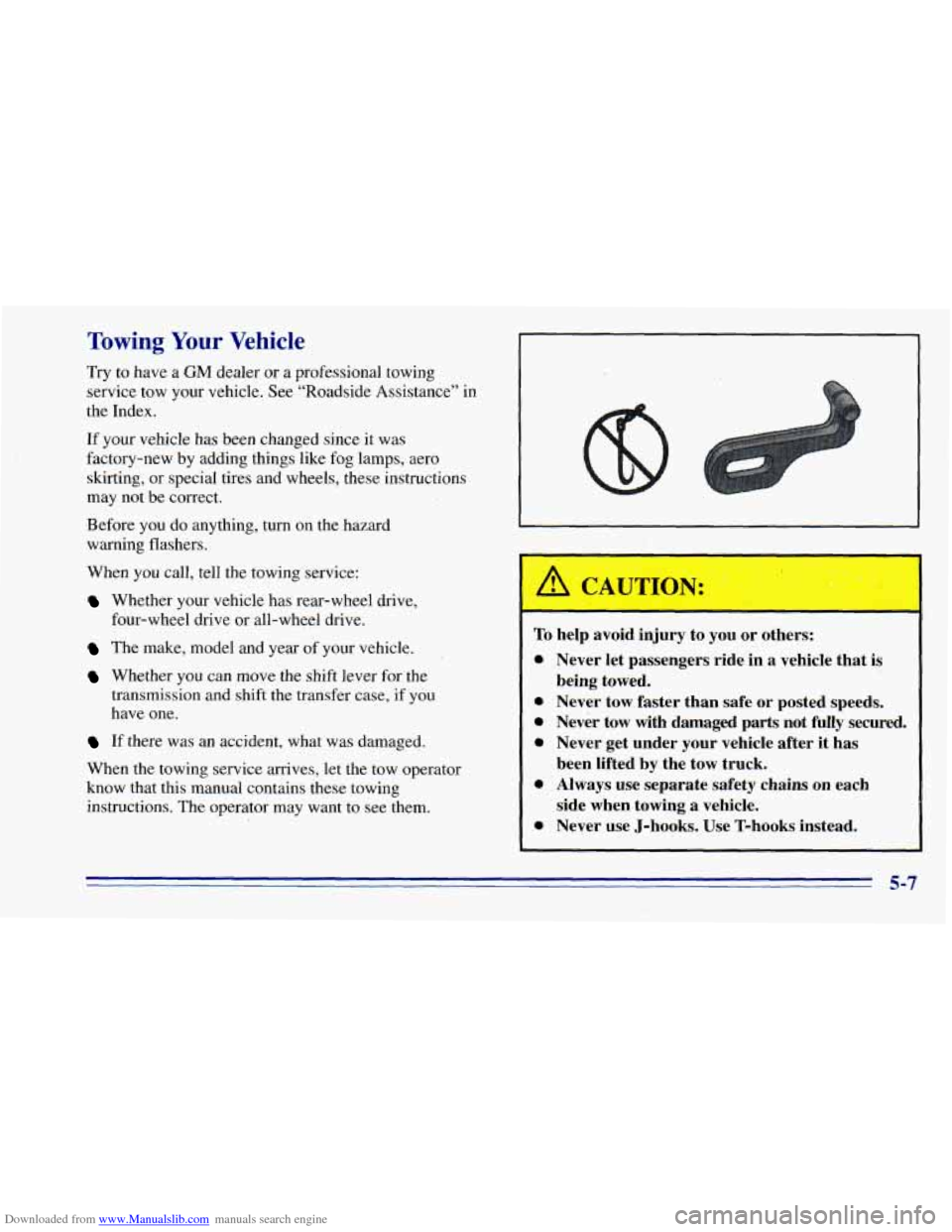
To help avoid injury to you or others:
0 Never let passengers ride in a vehicle that is
0 Never tow faster than safe or posted speeds.
0 Never tow with damaged parts not fully secured.
0 Never get under your vehicle after it has
0 Always use separate safety chains on each
0 Never use J-hooks. Use T-hooks instead.
being
towed.
been lifted by the tow truck.
side when towing a vehicle.
5-7
Page 221 of 392
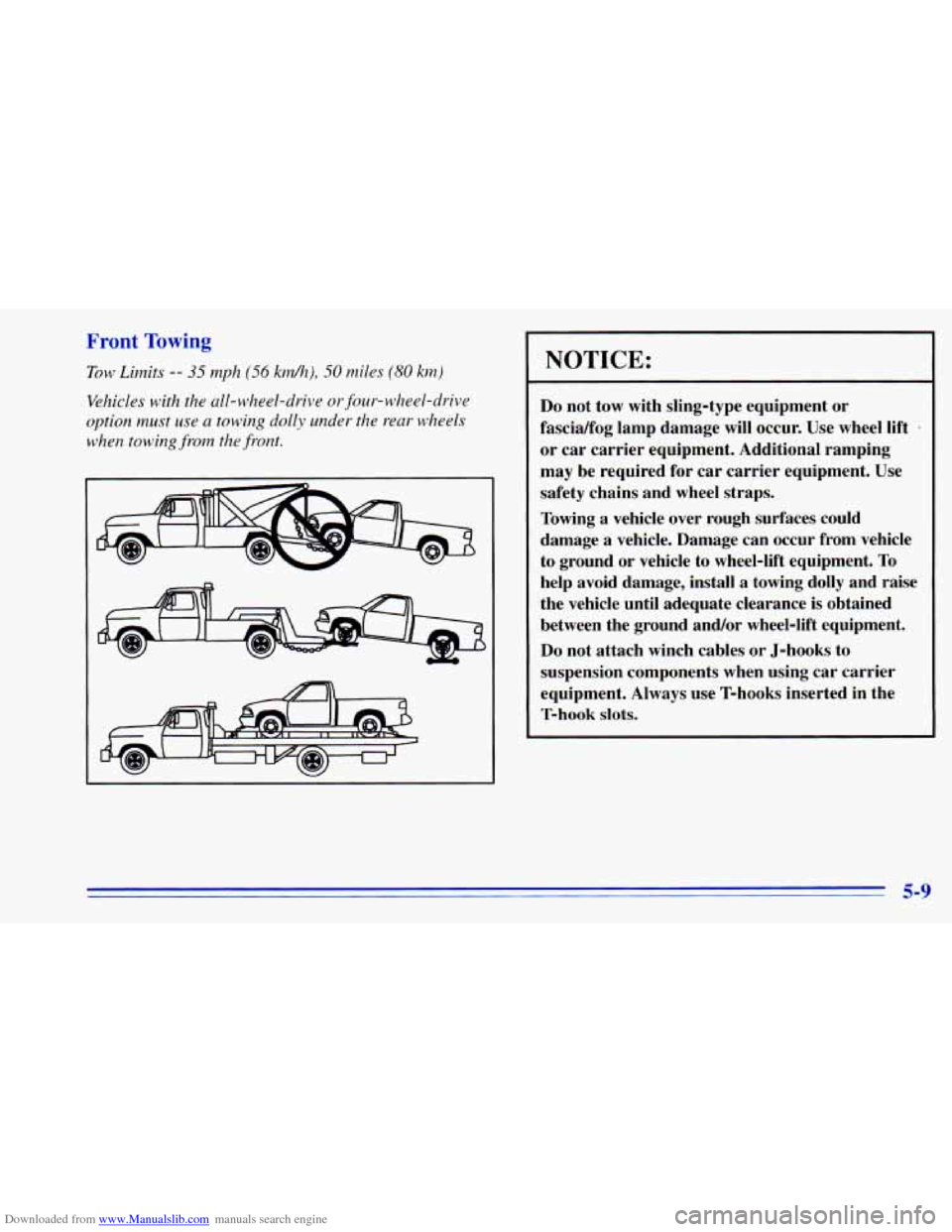
Downloaded from www.Manualslib.com manuals search engine Front Towing
Tow Limits -- 35 mph (56 kd?), 50 miles (80 kin)
Vehicles with the all-wheel-drive or four-wheel-drive
option must use
a towing dolly under the rear wheels
when towing
from the front.
I
NOTICE:
Do not tow with sling-type equipment or
fascia/fog lamp damage will occur, Use wheel lift
or car carrier equipment. Additional ramping
may be required for car carrier equipment. Use
safety chains and wheel straps.
Towing
a vehicle over rough surfaces could
damage
a vehicle. Damage can occur from vehicle
to ground or vehicle to wheel-lift equipment,
To
help avoid damage, install a towing dolly and raise
the vehicle until adequate clearance is obtained
between the ground and/or wheel-lift equipment.
Do not attach winch cables or J-hooks to
suspension components when using car carrier
equipment, Always use T-hooks inserted in the
T-hook
slots.
- 5-9
Page 222 of 392
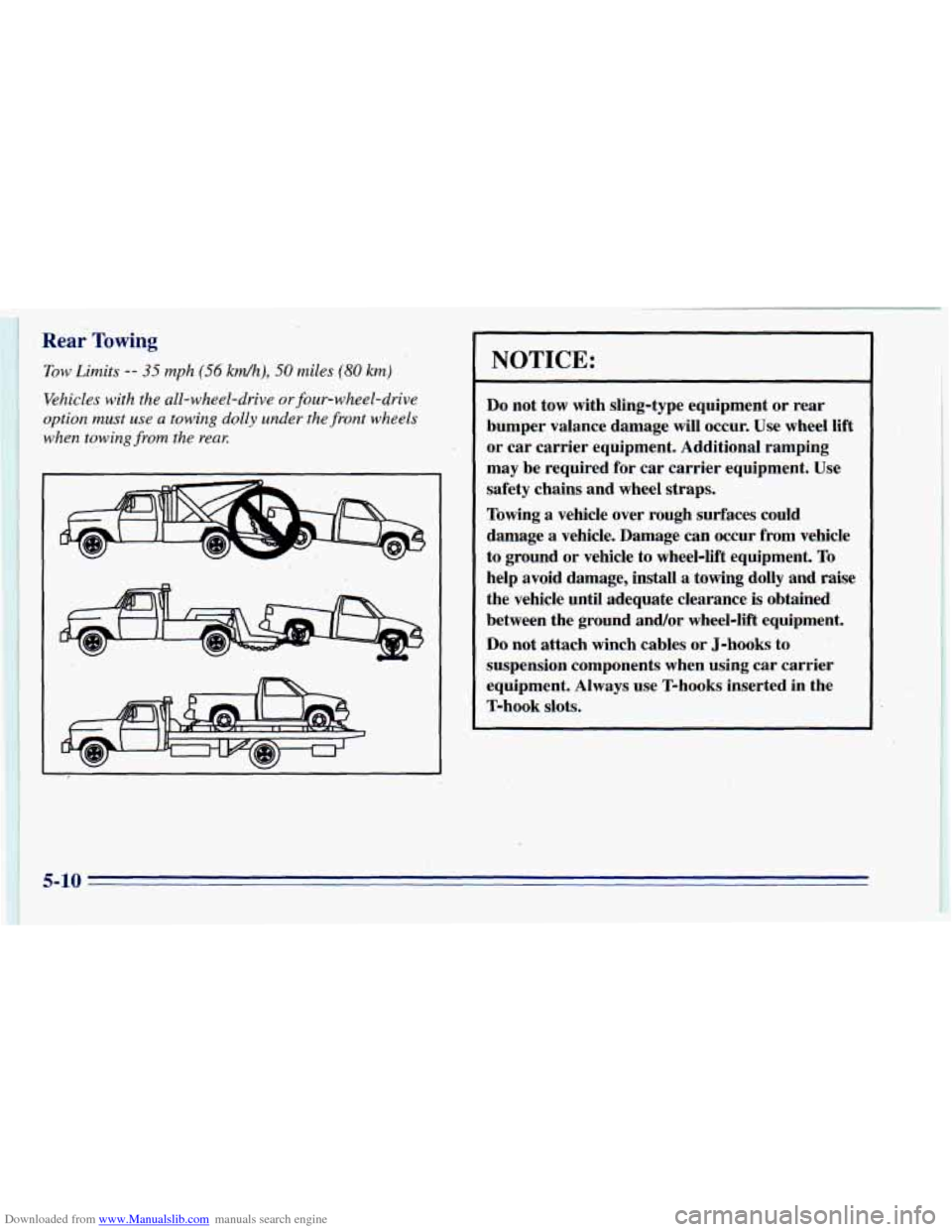
Downloaded from www.Manualslib.com manuals search engine Rear Towing
Tow Limits -- 35 mph (56 kh), 50 miles (80 km)
Vehicles with the all-wheel-drive or four- wheel-drive
option must use a towing dolly under the front
wheels
when towing from the real:
NOTICE:
Do not tow with sling-type equipment or rear
bumper valance damage will occur. Use wheel lift
or car carrier equipment. Additional ramping may be required for car carrier equipment. Use
safety chains and wheel straps.
Towing a vehicle over rough surfaces could
damage
a vehicle. Damage can occur from vehicle
to ground or vehicle to wheel-lift equipment. To
help avoid damage, install a towing dolly and raise
the vehicle until adequate clearance is obtained
between the ground and/or wheel-lift equipment.
Do not attach winch cables or J-hooks
to
suspension components when using car' carrier
equipment. Always use ,T-hooks inserted in the
T-hook slots.