1996 CHEVROLET BLAZER four wheel drive
[x] Cancel search: four wheel drivePage 233 of 392
Downloaded from www.Manualslib.com manuals search engine Changing a Flat Tire
If a tire goes flat, avoid further tire and wheel damage
by driving slowly to a level place. Turn on your hazard
warning flashers.
Changing
a tire can cause an injury. The vehicle
can slip
off the jack and roll over you or other
people. You and they could be badly injured.
Find
a level place to change your tire. To help
prevent the vehicle from moving:
1. Set the parking brake firmly.
2. Put an automatic transmission shift lever in
PARK (P) or shift
a manual transmission to
FIRST (1)
or REVERSE (R).
3. If you have a four-wheel-drive vehicle
with
a manual transfer case shift lever,
be sure the transfer case is in
a drive
gear
-- not in NEUTRAL (N).
CAUTION: (Continued) CAUTION: (Continued)
4. Turn off the
engine.
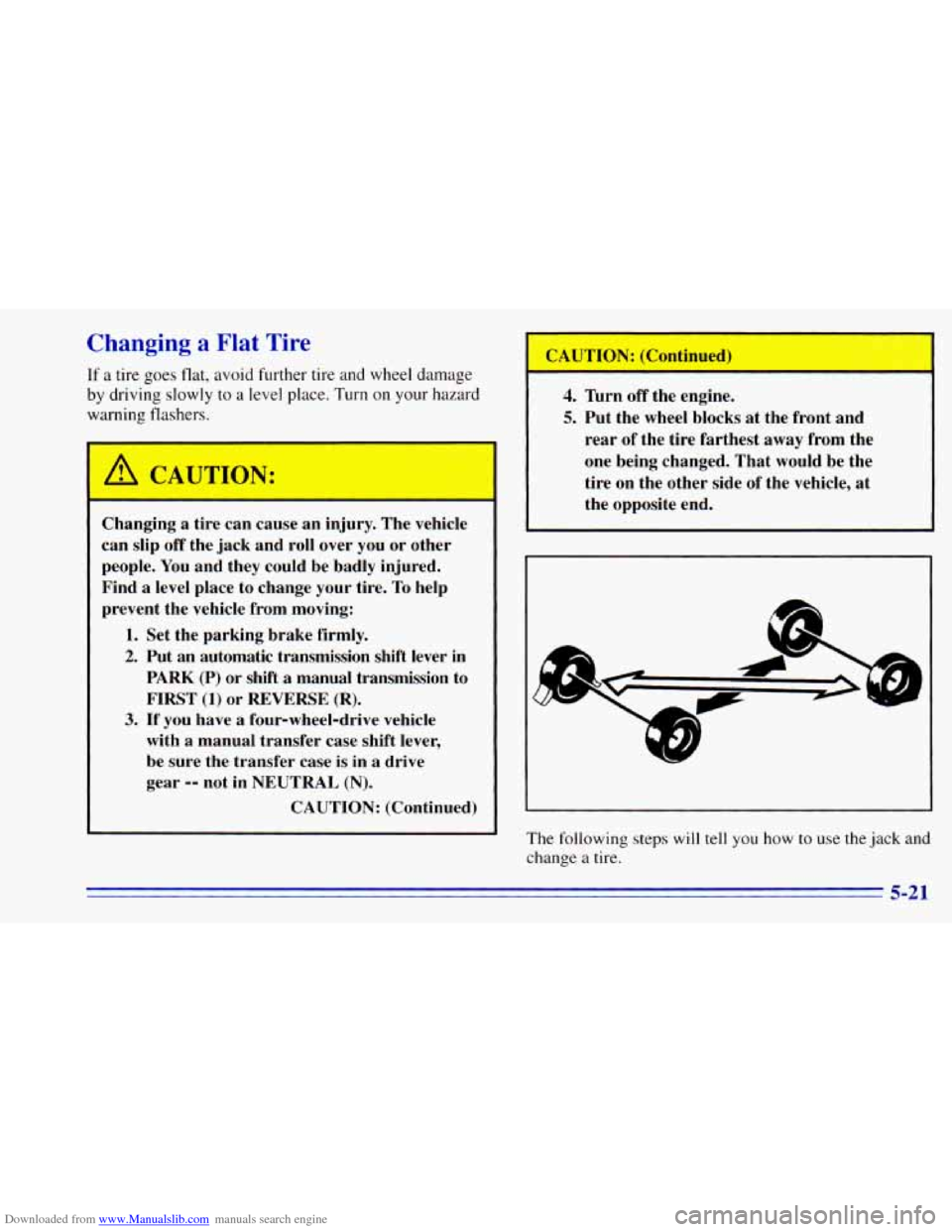
5. Put the wheel blocks at the front and
rear of the tire farthest away from the
one being changed. That would be the
tire on the other side of the vehicle,
at
the opposite end.
The following steps will tell
you how to use the jack and
change a tire.
5-21
Page 243 of 392
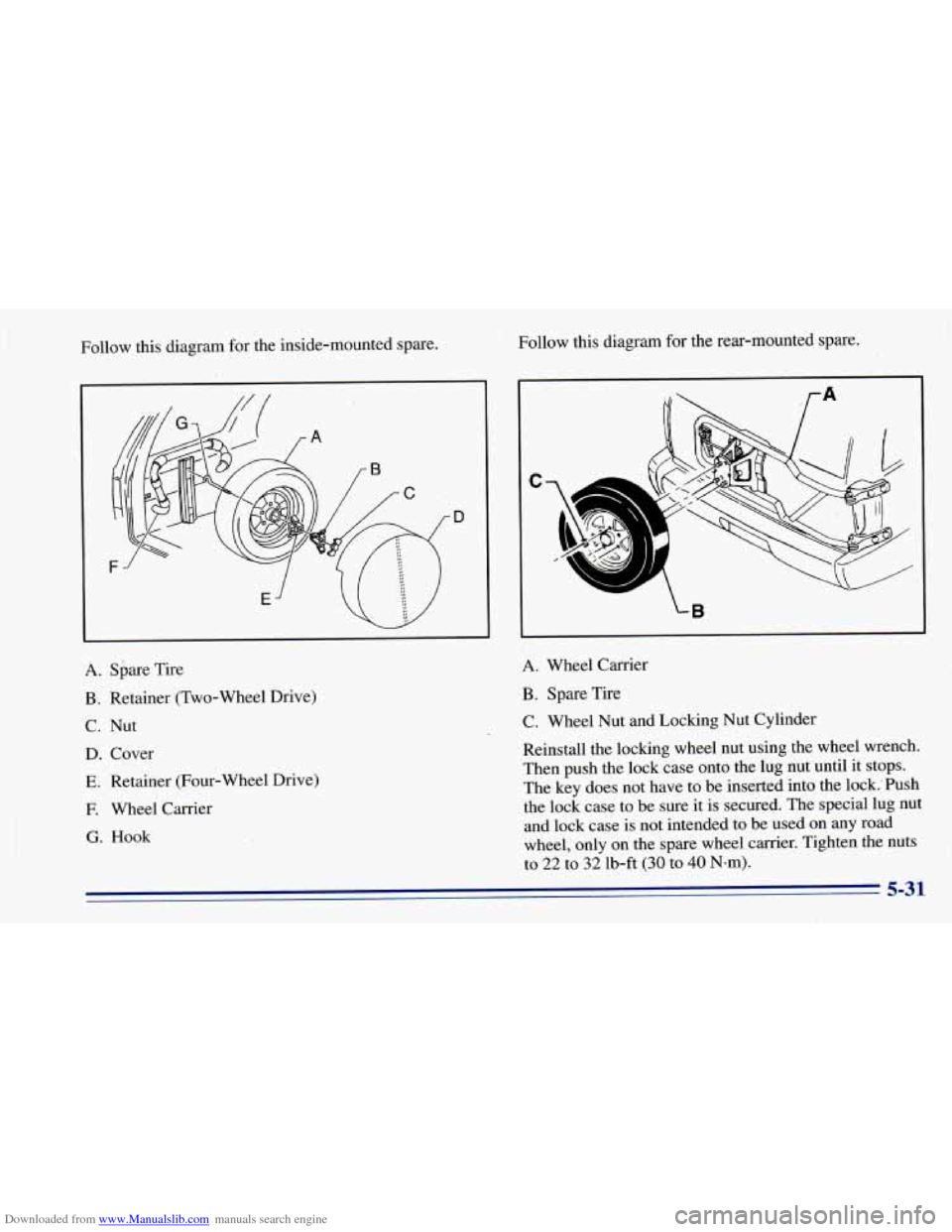
Downloaded from www.Manualslib.com manuals search engine Follow this diagram for the inside-mounted spare.
D
A. Spare Tire
B. Retainer (Two-Wheel Drive)
C. Nut
D. Cover
E. Retainer (Four-wheel Drive)
E Wheel Carrier
G. Hook Follow this diagram
for the rear-mounted spare.
A. Wheel Carrier
B. Spare Tire
C. Wheel Nut and Locking Nut Cylinder
Reinstall the locking wheel nut using the wheel wrench.
Then push the lock case onto the lug nut until it stops.
The key does not have to be inserted into. the 1ock:Push
the lock case
to be sure it is secured. The special lug nut
and lock case is not intended to be used on
any road
wheel, only on the spare wheel carrier. Tighten the nuts
to
22 to 32 lb-ft (30 to 40 N-m).
5-31
Page 260 of 392
Downloaded from www.Manualslib.com manuals search engine When to Change Engine Oil
See if any one of these is true for you:
e
0
0
e
e
Most trips are less than 5 to 10 miles (8 to 16 km),
This is particularly important when outside
temperatures are below freezing.
Most trips include extensive idling (such as frequent
driving in stop-and-go traffic).
You operate your vehicle in dusty areas or off-road
frequently.
You frequently tow a trailer or use a carrier on top of
your vehicle.
The vehicle is used for delivery service, police, taxi
or other commercial application.
Driving under these conditions causes engine oil
to
break down sooner. If any one of these is true for your
vehicle, then you need to change your oil and filter
every
3,000 miles (5 000 km) or 3 months -- whichever
occurs first.
If none of them is true, change the oil and filter every
7,500 miles (12 500 km) or 12 months -- whichever
occurs first. Driving a vehicle with a
fully warmed
engine under highway conditions causes engine oil
to
break down slower.
Remote Oil Filter (Four-Wheel Drive)
The access door for the remote oil filter is in the steering
linkage shield assembly located under the radiator
support. Twist the screw to unlock or lock the door.
What to Do with Used Oil
Did you know that used engine oil contains certain
elements that may be unhealthy for your skin and could
even cause cancer? Don’t let used oil stay
on your skin
for very long. Clean
your skin and nails with soap and
water, or a good hand cleaner. Wash or properly throw
away clothing or rags containing used engine oil. (See
the manufacturer’s warnings about the use and disposal
of
oil products.)
Used oil can be a real threat to the environment.
If you
change your own oil, be sure to drain all free-flowing oil
from the filter before disposal. Don’t ever dispose of oil
by putting
it in the trash, pouring it on the ground, into
sewers, or into streams or bodies
of water. Instead,
recycle
it by taking it to a place that collects used oil. If
you have a problem properly disposing of your used oil,
ask your dealer, a service station or
a local recycling
center for help.
6-12
Page 268 of 392
Downloaded from www.Manualslib.com manuals search engine What to Use
‘Refer to the Maintenance Schedule to determine what
kind
of lubricant to use. See “Recommended Fluids and
Lubricants” in the Index.
Four-wheel Drive and
All-Wheel Drive
Most lubricant checks in this section also apply to
four-wheel-drive vehicles. However, they have two
additional systems that need lubrication.
Transfer Case
When to Check Lubricant
Refer to the Maintenance Schedule to dererrnme how
often
to check the lubricant. See “Periodic Maintenance
Inspections” in the Index.
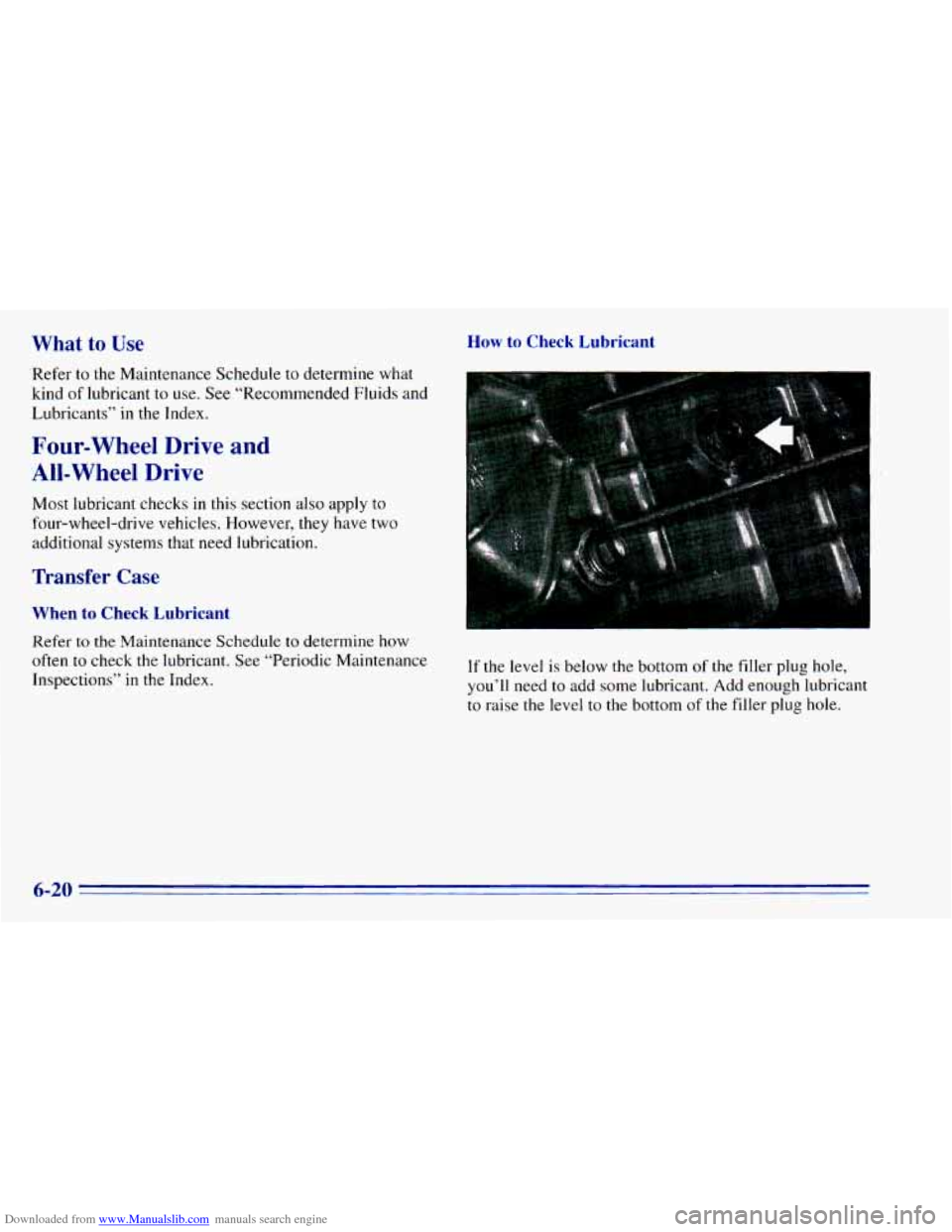
How to Check Lubricant
If the level is below the bottom of the filler plug hole,
you’ll need to add some lubricant. Add enough lubricant
to raise the level
to the bottom of the filler plug hole.
6-20
Page 296 of 392
Downloaded from www.Manualslib.com manuals search engine Tire Chains
NOTICE:
If your vehicle has P235/75R15, P235/70R15 or
31xlOSOR15LT/C size tires, don’t use tire chains.
They can damage your vehicle.
If you have other size tires, use tire chains only
where legal and only when you must. Use only
SAE Class “S” type chains that are the proper
size for your tires. Install them on the drive axle
tires (four-wheel-drive vehicles can use chains on
both axles) and tighten them
as tightly as possible
with the ends securely fastened. Drive slowly and
follow the chain manufacturer’s instructions.
If
you can hear the chains contacting your vehicle,
stop and retighten them.
If the contact continues,
slow down until it stops. Driving too fast or
spinning the wheels with chains on
will damage
your vehicle.
Appearance Care
Remember, cleaning products can be hazardous. Some
are toxic. Others can burst into flame if you strike a
match or get them
on a hot part of the vehicle. Some are
dangerous if
you breathe their fumes in a closed space.
When you use anything from a container to clean your
vehicle, be sure to follow the manufacturer’s warnings
and instructions. And always open your doors
or
windows when you’re cleaning the inside.
Never use these to clean your vehicle:
Gasoline
Benzene
Naphtha
Carbon Tetrachloride
Acetone
Paint Thinner
Turpentine
Lacquer Thinner
Nail Polish Remover
They can all
be hazardous -- some more than
others
-- and they can all damage your vehicle, too.
6-48
Page 308 of 392

Downloaded from www.Manualslib.com manuals search engine FuseKircuit Usage
Breaker
1
2
3
FuseKircuit Usage
Breaker
A
B
Power Door Locks, Power Seat,
Power Seat Lumbar, Remote Keyless Entry
Power Windows 4
Stoplamps, Hazard Lamps, Chime,
Center High-Mounted Stoplamp
Relay, Center High-Mounted
Stoplamp
Dome Lamps, Cargo Lamps, Visor
Vanity Mirror, Cigarette Lighter,
Inside Rearview Mirror Lamp,
Overhead Console Lamps, Glove
Box
Lamp, Horns, Horn Relay, IP
Courtesy Lamps, Power Outside
Rearview Mirror, Liftglass Release
Motor, Illuminated Entry Module
Parking Lamps, License Plate Lamps,
Electric Shift Transfer Case Module,
Underhood Lamp, Rear Wiper,
Ashtray Lamp, Door Switch Lamp
Alternator Field, A/C Compressor
Relay, Cluster Chime Module, DRL
Relay Coil, Four-Wheel-Drive
Indicator Lamp, DRL Module, Rear
Defog Timer, Transfer Case Control
Module Ignition, SIR Redundant
Ignition, RKE Ignition
6-60
Page 309 of 392

Downloaded from www.Manualslib.com manuals search engine FuseKircuit Usage
Breaker
5
7
8
9
10
11
Oxygen Sensor Heater, Exhaust Gas
Recirculation, Cam Sensor, CANN.
Purge, MAS
Blower Motor, Temperature Door
Motor, HI Blower Relay Coil
Power Auxiliary Outlets, Assembly
Line Diagnostic Link
Rear Window Defogger
PCMNCM Battery, ABS Battery
PCMNCM Ignition, Injectors, Crank
Sensor, Coil Driver Module
Radio, Inside Rearview Mirror Map
Lamp, Overhead Console Reading
Lamps, Rear Wiper, Rear Washer,
Overhead Console Display
12 DRAC, Anti-Lock Braking System, VCM IGN-3
13
14
Clock, Radio, Battery, CD Player
A/C Compressor Battery Feed
FuseKircuit Usage
Breaker
15
16
17
19
20
21
22 24 Daytime Running Lamps,
Fog Lamps,
Fog Lamp Relay
Turn Signals and Back-up Lamps,
Brake-Transmission Shift Interlock
Solenoid
Windshield Washer, Windshield
Wiper Motor
Electric Shift Transfer Case
Crank Signal, Air Bag System
Cluster Illumination, Radio
Illumination, Heater Lamp, Four-Wheel-Drive Illumination,
Chime Module, Fog Lamp
Illumination, Rear Wiper Switch, Rear
Defog Switch Illumination, Liftglass
Release Switch Illumination,
Overhead Console Illumination
Air Bag System
PRNDL Power, 4L60E Automatic
Transmission
6-61
Page 315 of 392
Downloaded from www.Manualslib.com manuals search engine Part A: Scheduled Maintenance
Services
Using Your Maintenance Schedule
We at General Motors want to help you keep your
vehicle in good working condition. But
we don’t know
exactly bow you’ll drive it. You may drive very short
distances
only a few times a week. Or you may drive
long distances
all the time in very hot, dusty weather.
You may use your vehicle
in making deliveries. Or
you may drive it to work, to do errands or
in many
other ways.
Because
of all the different ways people use their GM
vehicles, maintenance needs vary.
You may even need
more frequent checks and replacements than you’ll find
in the schedules
in this section. So please read this
section and note how you drive.
If you have any
questions on
how to keep your vehicle in good
condition, see your
GM dealer.
This part tells
you the maintenance services you should
have done and when
you should schedule them. If you
go to your dealer for your service needs, you’ll know
that GM-trained and supported service people will
perform the work using genuine
GM parts. The
proper fluids and lubricants
to use are listed in
Part D. Make sure whoever services your vehicle
uses these. All parts should be replaced and all
necessary repairs done before
you or anyone else
drives the vehicle.
These schedules are for vehicles
that:
carry passengers and cargo within recommended
limits. You will find these limits
on your vehicle’s
CertificationEire label. See “Loading Your Vehicle”
in the Index.
are driven on reasonable road surfaces within legal
driving limits.
0 are driven off-road in the recommended manner. See
“Off-Road Driving With Your Four-Wheel-Drive
Vehicle’’ in the Index.
use the recommended fuel. See “Fuel” in the Index.
Selecting the Right Schedule
First you’ll need to decide which of the two schedules is
right
for your vehicle. Here’s how to decide which
schedule
to follow:
7-3