Page 211 of 354
Downloaded from www.Manualslib.com manuals search engine Tie a red cloth to your vehicle to alert police that
you’ve been stopped by the
snow.
Put on extra clothing or wrap a blanket around you.
If you have no blankets or extra clothing, make body
insulators
from newspapers, burlap bags, rags, floor
mats -- anything you can wrap around yourself or
tuck under your clothing to keep warm.
A CAUTION:
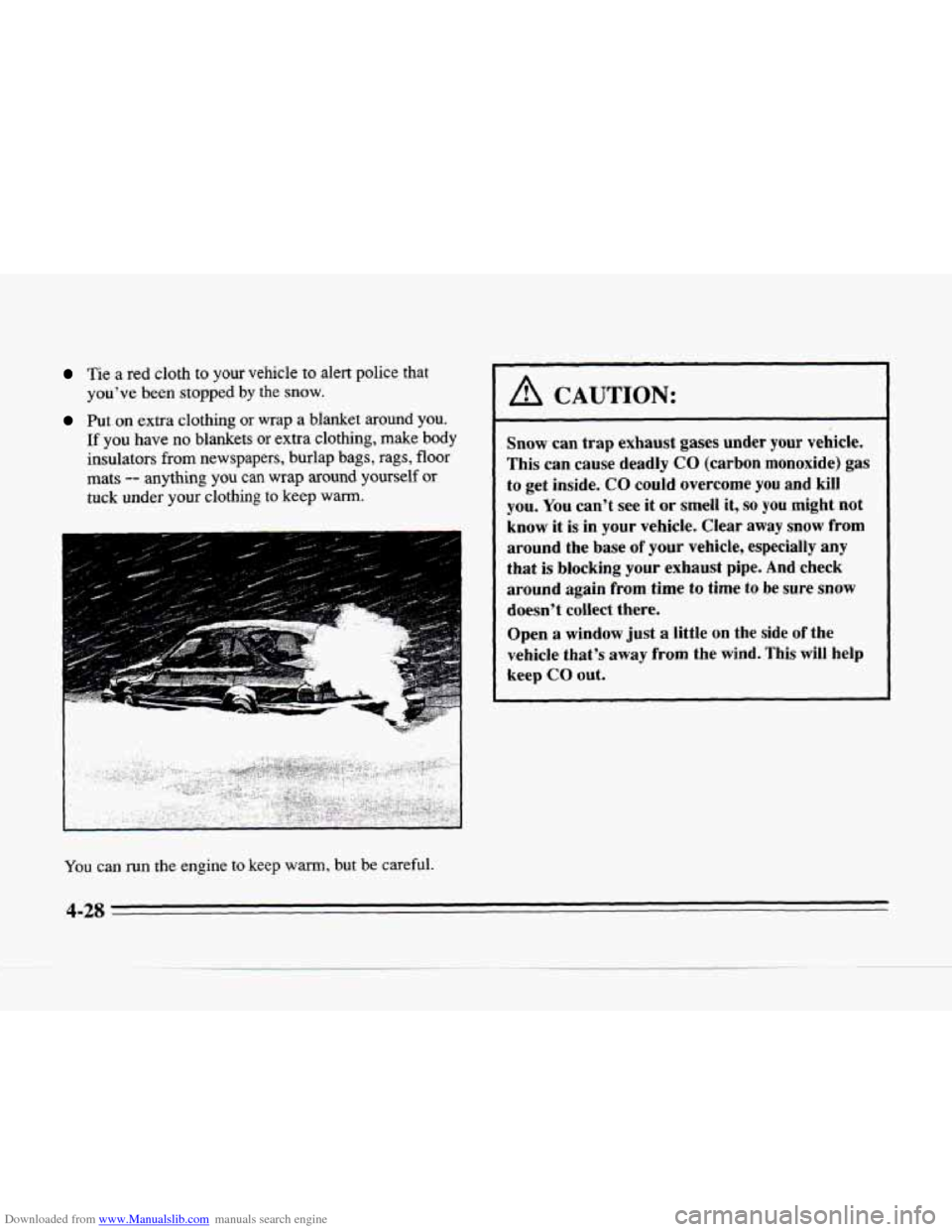
Snow can trap exhaust gases under your vehicle.
This can cause deadly
CO (carbon monoxide) gas
to get inside.
CO could overcome you and kill
you. You can’t see it or smell it, so you might not
know it is in your vehicle. Clear away snow from
around the base
of your vehicle, especially any
that is blocking your exhaust pipe. And check
around again from time to time
to be sure snow
doesn’t
collect there.
Open
a window just a little on the side of the
vehicle that’s away
from the wind. This will help
keep
CO out.
You can run the engine to keep warm, but be careful.
4-28
Page 218 of 354
Downloaded from www.Manualslib.com manuals search engine Safety Chains Driving with a nailer
LI
c
You
should always attach chains between your vehicle
and your trailer. Cross the safety chains under the tongue
of the trailer so that the tongue will not drop to the road
if it becomes separated from the hitch. Instructions
about safety chains may be provided by the hitch
manufacturer or by the trailer manufacturer. Follow the
manufacturer’s recommendation for attaching safety
chains and do not attach them to the bumper. Always
leave just enough slack
so you can turn with your rig.
And, never allow safety chains to drag on the ground.
Trailer Brakes
Because you have anti-lock brakes, don’t try to tap into
your vehicle’s hydraulic brake system.
If you do, both
brake systems won’t work well, or at all.
Be sure
to read and follow the instructions for the trailer
brakes
so you’ll be able to install, adjust and maintain
them properly. Towing a trailer
requires a certainanount
of experience.
Before setting out for the open road, you’ll want to get
to
know your rig. Acquaint yourself with the feel of
handling and braking with the added weight of the
trailer. And always keep in mind that the vehicle you
are
driving is now a good deal longer and not nearly as
responsive as your vehicle is by itself.
Before you start, check the trailer hitch and platform
(and attachments), safety chains, electrical connector,
lamps, tires and mirror adjustment.
If the trailer has
electric brakes, start your vehicle and trailer moving and
then apply the trailer brake controller by hand to
be sure
the brakes
are working. This lets you check your
electrical connection at the same time.
During your trip, check occasionally
to be sure that the
load
is secure, and that the lamps and any trailer brakes
are still working.
4-35
Page 220 of 354
Downloaded from www.Manualslib.com manuals search engine rr
L.
h
c
c
Turn Signals When Towing a Trailer
When you tow a trailer, your vehicle may need a
different turn signal flasher and extra wiring. Check
with your Cadillac dealer. The green arrows on your
instrument panel will flash whenever you signal a turn
or lane change. Properly hooked up, the trailer lamps
will also flash, telling other drivers you’re about to turn,
change lanes or stop.
When towing a trailer, the green arrows on your
instrument panel will flash for turns
even if the bulbs on
the trailer are burned
out. Thus, you may think drivers
behind you are seeing your signal when they are not.
It’s important to check occasionally to be sure the trailer
bulbs
are still working.
Driving On Grades
Reduce speed and shift to a lower gear before you start
down a long or steep downgrade.
If you don’t shift
down, you might have to use your brakes
so much that
they would
get hot and no longer work well.
On a long uphill grade, shift down and reduce your
speed to around
45 mph (70 km/h) or less to reduce the
possibility of engine and transaxle overheating.
Parking on Hills
You really should not park your vehicle, with a trailer
attached, on a hill. If something goes wrong, your rig
could start to move. People can be injured, and both
your vehicle and the trailer can be damaged.
But if you ever have to park your
rig on a hill, here’s
how to do it:
1.
2.
3.
4.
5.
Apply your regular brakes, but do not shift into
PARK
(P).
Have someone place chocks under the trailer wheels.
When the wheel chocks
are in place, release the
regular brakes until the chocks absorb the load.
Reapply the regular brakes. Then shift into
PARK (P) firmly and apply your parking brake.
Release the regular brakes.
4-37
Page 221 of 354
Downloaded from www.Manualslib.com manuals search engine When You Are Ready to Leave After
Parking
on a Hill
1. Apply your regular brakes and hold the pedal down
while
you:
Start your engine;
Shift into a gear; and
Be sure the parking brake has released.
2. Let up on the brake pedal.
3. Drive slowly until the trailer is clear of the chocks.
4. Stop and have someone pick up and store the chocks.
Maintenance When Trailer Towing
Your vehicle will need service more often when you’re
pulling a trailer. See the Maintenance Schedule for more
on this. Things that are especially important
in trailer
operation are automatic transaxle fluid (don’t overfill),
engine oil, belt, cooling system and brake adjustment.
Each of these
is covered in this manual, and the Index
will help you find them quickly. If you’re trailering, it’s
a good idea to review these sections before you start
your trip.
Check periodically to see that all
hitch nuts and bolts
are tight.
Page 224 of 354
Downloaded from www.Manualslib.com manuals search engine Other Warning Devices
If you carry reflective triangles, you can set one up at
the side
of the road about 300 feet (100 m) behind your
vehicle.
Jump Starting
If your battery has run down, you may want to use
another vehicle and some jumper cables to
start your
Cadillac. Please follow the steps below to do
it safely.
NOTICE:
Ignoring these steps could result in costly damage
to your vehicle that wouldn’t be covered by your
warranty.
Trying to start your Cadillac by pushing or
pulling it won’t work and it could damage your
vehicle.
A CAUTION:
Batteries can hurt you. They can be dangerous
because:
0 They contain acid that can burn you.
0 They contain gas that can explode or ignite.
0 They contain enough electricity to burn you.
If you don’t follow these steps exactly, some or all
of these things can hurt you.
. Check the other vehicle. It must have a 12-volt
battery with
a negative ground system.
I I
I NOTICE:
~
~~
If the other system isn’t a 12-volt system with a
negative ground, both vehicles can be damaged.
5-3
Page 226 of 354
Downloaded from www.Manualslib.com manuals search engine r)
L.
F
I A CAUTION:
Using a match near a battery can cause battery
gas to explode. People have been hurt doing this,
and some have been blinded. Use a flashlight
if
you need more light.
Be sure the battery has enough water. You don’t
need to add water to the Delco Freedom@ battery
installed in every new
GM vehicle. But if a
battery has filler caps, be sure the right amount
-of fluid is there. If it is low, add water to take care
of that first. If you don’t, explosive gas could be
present.
Battery fluid contains acid that can burn you.
Don’t get it on
you. If you accidentally get it in
your eyes or on your skin, flush the place with
water and get medical help immediately.
6. Check that the jumper cables don’t have loose or
missing insulation. If they do, you could get a shock.
The vehicles could also be damaged.
Before
you connect the cables, here are some’ things
you should know. Positive (+) will go to positive (+)
and negative (-) will go to negative (-) or a metal
engine part. Don’t connect positive
(+) to negative (-)
or you’ll get a short that would damage the battery and
maybe other parts, too.
A CAUTION:
Fans or other moving engine parts can injure you
badly. Keep your hands
away from moving parts
once the engines are
running.
Page 240 of 354
Downloaded from www.Manualslib.com manuals search engine L
L
4
-,. .
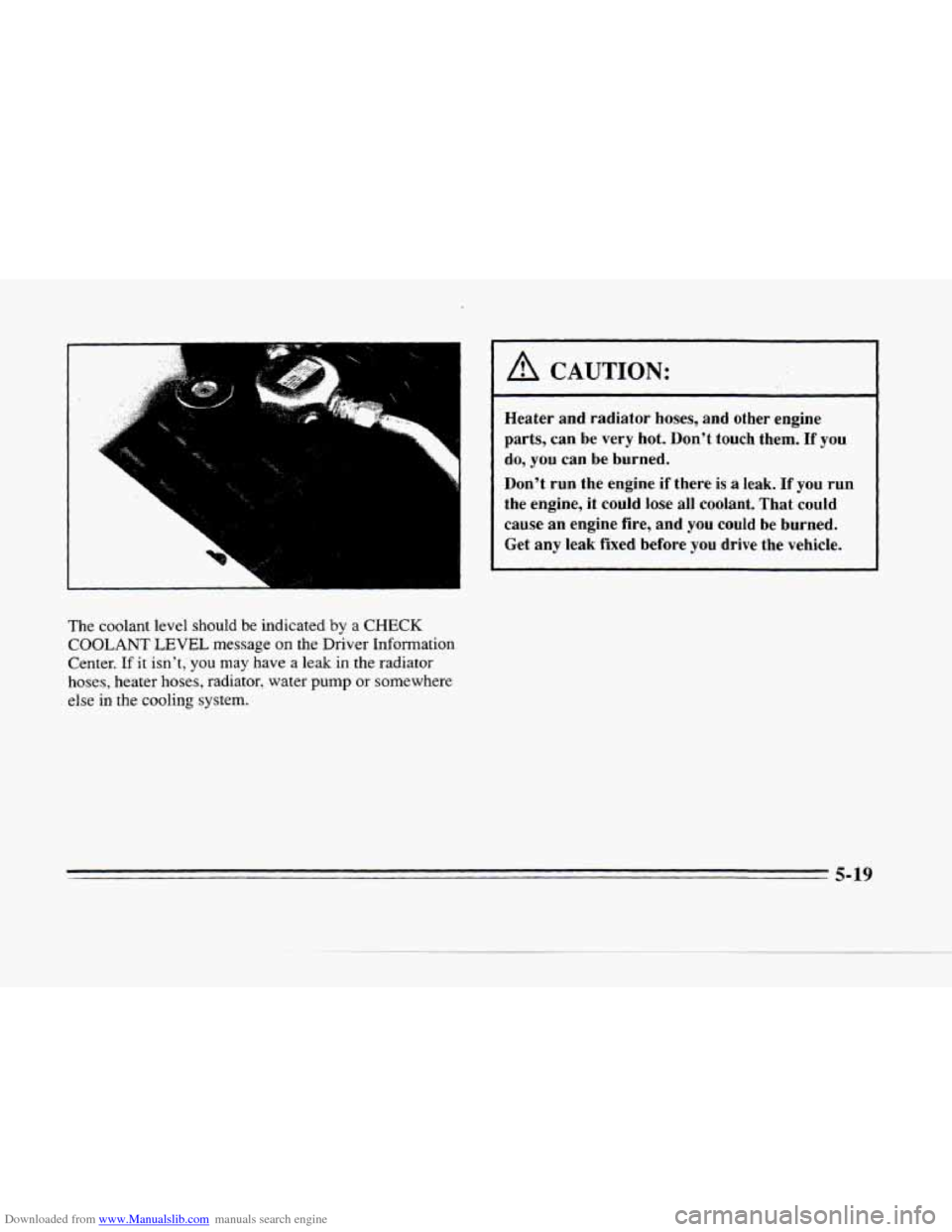
The coolant level should be indicated by a CHECK
COOLANT LEVEL message on the Driver Information
Center.
If it isn't, you may have a leak in the radiator
hoses, heater hoses, radiator, water
pump or somewhere
else in the cooling
system.
A CAUTION:
Heater and radiator hoses, and other engine
parts, can be very hot. Don't
touch them. If you
do, you can be burned.
Don't run the engine if there
is a leak. If you run
the engine, it could lose all coolant. That could
cause
an engine fire, and you could be burned.
Get any leak fixed before you drive the vehicle.
5-19
Page 241 of 354
Downloaded from www.Manualslib.com manuals search engine I NOTICE:
Engine damage if you keep running your engine
without coolant isn’t covered
by your warranty.
See “Overheated Engine Protection Operating
Mode’? in the Index.
If there seems to be no leak, with the engine
on, check to
see if
the electric engine fans are running. If the engine
is overheating, both
fans should be running. If they
aren’t, your vehicle needs service.
How to Add Coolant to the Coolant Surge
Tank
If you haven’t found a problem yet, but the coolant level
isn’t at the proper level (2.5 inches (60 mm) below the
base of the fill neck), add
a 50/50 mixture of clean
water (preferably distilled) and DEX-COOL TM
antifreeze at the coolant surge tank, but be sure the
cooling system, including the coolant surge tank
pressure cap, is cool before
you do it. (See “Engine
Coolant” in the Index
for more information.)
A CAUTION:
Steam and scalding liquids from a hot cooling
system can blow out and
burn you badly. They are
under pressure, and if you turn the coolant surge
tank pressure
cap -- even a little -- they can come
out at high speed. Never turn the
cap when the
cooling system, including the coolant surge tank
pressure cap, is hot. Wait
for the cooling system
and coolant surge tank pressure
cap to cool if you
ever have to turn the pressure cap.
5-20