1996 CADILLAC ELDORADO water
[x] Cancel search: waterPage 132 of 354
Downloaded from www.Manualslib.com manuals search engine If the Light Is On Steady
You may be able to correct the emission system
malfunction by considering the following:
Did you just drive through a deep puddle of water?
If so, your electrical system may be wet. The condition
will usually be corrected when the electrical system
dries out. A few driving trips should turn the light
off.
Are you low on fuel?
As your engine starts to run out of fuel, your engine may
not run as efficiently as designed since small amounts of
air are sucked into the fuel line causing a misfire. The
system can detect this. Adding fuel should correct this
condition. Make sure to install the fuel cap properly.
It
will take a few driving trips to turn the light off.
Have you recently changed brands of fuel?
If
so, be sure to fuel your vehicle with quality fuel (see
“Fuel” in the Index). Poor fuel quality will cause your
engine not to run as efficiently as designed.
Y0.u may
notice this as stalling after start-up, stalling when you
put the vehicle into gear, misfiring, hesitation on
acceleration or stumbling on acceleration. (These
conditions may go away once the engine is warmed up.)
This will be detected by the system and cause the light
to turn on.
If you experience this condition, change the fuel brand
you use. It will require at least one full tank of the
proper fuel to turn the light
off.
If none of the above steps have made the light turn off,
have your dealer or qualified service center check the
vehicle. Your dealer has the proper test equipment and
diagnostic tools to fix any mechanical
or electrical
problems that may have developed.
Page 186 of 354

Downloaded from www.Manualslib.com manuals search engine It’s the amount of alcohol that counts. For example, if
the same person drank three double martinis
(3 ounces
or
90 ml of liquor each) within an hour, the person’s
BAC would be close to
0.12 percent. A person who
consumes food just before or during drinking will have a
somewhat lower BAC level.
There
is a gender difference, too. Women generally have
a lower relative percentage
of body water than men. Since
alcohol is carried in body water, this means that a
woman generally will reach a higher
BAC level than a
man of her same body weight when each has the same
number of drinks.
The law in many U.S. states sets the legal limit at
a BAC
of 0.10 percent. In a growing number of US. states, and
throughout Canada, the limit is
0.08 percent. In some
other countries it’s even lower. The BAC limit for all
commercial drivers in the United States is
0.04 percent.
The BAC will be over
0.10 percent after three to six
drinks (in one hour). Of course, as we’ve seen, it
depends on how much alcohol is in the drinks, and how
quickly the person drinks them.
But the ability to drive is affected well below a BAC
of
0.10 percent. Research shows that the driving skills of
many people are impaired at a BAC approaching
0.05 percent, and that the effects are worse at night. All
drivers are impaired at BAC levels above 0.05 percent.
Statistics show that the chance
of being in a collision
increases sharply for drivers who have a BAC
of
0.05 percent or above. A driver with a BAC level of
0.06 percent has doubled his or her chance of having a
collision. At a BAC level of 0.10 percent, the chance of
this driver having a collision
is 12 times greater; at a
level of
0.15 percent, the chance is 25 times greater!
4-3
Page 198 of 354
Downloaded from www.Manualslib.com manuals search engine Of course, traction is reduced when water, snow, ice, Driving at Night
gravel or other material is on the road. For safety, you’ll
want to slow down and adjust your driving to these
conditions. It is important to slow down on slippery
surfaces because stopping distance will be longer and
vehicle control more limited.
While driving on a surface with reduced traction, try
your best to avoid sudden steering, acceleration or
braking (including engine braking by shifting to a lower
gear). Any sudden changes could cause the tires to
slide. You may not realize the surface is slippery until
your vehicle is skidding. Learn to recognize warning
clues
-- such as enough water, ice or packed snow on
the road to make a “mirrored surface”
-- and slow
down when you have any doubt.
Remember: Any anti-lock brake system
(ABS) helps
avoid only the braking skid.
I’
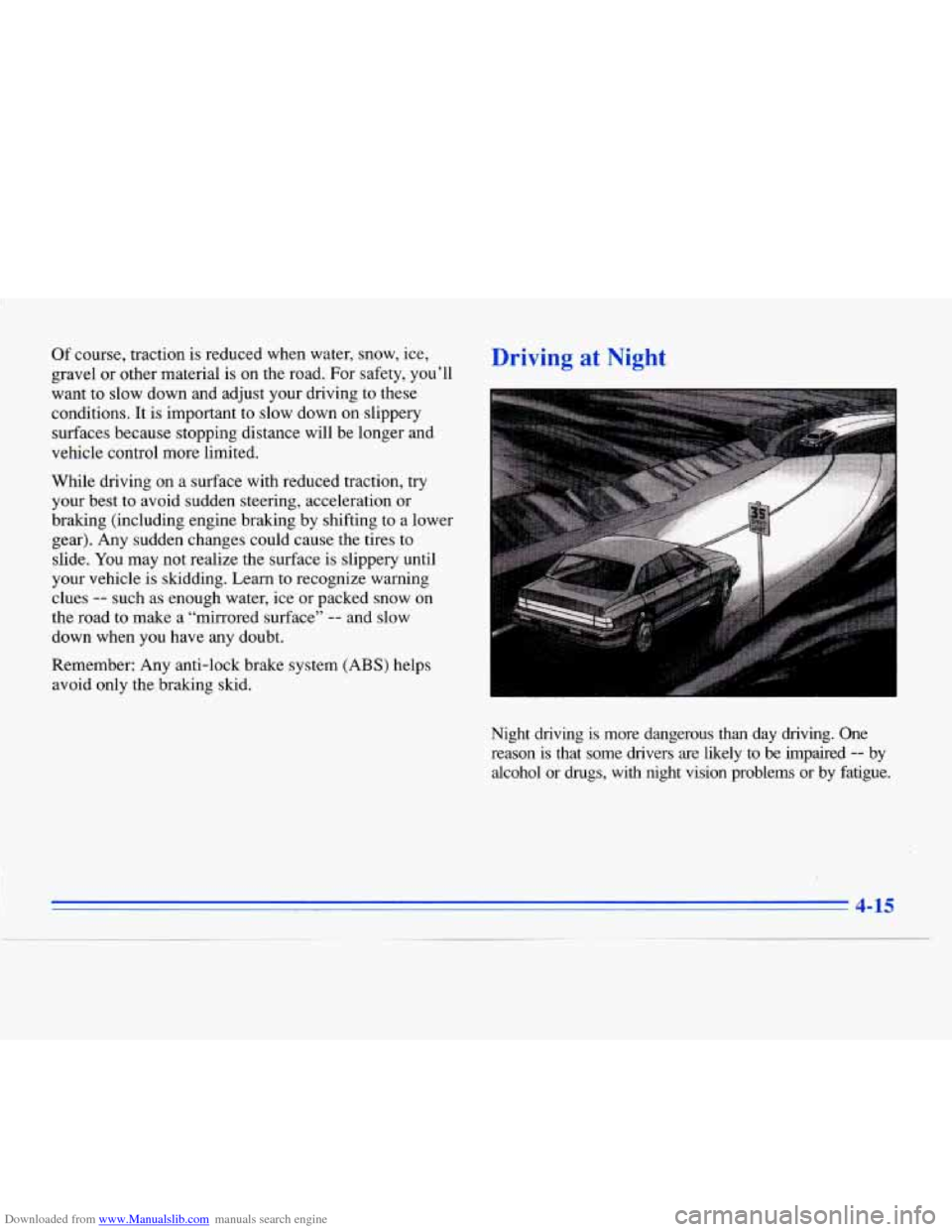
Night driving is more dangerous than day driving. One
reason
is that some drivers are likely to be impaired -- by
alcohol or
drugs, with night vision problems or by fatigue.
4-15
Page 201 of 354
Downloaded from www.Manualslib.com manuals search engine I
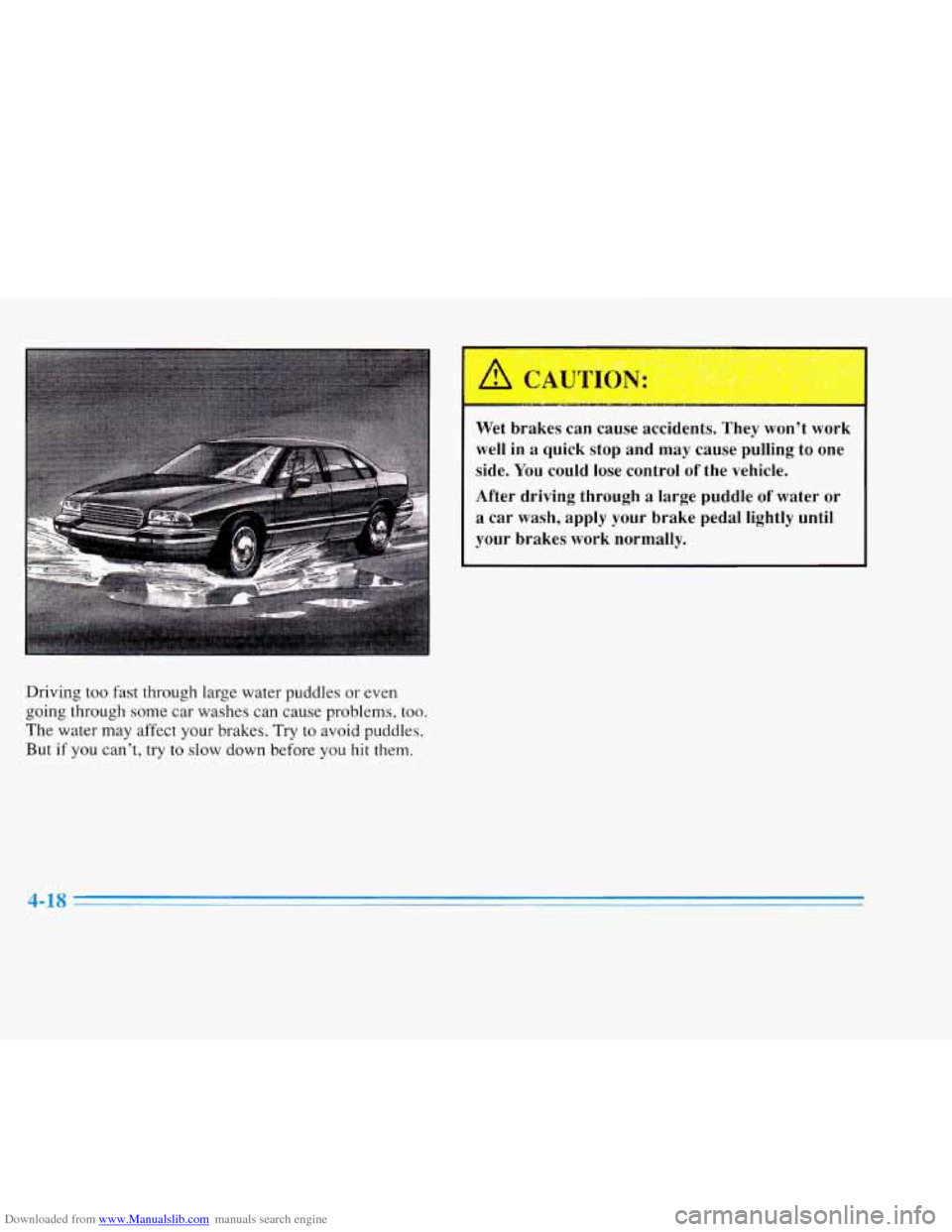
Driving too fast through large water puddles or even
going through some car washes can cause problems, too.
The water may affect your brakes. Try to avoid puddles.
But
if you can't, try to slow down before you hit them.
Wet brakes can cause accidents. They won't work
well in a quick stop and may cause pulling
to one
side.
You could lose control of the vehicle.
After driving through
a large puddle of water or
a car wash, apply your brake pedal lightly until
your brakes work normally.
Page 202 of 354
Downloaded from www.Manualslib.com manuals search engine Hydroplaning
Hydroplaning is dangerous. So much water can build up
under your tires that they can actually ride on the water.
This can happen if the road is wet enough and you’re
going fast enough. When your vehicle is hydroplaning,
it has little or no contact with the road.
Hydroplaning doesn’t happen often. But it can
if your
tires haven’t much tread or if the pressure in one or
more
is low. It can happen if a lot of water is standing on
the road. If you can see reflections from trees, telephone
poles or other vehicles, and raindrops “dimple” the
water’s surface, there could be hydroplaning.
Hydroplaning usually happens at higher speeds. There
just isn’t a hard and fast rule about hydroplaning. The
best advice is to slow down when it is raining.
Driving Through Deep Standing Water
NOTICE:
If you drive too quickly through deep puddles or
standing water, water can come in through your
engine’s air intake and badly damage your
engine. Never drive through water that
is slightly
lower than the underbody
of your vehicle. If you
can’t avoid deep puddles or standing water, drive
through them very slowly.
~~ ~
Some Other Rainy Weather Tips
Turn on your low-beam headlamps -- not just your
parking lamps
-- to help make you more visible to
others.
Besides slowing down, allow some extra following
distance. And be especially careful when you pass
another vehicle. Allow yourself more clear room
ahead, and be prepared to have your view restricted
by road spray.
0 Have good tires with proper tread depth. (See
“Tires” in the Index.)
4-19
Page 217 of 354
Downloaded from www.Manualslib.com manuals search engine If you’re using a “dead-weight” hitch, the trailer
tongue
(A) should weigh 10% of the total loaded trailer
weight (B). If you have a “weight-distributing” hitch,
the trailer tongue
(A) should weigh 12% of the total
loaded trailer weight
(B).
After you’ve loaded your trailer, weigh the trailer and
then the tongue, separately, to see if the weights are
proper. If they aren’t, you may be able to get them right
simply by moving some, items around in the trailer.
Total Weight on Your Vehicle’s Tires
Be sure your vehicle’s tires are inflated to the
recommended pressure for cold tires. You’ll find these
numbers
on the Certification label at the rear edge of the
driver’s door
or see “Loading Your Vehicle” in the
Index. Then be sure you don’t
go over the GVW limit
for your vehicle, including the weight of the trailer
tongue.
Hitches
It’s important to have the correct hitch equipment.
Crosswinds, large trucks going by and rough roads are a
few reasons why you’ll need
the right hitch. Here are
some rules to follow:
Will you have to make any holes in the body of your
vehicle when you install
a trailer hitch? If you do,
then be sure to seal
the holes later when you remove
the hitch. If you don‘t seal them. deadly carbon
monoxide
(CO) from your exhaust can get into your
vehicle (see “Carbon Monoxide” in the Index). Dirt
and water can, too.
The bumpers on your vehicle are not intended for
hitches.
Do not attach rental hitches or other
bumper-type hutches to them. Use
only a frame-mounted
hitch that does not attach
to the bumper.
Safety Chains
You should always attach chains between your vehicle
and your trailer. Cross the safety chains under the tongue
of the trailer so that the tongue will not drop to the road
if it becomes separated from the hitch. Instructions
about safety chains may be provided by the hitch
manufacturer or by the trailer manufacturer. Follow
the
manufacturer’s recommendation for attaching safety
chains and do not attach them
to the bumper. Always
4-34
Page 226 of 354
Downloaded from www.Manualslib.com manuals search engine 6. Check that the jumper cables don’t have loose or
missing insulation.
If they do, you could get a shock.
The vehicles could also be damaged.
Before you connect the cables, here are some things
you should know. Positive
(+) will go to positive (+)
and negative (-) will go to negative (-) or a metal
engine part. Don’t connect positive
(+) to negative (-)
or you’ll get a short that would damage the battery and
maybe other parts, too.
Using a match near a battery can cause battery
gas to explode. People have been hurt doing this,
and some have been blinded. Use
a flashlight if
you need more light.
Be sure the battery has enough water. You don’t
need to add water to the Delco Freedom@ battery
installed in every new
GM vehicle. But if a
battery has filler caps, be sure the right amount
of fluid is there. If it is low,
add water to take care
of that first.
If you don’t, explosive gas could be
present.
Battery fluid contains acid that can burn you.
Don’t get it on you. If you accidentally get it in
your eyes
or on your skin, flush the place with
water and get medical help immediately.
Fans or other moving engine parts can injure you
badly. Keep your hands away from moving parts
once the engines are running.
5-5
Page 240 of 354
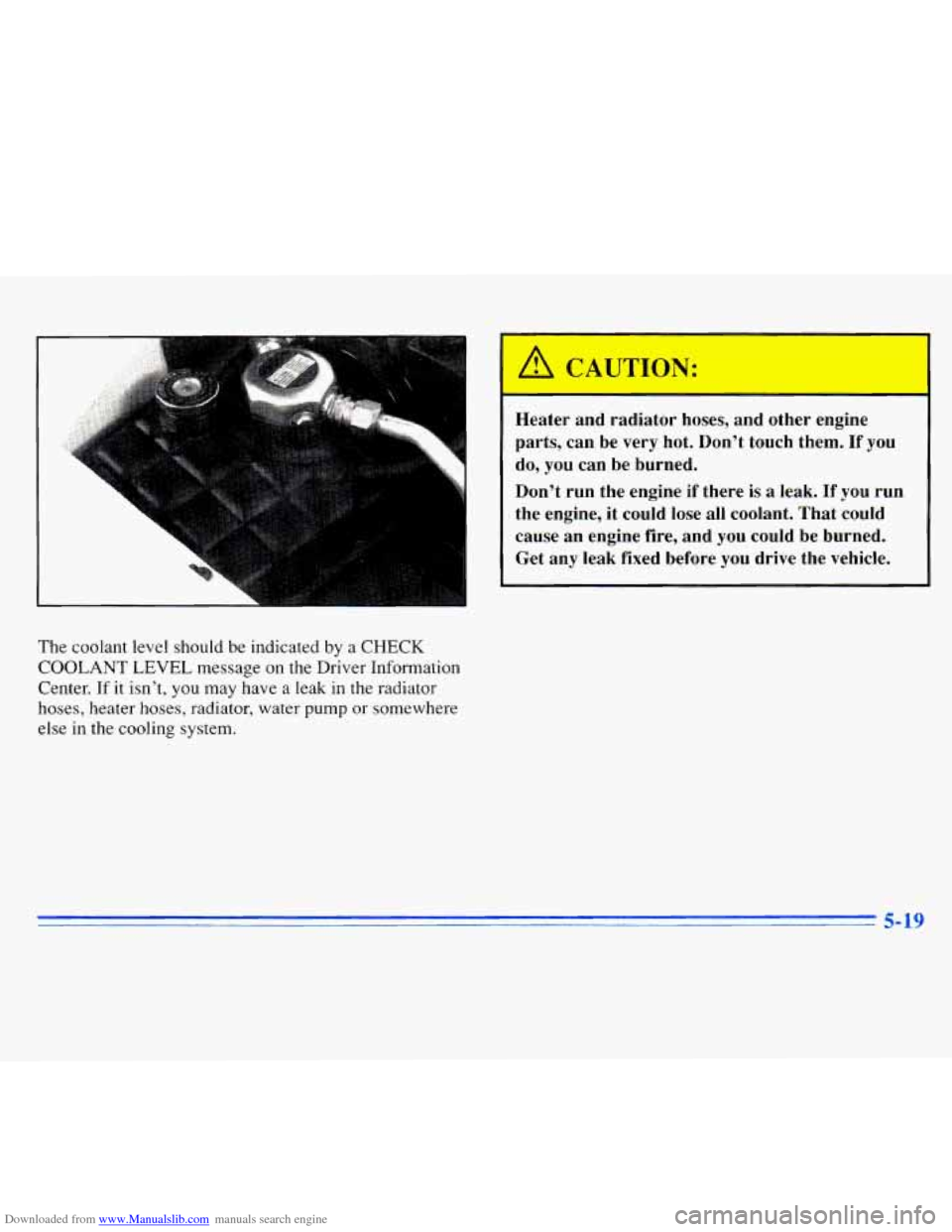
Downloaded from www.Manualslib.com manuals search engine The coolant level should be indicated by a CHECK
COOLANT LEVEL message on the Driver Information
Center. If
it isn’t, you may have a leak in the radiator
hoses, heater hoses, radiator, water
pump or somewhere
else
in the cooling system,
A CAUTION:
Heater and radiator hoses,
parts, can be very hot. Don’t touch them.
If you
do, you can be burned.
Don’t run the engine if there is
a leak. If you run
the engine,
it could lose all coolant. That could
cause an engine fire, and you could be burned.
Get
any leak fixed before you drive the vehicle.
5-19