1996 CADILLAC ELDORADO light
[x] Cancel search: lightPage 43 of 354
Downloaded from www.Manualslib.com manuals search engine Rear Seat Passengers
It’s very important for rear seat passengers to buckle up!
Accident statistics show that unbelted people in the rear
seat are hurt more often in crashes than those who are
wearing safety belts.
Rear passengers who aren’t safety belted can be thrown
out of the vehicle in a crash. And
they can strike others
in the vehicle who are wearing safety belts.
Rear Seat Outside Passenger Positions
n
I
u
Lap-Shoulder Belt
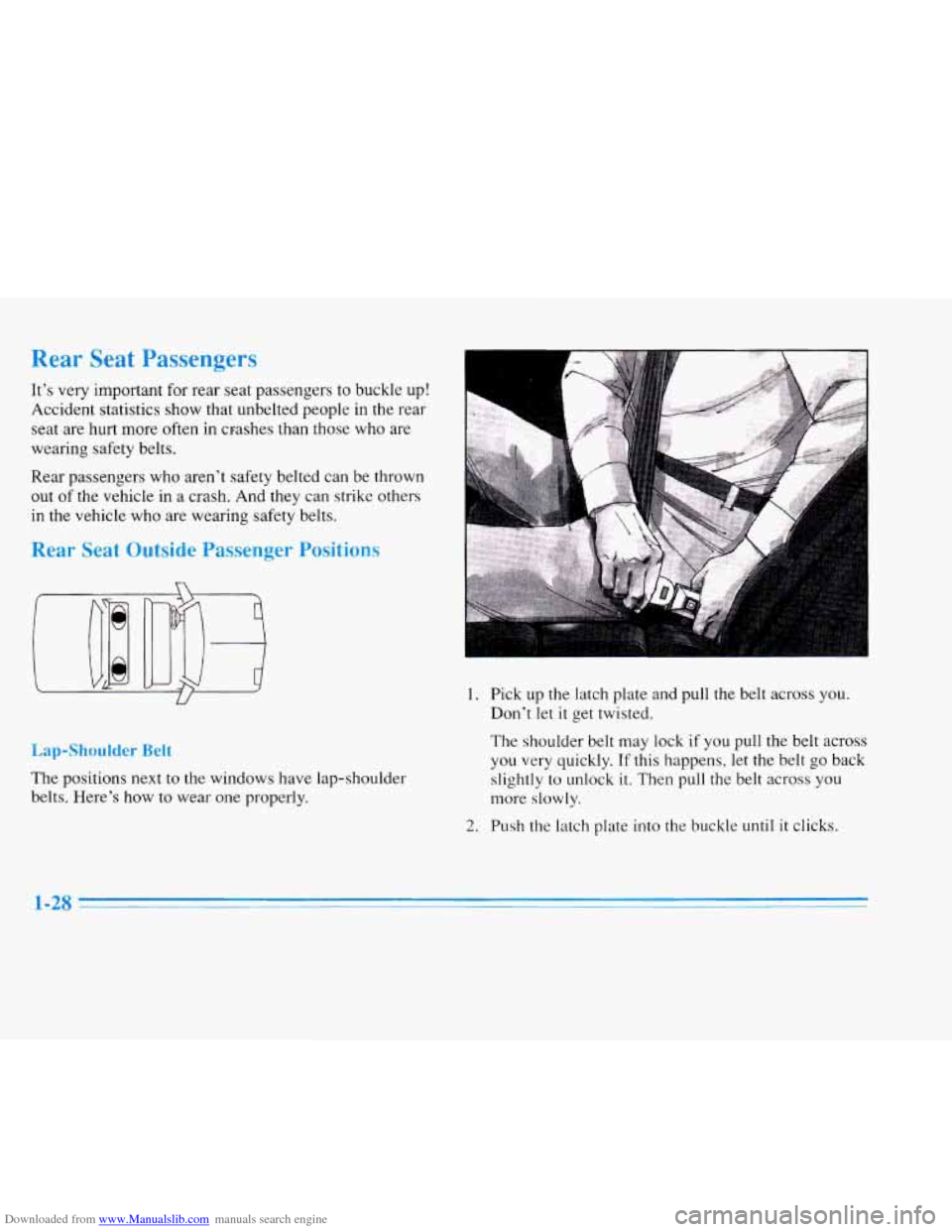
The positions next to the windows have lap-shoulder
belts. Here’s how to wear one properly.
L
1. Pick up the latch plate and pull the belt across you.
Don’t let
it get twisted.
The shoulder belt may lock if you pull the belt across
you very quickly.
If this happens, let the belt go back
slightly
to unlock it. Then pull the belt across you
more
slowly.
2. Push the latch plate into the buckle until it clicks.
1-28
Page 60 of 354

Downloaded from www.Manualslib.com manuals search engine Safety Belt Extender
If the vehicle’s safety belt will fasten around you, you
should use it.
But if
a safety belt isn’t long enough to fasten, your
dealer will order you
an extender. It’s free. When you go
in to order it, take the heaviest coat you will wear,
so the
extender will be long enough for you. The extender will
be just for you, and just for the seat in your vehicle that
you choose. Don’t let someone else use it, and use it
only for the seat it is made to fit. To wear it, just attach it
to the regular safety belt.
Checking Your Restraint Systems
Now and then, make sure the safety belt reminder light
and all your belts, buckles, latch plates, retractors and
anchorages are working properly.
Look for any other
loose or damaged safety belt system parts. If you see
anything that might keep a safety belt system from
doing its job, have it repaired. Torn or
frayed safety belts may not protect you
in a
crash. They can rip apart under impact forces. If
a belt is
tom or frayed, get a new one right away.
Also look for any opened or broken air bag covers, and
have them repaired or replaced. (The air bag system
does not need regular maintenance.)
Replacing Restraint System Parts
After a Crash
If you’ve had a crash, do you need new belts?
After a very minor collision, nothing may be necessary.
But if the belts were stretched, as they would be if worn
during a more severe crash, then you need new belts.
If belts are
cut or damaged, replace them. Collision
damage also may mean you will need to have safety belt
or seat
parts repaired or replaced. New parts and repairs
may be necessary even if the belt wasn’t being used at
the time of the collision.
If an air bag inflates, you’ll need to replace air bag
system parts. See the part on the air bag system earlier
in
this section.
1-45
Page 72 of 354

Downloaded from www.Manualslib.com manuals search engine When you park your Cadillac and open the driver’s
door, you’ll hear a chime reminding you to remove your
key from the ignition and take it with you. Always do
this. Your steering wheel will be locked, and
so will
your ignition and transaxle. And remember to lock
the doors.
Parking at Night
Park in a lighted spot, close all windows and lock your
vehicle. Remember to keep your valuables out
of sight.
Put them in a storage area, or take them with you.
Parking Lots
If you park in a lot where someone will be watching
your vehicle, it’s best to lock it up and take your keys.
But what if you have to leave your ignition key? What if
you have to leave something valuable in your vehicle?
0 Put your valuables in a storage area, like your trunk
or glove box.
Lock the glove box.
Lock all the doors except the driver’s.
Then take the door key and remote lock control key
chain with you.
Theft-Deterrent System (Option)
SECURITY
If your ignition is off and
either door is open, the
SECURITY light will flash
reminding you to activate
the system (the light will
also flash if the battery
has been disconnected
or reconnected).
1. Open the door.
2. Lock the door using the power door lock or the
Keyless Entry system. The SECURITY light should
come
on and stay on.
3. Close all the doors. The SECURITY light should go
off within approximately 30 seconds.
The horn will sound and the lamps will flash for several
minutes when the door or trunk is opened without the
key or Keyless Entry system. The horn also sounds
if
the locks are damaged.
2-11
~
1
~-
Page 83 of 354

Downloaded from www.Manualslib.com manuals search engine FIRST (lji This position gives you even more power Parking Brake
than SECOND (2). You can use it on very steep hills,
or
in deep snow or mud. (If the shift lever is put in
FIRST (l), the transaxle won’t shift into gear until the
vehicle is
going slowly enough.)
NOTICE: - --
If your front wheels can’t rotate, don’t try to
dri.ve. This-might happeh if
you were stuck in
very.deep sand or mud
or were up against a solid
object.
You could damage your transaxle.
Also, if you stop when going uphill, don’t hold Hold
the regular brake
pedal down with your right
foot and push, down the
parking brake pedal with
your left foot to set the
parking brake.
If the
ignition is on, the PARK
BRAKE indicator light
will come ,on.
your vehicle there with only the accelerator
If you try to drive off with the parking brake on, the
pedal.
This could cause overheating and damage PARK BRAKE indicator light stays on. See “Parking
the transaxle. Use
your brakes to hold your
Brake Indicator Light” in the Index for more
vehicle in position on
a hill. information.
When you move out
of PARK (P) or NEUTRAL.(N),*if
the engine is running, the p&king brake should release. If
it doesn’t, you can manually release the parking brake.
Page 92 of 354
Downloaded from www.Manualslib.com manuals search engine Turn SignallMultifunction Lever
Turn and Lane Change Signals
The turn signal has two upward (for right) and two
downward (for left) positions. These positions allow you
to signal a turn or a lane change.
To signal a turn move the lever all the way up or down.
The lever returns automatically when the
turn is complete.
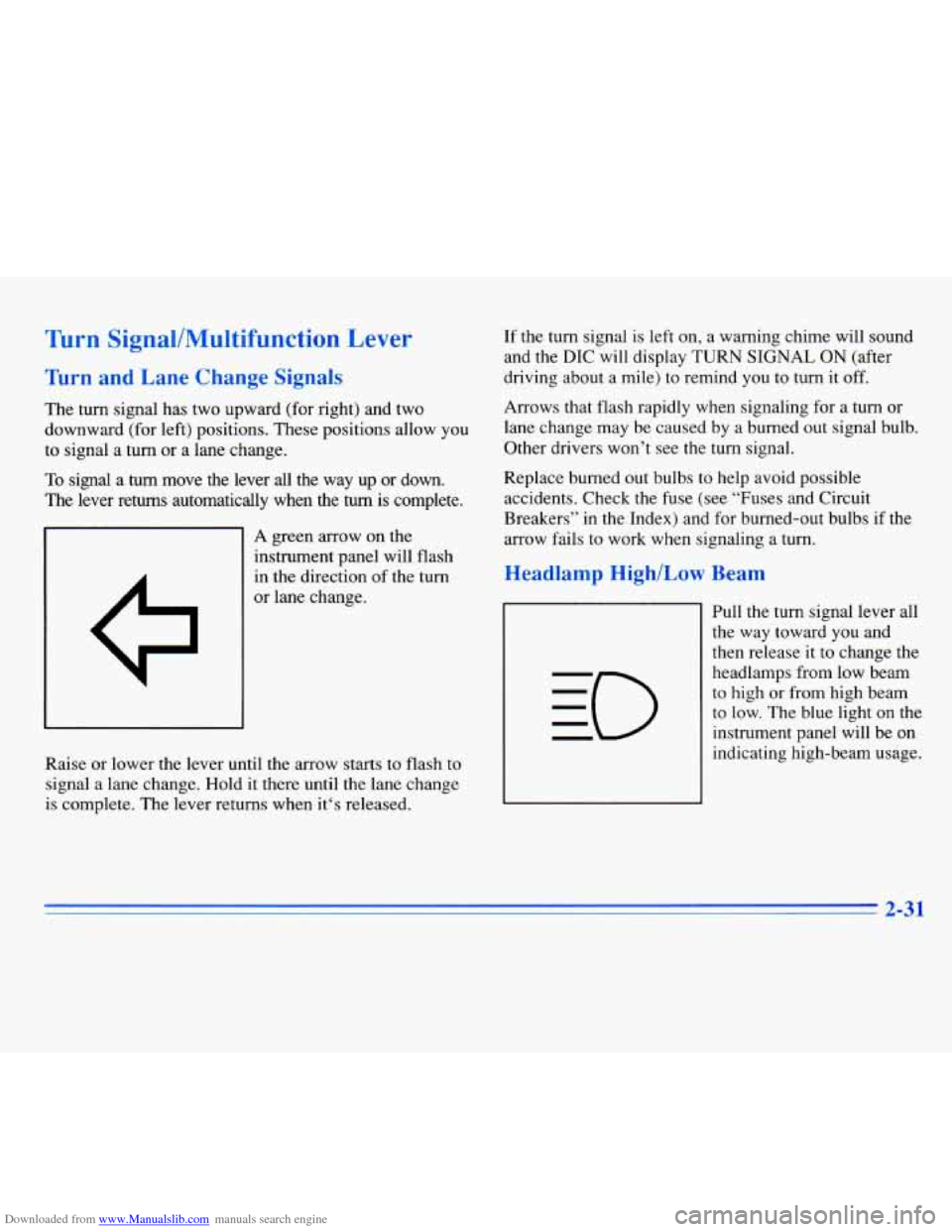
A green arrow on the
instrument panel will flash
in the direction of the turn
or lane change.
Raise or lower the lever until the arrow starts
to flash to
signal a lane change. Hold it there until the lane change
is complete. The lever returns when it‘s released. If
the turn signal is left on, a warning chime will sound
and the DIC will display TURN SIGNAL ON (after
driving about a mile) to remind you to turn it
off.
Arrows that flash rapidly when signaling for a turn or
lane change may be caused by a burned out signal bulb.
Other drivers won’t see
the turn signal.
Replace burned out bulbs
to help avoid possible
accidents. Check
the fuse (see “Fuses and Circuit
Breakers” in the Index) and for burned-out bulbs
if the
arrow fails to work when signaling a turn.
Headlamp High/Low Beam
Pull the turn signal lever all
the way toward you and
then release it to change the
headlamps from low beam
to high or from high beam
to low. The blue light on the
instrument panel will be on
indicating high-beam usage.
2-31
Page 99 of 354
Downloaded from www.Manualslib.com manuals search engine Reducing Speed While Using Cruise Control
There are two ways to reduce your speed while using
cruise control:
Push in the button at the end of the lever until you
reach a desired lower speed, then release
it. A
CRUISE ENGAGED message will then display.
To slow down in very small amounts, push the button
for less than half a second. Each time you do this,
you’ll go
1 mph (1.6 km/h) slower.
Passing Another Vehicle While Using Cruise Control
Use the accelerator pedal to increase your speed. When
you take your
foot off the pedal, your vehicle will slow
down to the cruise control speed you set earlier.
Using Cruise Control on Hills
How well your cruise control will work on hills depends
upon your speed, load and the steepness
of the hills.
When going up steep hills, you may have to step on the
accelerator pedal to maintain your speed. When going
downhill, you may have to brake or shift
to a lower gear
to keep your speed down.
Of course, applying the brake
takes you out
of cruise control. Many drivers find this to
be too much trouble and don’t use cruise control on
steep hills.
Ending Cruise Control
There are two ways to end cruise control:
0 Step lightly on the brake pedal.
Move the CRUISE switch to OFF.
Erasing Speed Memory
The cruise control set speed memory is erased when you
turn
off the cruise control or the ignition.
Page 100 of 354
Downloaded from www.Manualslib.com manuals search engine Lamps
I"
..
, __.",
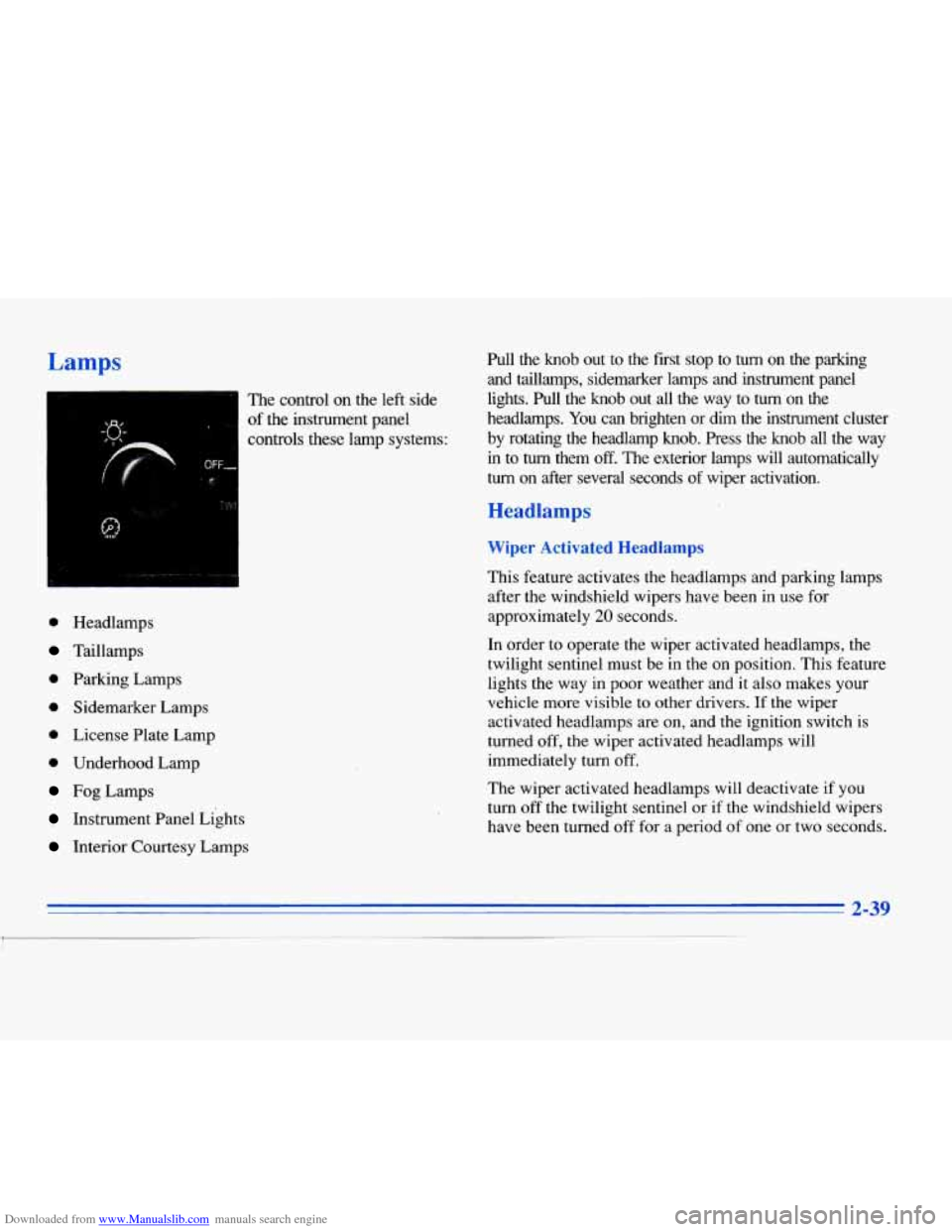
The control on the left side
of the instrument panel
controls these lamp systems:
OFF,
'f"
0 Headlamps
Taillamps
0 Parking Lamps
0 Sidemarker Lamps
0 License Plate Lamp
0 Underhood Lamp
Fog Lamps
Instrument Panel Lights
Interior Courtesy Lamps Pull the knob out to the first stop to
turn on the parking
and taillamps, sidemarker lamps and instrument panel
lights.
Pull the knob out all the way to turn on the
headlamps.
You can brighten or dim the instrument cluster
by rotating the headlamp knob. Press the knob all the way
in to turn them off. The exterior lamps will automatically
turn on after several seconds of wiper activation.
Headlamps
Wiper Activated Headlamps
This feature activates the headlamps and parking lamps
after the windshield wipers have been in use for
approximately
20 seconds.
In order to operate the wiper activated headlamps, the
twilight sentinel must be in the on position. This feature
lights the way in poor weather and it also makes your
vehicle more visible to other drivers.
If the wiper
activated headlamps are on, and the ignition switch is
turned off, the wiper activated headlamps will
immediately turn off.
The wiper activated headlamps will deactivate
if you
turn off the twilight sentinel or
if the windshield wipers
have been turned off for a period of one or two seconds.
2-39
Page 101 of 354
Downloaded from www.Manualslib.com manuals search engine Lamps On Reminder
You will hear a warning chime if you pull the key from
the ignition while leaving the lamps on,
if the manual
headlamp control is activated. An exception to this
is
when you’re using twilight sentinel.
Daytime Running Lamps
Daytime Running Lamps (DRL) can make it easier for
others to see the front of your vehicle during
the day.
DRL can be helpful in many different driving
conditions, but they can be especially helpful
in the
short periods after dawn and before sunset.
A light sensor on top of the instrument panel makes the
DRL work,
so be sure it isn’t covered.
The DRL system will make the high-beam headlamps
come on at reduced brightness when:
the ignition is on,
0 the headlamp switch is off and
0 the transaxle is not in PARK (P).
When DRL are on, only your high-beam headlamps (at
reduced brightness) will be on.
No other exterior lamps
such as the parking lamps, taillamps, etc. will be on
when the DRL are being used. Your instrument panel
won’t be
lit up either.
When it’s dark enough outside, the high-beam
headlamps (at reduced intensity) will change to
low-beam headlamps. When it’s bright enough outside,
the regular lamps will go off, and the high-beam
headlamps change to the reduced brightness of DRL.
To idle your vehicle with the DRL off, turn off the
twilight sentinel switch and shift the transaxle into
PARK (P). Placing your vehicle in PARK
(P) disables
the
DRL. The DRL will stay off until you shift out of
PARK (P).
As with any vehicle, you should turn on the regular
headlamp system when you need
it.