Page 62 of 354
Downloaded from www.Manualslib.com manuals search engine Section 2 Features and Controls
I
Here you can learn about the many standard and optional
features on your Cadillac,
and dormation on starting,
shifting and braking.
Also explained are the instrument
panel and the warning systems that tell you
if everything is
working properly -- and what to do if you have a problem.
Keys
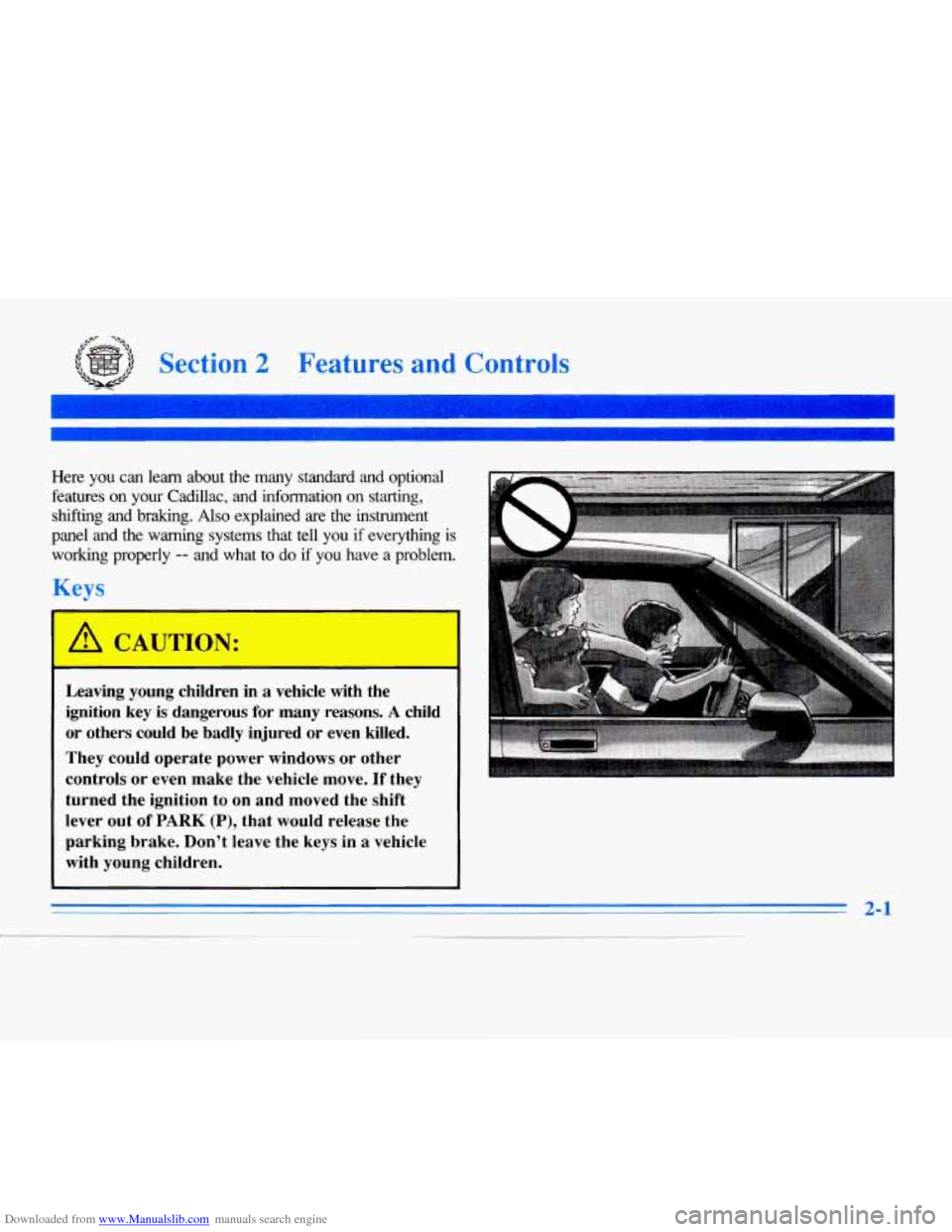
A CAUTION:
Leaving young children in a vehicle with the
ignition key
is dangerous for many reasons. A child
or others could be badly injured or even killed.
They could operate power windows or other
controls
or even make the vehicle move. If they
turned the ignition to on and moved the shift lever out
of PARK (P), that would release the
parking brake. Don't leave the keys in
a vehicle
with young children.
2-1
Page 80 of 354
Downloaded from www.Manualslib.com manuals search engine PARK (P): This locks the front wheels. It’s the best
position to use when you start the engine because your
vehicle can’t move easily.
It is dangerous to get out of your vehicle if the
shift lever is not fully in
PARK (P) with the
parking brake firmly set. Your vehicle can roll.
Don’t leave your vehicle when the engine is
running unless you have to. If you have left the
engine running, the vehicle can move suddenly.
You or others could be injured.
To be sure your
vehicle won’t move, even when you’re on fairly
level ground, always set your parking brake and
move the shift lever to
PARK (P).
See “Shifting Into PARK (P)” in the Index. If
you’re pulling
a trailer, see “Towing a Trailer” in
the Index. Ensure
the shift lever is fully in PARK
(P) range before
starting the engine. Your Cadillac has a brake-transaxle
shift interlock. You have to fully
apply your regular
brakes
before you can shift from PARK (P) when
the ignition key is in the
RUN position. If you cannot
shift out of PARK
(P), ease pressure on the shift
lever
-- push the shift lever all the way into PARK (P)
and release the shift lever button on the floor shift
console models
as you maintain brake application. Then
move the shift lever into the gear you wish. (Press the
shift lever button before moving the shift lever on
floor
shift console models.) See “Shifting Out of PARK (P)”
in this section.
2-19
Page 83 of 354

Downloaded from www.Manualslib.com manuals search engine FIRST (lji This position gives you even more power Parking Brake
than SECOND (2). You can use it on very steep hills,
or
in deep snow or mud. (If the shift lever is put in
FIRST (l), the transaxle won’t shift into gear until the
vehicle is
going slowly enough.)
NOTICE: - --
If your front wheels can’t rotate, don’t try to
dri.ve. This-might happeh if
you were stuck in
very.deep sand or mud
or were up against a solid
object.
You could damage your transaxle.
Also, if you stop when going uphill, don’t hold Hold
the regular brake
pedal down with your right
foot and push, down the
parking brake pedal with
your left foot to set the
parking brake.
If the
ignition is on, the PARK
BRAKE indicator light
will come ,on.
your vehicle there with only the accelerator
If you try to drive off with the parking brake on, the
pedal.
This could cause overheating and damage PARK BRAKE indicator light stays on. See “Parking
the transaxle. Use
your brakes to hold your
Brake Indicator Light” in the Index for more
vehicle in position on
a hill. information.
When you move out
of PARK (P) or NEUTRAL.(N),*if
the engine is running, the p&king brake should release. If
it doesn’t, you can manually release the parking brake.
Page 84 of 354
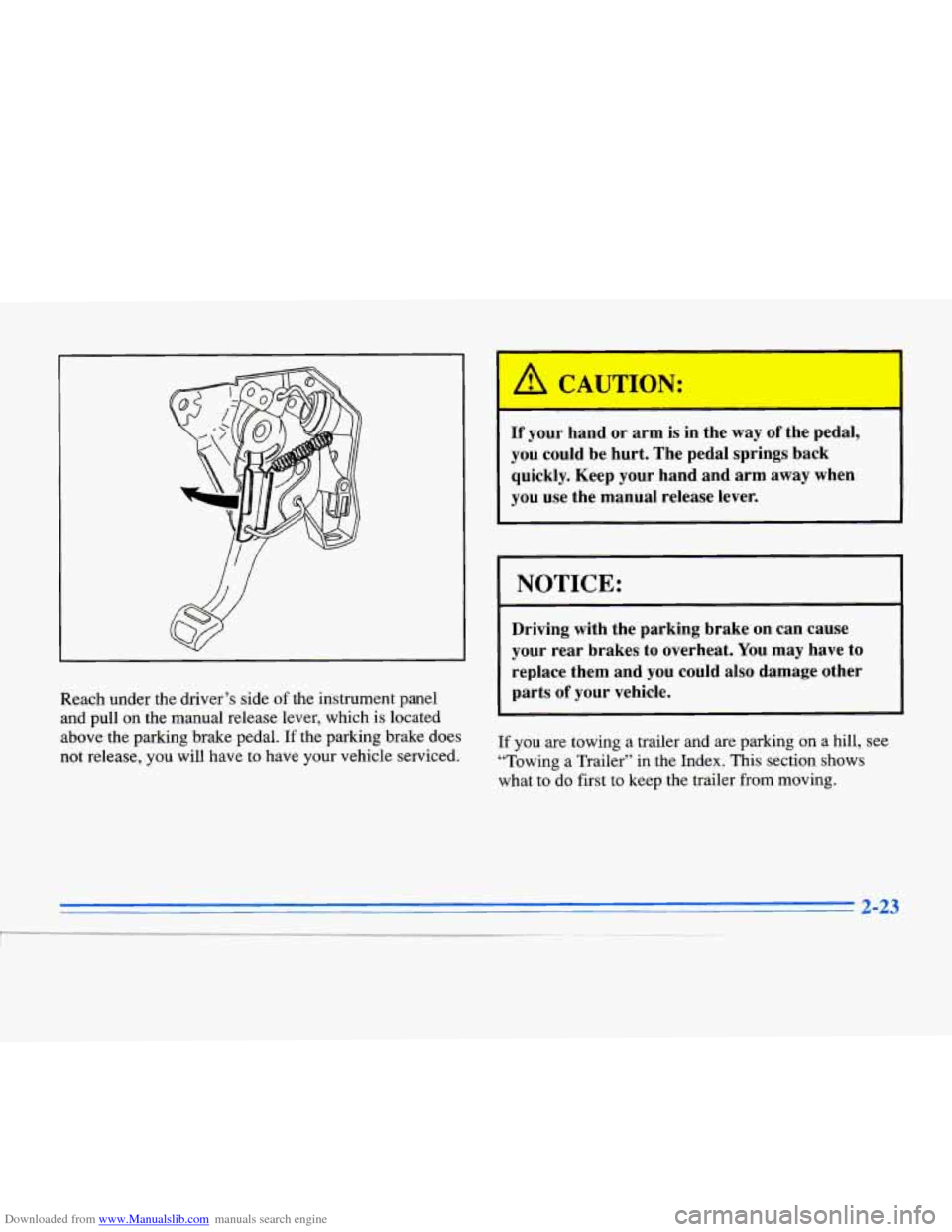
Downloaded from www.Manualslib.com manuals search engine Reach under the driver’s side of the instrument panel
and pull
on the manual release lever, which is located
above the parking brake pedal. If the parking brake does
not release, you will have to have your vehicle serviced.
A CAUTION:
-
If your hand or arm is in the way of the pedal,
you could be hurt. The pedal springs back quickly. Keep your hand and arm away when
you use the manual release lever.
NOTICE:
Driving with the parking brak6 bn’can cause
your rear brakes to overheat. You may have to
replace them and you could also damage other
parts
of your vehicle.
If you are towing a trailer and are parking on a hill, see
“Towing a Trailer’’ in the Index. This section shows
what to do first to keep the trailer from moving.
2-23
Page 85 of 354
Downloaded from www.Manualslib.com manuals search engine YYiif“rg Into PARK (P)
It can be dangerous to get out of your vehicle if
the shift lever is not fully in PARK (P) with the
parking brake firmly set. Your vehicle can
roll.
If you have left the engine running, the vehicle
can move suddenly. You
or others could be
injured.
To be sure your vehicle won’t move, even
when you’re on
fairly level ground, use the steps
that follow. If you’re pulling a trailer, see
“Towing
a Trailer” in the Index.
Steering Column Shift Lever
1. Hold the brake pedal down with your right foot.
2. Move the shift lever into the PARK (P) position like this:
I ~~~
Pull the lever toward you.
Page 86 of 354
Downloaded from www.Manualslib.com manuals search engine Move the lever up as far as it will go.
3, With your right foot still holding the brake pedal
down, set the parking brake.
4. Move the ignition key to LOCK.
5. Remove the key and take it with you. If you can
leave your vehicle with the ignition key
in your
hand, your vehicle is in PARK (P).
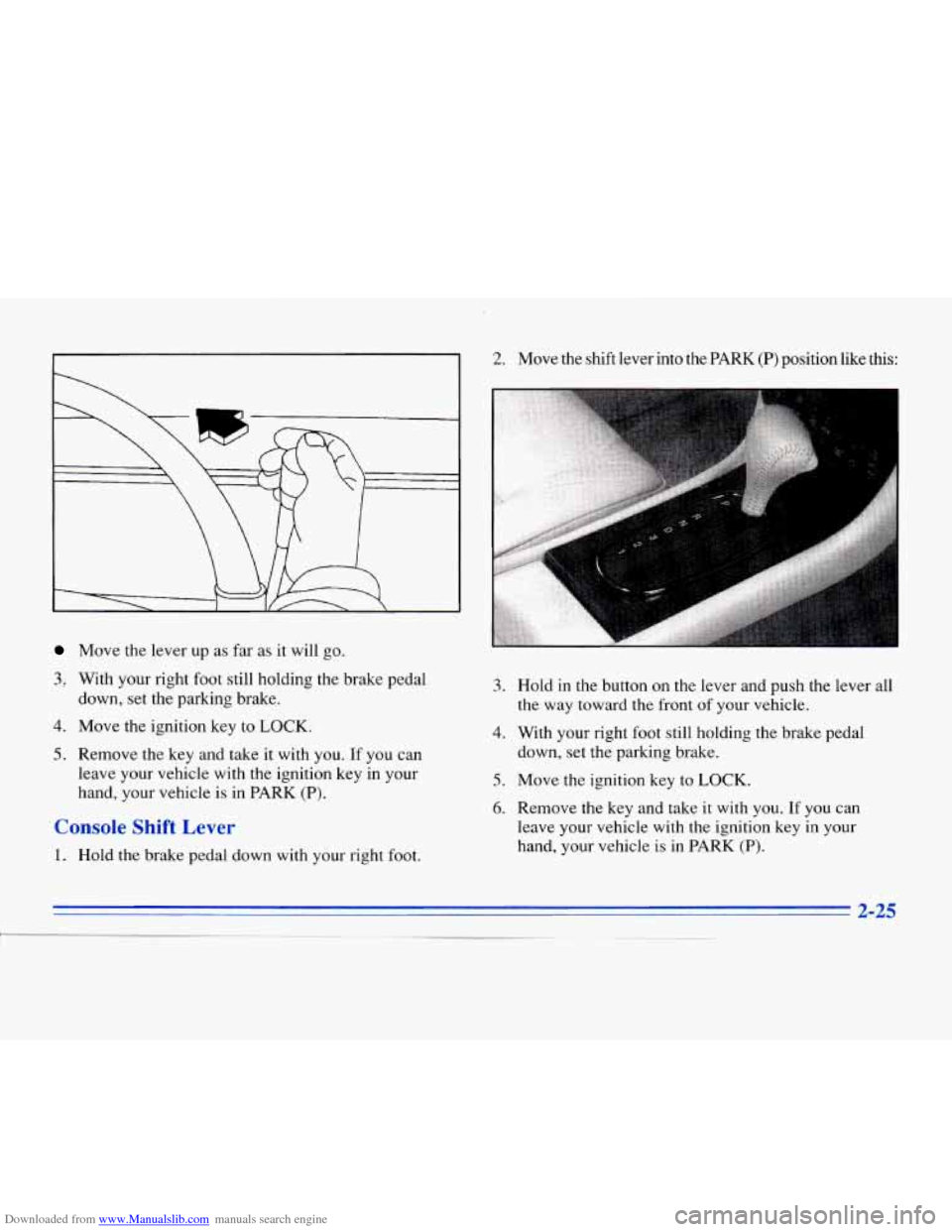
Console Shift Lever
1. Hold the brake pedal down with your right foot.
2. Move the shift lever into the PARK (P) position like this:
3. Hold in the button on the lever and push the lever all
the way toward the front
of your vehicle.
4. With your right foot still holding the brake pedal
down, set the parking brake.
5. Move the ignition key to LOCK.
6. Remove the key and take it with'you. If you can
leave your vehicle with the ignition key in your
hand, your vehicle is in PARK
(P).
Page 87 of 354
Downloaded from www.Manualslib.com manuals search engine Leaving Your Vehicle With the
Engine Running
It can be dangerous to leave your vehicle with the
engine running. Your vehicle could
move
suddenly if the shift lever is not fully in PARK (P)
with the parking brake firmly set. And, if you
leave the vehicle with
the engine running, it could
overheat and even catch fire. You or others
could
be injured. Don’t leave your vehicle with the
engine running unless
you have to.
If you have to leave your vehicle with the engine
running, be sure your vehicle
is in PARK (P) and your
parking brake
is firmly set before you leave it. After
you’ve moved the shift lever into the PARK
(P)
position, hold the regular brake pedal down. Then, see if
you can move the shift lever away from PARK (P)
without first pulling
it toward you (or, if you have the
console shift lever, without first pressing the button).
If
you can, it means that the shift lever wasn’t fully locked
into
PARK (P).
Torque Lock
If you are parking on a hill and you don’t shift your
transaxle into
PARK (P) properly, the weight of the
vehicle may put too much force
on the parking pawl in
the transaxle. You may find it difficult to pull the shift
lever out of
PARK (P). This is called “torque lock.” To
prevent torque lock, set the parking brake and then shift
into PARK (P) properly before you leave the driver’s
seat.
To find out how, see “Shifting Into PARK (P)” in
the Index.
If torque lock does occur, you may need to have another
vehicle push yours a little uphill to take some of the
pressure from the transaxle,
so you can pull the shift
lever out
of PARK (P).
2-26
Page 88 of 354

Downloaded from www.Manualslib.com manuals search engine Shifting Out of PARK (P)
Your Cadillac has a brake-transaxle shift interlock. You
have to fully
apply your regular brakes before you can
shift from PARK (P) when the ignition is in the RUN
position. See “Automatic Transaxle” in the Index.
If you cannot shift out of PARK (P), ease pressure
on
the shift lever -- push the shift lever all the way into
PARK
(P) and also release the shift lever button on floor
shift models as
you maintain brake application. Then
move the shift lever into
the gear you want. (Press the
shift lever button before moving the shift lever.) If you
ever hold the brake pedal down but still can’t shift out of
PARK (P), try this:
1. Turn the key to OFF. Open and close the driver’s
door to turn off the Retained Accessory Power
feature.
2. Apply and hold the brake until the end of Step 4.
3. Shift to NEUTRAL (N).
4. Start the vehicle and then shift to the drive gear
you want.
5. Have the vehicle fixed as soon as you can.
Parking Over Things That Burn
Things that can burn could touch hot exhaust
parts under your vehicle and ignite. Don’t park
over papers, leaves, dry grass or other things that
can burn.
2-27
1