1996 CADILLAC ELDORADO fuel pressure
[x] Cancel search: fuel pressurePage 14 of 354
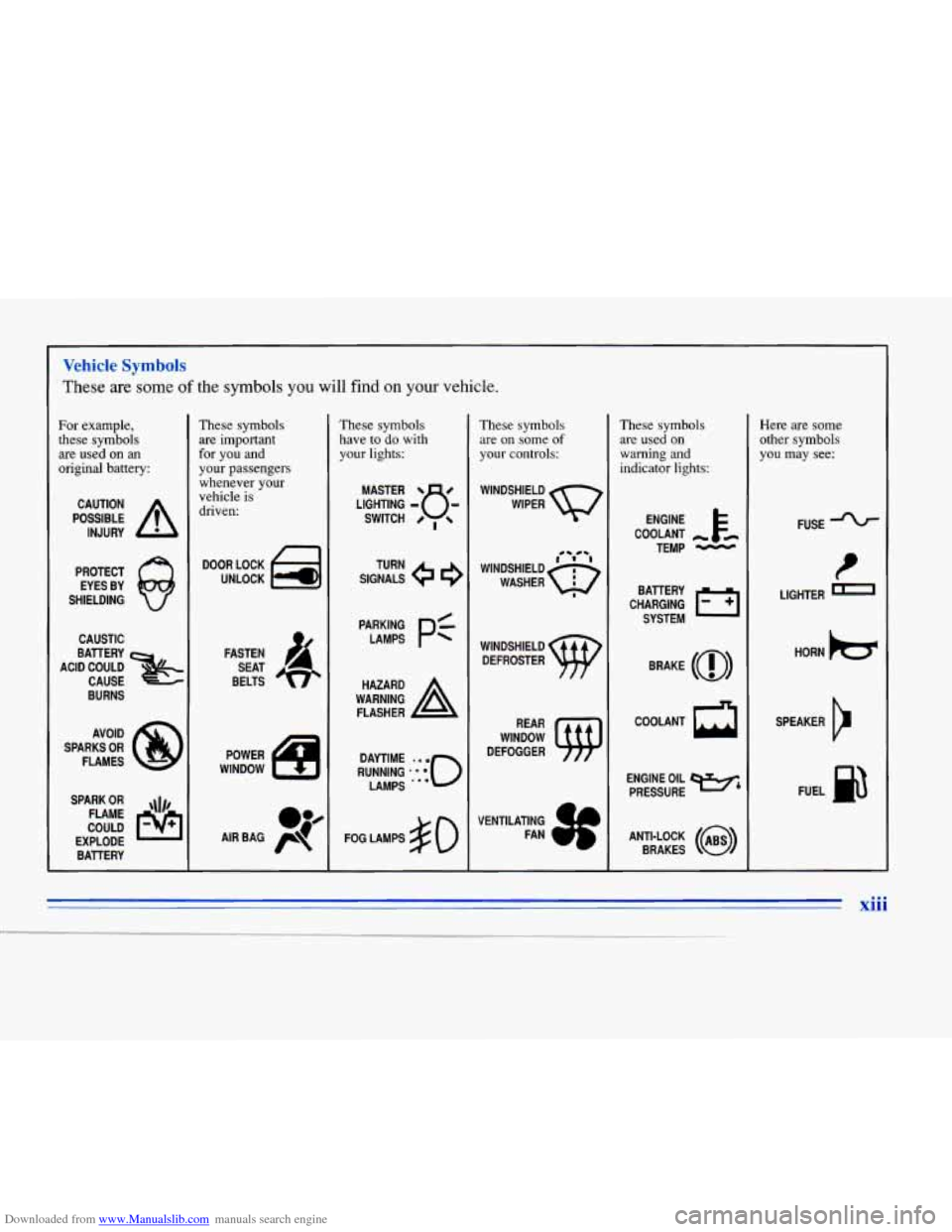
Downloaded from www.Manualslib.com manuals search engine Vehicle Symbols
These are some of the symbols you will find on your vehicle.
For example,
these symbols
are used on an
original battery:
POSSIBLE A
CAUTION
INJURY
PROTECT EYES BY
SHIELDING
CAUSTIC
BURNS AVOID
SPARKS
OR
FLAMES
SPARK
OR ,\I/,
COULD FLAME
EXPLODE BAITERY
These symbols
are important
for you and
your passengers
whenever your
vehicle is
driven:
DOOR LOCK
UNLOCK
FASTEN SEAT
BELTS
n
These symbols
have
to do with
your lights:
SIGNALS e e3
TURN
FOG LAMPS
& 0
These symbols are on some
of
your controls:
WINDSHIELD
WIPER
WINDSHIELD DEFROSTER
VENTILATING FAN
These symbols
are used on
warning and
indicator lights:
COOLANT -
TEMP -
CHARGING F’J
BATTERY
SYSTEM
BRAKE
(0)
COOLANT a
ENGINE OIL e,
PRESSURE
ANTI-LOCK
(@)
BRAKES
Here are some
other symbols
you may see:
FUSE
LIGHTER HORN
)tr
SPEAKER
cr
FUEL p3
xiii
,
Page 144 of 354

Downloaded from www.Manualslib.com manuals search engine SERVICE RIDE CONTROL - 84: This message is
displayed to indicate that the suspension system
is not
operating properly. To correct this problem have your
vehicle serviced at your Cadillac dealership.
SERVICE TRANSMISSION - 100: If a problem is
detected with the transaxle, this message will appear.
Have your vehicle checked by your Cadillac dealership.
SPEED SENSOR FAULT - 109: A circuit problem
with the vehicle speed sensor will trigger this message
to appear. Have your Cadillac dealership service your
vehicle.
STARTING DISABLED DUE TO THEFT SYSTEM
REMOVE IGNITION KEY
- 33: This message will
appear when the Personalized Automotive Security
System (PASS-Key
11) senses that an improper ignition
key is being used to try to start the vehicle. Check the
ignition key for damage.
If it is damaged, it may need to
be replaced.
If you see no damage, clean the pellet
contacts with a soft cloth
or napkin. Remove the ignition
key and wait for the DIC to display WAIT
3 MINUTES.
The instrument panel cluster will then run a timer and
change
the messages to WAIT 2 MINUTES, WAIT
1 MINUTE and then START CAR. When the START
CAR message is displayed, try again to start the engine.
STOP ENGINE ENGINE OVERHEATED - 42: This
message will appear when the engine has overheated.
Stop and turn the engine
off immediately to avoid severe
engine damage. See “Engine Overheating” in the Index.
STOP ENGINE LOW OIL PRESSURE - 35: If this
message appears while the engine is running, stop the
engine and do not operate
it until the cause of low oil
pressure is corrected. Severe damage to the engine
can result.
THEFT SYSTEM PROBLEMKAR MAY NOT
RESTART
- 34: This message means there is a problem
in the Personalized Automotive Security System
(PASS-Key 11). A fault has been detected in the system
which means that the PASS-Key I1 system is disabled
and is not protecting the vehicle. The vehicle usually
restarts however, you may want to take your vehicle to
a
proper service center before turning off the engine.
TOP SPEED FUEL CUT-OFF - 111: This message
will appear when the PCM senses that the maximum
speed for your Cadillac has been reached. The speed of
your vehicle will decrease several mph as the fuel
supply is cutoff. This allows your vehicle to stay in a
stable operating range.
2-83
1
Page 205 of 354
Downloaded from www.Manualslib.com manuals search engine The exit speed is usually posted.
Reduce your speed according to your speedomete.r, not
to your sense of motion. After driving for any distance
at higher speeds, you may te.nd to think you are going
slower than you actually are.
Before Leaving on a Long Trip
Make sure you’re ready. Try to be well rested. If you
must start when you’re not fresh
-- such as after a day’s
work
-- don’t plan to make too many miles that first part
of the journey. Wear comfortable clothing and shoes you
can easily drive in.
Is your vehicle ready for a long trip‘? If you keep it
serviced and maintained, it’s ready to go. If it needs
service, have it done before starting out. Of course,
you’ll find experienced and able service experts in
Cadillac dealerships all across North America. They’ll
be ready and willing to help if you need
it.
Here are some things you can check before a trip:
0
0
0
Wimid1icld Washer Fluid: Is the reservoir full? Are
all windows clean inside and outside?
Wiper Blndes: Are they in good shape?
Fuel, Eugilze Oil, Other- Fluids: Have you checked
all levels?
Lmps: Are they all working? Are the lenses clean?
Tiws: They are vitally important to a safe,
trouble-free trip.
Is the tread good enough for
long-distance driving? Are the tires all inflated to
the
recommended pressure?
Weatlzer Forecasts: What’s the weather outlook
along your route? Should you delay your trip a short
time
to avoid a major storm system?
Maps: Do you have up-to-date maps?
4-22
Page 212 of 354
Downloaded from www.Manualslib.com manuals search engine Run your engine only as long as you must. This saves
fuel. When you run the engine, make it go a little faster
than just idle. That
is, push the accelerator slightly. This
uses less fuel for the heat that you get and it keeps the
battery charged. You will need a well-charged battery to
restart the vehicle, and possibly for signaling later on
with your headlamps. Let the heater run for awhile.
Then, shut the engine off and close the window almost
all the way to preserve the heat. Start the engine again
and repeat this only when you feel really uncomfortable
from the cold. But do it as little as possible. Preserve the
fuel as long
as you can. To help keep warm, you can get
out of the vehicle and do some fairly vigorous exercises
every half hour or
so until help comes.
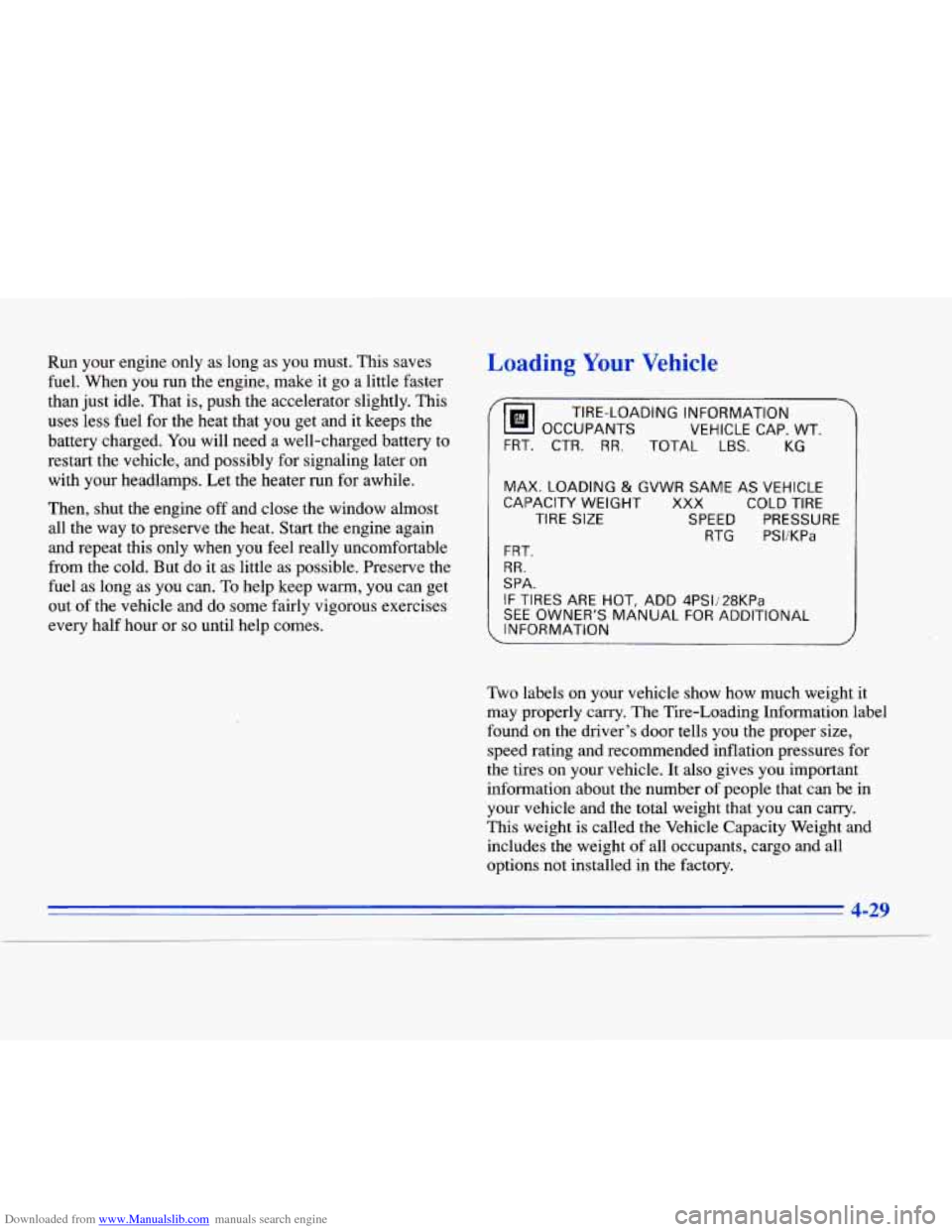
Loading Your Vehicle
‘ OCCUPANTS
VEHICLE CAP. WT.
TIRE-LOADING INFORMATION
FRT. CTR.
RR. TOTAL LBS. KG
MAX. LOADING & GVWR SAME AS VEHICLE
CAPACITY WEIGHT
XXX COLD TIRE
TIRE SIZE SPEED PRESSURE
RTG PSI/KPa
FRT.
RR.
SPA.
IF TIRES ARE HOT. ADD 4PS1/28KPa
SEE OWNER’S MANUAL FOR ADDITIONAL
INFORMATION
Two labels on your vehicle show how much weight it
may properly carry. The Tire-Loading Information label
found on the driver’s door tells you the proper size,
speed rating and recommended inflation pressures for
the tires on your vehicle. It also gives you important
information about the number of people that can be in
your vehicle and the total weight that you can carry.
This weight is called the Vehicle Capacity Weight and
includes the weight of all occupants, cargo and all
options not installed in the factory.
I
4-29
Page 296 of 354
Downloaded from www.Manualslib.com manuals search engine Inflation -- Tire Pressure
The Tire-Loading Information label which is located on
the rear edge of the driver’s door, shows the correct
inflation pressures for your tires when they’re cold.
“Cold” means your vehicle has been sitting for at least
three hours or driven no more than a mile.
If you’ll be driving at speeds higher than 100 mph
(160 km/h) where it is legal, raise the cold inflation
pressure
of each tire to 35 psi (240 Wa). When you end
this very high-speed driving, reduce the cold inflation
pressures to those listed on the Tire-Loading
Information label.
NOTICE:
Don’t let anyone tell you that underinflation or
overinflation is all right.
It’s not. If your tires
don’t have enough air (underinflation), you can
get the following:
Too much flexing
Too much heat
Tire overloading
Bad wear
Bad handling
Bad fuel economy.
If your tires have too much air (overinflation),
you can get the following:
Unusual wear
Bad handling
Rough ride
Needless damage from road hazards.
6-37
I
Page 316 of 354

Downloaded from www.Manualslib.com manuals search engine Fuse
MIRROR
FOG/DRL
IGP
. JO (ENG)'
CRANK
S
t
Usage
Inadvertent Power Relay, Outside
Rearview Mirror, Data Line
Connector (DLC), Flash-to-Pass
Module
Daytime Running Lamp (DRL)
Relay (Domestic Only), Fog Lamp
Relay (Optional), Headlamp
Switch, Right and Left Front Fog
Lamps (Optional)
Powertrain Control Module (PCM)
Sensing and Diagnostic Module
Anti-Lock Brake System/Anti-Slip
Regulation-5 (ABS/ASR-5) Controller
Rear Ignition-
1 Relay, Front Fog
Lamp Relay, Rear Lamp Relay (Export), Controlled Power
Back-up Relay, DRL Relay
(Domestic Only) (SDM)
Fuse
WIPERS
OXY SEN2*
OXY SENl*
FUEL
PUMP*
INJ*
INJ*
CRUISE
DISTR*
PCM (IGN)*
Usage
Accessory Relay, Wiper Switch,
Cluster, Wiper Motor, Wiper Pump
02 Sensor Rear, Catalytic
Converter (CAT) Rear
02 Sensor
02 Sensor Front, CAT Front 02
Sensor
Engine Oil Pressure Indicator, PCM, Fuel Pump Relay, Fuel Pump
Injectors
2, 3,5, 8
Injectors 1,4,6,7
Stepper Motor Cruise Control,
Park-Neutral Position Switch,
Back-up Lamps, Electrochromatic
Mirror, Brake-Transaxle Shift
Interlock (BTSI)
Electronic Ignition Control
PCM
6
I
Page 351 of 354
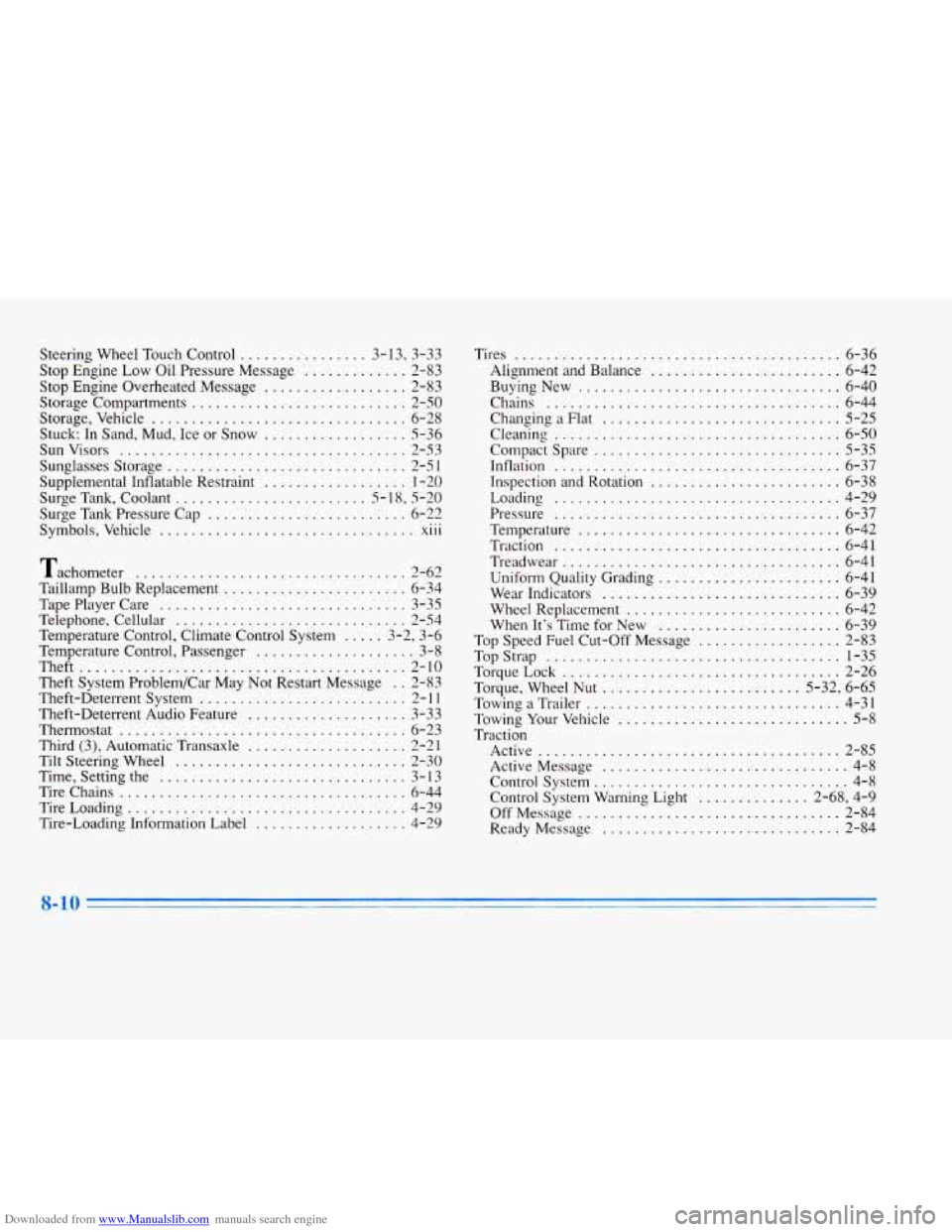
Downloaded from www.Manualslib.com manuals search engine Steering Wheel Touch Control ................ 3-13. 3-33
Stop Engine Low Oil Pressure Message
............. 2-83
Stop Engine Overheated Message
.................. 2-83
Storage Compartments
........................... 2-50
Storage. Vehicle
................................ 6-28
Stuck:
In Sand. Mud. Ice or Snow .................. 5-36
Sunvisors
.................................... 2-53
Sunglasses Storage
.............................. 2-5 1
Supplemental Inflatable Restraint .................. 1-20
Surge Tank. Coolant
........................ 5- 18. 5-20
Surge Tank Pressure Cap ......................... 6-22
Symbols. Vehicle
................................ x111 ...
Tachometer .................................. 2-62
Taillamp Bulb Replacement
....................... 6-34
TapePlayerCare
............................... 3-35
Telephone. Cellular
............................. 2-54
Temperature Control. Climate Control System ..... 3-2. 3-6
Temperature Control. Passenger
.................... 3-8
Theft
......................................... 2-10
Theft System Problem/Car May Not Restart Message
. . 2-83
Theft-Deterrent System
.......................... 2- 1 1
Theft-Deterrent Audio Feature .................... 3-33
Thermostat
.................................... 6-23
Third (3)’ Automatic Transaxle
.................... 2-2 1
Tilt Steering Wheel ............................. 2-30
Time. Setting the
............................... 3- 1 3
Tire Chains
.................................... 6-44
TireLoading
................................... 4-29
Tire-Loading Information Label
................... 4-29 Tires
......................................... 6-36
Alignment and Balance
........................ 6-42
BuyingNew
................................. 6-40
Chains
..................................... 6-44
Changing a Flat
.............................. 5-25
Cleaning
.................................... 6-50
Compact Spare
............................... 5-35
Inflation
.................................... 6-37
Inspection and Rotation
........................ 6-38
Pressure
.................................... 6-37
Temperature
................................. 6-42
Traction
.................................... 6-41
Treadwear
................................... 6-41
Uniform Quality Grading ....................... 6-41
Wear Indicators .............................. 6-39
Wheel Replacement
........................... 6-42
When
It’s Time for New ....................... 6-39
Top Speed Fuel Cut-Off Message
.................. 2-83
TorqueLock
................................... 2-26
Torque, Wheel
Nut ......................... 5-32, 6-65
Towing a Trailer
................................ 4-31
Towing Your Vehicle
............................. 5-8
Traction Active
...................................... 2-85
Active Message
............................... 4-8
Control System
................................ 4-8
OffMessage
................................. 2-84
Ready Message
.............................. 2-84
Loading
.................................... 4-29
TopStrap
..................................... 1-35
Control System Warning Light .............. 2-68, 4-9
.