1996 BUICK REGAL oil type
[x] Cancel search: oil typePage 149 of 356
C __~ ~ ~ Iur C mette Tape PIayer
A tape player that is not cleaned regularly can cause
reduced sound quality, ruined cassettes or a damaged
mechanism. Cassette tapes should be stored in their
cases away from contaminants, direct sunlight and
extreme heat. If they aren’t, they may not operate
properly or may cause failure
of the tape player.
Your tape player should be cleaned regularly after every
50 hours of use. Your radio may display CLN to indicate
that you have used your tape player for
50 hours without
resetting the tape clean timer. If you notice a reduction in
sound quality,
try a known good cassette to see if the tape
or the tape player is at fault. If this other cassette has no
improvement
in sound quality, clean the tape player.
Cleaning may be done with a scrubbing action,
non-abrasive cleaning cassette with pads which scrub
the tape head as the hubs of the cleaner cassette turn. It
is normal for the cassette to eject while cleaning. Insert
the cassette at least three times to ensure thorough
cleaning. A scrubbing action cleaning cassette is
available through your Buick dealer. You
may also choose a non-scrubbing action, wet-type
cleaner which uses a cassette with a fabric belt to clean
the tape head. This type
of cleaning cassette will not
eject. It may not clean as thoroughly as the scrubbing
type cleaner.
Cassettes are subject to wear and the sound quality may
degrade over time. Always make sure that the cassette
tape is in good condition before you have your tape
player serviced.
Care of Your Compact Discs
Handle discs carefully. Store them in their original cases
or other protective cases and away from direct sunlight
and dust. If the surface of a disc is soiled, dampen a
clean, soft cloth in
a mild, neutral detergent solution and
clean it, wiping from the center to the edge.
Be sure never to touch the signal surface when handling
discs. Pick up discs by grasping the outer edges or the
edge
of the hole and the outer edge.
t
ProCarManuals.com
Page 266 of 356
Using Solvent-Qpe Cleaner on Fabric
First, see if you have to use solvent-type cleaner at all.
Some spots and stains will clean off better with just
water and mild soap.
If you need to use
a solvent:
0 Gently scrape excess soil from the trim material with
a clean, dull knife or scraper. Use very little cleaner,
light pressure and clean cloths (preferably
cheesecloth). Cleaning should start at the outside of
the stain, “feathering” toward the center. Keep
changing to
a clean section of the cloth.
0 When you clean a stain from fabric, immediately
dry the area with
a blow dryer to help prevent a
cleaning ring.
Special Cleaning Problems
Greasy or Oily Stains
Stains caused by grease, oil, butter, margarine, shoe
polish, coffee with cream, chewing gum, cosmetic
creams, vegetable oils, wax crayon, tar and asphalt can
be removed
as follows:
0 Carefully scrape off excess stain.
0 Follow the solvent-type instructions
described earlier.
Shoe polish, wax crayon, tar and asphalt will stain if
left on
a vehicle’s seat fabric. They should be removed
as
soon as possible. Be careful, because the cleaner
will dissolve them and mdy cause them to spread.
Non-Greasy Stains
Stains caused by catsup, coffee (black), egg, fruit, fruit
juice, milk, soft drinks, wine, vomit, urine and blood can
be removed
as follows:
0 Carefully scrape off excess stain, then sponge the
soiled
area with cool water.
0 If a stain remains, follow the foam-type instructions
described earlier.
6-44
ProCarManuals.com
Page 267 of 356
0 If an odor lingers after cleaning vomit or urine,
treat the area with
a watedbaking soda solution:
1 teaspoon
(5 ml) of baking soda to 1 cup (250 ml)
of lukewarm water.
If needed, clean lightly with solvent-type cleaner.
Combination Stains
Stains caused by candy, ice cream, mayonnaise, chili
sauce and unknown stains can be removed
as follows:
Carefully scrape off excess stain, then clean with
cool water and allow to dry.
If a stain remains, clean it with solvent-type cleaner.
Cleaning Vinyl
Use warm water and a clean cloth.
0 Rub with a clean, damp cloth to remove dirt. You
may have to do it more than once.
Things like tar, asphalt and shoe polish will stain if
you don’t get them off quickly. Use
a clean cloth and
a GM Vinyl/Leather Cleaner or equivalent product.
Cleaning Leather
Use a soft cloth with lukewarm water and a mild soap or
saddle soap.
For stubborn stains, use a GM Vinylkeather Cleaner
or equivalent product.
Never use oils, varnishes, solvent-based or abrasive
cleaners, furniture polish or shoe polish on leather.
Soiled leather should be cleaned immediately. If
dirt is allowed to work into the finish, it can harm
the leather.
Cleaning the Top of the Instrument Panel
Use only mild soap and water to clean the top surfaces
of the instrument panel. Sprays containing silicones or
waxes may cause annoying reflections in the windshield
and
even make it difficult to see through the windshield
under certain conditions.
ProCarManuals.com
Page 283 of 356
Capacities and Specifications
Automatic Transaxle
Pan Removal and Replacement .............................. 7 quarts (6.7 L)
When draiizilzg/replacil.Ig convertec more,fluid may be needed.
Cooling System Including Reservoir
3.1L(CodeM) ...................................... 11.6quarts(10.93L)
3.8L (Code
K) ....................................... 10.7 quarts (10.1 L)
Refrigerant (R-l34a), Air Conditioning* .................... 2.0 lbs (0.91 kg)
*See “Air Conditioning Refriger~-lnts”l~~tel- in th,is section.
Engine Crankcase
Oil and Filter Change ................................... 4.5 quarts (4.2 L)
Wheel Nut Torque .................................... 100 Ib-ft (140 N.m)
Fuel Tank ........................................... 17.1 gallons (64.7 L)
Wiper Blade Lengths
Type ............................................................. Pin
Length
.................................................. 20”(508mm)
Note: All capacities are approximate when adding. Be sure to Jill to the
approximate level, as recommended in this manual.
6-61
ProCarManuals.com
Page 285 of 356
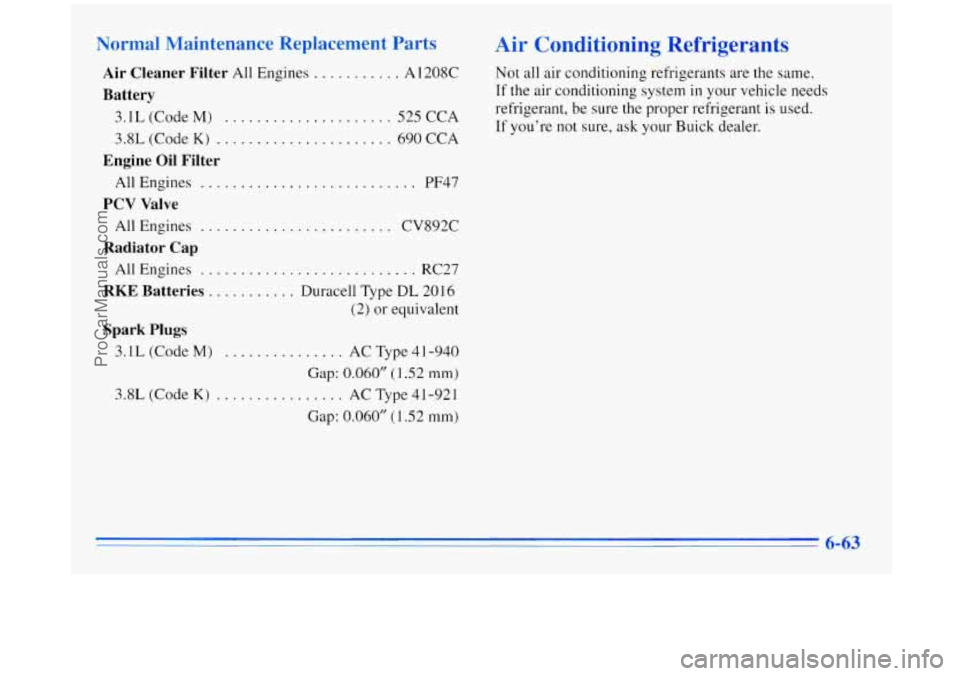
Normal Maintenance Replacement Parts
Air Cleaner Filter All Engines ........... A 1208C
Battery
3.1L (Code M) ..................... 525 CCA
3.8L (Code
K) ...................... 690 CCA
Engine Oil Filter
PCV Valve
All Engines ........................... PF47
All Engines
........................ CV892C
Radiator Cap
All Engines ........................... RC27
RKE Batteries ........... Duracell Type DL 2016
(2) or equivalent
Spark Plugs
3.1L (Code M) ............... AC Type 41 -940
Gap: 0.060” (1.52 mm)
3.8L (Code K) ................ AC Type 41-921
Gap:
0.060” (1.52 mm)
Air Conditioning Refrigerants
Not all air conditioning refrigerants are the same.
If the air conditioning system in your vehicle needs
refrigerant, be sure the proper refrigerant is used.
If you’re not sure, ask your Buick dealer.
6-63
ProCarManuals.com