1996 BUICK REGAL service
[x] Cancel search: servicePage 3 of 356

The 1996 Buick Regal Owner’s Manual
7-
Seats and Restraint Systems ............................................................. 1-1
This section tells you how to use your seats and safety belts properly. It also explains “SRS” system.
This section explains how to start and operate your Buick.
This section tells you how to adjust the ventilation and comfort controls and how to operate your
audio system.
Here you’ll find helpful information and tips about the road and how to drive under different conditions.
This section tells you
what to do if you have a problem while driving, such as a flat tire or
overheated engine, etc.
Here the manual tells you how to keep
your Buick running properly and looking good.
This section tells
you when to perform vehicle maintenance and what fluids and lubricants to use.
This section tells you how to contact Buick for assistance and how to get service publications.
It also
gives you information on “Reporting Safety Defects” on page
8-7.
Index ........................................................................\
........ 9-1
Here’s an alphabetical listing of almost every subject in this manual. You can use it to quickly find something
you want to read.
Features and Controls .................................................................. 2-1
Comfort Controls and Audio Systems ..................................................... 3-1
YourDrivingandtheRoad .............................................................. 4-1
ProblemsontheRoad .................................................................. 5-1
Service and Appearance Care. ........................................................... 6-1
Maintenanceschedule .................................................................. 7-1
Customer Assistance Information ........................................................ 8-1
i
ProCarManuals.com
Page 4 of 356

GEmRAL MOTORS, GM and the GM Emblem,
BUICK, the BUICK Emblem and the name REGAL
are
registered trademarks of General Motors Corporation.
This manual includes the latest information at the time it
was printed. We reserve the right to make changes in the
product after that time without further notice. For
vehicles first sold in Canada, substitute the name
“General Motors of Canada Limited” for Buick Motor
Division whenever it appears in
this manual.
WE SUPPORT
VOLUNTARY TECHNICIAN
CERTIFICATION THROUGH
AUTOMOTIVE
National Institute for
SERVICE
EXCELLENCE
For Canadian Owners Who Prefer a
French Language Manual:
Aux propriktaires canadiens: Vous pouvez vous
procurer un exemplaire de
ce guide en franqais chez
votre concessionaire
ou au:
Please keep this manual in
your Buick,
so it will be there
if you ever need it when you’re on the road. If you sell
the vehicle, please leave this manual in it
so the new
owner can use it.
DGN Marketing Services Ltd.
1500 Bonhill Rd.
Mississauga, Ontario L5T 1C7
Litho in.
U.S.A.
Part No. 25632198 B First Edition
ProCarManuals.com
Page 9 of 356
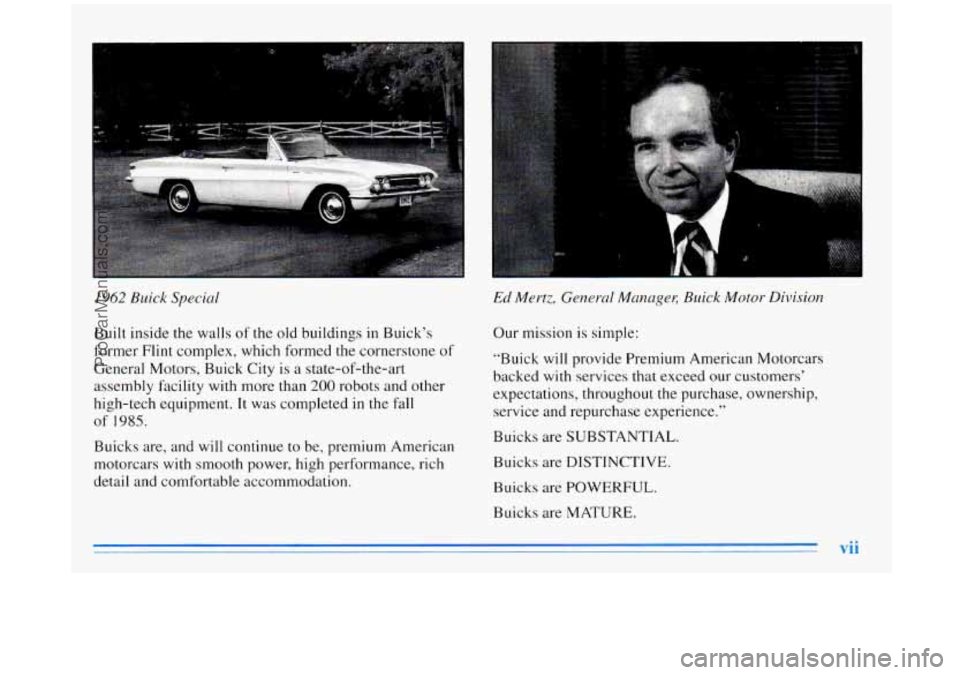
I962 Buick Special
Built inside the walls of the old buildings in Buick’s
former Flint complex, which formed the cornerstone of
General Motors, Buick City is
a state-of-the-art
assembly facility with more than
200 robots and other
high-tech equipment. It was completed
in the fall
of
1985.
Buicks are, and will continue to be, premium American
motorcars with smooth power, high performance, rich
detail and comfortable accommodation.
Ed Mertz, General Manager; Buick Motor Division
Our mission is simple:
“Buick will provide Premium American Motorcars
backed with services that exceed our customers’
expectations, throughout the purchase, ownership,
service and repurchase experience.”
Buicks are SUBSTANTIAL.
Buicks are DISTINCTIVE.
Buicks are POWERFUL.
Buicks are MATURE.
ProCarManuals.com
Page 36 of 356

How does an air bag restrain?
In moderate to severe frontal or near-frontal collisions,
even belted occupants can contact the steering wheel or
the
instrument panel. The air bag supplements the protection
provided by safety belts. Air bags distribute the force
of
the impact more evenly over the occupant’s upper body,
stopping the occupant more gradually. But air bags would
not help you
in many types of collisions, including
rollovers, rear impacts and side impacts, primarily because
an occupant’s motion is not toward the air bag. Air bags
should never be regarded as anything more than
a
supplement to safety belts, and then only in moderate
to severe frontal or near-frontal collisions.
What will you see after an air bag inflates?
After the air bag inflates, it quickly deflates. This occurs
so quickly that some people may not even realize the air
bag inflated. Some components of the air bag module
in
the steering wheel hub for the driver’s air bag, or the
instrument panel for the right front passenger’s bag, will
be hot for
a short time. The part of the bag that comes
into contact with you may be warm, but
it will never be
too hot to touch. There will be some smoke and dust
coming from vents
in the deflated air bags. Air bag
inflation will not prevent the driver from seeing or from
being able to steer the vehicle, nor will
it stop people
from leaving the vehicle.
When an air bag inflates, there is dust in the air.
This dust could cause breathing problems for
people with a history of asthma or other
breathing trouble.
To avoid this, everyone in the
vehicle should get out as soon as
it is safe to do so.
If you have breathing problems but can’t get out
of the vehicle after an air bag inflates, then get
fresh air by opening a window or door.
In many crashes severe enough to inflate an air bag,
windshields are broken by vehicle deformation.
Additional windshield breakage may
also occur from the
right front passenger’s air bag.
The air bags are designed to inflate only once. After
they inflate, you’ll need some new parts for your air
bag system. If you don’t get them, the air bag system
won’t be there to help protect you
in another crash.
A new system will include air bag modules and
possibly other parts. The service manual for your
vehicle covers the need to replace other parts.
ProCarManuals.com
Page 37 of 356

0 Your vehicle is equipped with a crash sensing and
diagnostic module, which records information about
the air bag system. The module records information
about the readiness
of the system, when the sensors are
activated and driver’s safety belt usage at deployment.
Let only qualified technicians work on your air bag
system. Improper service can mean that your air bag
system won’t work properly. See your dealer for service
NOTICE:
If you damage the cover for the driver’s or the
right front passenger’s air bag, they may not
work properly. You may have to replace the air
bag module in the steering wheel
or both the air
bag module and the instrument panel for the
right front passenger’s air bag.
Do not open or
break the air bag covers.
Servicing Your Air Bag-Equipped Buick
Air bags affect how your Buick should be serviced.
There are parts
of the air bag system in several places
around your vehicle.
You don’t want the system to
inflate while someone
is working on your vehicle.
Your Buick dealer and the Regal Service Manual have
information about servicing your vehicle and the air bag
system.
To purchase a service manual, see “Service and
Owner Publications” in the Index.
A CAUTION -
-
For up to 10 seconds after the ignition key is
turned off and the battery is disconnected, an air
bag can still inflate during improper service.
You
can be injured if you are close to an air bag when
it inflates. Avoid wires wrapped with yellow tape
or yellow connectors. They are probably part of
the air bag system. Be sure to follow proper
service procedures, and make sure the person
performing work for you is qualified to do
so.
The air bag system does not need regular maintenance.
1-23
ProCarManuals.com
Page 70 of 356

Just close your doors and turn on the ignition. All of the
doors will lock when
you move your shift lever out of
PARK (P) or NEUTRAL (N). All doors will unlock
automatically when the ignition is turned off.
If someone needs to get out while
the vehicle is running,
have that person use the manual or power lock. When
the
door is closed again, it will lock automatically as long as
the shift lever is
out of PARK (P) or NEUTRAL (N) and
the ignition is on. Note that the door must be opened,
then closed, or the door will not automatically relock.
If
you don’t .want the doors to unlock automatically
when
you turn the ignition off, you can remove the
LOCK CONTROL fuse in the instrument panel fuse
block. See “Fuses and Circuit Breakers” in the Index.
-,wing Your Vehicle
If you are leaving the vehicle, take your keys, open your
door and set the locks from inside. Then get
out and
close the door.
Remote Keyl. !c Entry (Option)
If your Buick has this option, you can lock and unlock your
doors
or unlock your trunk from up to 30 feet (9 m) away
using the key chain transmitter supplied with your vehicle.
Your Remote Keyless Entry transmitter operates on a
radio frequency subject to Federal Communications
Commission (FCC) Rules.
This device complies with
Part 15 of the FCC Rules.
Operation is subject to the following two conditions:
(1) This device may not cause harmful interference, and
(2) This device must accept any interference received,
including interference that may cause undesired operation.
Should interference to this system occur, try this:
a
a
0
a
Check to determine if battery replacement is
necessary. See the instructions on battery replacement.
Check the distance. You may be
too far from your
vehicle. This product has a maximum range.
Check the location. Other vehicles or objects may be
blocking the signal.
See your Buick dealer or a qualified technician for service.
Changes or modifications to this system by other than an
authorized service facility could void authorization to
use this equipment.
2-4
ProCarManuals.com
Page 74 of 356

Parking Lots
If you park in a lot where someone will be watching
your vehicle, it’s best to lock it up and take your keys.
But what if you have to leave your ignition key? What if
you have to leave something valuable in your vehicle?
0 Put your valuables in a storage area, like your trunk
Lock the glove box.
Lock all the doors except the driver’s.
Then take the door key with you.
or glove
box.
Your vehicle
is equipped
with
the PASS-Key I1
(Personalized Automotive
Security System)
theft-deterrent system.
PASS-Key I1 is a passive
theft-deterrent system. It
works when you insert or
remove
the key from the
ignition. PASS-Key
I1 uses a resistor pellet
in the ignition key
that matches
a decoder in your vehicle.
When the PASS-Key I1 system senses that someone is
using the wrong key, it shuts down the vehicle’s starter
and fuel systems.
For about three minutes, the starter
won’t work and
fuel won’t go to the engine. If someone
tries to start your vehicle again or uses another key
during this time, the vehicle will not start. This
discourages someone from randomly trying different
keys
with different resistor pellets in an attempt to make
a match.
The ignition
key must be clean and dry before it’s
inserted in the ignition or the engine may not start.
If the
engine does not start and the SECURITY light is on, the
key may be dirty or wet. Turn
the ignition off.
Clean and dry the key. Wait about three minutes and try
again. The SECURITY light may remain on during this
time. If
the starter still won’t work, and the key appears
to be clean and dry, wait about three minutes and try
another ignition key. At this time, you may also want to
check the fuse (see
“Fuses and Circuit Breakers” in the
Index). If the starter won’t work with the other key, your
vehicle needs service.
If your vehicle does start, the first
ignition key may be faulty. See your Buick dealer or
a
locksmith who can service the PASS-Key 11.
2-8
ProCarManuals.com
Page 75 of 356
If you accidentally use a key that has a damaged or
missing resistor pellet, the starter won’t work, and the
SECURITY light will flash. But you don’t have to wait
three minutes before trying another ignition key.
See your Buick dealer
or a locksmith who can service
the PASS-Key
I1 to have a new key made.
If you’re ever driving and the SECURITY light comes
on, you will be able to restart your engine if you turn it
off. Your PASS-Key I1 system, howevcr, is not working
properly and must be serviced by your Buick dealer. Your
vehicle is not protected by the PASS-Key I1 system.
If you lose or damage a PASS-Key I1 ignition key, see
your Buick dealer or a locksmith who can service
PASS-Key I1 to have a new key made.
New Vehicle CCBreak-InSS
NOTICE:
Your modern Buick doesn’t need an elaborate
“break-in.” But it will perform better in the long
run if you follow these guidelines:
0 Don’t drive at any one speed -- fast or
slow -- for the first 500 miles (804 km).
Don’t make full-throttle starts.
200 miles (322 km) or so. During this time
your new brake linings aren’t yet broken
in. Hard stops with new linings can mean
premature wear and earlier replacement.
Follow this breaking-in guideline every
time you get new brake linings.
See “Towing
a Trailer’’ in the Index for
more information.
0 Avoid making hard stops for the first
0 Don’t tow a trailer during break-in.
ProCarManuals.com