1996 BUICK REGAL reset
[x] Cancel search: resetPage 138 of 356
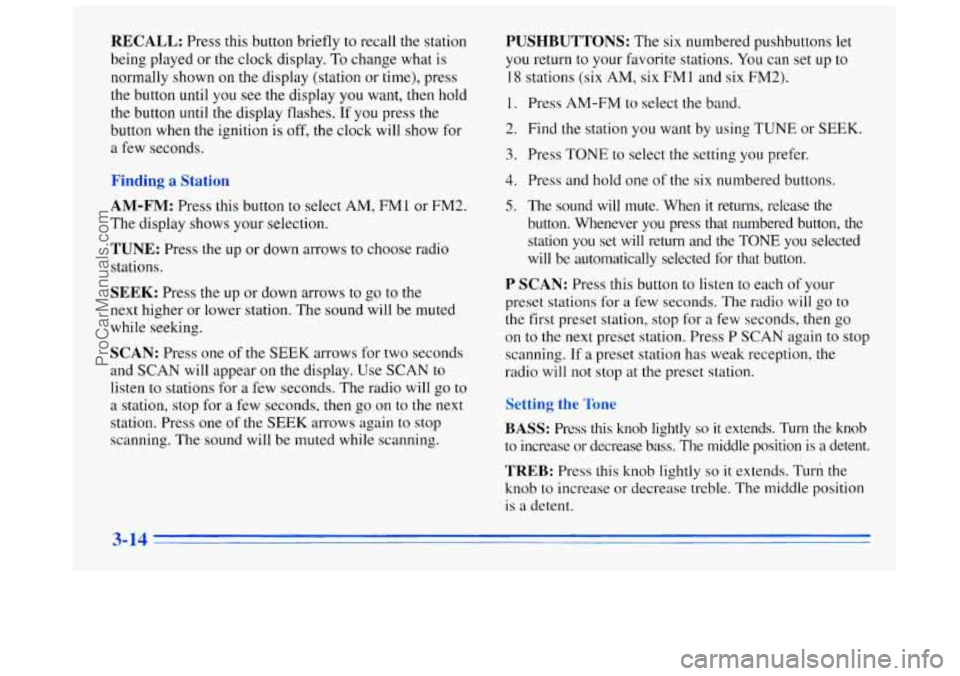
RECALL: Press this button briefly to recall the station
being played or the clock display. To change what is
normally shown on the display (station or time), press
the button until you see the display
you want, then hold
the button
until the display flashes. If you press the
button when the ignition is off, the clock will show for
a few seconds.
ung a :atlon
AM-FM: Press this button to select AM, FM1 or FM2.
The display shows your selection.
TUNE: Press the up or down arrows to choose radio
stations.
SEEK: Press the up or down arrows to go to the
next higher or lower station. The sound will be muted
while seeking.
SCAN: Press one of the SEEK arrows for two seconds
and
SCAN will appear on the display. Use SCAN to
listen to stations for a few seconds. The radio will go to
a station, stop
for a few seconds, then go on to the next
station. Press one of the SEEK arrows again to stop
scanning. The sound will be muted while scanning.
PUSHBUTTONS: The six numbered pushbuttons let
you return to your favorite stations. You can set up to
18 stations (six AM, six FM 1 and six FM2).
1. Press AM-FM to select the band.
2. Find the station you want by using TUNE or SEEK.
3. Press TONE to select the setting you prefer.
4. Press and hold one of the six numbered buttons.
5. The sound will mute. When it returns, release the
button. Whenever you press that numbered button, the
station you set will return and the TONE you selected
will be automatically selected for that button.
P SCAN: Press this button to listen to each of your
preset stations
for a few seconds. The radio will go to
the first preset station, stop for
a few seconds, then go
on to the next preset station. Press P
SCAN again to stop
scanning. If
a preset station has weak reception, the
radio will not stop at the preset station.
TREB: Press this knob lightly so it extends. Turn the
knob to increase
or decrease treble. The middle position
is a detent.
3-14
ProCarManuals.com
Page 139 of 356
Push the knobs back in when you are not using them.
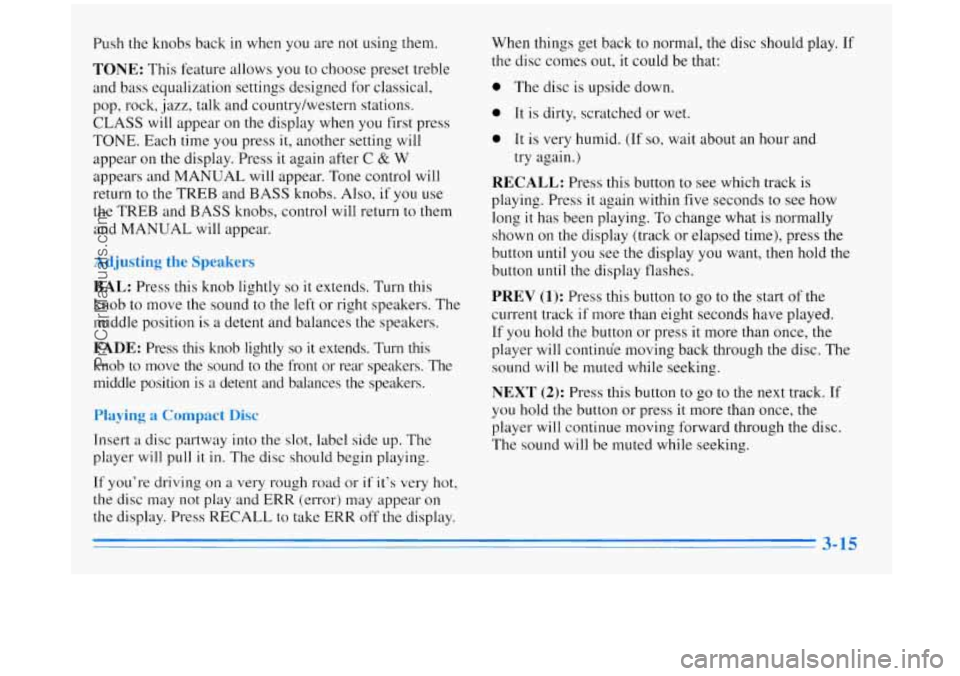
TONE: This feature allows you to choose preset treble
and bass equalization settings designed for classical,
pop, rock,
jazz, talk and countrylwestern stations.
CLASS will appear on the display when you first press
TONE. Each time you press it, another setting will
appear on the display. Press
it again after C & W
appears and MANUAL will appear. Tone control will
return to the TREB and BASS knobs. Also,
if you use
the TREB and BASS knobs, control will return to them
and MANUAL will appear.
djusting the Spc cers
BAL: Press this knob lightly so it extends. Turn this
knob to move the sound to the left or right speakers. The
middle position is
a detent and balances the speakers.
FADE: Press this knob lightly so it extends. Turn this
knob to move the sound to the front or rear speakers. The
middle position is a detent and balances the speakers.
Cc
Insert a disc partway into the slot, label side up. The
player will pull
it in. The disc should begin playing.
If you’re driving on a very rough road or if it’s very hot,
the disc may not play and
ERR (error) may appear on
the display. Press RECALL
to take ERR off the display. When
things get back to normal, the disc should play.
If
the disc comes out, it could be that:
0 The disc is upside down.
0 It is dirty, scratched or wet.
0 It is very humid. (If so, wait about an hour and
RECALL: Press this button to see which track is
playing. Press it again within five seconds
to see how
long
it has been playing. To change what is normally
shown on the display (track or elapsed time), press the
button until you see the display you want, then hold the
button
until the display flashes.
PREV (1): Press this button to go to the start of the
current track
if more than eight seconds have played.
If you hold the button or press it more than once, the
player
will continu’e moving back through the disc. The
sound will be muted while seeking.
NEXT (2): Press this button to go to the next track. If
you hold the button
or press it more than once, the
player will continue moving forward through the disc.
The sound will be muted while seeking.
try
again.)
ProCarManuals.com
Page 141 of 356
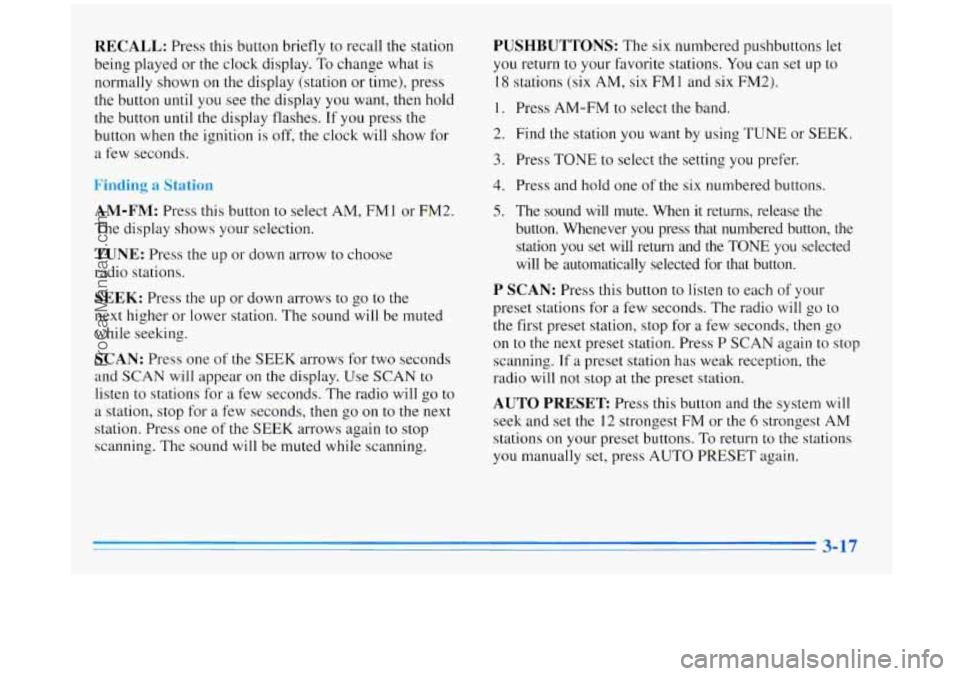
RECALL: Press this button briefly to recall the station
being played or the clock display. To change what is
normally shown on the display (station or time), press
the button until you see
the display you want, then hold
the button until the display flashes. If
you press the
button when the ignition is off,
the clock will show for
a few seconds.
AM-FM: Press this button to select AM, FMl or FM2.
The display shows your selection.
TUNE: Press the up or down arrow to choose
radio stations.
SEEK: Press the up or down arrows to go to the
next higher or lower station. The sound will be muted
while seeking.
SCAN: Press one of the SEEK arrows for two seconds
and
SCAN will appear on the display. Use SCAN to
listen to stations for a few seconds. The radio will go
to
a station, stop for a few seconds, then go on to the next
station. Press one of the
SEEK arrows again to stop
scanning. The sound will be muted while scanning.
PUSHBUTTONS: The six numbered pushbuttons let
you return to your favorite stations.
You can set up to
18 stations (six AM, six FM1 and six FM2).
1. Press AM-FM to select the band.
2. Find the station you want by using TUNE or SEEK.
3. Press TONE to select the setting you prefer.
4. Press and hold one of the six numbered buttons.
5. The sound will mute. When it returns, release the
button. Whenever you press that numbered button, the
station
you set will return and the TONE you selected
will be automatically selected for that button.
P SCAN: Press this button to listen to each of your
preset stations for
a few seconds. The radio will go to
the first preset station, stop for
a few seconds, then go
on to the next preset station. Press P SCAN again to stop
scanning. If a preset station
has weak reception, the
radio will not stop at the preset station.
AUTO PRESET Press this button and the system will
seek and set the
12 strongest FM or the 6 strongest AM
stations on your preset buttons.
To return to the stations
you manually set, press AUTO PRESET again.
ProCarManuals.com
Page 142 of 356
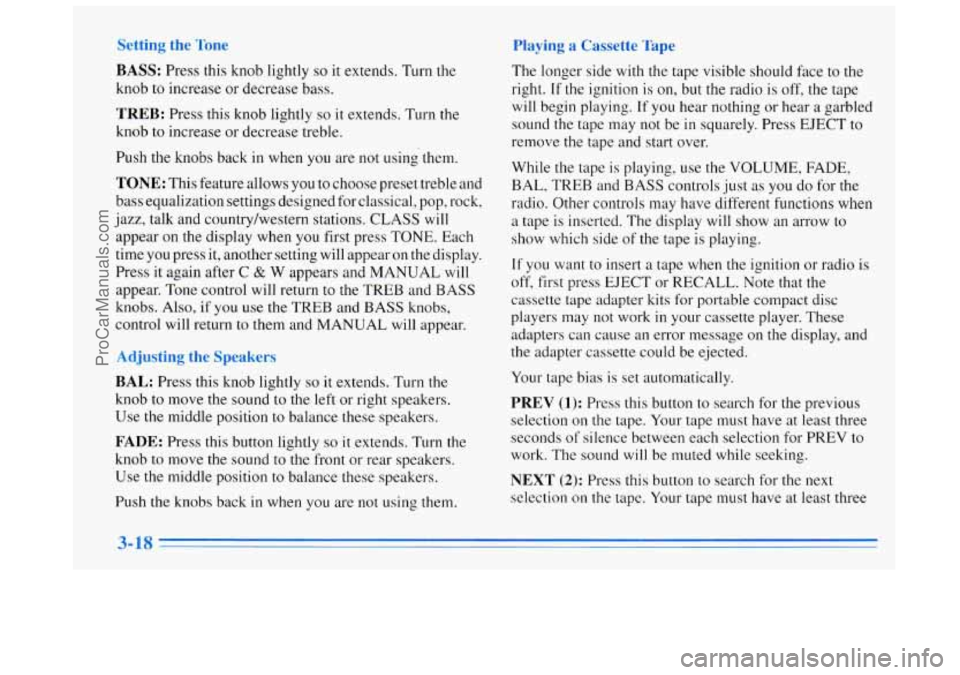
Setting the Tone
BASS: Press this knob lightly so it extends. Turn the
knob to increase or decrease bass.
Playing a Cassette Tape
The longer side with the tape visible should face to the
right.
If the ignition is on, but the radio is off, the tape
will begin playing. If you hear nothing or hear
a garbled
sound the tape may not
be in squarely. Press EJECT to
remove the tape and start over.
While
the tape is playing, use the VOLUME, FADE,
BAL, TREB and BASS controls just as you do for the
radio. Other controls may have different functions when
a tape is inserted. The display will show
an arrow to
show which side of the tape is playing.
TREB: Press this knob lightly so it extends. Turn the
knob
to increase or decrease treble.
Push the knobs back in when you are not using them.
TONE: This feature allows you to choose preset treble and
bass equalization settings designed for classical, pop, rock,
jazz, talk and country/western stations. CLASS will
appear
on the display when you first press TONE. Each
time you press
it, another setting will appear on the display.
Press it again after
C & W appears and MANUAL will
appear. Tone control will return
to the TREB and BASS
knobs.
Also, if you use the TREB and BASS knobs,
control will return
to them and MANUAL will appear.
Adjusting the Speakers
BAL: Press this knob lightly so it extends. Turn the
knob to move the sound
to the left or right speakers.
Use
the middle position to balance these speakers.
FADE: Press this button lightly so it extends. Turn the
knob to move
the sound to the front or rear speakers.
Use the middle position to balance these speakers.
Push the knobs back
in when you are not using them.
If you want to insert a tape when the ignition or radio is
off, first press EJECT or RECALL. Note that the
cassette tape adapter kits for portable compact disc
players may not work
in your cassette player. These
adapters can cause an error message on the display, and
the adapter cassette could be ejected.
Your tape bias
is set automatically.
PREV (1): Press this button to search for the previous
selection on the tape. Your tape must have at least three
seconds of silence between each selection for PREV to
work. The sound
will be muted while seeking.
NEXT (2): Press this button to search for the next
selection on the tape. Your tape must have at least three
3-18
ProCarManuals.com
Page 143 of 356
seconds of silence between each selection for NEXT to
work. The sound will be muted while seeking.
The
SEEK down and up arrows will also find the
previous and next selections on the tape.
44 (3): Press this button to reverse the tape rapidly.
Press
it again to return to playing speed. The radio will
play while the tape reverses.
,, (4): Press this button to advance quickly to another
part of the tape. Press
the button again to return to
playing speed.
The radio will play while the tape
advances.,
SIDE (5): Press this button to change the side of the
tape that is playing.
SOURCE: Press this button to change to the tape or
disc function when the radio
is on. If both a tape and a
disc are installed, the system will first go to tape play;
TAPE will appear on
the display. If SOURCE is pressed
again, the system will go to disc play; CD will appear on
the display.
EJECT The system has two EJECT buttons. Press the
button near the CD slot
to remove a disc. Press the button
near
the tape slot to remove a tape. The radio will play.
CLN: This message may appear on the display. If it
does, your cassette tape player needs to be cleaned. It
will still play tapes, but you should clean it as soon
as
possible to prevent damage to your tapes and player. See
“Care of Your Cassette Tape Player”
in the Index. After
you clean the player, press and hold EJECT for five
seconds
to reset the CLN indicator. The radio will
display
--- to show the indicator was reset.
Your cassette tape player automatically reduces
background noise from tapes encoded with Dolby NR.
You may turn Dolby off by pressing the number
six preset.
Dolby Noise Reduction is manufactured under a license
from Dolby Laboratories Licensing Corporation. Dolby
and the double-D symbol are trademarks of Dolby
Laboratories Licensing Corporation.
Playing a Compact Disc
Insert a disc partway into the slot, label side up. The
player will
pull it in. The disc should begin playing.
If you’re driving on a very rough road or if it’s very hot,
the disc may not play and an error code may appear on
the display. Press
RECALL to take the error code off the
3-19
ProCarManuals.com
Page 149 of 356
C __~ ~ ~ Iur C mette Tape PIayer
A tape player that is not cleaned regularly can cause
reduced sound quality, ruined cassettes or a damaged
mechanism. Cassette tapes should be stored in their
cases away from contaminants, direct sunlight and
extreme heat. If they aren’t, they may not operate
properly or may cause failure
of the tape player.
Your tape player should be cleaned regularly after every
50 hours of use. Your radio may display CLN to indicate
that you have used your tape player for
50 hours without
resetting the tape clean timer. If you notice a reduction in
sound quality,
try a known good cassette to see if the tape
or the tape player is at fault. If this other cassette has no
improvement
in sound quality, clean the tape player.
Cleaning may be done with a scrubbing action,
non-abrasive cleaning cassette with pads which scrub
the tape head as the hubs of the cleaner cassette turn. It
is normal for the cassette to eject while cleaning. Insert
the cassette at least three times to ensure thorough
cleaning. A scrubbing action cleaning cassette is
available through your Buick dealer. You
may also choose a non-scrubbing action, wet-type
cleaner which uses a cassette with a fabric belt to clean
the tape head. This type
of cleaning cassette will not
eject. It may not clean as thoroughly as the scrubbing
type cleaner.
Cassettes are subject to wear and the sound quality may
degrade over time. Always make sure that the cassette
tape is in good condition before you have your tape
player serviced.
Care of Your Compact Discs
Handle discs carefully. Store them in their original cases
or other protective cases and away from direct sunlight
and dust. If the surface of a disc is soiled, dampen a
clean, soft cloth in
a mild, neutral detergent solution and
clean it, wiping from the center to the edge.
Be sure never to touch the signal surface when handling
discs. Pick up discs by grasping the outer edges or the
edge
of the hole and the outer edge.
t
ProCarManuals.com
Page 246 of 356
Radiator Pressure Cap
NOTICE:
Your radiator cap is a 15 psi (105 kPa)
pressure-type cap and must be tightly installed to
prevent coolant loss and possible engine damage
from overheating. Be sure the arrows on the cap
line up with the overflow tube on the radiator filler neck.
When you replace your radiator pressure cap, an AC@
cap is recommended.
Thermostat
Engine coolant temperature is controlled by a thermostat
in the engine coolant system. The thermostat stops the
flow of coolant through the radiator until the coolant
reaches
a preset temperature.
When
you replace your thermostat, an AC@ thermostat
is recommended.
Power Steering Fluid
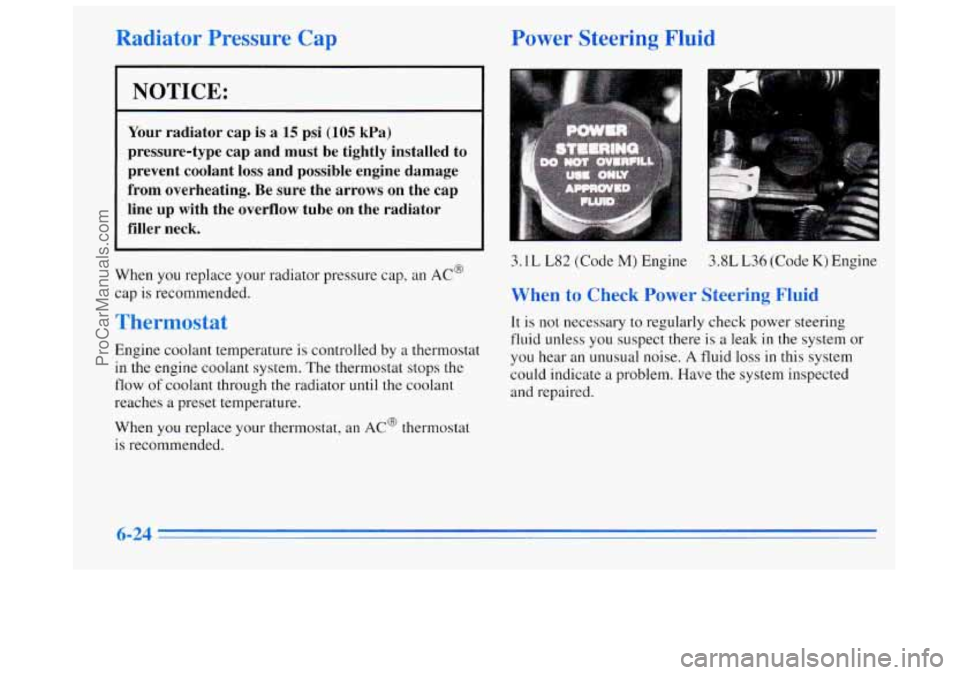
3.lL L82 (Code M) Engine 3.8L L36 (Code K) Engine
When to Check Power Steering Fluid
It is not necessary to regularly check power steering
fluid unless
you suspect there is a leak in the system or
you hear an unusual noise.
A fluid loss in this system
could indicate a problem. Have the system inspected
and repaired.
6-24
ProCarManuals.com
Page 262 of 356
Warning: The temperature grade for this tire is
established
for a tire that is properly inflated and not
overloaded. Excessive speed, underinflation, or
excessive loading, either separately or
in combination,
can cause heat buildup and possible tire failure.
Wheel Alignment and Tire Balance
The wheels on your vehicle were aligned and balanced
carefully at the factory
to give you the longest tire life
and best overall performance.
In most cases, you will not need to have your wheels
aligned again. However, if you notice unusual tire wear
or your vehicle pulling
one way or the other, the
alignment may need to be reset.
If you notice your
vehicle vibrating when driving on
a smooth road, your
wheels may need to be rebalanced.
Wheel Replacement
Replace any wheel that is bent, cracked, or badly rusted
or corroded. If wheel
nuts keep coming loose, the wheel,
wheel bolts and wheel
nuts should be replaced. If the
wheel leaks air, replace it (except some aluminum
wheels, which can sometimes be repaired). See your
Buick dealer if
any of these conditions exist.
I
Your dealer will know the kind of wheel you need.
Each new wheel should have the
same load-carrying
capacity, diameter, width, offset and be mounted the
same way
as the one it replaces.
If you need to replace any of your wheels, wheel bolts
or wheel nuts, replace them only with new
GM original
equipment parts. This way, you will be sure to have
the right wheel, wheel bolts and wheel nuts for your
Buick model.
Using the wrong replacement wheels, wheel bolts I
or wheel nuts on your vehicle can be dangerous.
It could affect the braking and handling
of your
vehicle, make your tires lose air and make you
lose control.
You could have a collision in which
you or others could be injured. Always use the
correct wheel, wheel bolts and wheel nuts for
replacement.
6-40
ProCarManuals.com