1995 PONTIAC GRAND-AM maintenance
[x] Cancel search: maintenancePage 2 of 354
v The 1995 Pontiac Grand Am Owner’s Manual
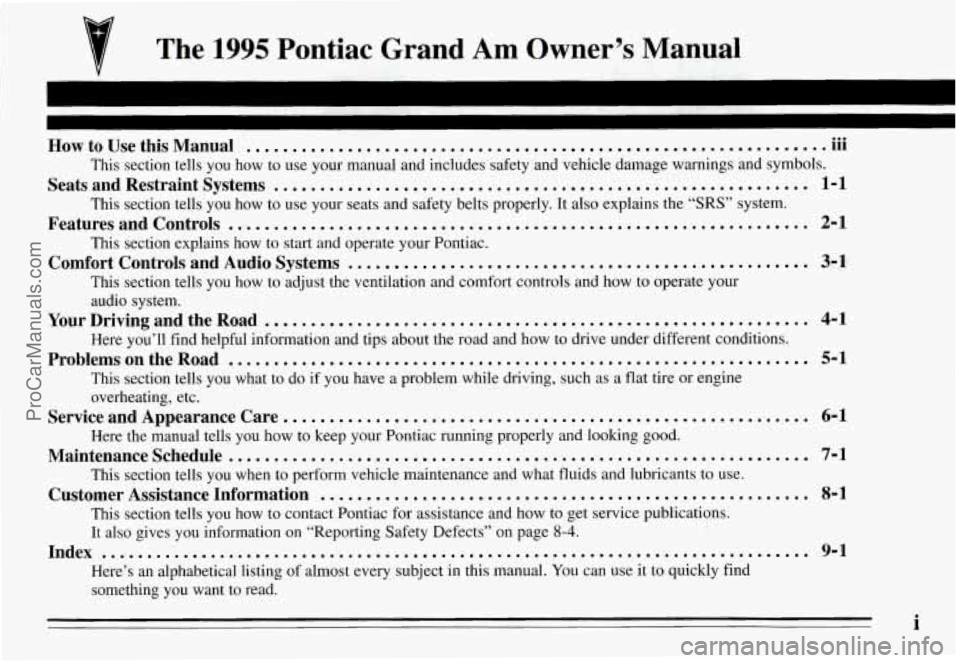
... How to Use this Manual .............................................................. .111
Seats and Restraint Systems .......................................................... 1-1
Features and Controls ............................................................... 2-1
Comfort Controls and Audio Systems .................................................. 3-1
This section tells you how to use your manual and includes safety and vehicle damage warnings and symbols.
This section tells you how to use your seats and safety belts properly. It also explains the “SRS” system.
This section explains how to start and operate your Pontiac.
This section tells you how to adjust the ventilation and comfo\
rt controls and how to operate your
audio system.
Here you’ll find helpful information and tips about the road\
and how
to drive under different conditions.
This section tells you what to do
if you have a problem while driving, such as a flat tire or engine
overheating, etc.
Here the manual tells you how to keep your Pontiac running properly and looking good.
This section tells you when to perform vehicle maintenance and what fluids and lubricants to use.
This section tells you how to contact Pontiac for assistance and how to get service publications.
It also gives you information on “Reporting Safety Defects” on page 8-4.
Here’s an alphabetical listing of almost every subject in this manual. You can use it to quickly find
something you want to read.
YourDrivingandtheRoad ........................................................... 4-1
ProblemsontheRoad ............................................................... 5-1
Service and Appearance Care. ........................................................ 6-1
Maintenanceschedule ............................................................... 7-1
Customer Assistance Information ..................................................... 8-1
Index ........................................................................\
..... 9-1
i
ProCarManuals.com
Page 30 of 354
Servicing Your Air Bag-Equipped Pontiac
The air bag affects how your Pontiac should be serviced.
There are parts of the air bag system in several places
around your vehicle. You don’t want the system to
inflate while someone is working
on your vehicle. Your
Pontiac dealer and the
1995 Grand Am Service Manual
have information about servicing your vehicle and the
air bag system.
To purchase a service manual, see
“Service Publications” in the Index. The air bag system
does not need regular maintenance.
Safety Belt Use During Pregnancy
Safety belts work for everyone, including pregnant
women. Like all occupants, they are more likely
to be
seriously injured if they don’t wear safety belts.
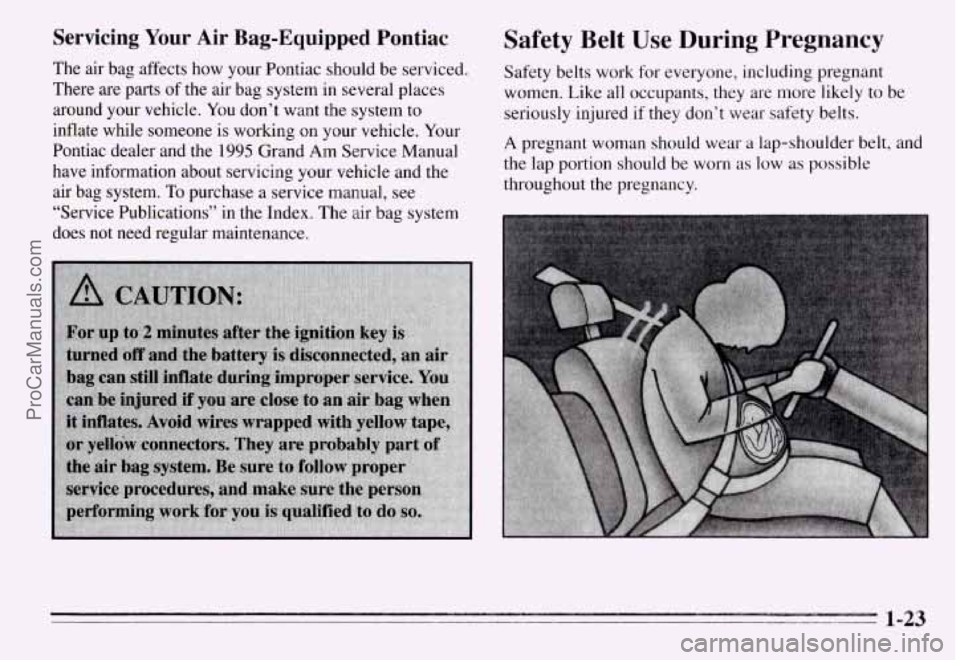
A pregnant woman should wear a lap-shoulder belt, and
the lap portion should be worn as low
as possible
throughout the pregnancy.
ProCarManuals.com
Page 180 of 354

When You Are Ready to Leave After
Parking on a Hill
1. Apply your regular brakes and hold the pedal down
while you:
Start your engine;
Shift into a gear; and
Release the parking brake.
2. Let up on the brake pedal.
3. Drive slowly until the trailer is clear of the chocks.
4. Stop and have someone pick up and store the chocks.
Maintenance When Trailer Towing
Your vehicle will need service more often when you’re
pulling a trailer. See the Maintenance Schedule for more
on this. Things that are especially important in trailer
operation are automatic transaxle fluid (don’t overfill),
engine oil, belt, cooling system, and brake adjustment.
Each
of these is covered in this manual, and the Index
will help you find them quickly. If you’re trailering, it’s
a good idea to review these sections before you start
your trip.
Check periodically to see that all hitch nuts and bolts are
tight.
4-37
ProCarManuals.com
Page 212 of 354
Section 6 Service and Appearance Care
Here you will find information about the care of your
Pontiac.
This section begins with service and fuel
information, and then it shows how to check important
fluid and lubricant levels. There
is also technical
information about your vehicle, and a part devoted to its
appearance care.
Service
Your Pontiac dealer knows your vehicle best and wants
you to be happy with it. We hope you’ll
go to your
dealer for all your service needs. You’ll get genuine
GM
parts and GM-trained and supported service people.
We hope you’ll want to keep your GM vehicle all
GM.
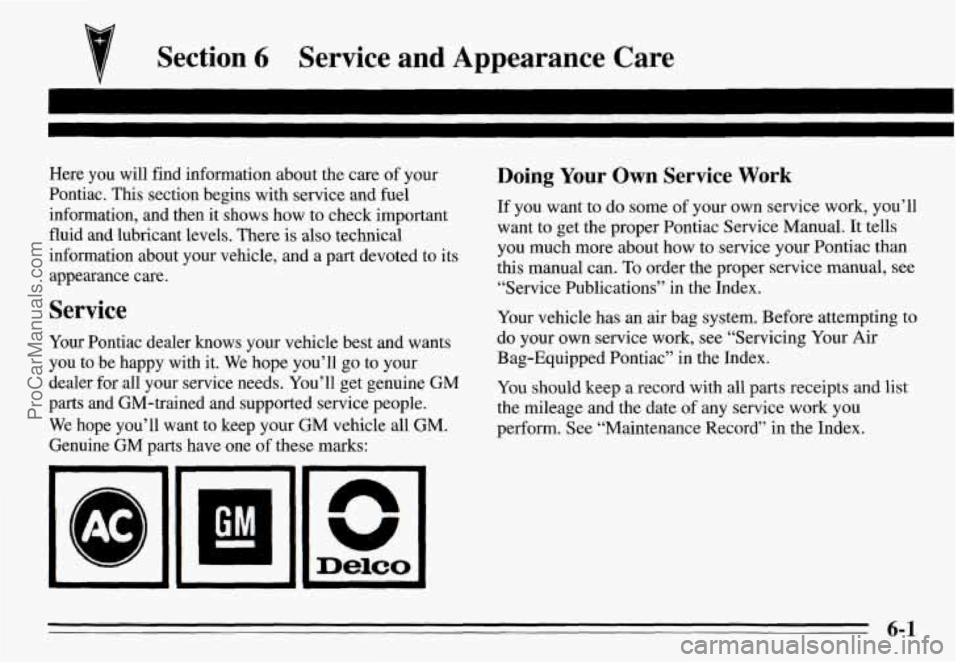
Genuine GM parts have one of these marks:
Doing Your Own Service Work
If you want to do some of your own service work, you’ll
want to get the proper Pontiac Service Manual. It tells
you much more about how to service your Pontiac than
this manual can.
To order the proper service manual, see
“Service Publications” in the Index.
Your vehicle has an air bag system. Before attempting to
do your own service work, see “Servicing
Your Air
Bag-Equipped Pontiac” in the Index.
You should keep a record with all parts receipts and list
the mileage and the date of any service work you
perform. See “Maintenance Record” in the Index.
GM
6-1
ProCarManuals.com
Page 228 of 354

Air Cleaner
Refer to the Maintenance Schedule to determine when to
replace the air filter.
See “Scheduled Maintenance Services” in the Index.
NOTICE:
If the air cleaner is off, a backfire can cause a
damaging engine fire. And, dirt can easily get
into your engine, which will damage it. Always
have the air cleaner in place when you’re driving.
6-17
ProCarManuals.com
Page 229 of 354
Air Filter Replacement
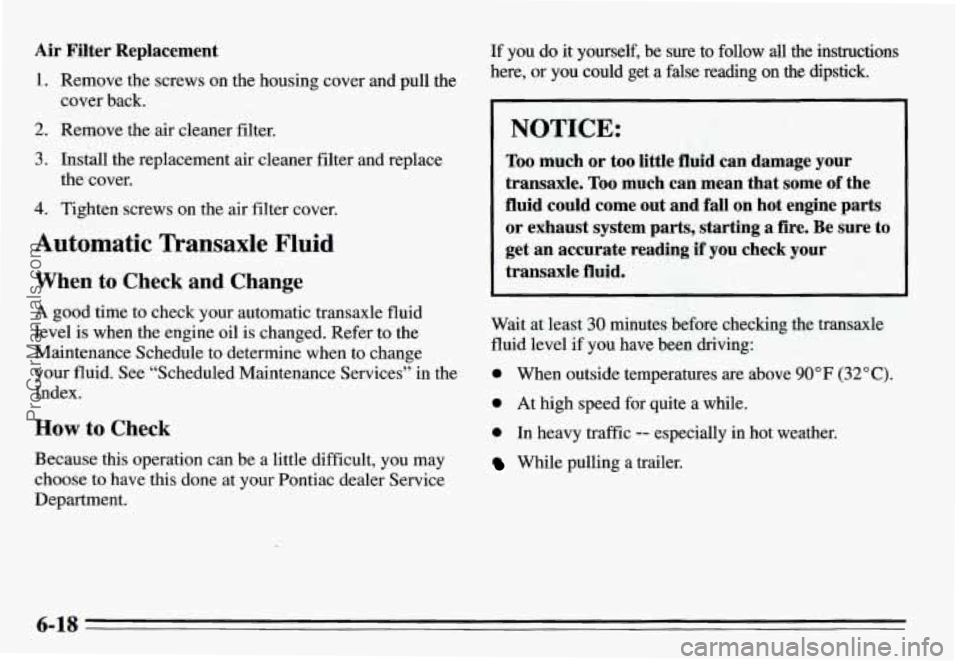
1. Remove the screws on the housing cover and pull the
cover back.
2. Remove the air cleaner filter.
3. Install the replacement air cleaner filter and replace
the cover.
4. Tighten screws on the air filter cover.
Automatic Transaxle Fluid
When to Check and Change
A good time to check your automatic transaxle fluid
level is when the engine oil
is changed. Refer to the
Maintenance Schedule to determine when to change
your fluid. See “Scheduled Maintenance Services” in the
Index.
How to Check
Because this operation can be a little difficult, you may
choose to have this done at your Pontiac dealer Service
Department.
If you do it yourself, be sure to follow all the instructions
here, or you could get
a false reading on the dipstick.
Too much or too little fluid can damage your
transaxle.
Too much can mean that some of the
fluid could come out and fall on hot engine parts
or exhaust system parts, starting a fire. Be sure to
get an accurate reading if
you check your
transaxle fluid.
Wait at least 30 minutes before checking the transaxle
fluid level if you have been driving:
0 When outside temperatures are above 90°F (32” C).
0 At high speed for quite a while.
0 In heavy traffic -- especially in hot weather.
While pulling a trailer.
6-18
ProCarManuals.com
Page 231 of 354

How to Add Fluid Manual Transaxle Fluid
Refer to the Maintenance Schedule to determine what
kind of transaxle fluid to use. See “Recommended
Fluids and Lubricants” in the Index.
If the fluid level is low, add only enough of the proper
fluid to bring the level into
the cross-hatched area on
the dipstick.
1. Pull out the dipstick.
2. Using a long-neck funnel, add enough fluid at the
dipstick hole to bring it to the proper 1evel.It doesn’t
take much fluid, generally less than a pint (OSL).
Dun ’t overjill. We recommend you use only fluid
labeled DEXRON@-111, because fluid with that label
is made especially for your automatic transaxle.
Damage caused by fluid other than DEXRON@-III
is not covered by your new vehicle warranty.
0 After adding fluid, recheck the fluid level as
When the correct fluid level is obtained, push the
described under “How to Check.”
dipstick back in all the way.
When to Check
A good time to have it checked is when the engine oil is
changed. However, the fluid in your manual transaxle
doesn’t require changing.
How to Check
Because this operation can be a little difficult, you may
choose to have this done at your Pontiac dealer Service
Department.
If you do it yourself, be sure to follow all the instructions
here, or you could get a false reading on the dipstick.
r NOTICE:
Too much or too little fluid can damage your
transaxle.
Too much can mean that some of the
fluid could come out and fall on hot engine parts
or exhaust system parts, starting
a fire. Be sure to
get an accurate reading if you check your
transaxle fluid.
6-20
ProCarManuals.com
Page 232 of 354
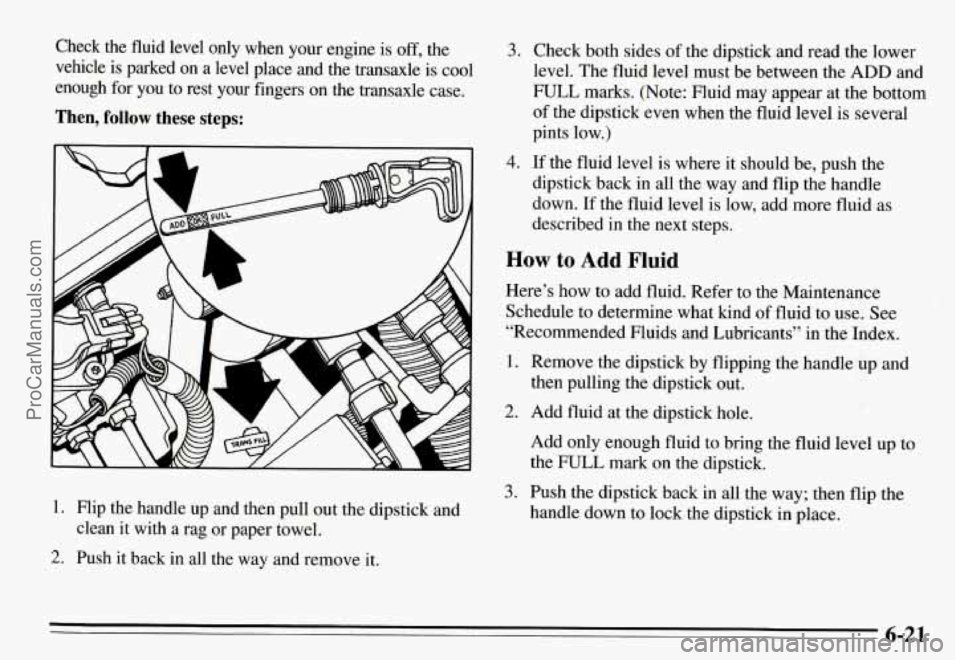
Check the fluid level only when your engine is off, the
vehicle is parked
on a level place and the transaxle is cool
enough
for you to rest your fingers on the transaxle case.
Then, follow these steps:
1. Flip the handle up and then pull out the dipstick and
2. Push it back in all the way and remove it.
clean it with a rag or paper towel.
3. Check both sides of the dipstick and read the lower
level. The fluid level must be between the ADD and
FULL marks. (Note: Fluid may appear at the bottom
of the dipstick even when the fluid level
is several
pints low.)
4. If the fluid level is where it should be, push the
dipstick back in all the way and flip the handle
down. If the fluid level is low, add more fluid as
described in the next steps.
How to Add Fluid
Here’s how to add fluid. Refer to the Maintenance
Schedule to determine what kind
of fluid to use. See
“Recommended Fluids and Lubricants” in the Index.
1. Remove the dipstick by flipping the handle up and
2. Add fluid at the dipstick hole.
then pulling the dipstick out.
Add only enough fluid to bring the fluid level up to
the FULL mark on the dipstick.
handle down to lock the dipstick in place.
3. Push the dipstick back in all the way; then flip the
6-21
ProCarManuals.com