Page 235 of 354
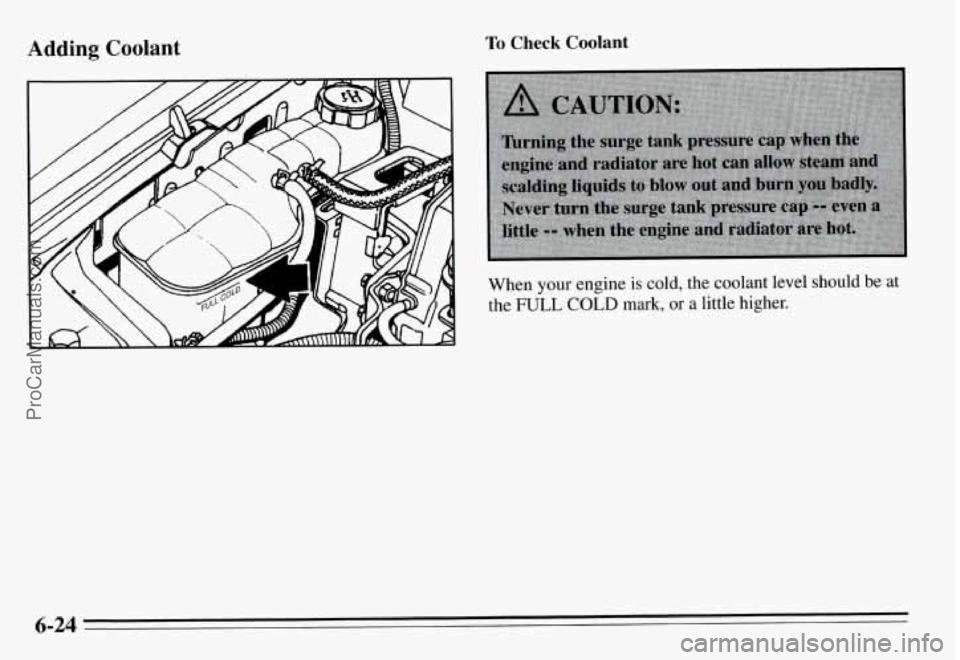
Adding Coolant To Check Coolant
When your engine is cold, the coolant level should be at
the
FULL COLD mark, or a little higher.
6-24
ProCarManuals.com
Page 237 of 354
Power Steering Fluid
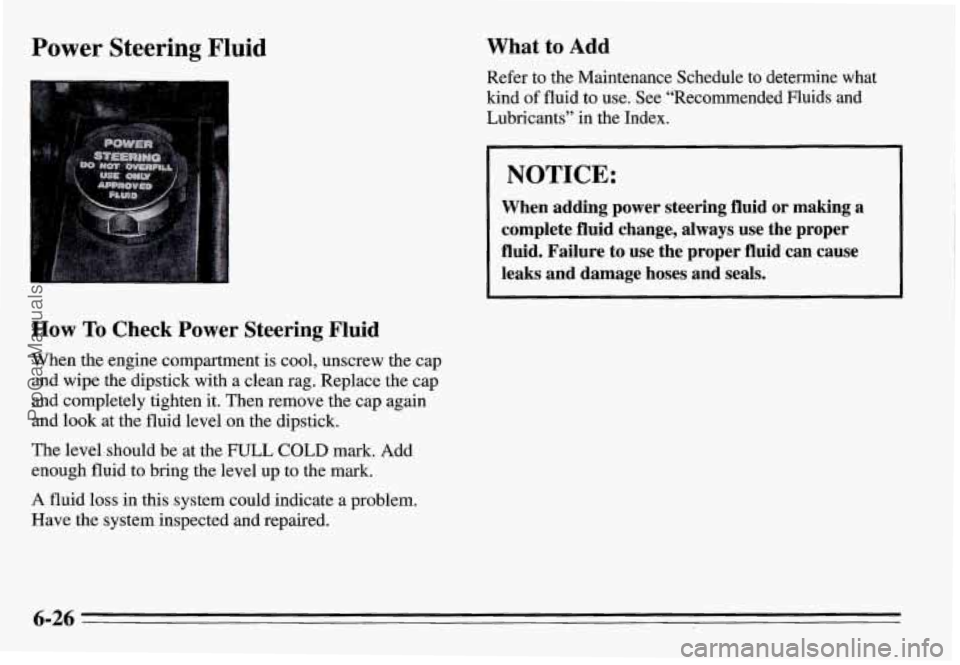
How To Check Power Steering Fluid
When the engine compartment is cool, unscrew the cap
and wipe the dipstick with a clean rag. Replace the cap
and completely tighten it. Then remove the cap again
and look at the fluid level on the dipstick.
The level should be at the FULL COLD mark. Add
enough fluid to bring the level up to the mark.
A fluid loss in this system could indicate a problem.
Have the system inspected and repaired.
What to Add
Refer to the Maintenance Schedule to determine what
kind of fluid to use. See “Recommended Fluids and
Lubricants” in
the Index.
I I
NOTICE:
When adding power steering fluid or making a
complete fluid change, always use the proper
fluid. Failure to use the proper fluid can cause
leaks and damage hoses and seals.
6-26
ProCarManuals.com
Page 262 of 354
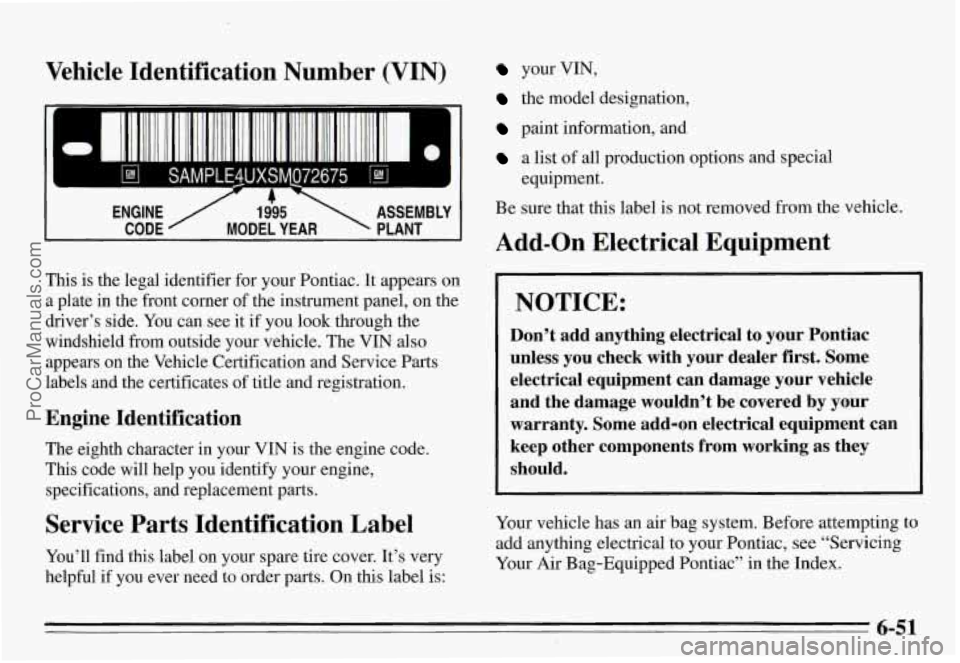
Vehicle Identification Number (VIN)
1.
SAMPLE4UXSM072675
I
ENGINE ,/ 1k5 ASSEMBLY
CODE MODEL YEAR PLANT
This is the legal identifier for your Pontiac. It appears on
a plate in the front corner of the instrument panel, on the
driver’s side. You can see it if you
look through the
windshield from outside your vehicle. The VIN also
appears on the Vehicle Certification and Service Parts
labels and the certificates of title and registration.
Engine Identification
The eighth character in your VIN is the engine code.
This code will help you identify your engine,
specifications, and replacement parts.
Service Parts Identification Label
You’ll find this label on your spare tire cover. It’s very
helpful if you ever need to order parts.
On this label is:
your VIN,
the model designation,
paint information, and
a list of all production options and special
Be sure that this label is not removed from the vehicle.
equipment.
Add-on Electrical Equipment
NOTICE:
Don’t add anything electrical to your Pontiac
unless you check with your dealer first. Some
electrical equipment can damage your vehicle
and the damage wouldn’t be covered by your
warranty. Some add-on electrical equipment can
keep other components from working
as they
should.
Your vehicle has an air bag system. Before attempting to
add anything electrical to your Pontiac,
see “Servicing
Your Air Bag-Equipped Pontiac” in the Index.
6-51
ProCarManuals.com
Page 267 of 354

Replacement Bulbs
Back Up Lamps ............................ 2057
Front Parking/Turn Signal Lamps
........... 2057 NA
License Plate Lamp
......................... 194
Center High-Mounted Stoplamp
............... 912
OUTSIDE LAMPS BULB
Halogen Headlamps
LowBeam ............................... 9006
High Beam ............................... 9005
Side Marker Lamps
Front ................................. 194NA
Rear
...................................... 24
TrunkLamp
................................ 906
Stop/Tail/Turn Signal Lamps .................. 2057
Fog Lamps ................................. 885
INSIDE LAMPS BULB
Ashtray .................................... 161
Without Sunroof ........................... 168
With Sunroof
............................ 214-2
Rear Reading Lamps
......................... 168
Underdash Lamp
............................ 194
Heater
& AK Control ........................ 161
High-Beam Indicator
......................... 161
Front Reading Lamps
Indicator Lamps
Charge. Oil. Fasten Safety Belts. ABS. Upshift. Low
Coolant. Brake.
Turn Signals. Malfunction Indicator
Lamp (Service Engine Soon). Check Gages
..... 161
Glovebox Lamp ............................. 161
6-56
ProCarManuals.com
Page 307 of 354

Part B: Owner Checks and Services
Listed below are owner checks and services which
should be performed at the intervals specified to help
ensure the safety, dependability and emission control
performance of your vehicle.
Be sure any necessary repairs are completed at once.
Whenever any fluids or lubricants are added to your
vehicle, make sure they are the proper ones, as shown in
Part
D.
At Each Fuel Fill
It is important for you or a service station attendant to
perfom these underhood checks at eachfuelfill.
Engine Oil Level
Check the engine oil level and add the proper oil if
necessary. See “Engine Oil” in the Index for further
details.
Engine Coolant Level
Check the engine coolant level and add the proper
coolant mix
if necessary. See “Coolant” in the Index for
further details.
Windshield Washer Fluid Level
Check the windshield washer fluid level in the
windshield washer tank and add the proper fluid
if
necessary. See “Windshield Washer Fluid” in the Index
for further details.
At Least Once a Month
Tire Inflation
Check tire inflation. Make sure tires are inflated to the
pressures specified on the Tire-Loading Information
label located on the rear edge
of the driver’s door. See
“Tires” in the Index for further details.
Cassette Deck
Clean cassette deck. Cleaning should be done every 50
hours of tape play. See “Audio Systems” in the Index for
further details.
At Least Twice a Year
Hydraulic Clutch System Inspection
Check the fluid level in the clutch reservoir. See
“Hydraulic Clutch Fluid” in the Index. A fluid loss in
this system could indicate a problem. Have the system
inspected and repaired at once.
7-38
ProCarManuals.com
Page 309 of 354

Brake-Transaxle Shift Interlock -- BTSI
(Automatic Transaxle)
1. Before you start, be sure you have enough room
around the vehicle. It should be parked on a level
surface.
2. Firmly apply the parking brake (see “Parking Brake”
in the Index if necessary).
NOTE: Be ready to apply the regular brake
immediately if the vehicle begins to move.
3. With the engine off, turn the key to the RUN
position, but don’t start the engine. Without applying
the regular brake, try to move the shift lever out of
PARK (P) with normal effort. If the shift lever
moves out of
PARK (P), your vehicle’s BTSI needs
service.
Steering Column Lock
While parked, and with the parking brake set, try to turn
the key to LOCK
in each shift lever position.
0 With an automatic transaxle, the key should turn to
LOCK only when the shift lever is in PARK
(P).
With a manual transaxle, the key should turn to
LOCK only when the shift lever is in REVERSE (R).
On vehicles with a key release button, try to turn the key
to LOCK without pressing the button. The key should
turn to LOCK only with the key button depressed.
On all vehicles, the key should come out only in LOCK.
Parking Brake and Automatic Transaxle PARK (P)
Mechanism Check
ProCarManuals.com
Page 310 of 354

Park on a fairly steep hill, with the vehicle facing
downhill. Keeping your foot on the regular brake, set the
parking brake.
To check the parking brake: With the engine running
and transaxle in
NEUTRAL (N), slowly remove foot
pressure from the regular brake pedal.
Do this until
the vehicle is held by the parking brake only.
0 To check the PARK (P) mechanism’s holding ability:
Shift to PARK (P). Then release all brakes.
Underbody Flushing
At least every spring, use plain water to flush any
corrosive materials from the underbody. Take care to
clean thoroughly any areas where mud and other debris
can collect.
Part C: Periodic Maintenance
Inspections
Listed below are inspections and services which should
be performed at least twice a year (for instance, each
spring and fall). You should let your
GM dealer’s
service department or other qualified service center do
these jobs. Make sure any necessary repairs are
completed at once.
Restraint Systems
Now and then, make sure all your belts, buckles, latch
plates, retractors, anchorages and reminder systems are
working properly.
Look for any loose parts or damage.
If you see anything that might keep a restraint system
from doing its job, have it repaired.
Steering, Suspension and Front-Wheel-
Drive Axle Boot and Seal Inspection
Inspect the front and rear suspension and steering
system for damaged, loose or missing parts, signs of
wear, or lack of lubrication. Inspect the power steering
lines and hoses for proper hookup, binding, leaks,
cracks, chafing, etc. Clean and then inspect the drive
axle boot seals for damage, tears or leakage. Replace
seals if necessary.
7-41
ProCarManuals.com
Page 311 of 354
Exhaust System Inspection
Inspect the complete exhaust system. Inspect the body near the exhaust system. Look for broken, damaged,
missing or out-of-position parts as well as open seams,
holes, loose connections, or other conditions which
could cause a heat build-up in the floor pan or could let
exhaust fumes into the vehicle. See “Engine Exhaust” in
the Index.
Throttle Linkage Inspection
Inspect the throttle linkage for interference or binding,
and for damaged or missing parts. Replace parts as
needed. Accelerator and cruise control cables should not
be lubricated.
Manual Transaxle
Check the transaxle fluid level; add if needed. See
“Manual Transaxle” in the Index. A fluid loss may
indicate a problem. Check the system and repair
if
needed.
Brake System Inspection
Inspect the complete system. Inspect brake lines and
hoses for proper hookup, binding, leaks, cracks, chafing,
etc. Inspect disc brake pads for wear and rotors for
surface condition. Also inspect drum brake linings for
wear and cracks. Inspect other brake parts, including
drums, wheel cylinders, calipers, parking brake, etc. The
parking brake is self-adjusting and no manual adjustment
is required. You may need to have your
brakes inspected more often if your driving habits or
conditions result in frequent braking.
7-42
ProCarManuals.com