Page 108 of 338
Oil Pressure Gage (Option)
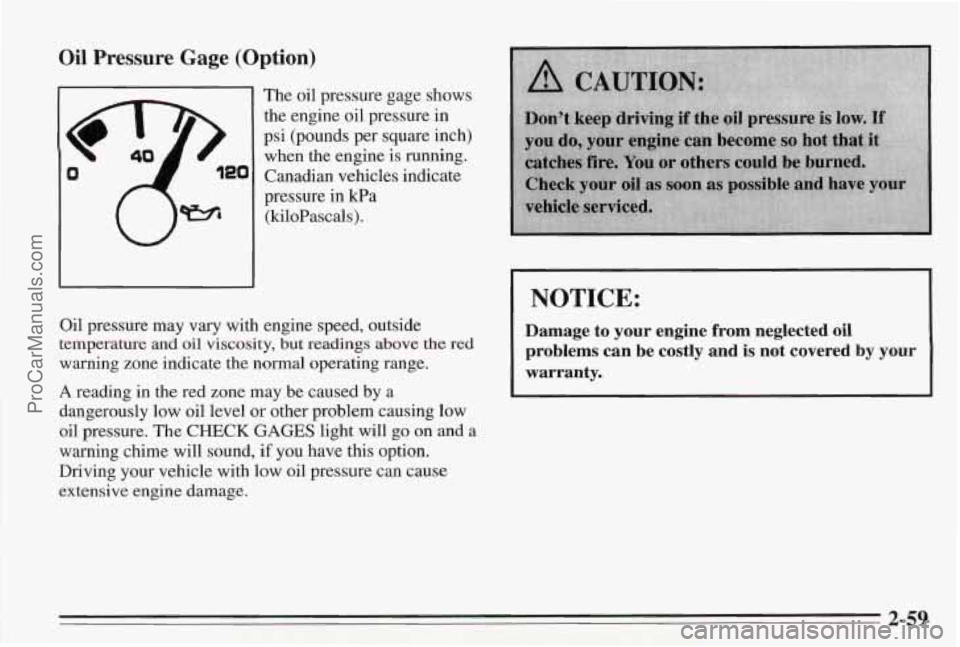
The oil pressure gage shows
the engine
oil pressure in
psi (pounds per square inch)
when the engine is running.
Canadian vehicles indicate
pressure in Ea
(kiloPascals).
NOTICE:
Oil pressure may vary with engine speed, outside
temperature and oil viscosity,
but readings above the red
warning zone indicate the normal operating range.
A reading in the red zone may be caused by a
dangerously
low oil level or other problem causing low
oil pressure. The
CHECK GAGES light will go on and a
warning chime will sound, if you have this option.
Driving your vehicle with low oil pressure can cause
extensive engine damage.
Damage to your engine from neglected oil
problems can be costly and is not covered by your
warranty.
2-59
ProCarManuals.com
Page 227 of 338
What Kind of Oil to Use
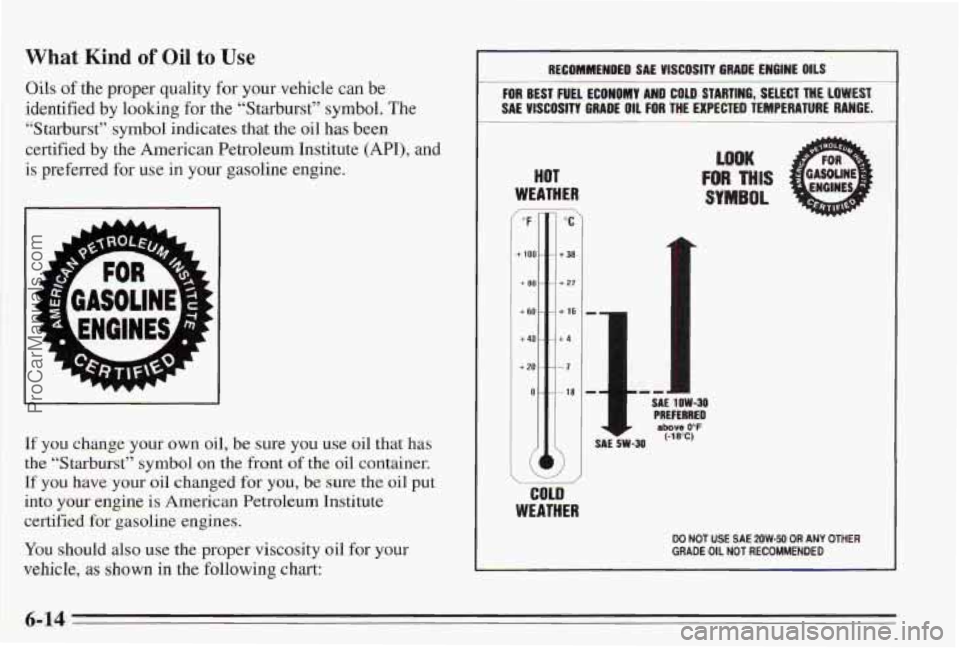
Oils of the proper quality for your vehicle can be
identified by looking for the “Starburst” symbol. The
“Starburst” symbol indicates that
the oil has been
certified by the American Petroleum Institute (API), and
is preferred for use in your gasoline engine.
**
L
t
t L
4
If you change your own oil, be sure you use oil that has
the “Starburst” symbol on the front of the oil container.
If you have your oil changed for you, be sure the oil put
into your engine is American Petroleum Institute
certified for gasoline engines.
You should also use
the proper viscosity oil for your
vehicle,
as shown in the following chart:
~
RECOMMENDED SAE VISCOSITY GRADE ENGINE OILS
FOR BEST FUEL ECONOMY AND COLD STARTINB, SELECT THE LOWEST
SAL VISCOSITY GRADE OIL FOR THE EXPECTED TEMPERATURE RANGE.
HOT
WEATHER 7
“C
+ 38
+ 27
+ 16
t4
-1
- 18
M
LOOK
FOR THIS 1
SYMBOL
I E ERRRED 1OW-30
mve 0°F (-1 8°C)
WEATHER
DO NOT USE SAE 2OW.50 OR ANY OTHER GRADE OIL NOT RECOMMENDED
6-14
ProCarManuals.com
Page 228 of 338
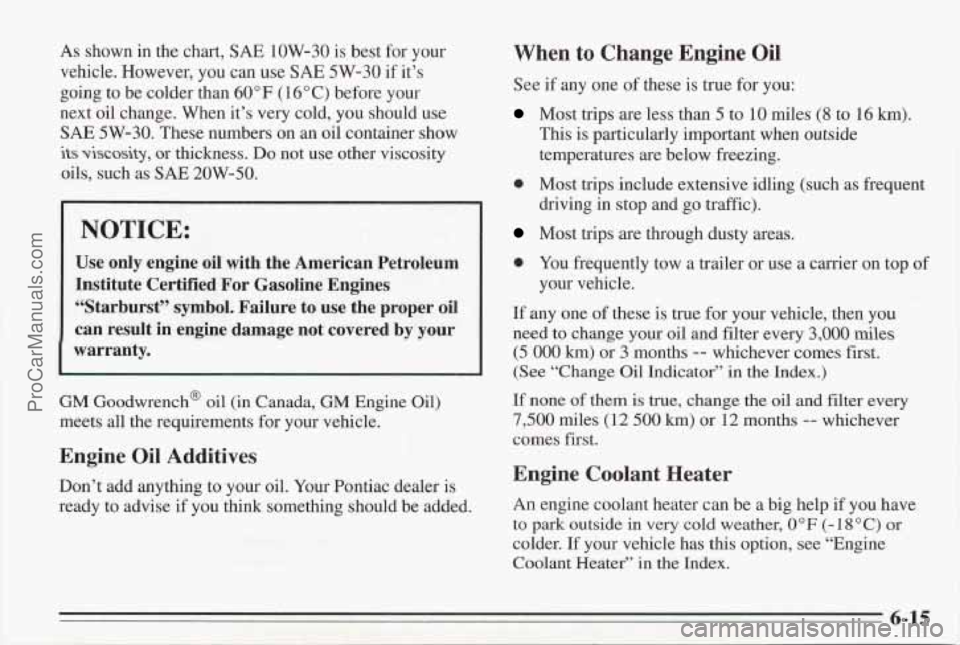
As shown in the chart, SAE 1OW-30 is best for your
vehicle. However, you can use
SAE 5W-30 if it’s
going to be colder than
60” F ( 16” C) before your
next oil change. When it’s very cold,
you should use
SAE 5W-30. These numbers on an oil container show
its viscosity, or thickness. Do not use other viscosity
oils, such as
SAE 20W-50.
NOTICE:
Use only engine oil with the American Petroleum
Institute Certified For Gasoline Engines
“Starburst” symbol. Failure to use the proper
oil
can result in engine damage not covered by your
warranty.
GM Goodwrench@ oil (in Canada, GM Engine Oil)
meets all the requirements for your vehicle.
Engine Oil Additives
Don’t add anything to your oil. Your Pontiac dealer is
ready to advise
if you think something should be added.
When to Change Engine Oil
See if any one of these is true for you:
Most trips are less than 5 to 10 miles (8 to 16 km).
This is particularly important when outside
temperatures are below freezing.
0 Most trips include extensive idling (such as frequent
driving in stop and go traffic).
Most trips are through dusty areas.
@ You frequently tow a trailer or use a carrier on top of
If any one of these is true for your vehicle, then you
need to change your oil and filter every
3,000 miles
(5 000 km) or 3 months -- whichever comes first.
(See “Change Oil Indicator” in
the Index.)
If none of them is true, change the oil and filter every
7,500 miles (12 500 km) or 12 months -- whichever
comes first. your vehicle.
Engine Coolant Heater
An
engine coolant heater can be a big help if you have
to park outside in very cold
weather, 0°F (- 18°C) or
colder. If your vehicle has this option, see “Engine
Coolant Heater” in the Index.
6-15
ProCarManuals.com
Page 310 of 338
Exhaust System Inspection
Inspect the complete exhaust system. Inspect the body
near the exhaust system. Look for broken, damaged,
missing or out-of-position parts as well as open seams,
holes, loose connections, or other conditions which
could cause a heat build-up in the floor pan or could let
exhaust fumes into the vehicle. See “Engine Exhaust” in
the Index.
Throttle Linkage Inspection
Inspect the throttle linkage for interference or binding,
and for damaged or missing parts. Replace parts as
needed. Accelerator and cruise control should not
be
lubricated.
Brake System Inspection
Inspect the complete system. Inspect brake lines and
hoses for proper hookup, binding, leaks, cracks, chafing,
etc. Inspect disc brake pads for wear and rotors for
surface condition. Also inspect drum brake linings for
wear and cracks. Inspect other brake parts, including
drums, wheel cylinders, calipers, parking brake, etc.
Check parking brake adjustment. You may need to have
your brakes inspected more
often if your driving habits
or conditions result in frequent braking.
I.
...
Part D: Recommended Fluids and
Lubricants
NOTE: Fluids and lubricants identified below by name,
part number
or specification may be obtained from your
GM dealer.
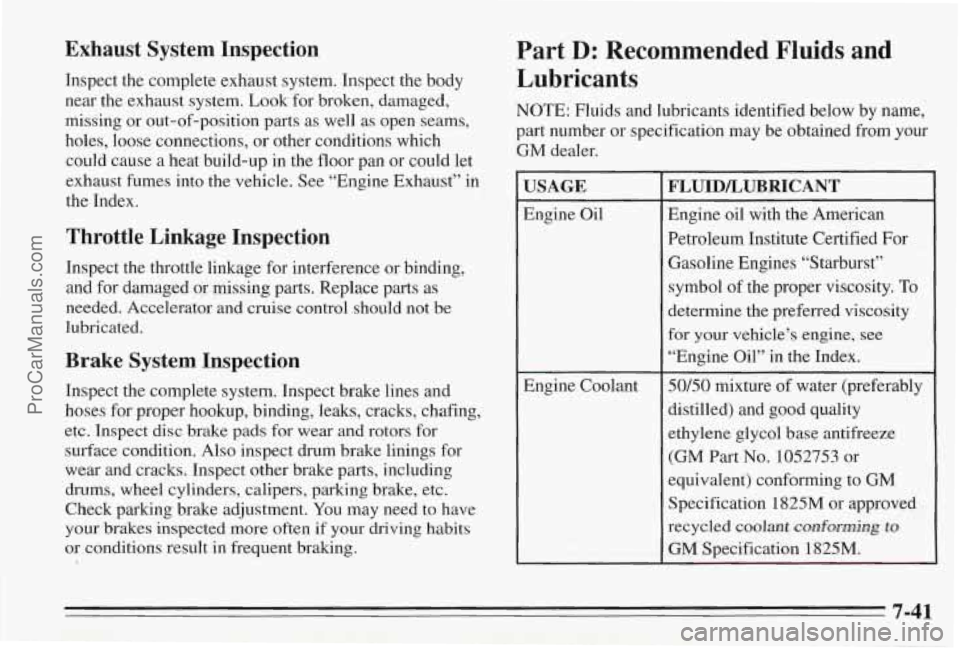
USAGE
Engine Oil
Engine Coolant
FLUIDLUBRICANT
Engine oil with the American
Petroleum Institute Certified
For
Gasoline Engines “Starburst”
symbol of the proper viscosity.
To
determine the preferred viscosity
for your vehicle’s engine,
see
“Engine Oil” in the Index.
50/50 mixture of water (preferably
distilled) and good quality
ethylene glycol base antifreeze
(GM Part
No. 1052753 or
equivalent) conforming to GM
Specification 1825M or approved
recycled coolant
conforming ta
GM Specification 1825M.
ProCarManuals.com