1995 PONTIAC BONNEVILLE maintenance
[x] Cancel search: maintenancePage 2 of 338
The 1995 Pontiac Bonneville Owner’s Manual
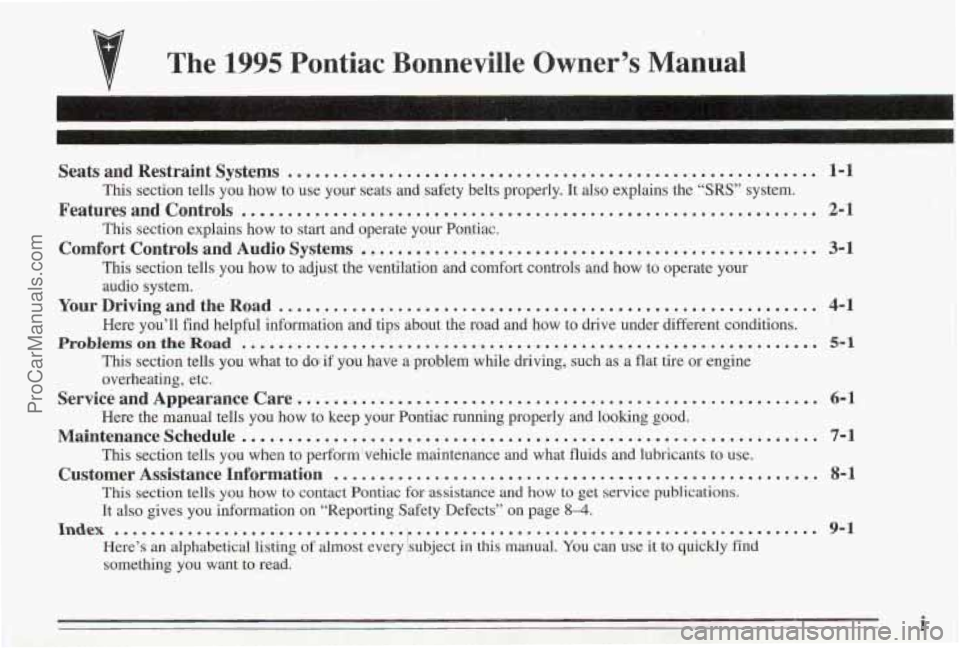
Seats and Restraint Systems .......................................................... 1-1
Features and Controls ............................................................... 2-1
Comfort Controls and Audio Systems .................................................. 3-1
This section tells you how to use your seats and safety belts\
properly. It also explains the “SRS” system. This section explains how to start and operate your Pontiac.
This section tells you how to adjust the ventilation and comfo\
rt controls and how to operate your audio system.
Here you’ll find helpful information and tips about the road\
and how to drive under different conditions.
This section tells
you what to dorif you have a problem while driving, such as a fl\
at tire or engine
overheating, etc.
Here the
rrmmal tells you how to keep your Pontiac running properly and loolun\
g good.
This section tells you when to perform’vehicle maintenance and wha\
t fluids and lubricants to use.
This section tells you how to contact Pontiac for assistance a\
nd how to get service publications.
It also gives you information on “Reporting Safety Defects’\
’ on page
8-4.
Here’s an alphabetical listing of almost every jsubject in this manual. You can use it to quickly find
something you want to read.
YourDrivingandtheRoad ........................................................... 4-1
ProblemsontheRoad ............................................................... 5-1
Service and Appearance Care ......................................................... ,6-1
Maintenanceschedule ............................................................... 7-1
Customer Assistance Information ..................................................... 8-1
Index ........................................................................\
....... 9-1
1
ProCarManuals.com
Page 28 of 338

Your vehicle is equipped with a diagnostic module,
which records information about the air bag system.
The module records information about the readiness
of the system, when the sensors are activated
and
driver’s safety belt usage at deployment.
Let only qualified technicians work on your air bag
system. Improper service can mean that your air bag
system won’t work properly. See your dealer
for
service.
Servicing Your Air Bag-Equipped Pontiac
Air bags affect how your Pontiac should be serviced.
There are parts of the air bag system in several places
around your vehicle.
You don’t want the system to
inflate while someone is working on
your vehicle. Your
Pontiac dealer and the 1995 Bonneville Service Manual
have information about servicing your vehicle and the
air bag system. To purchase a service manual, see
“Service Publications” in the Index.
The air bag system does not need regular maintenance.
1-21
ProCarManuals.com
Page 115 of 338
Boost Gage (Option)
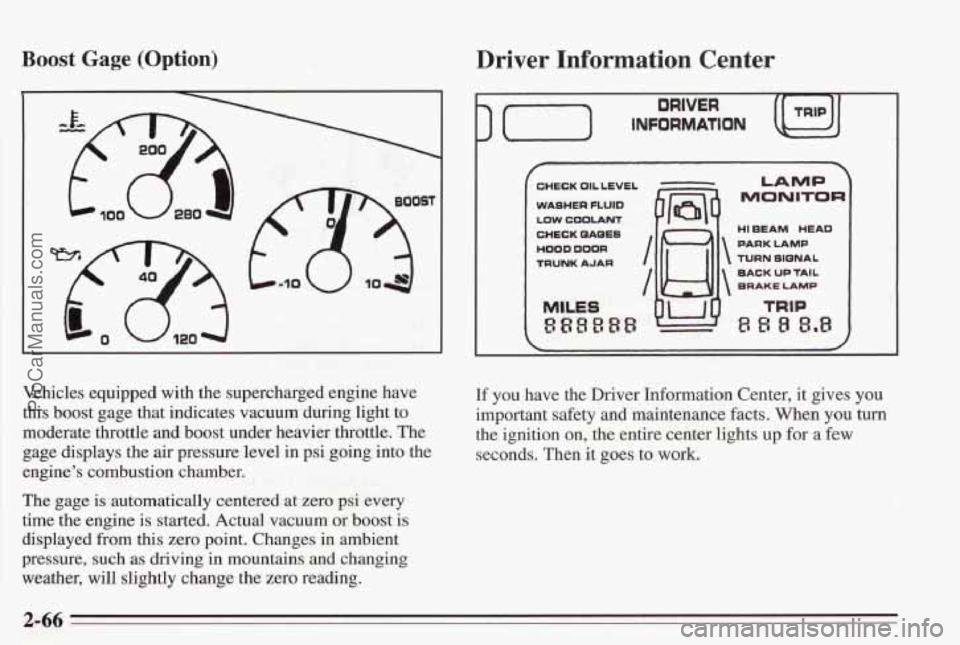
Vehicles equipped with the supercharged engine have
this boost gage that indicates vacuum during light to
moderate throttle and boost under heavier throttle. The
gage displays the air pressure level in psi going into the
engine’s combustion chamber.
The gage is automatically centered at zero psi every
time the engine is started. Actual vacuum or
boost is
displayed from this zero point. Changes in ambient
pressure, such
as driving in mountains and changing
weather, will slightly change the zero reading.
Driver Information Center
) (-) INFORMATION
DRIVER
CHECK OIL LEVEL
WASHER
FLUID
LOW COOLANT
CHECK QAQES
HOOD DOOR
TRUNK AJAR
MILES
888888
I /w
7
LAMP
MONITOR
HI EEAM HEAD
PARK LAMP
TURN SIQNAL
BACK
UP TAIL
BRAKE LAMP
If you have the Driver Information Center, it gives you
important safety and maintenance facts. When you turn
the ignition on, the entire center lights
up for a few
seconds. Then it goes to work.
2-66
ProCarManuals.com
Page 179 of 338

Parking on Hills
You really should not park your vehicle, with a trailer
attached, on
a hill. If something goes wrong, your rig
could start to move. People can be injured, and both
your vehicle and the trailer can be damaged.
But
if you ever have to park your rig on a hill, here’s
how to do it:
1. Apply your regular brakes, but don’t shift into
PARK (P) yet.
2. Have someone place chocks under the trailer wheels.
3. When the wheel chocks are in place, release the
regular brakes until the chocks absorb the load.
4. Reapply the regular brakes. Then apply your parking
brake, and then shift to
PARK (P).
5. Release the regular brakes.
When You Are Ready to Leave After
Parking
on a Hill
1. Apply your regular brakes and hold the pedal down
while you:
Start your engine;
Shift into a gear; and
Release the parking brake.
2. Let up on the brake pedal.
3. Drive slowly until the trailer is clear of the chocks.
4. Stop and have someone pick up and store the chocks.
Maintenance When Trailer Towing
Your vehicle will need service more often when you’re
pulling a trailer. See the Maintenance Schedule for more
on this. Things that are especially important in trailer
operation are automatic transaxle fluid (don’t overfill),
engine
oil, belts, cooling system, and brake adjustment.
Each
of these is covered in this manual, and the Index will
help you find them quickly. If you’re trailering, it’s a good
idea
to review these sections before you start your trip.
Check periodically to see that all hitch nuts and bolts
are tight.
4-36
ProCarManuals.com
Page 215 of 338

Doing Your Own Service Work
If you want to do some of your own service work, you’ll
want
to get the proper Pontiac Service Manual. It tells
you much more about how
to service your Pontiac than
this manual can.
To order the proper service manual, see
“Service Publications” in the Index.
Your vehicle
has an air bag system. Before attempting to
do your own service work, see “Servicing Your Air
Bag-Equipped Pontiac” in the Index.
You should keep
a record with all parts receipts and list
the mileage
and the date of any service work you
perform. See “Maintenance Record” in the Index.
NOTICE:
If you try to do your own service work without
knowing enough about it, your vehicle could be
damaged.
6-2
ProCarManuals.com
Page 224 of 338

Engine Accessory Belt
A
C
The 3800 (L36) engine uses an engine accessory belt.
This diagram shows the features connected by the belt
routing. See “Maintenance Schedule” in the Index for
when to check the belt.
A. Power Steering
B . Alternator
C. Air Conditioning
D. Crank
E. Coolant Pump
E Tensioner
3800 Supercharged (L67) Engine
(Option)
Your Bonneville may have a 3800 Supercharged engine.
The Supercharger is
a device which is designed to pump
more air into the engine than it would normally
use.
This air mixed with fuel, creates increased engine
power. Since the Supercharger is a pump and is driven
from an engine accessory drive belt, increased pressure
is available at all driving conditions.
The powertrain control module
(PCM), works with a
vacuum control to regulate the increased pressure
required during specific driving conditions. When this
increased pressure or boost is not desired, such as during
idling
and light throttle cruising, the excess air that the
Supercharger is pumping is routed through a bypass.
All
of these controls, working together provide high
performance character
and fuel efficiency in the
3800 V6 Supercharged engine.
The power steering pump uses a remote reservoir
mounted on the throttle and cruise control cable bracket.
See “Maintenance Schedule”
in the Index for when you
should check the fluid.
6-11
ProCarManuals.com
Page 225 of 338

Engine Accessory Belt coolant pump and air conditioning compressor. Each
belt has its own tensioner and idler pulley.
1. Front Belt C. Crank
2. Back Belt D. Supercharger
A. Alternator
E. Coolant Pump
B. Power Steering E Air Conditioning
The Supercharged
38800 engine uses two accessory drive
belts. One belt drives the generator and the power
steering pump. The second belt drives the supercharger, See
“Maintenance Schedule” in
the Index for when to
check the accessory drive belts and Supercharger oil
level. Have your dealer check the oil level in the
Supercharger.
Engine Oil
CHECK OIL
LEVEL
If the CHECK QIL LEVEL light on the instrument
panel comes
on, it means you need to check your engine
oil level
right away. for more information, see “Check
Oil Level Light” in
the Index. You should check your
engine
oil level regularly; this is an added reminder.
6-12
ProCarManuals.com
Page 229 of 338

What to Do with Used Oil
Did you how that used engine oil contains certain
elements that may be unhealthy for your skin and could
even cause cancer? Don’t let used oil stay on your
skin
for very long. Clean your skin and nails with soap and
water, or a good hand cleaner. Wash or properly throw
away clothing or rags containing used engine
oil. (See
the manufacturer’s warnings about the use and disposal
of oil products.)
Used oil can be a real threat to the environment. If you
change your
own oil, be sure to drain all free-flowing oil
from the filter before disposal. Don’t ever dispose of oil
by putting it in the trash, pouring it on the ground, into
sewers, or into streams or bodies of water. Instead,
recycle
it by taking it to a place that co’llects lased oil. If
you have a problem properly disposing of your used oil,
ask your dealer, a service station or
a local recycling
center for help.
Air Cleaner
Refer to the Maintenance Schedule to determine when to
replace the air filter.
See “Scheduled Maintenance Services”
in the Index.
NOTICE:
If the air cleaner is off, a backfire can cause a
damaging engine &e. And, dirt can eady get
into your engine,
which will damage it. Always
have the air cleaner in place when you’re driving.
6-16
ProCarManuals.com