1995 PONTIAC BONNEVILLE overheating
[x] Cancel search: overheatingPage 2 of 338
The 1995 Pontiac Bonneville Owner’s Manual
Seats and Restraint Systems .......................................................... 1-1
Features and Controls ............................................................... 2-1
Comfort Controls and Audio Systems .................................................. 3-1
This section tells you how to use your seats and safety belts\
properly. It also explains the “SRS” system. This section explains how to start and operate your Pontiac.
This section tells you how to adjust the ventilation and comfo\
rt controls and how to operate your audio system.
Here you’ll find helpful information and tips about the road\
and how to drive under different conditions.
This section tells
you what to dorif you have a problem while driving, such as a fl\
at tire or engine
overheating, etc.
Here the
rrmmal tells you how to keep your Pontiac running properly and loolun\
g good.
This section tells you when to perform’vehicle maintenance and wha\
t fluids and lubricants to use.
This section tells you how to contact Pontiac for assistance a\
nd how to get service publications.
It also gives you information on “Reporting Safety Defects’\
’ on page
8-4.
Here’s an alphabetical listing of almost every jsubject in this manual. You can use it to quickly find
something you want to read.
YourDrivingandtheRoad ........................................................... 4-1
ProblemsontheRoad ............................................................... 5-1
Service and Appearance Care ......................................................... ,6-1
Maintenanceschedule ............................................................... 7-1
Customer Assistance Information ..................................................... 8-1
Index ........................................................................\
....... 9-1
1
ProCarManuals.com
Page 104 of 338
The traction control system warning light may come on
for the following reasons:
0 If you turn the system off by pressing the button
located on the center console, the warning light will
come on and stay on.
To turn the system back on,
press the button again. The warning light should go
off. (See “Traction Control System” in the Index for
more information.)
If there’s a brake system problem that is specifically
related to traction control, the traction control system
will turn off and the warning light
will come on. If
your brakes begin to overheat, the traction control
system will turn
off and the warning light will come
on until
your brakes cool down.
engine-related problem, the system will turn
off and
the warning light will come on.
If the traction control system is affected by an
If the traction control system warning light comes on
and stays on for an extended period of time when the
system is turned on, your vehicle needs service.
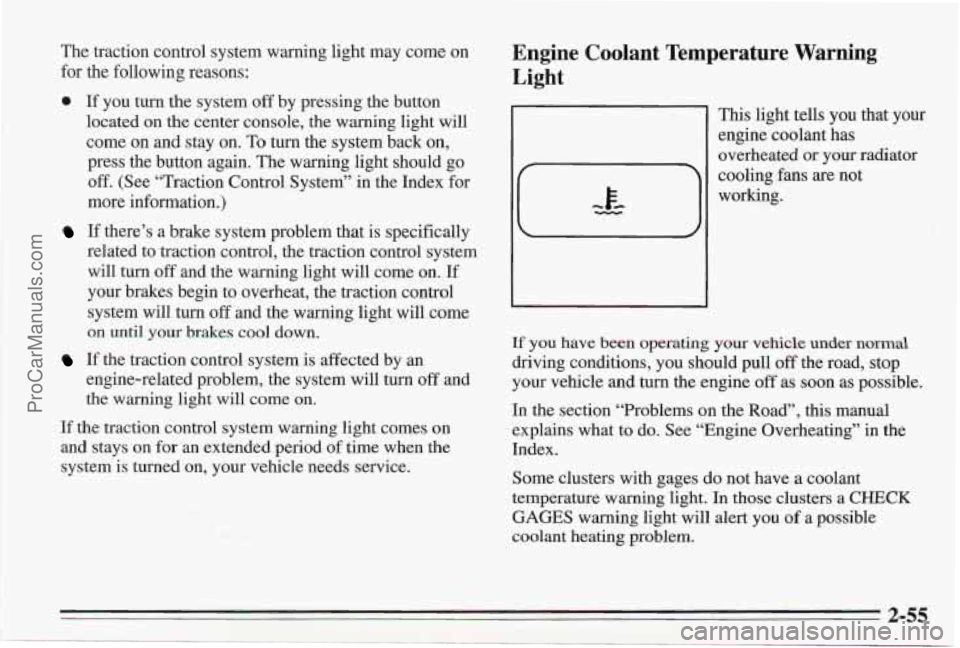
Engine Coolant Temperature Warning
Light
1
This light tells you that your
engine coolant has
overheated
or your radiator 4
cooling fans are not
working.
If you have been operating your vehicle under normal
driving conditions, you should pull off the road, stop
your vehicle and turn the engine
off as soon as possible.
In the section “Problems on the Road”, this manual
explains what to do. See “Engine Overheating” in the
Index.
Some clusters with gages
do not have a coolant
temperature warning light. In those clusters a
CHECK
GAGES warning light will alert you of a possible
coolant heating problem.
2-55
ProCarManuals.com
Page 105 of 338
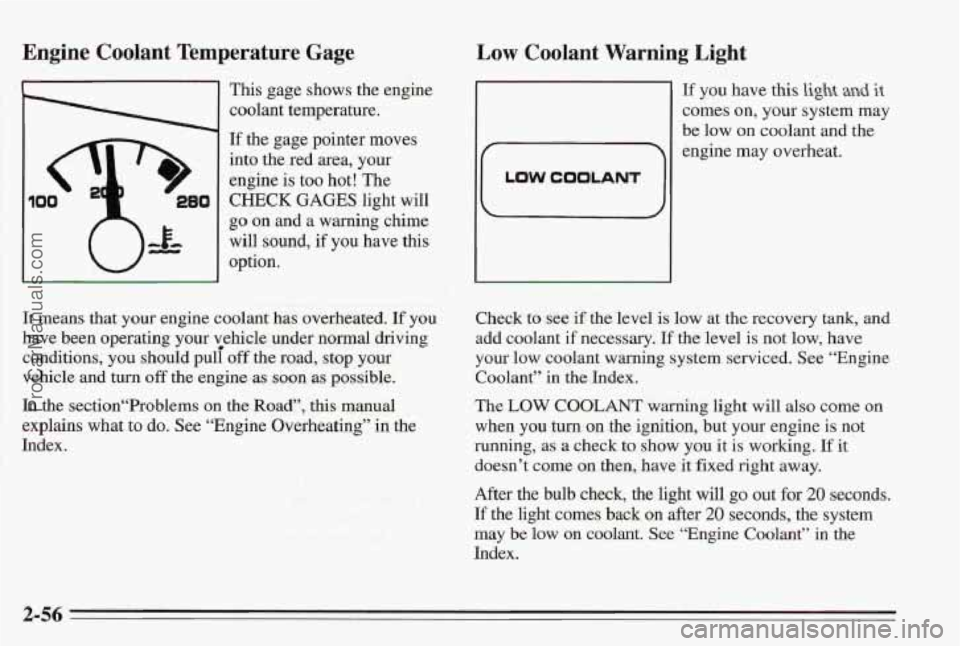
Engine Coolant Temperature Gage
This gage shows the engine
coolant temperature.
If the gage pointer moves
into the red area, your
engine
is too hot! The
CHECK GAGES light will
go on and a warning chime
will sound, if
you have this
option.
It means that your engine coolant has overheated. If you
have been operating your vehicle lander normal driving
conditions, you should puli off the road, stop you
vehicle and turn off the engine as soon as possible.
In the section“Prob1ems on the Road”, this mud
explains what to do. See “Engine Overheating” in the
-. -. . 5 . Index. .~ c.
.L -,
Low Coolant Warning Light
L
LOW COOLANT
If you have this light and it
comes on, your system may
be low on coolant and the
engine
may overheat.
Check to
see if the level is low at the recovery tank, and
add coolant if necessary.
If the level is not low, have
your low coolant warning system serviced. See “Engine
Coolant” in the
Index.
The LOW COOLANT warning light will also come on
when you turn on the ignition, but your engine is not
running, as
a check to show you it is working. If it
doesn’t come
on then, have it fixed right away.
After the
bulb check, the light will go out for 20 seconds.
If the light comes back on after 20 se’conds, the system
may be low on coolant. See “Engine Coolant”
in the
Index.
2-56
ProCarManuals.com
Page 178 of 338
Making Thms
NOTICE:
Making very sharp turns while trailering could cause the trailer to come in contact with the vehicle. Your vehicle could be damaged. Avoid
making very sharp turns while trailering.
When you’re turning with a trailer, make wider turns
than normal.
Do this so your trailer won’t strike soft
shoulders, curbs, road signs, trees, or other objects.
Avoid jerky or sudden maneuvers. Signal well in
Tldvance.
’Ibrn Signals When Towing a Trailer
When you tow a trailer, your vehicle has to have a
different turn signal flasher and extra wiring. The green
arrows on your instrument panel will flash whenever
you signal a turn or lane change. Properly hooked up,
the trailer lamps will also flash, telling other drivers
you’re about to turn, change lanes or stop.
When towing a trailer, the green arrows on your
instrument panel will flash for turns even if the bulbs on
the trailer are burned out.
Thus, you may think drivers behind
you are seeing your signal when they are not. It’s
important to check occasionally to be sure the trailer
bulbs are still working.
Your vehicle has bulb warning lights. When you plug a
trailer lighting system into your vehicle’s lighting
system, its bulb warning lights may not let you know if
one of your lamps goes out.
So, when you have a trailer
lighting system plugged in, be sure to check your
vehicle and trailer lamps from time to time to be sure
they’re all working. Once you disconnect the trailer lamps, the bulb warning lights again can tell you if one
of your vehicle larnps is out.
Driving On Grades
Reduce speed and shift to a lower gear before you start
down a long or steep downgrade.
If you don’t shift
down, you might have to use your brakes
so much that
they would get hot and
no longer work well.
On a long uphill grade, shift down to DRIVE (@) and
reduce your speed to around 45 mph (70 kmph) to
reduce the possibility of engine and transaxle
overheating.
ProCarManuals.com
Page 191 of 338
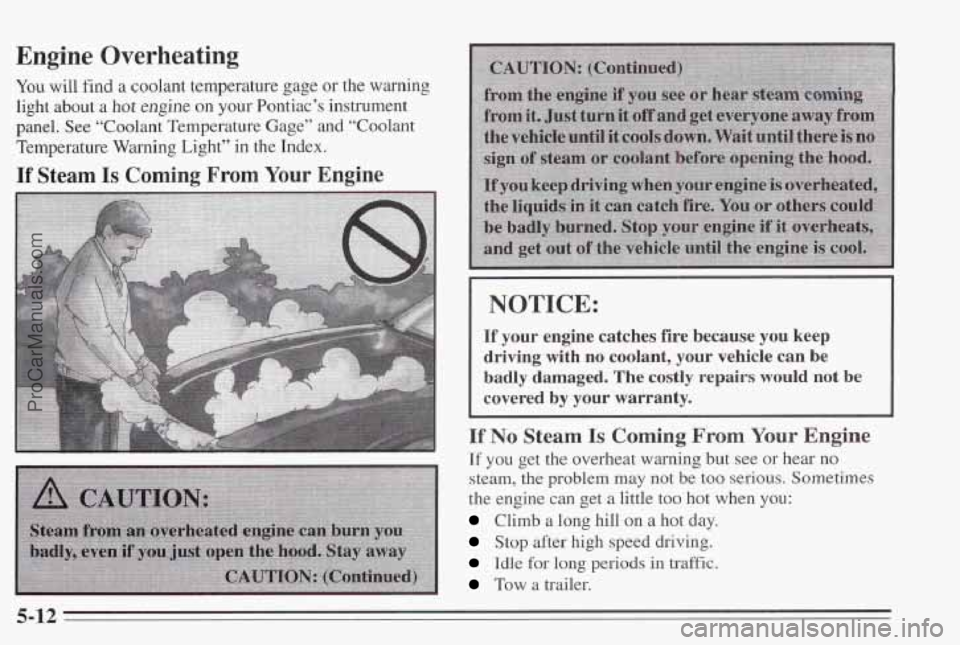
Engine Overheating
You will find a coolant temperature gage or the warning
light about a hot
engine on your Pontiac’s instrument
panel. See “Coolant Temperature Gage” and “Coolant
Temperature Warning Light”
in the Index.
If Steam Is Coming From Your Engine
I NOTICE:
If your engine catches fire because you keep
driving with no coolant, your vehicle can be
badly damaged. The costly repairs would not be
covered by your warranty.
If No Steam Is Coming From Your Engine
If you get the overheat warning but see or hear no
steam,
the problem may not be too serious. Sometimes
the engine can get a little too hot when
you:
Climb a long hill on a hot day.
Stop after high speed driving.
Idle for long periods in traffic.
Tow a trailer.
5-12
ProCarManuals.com
Page 193 of 338
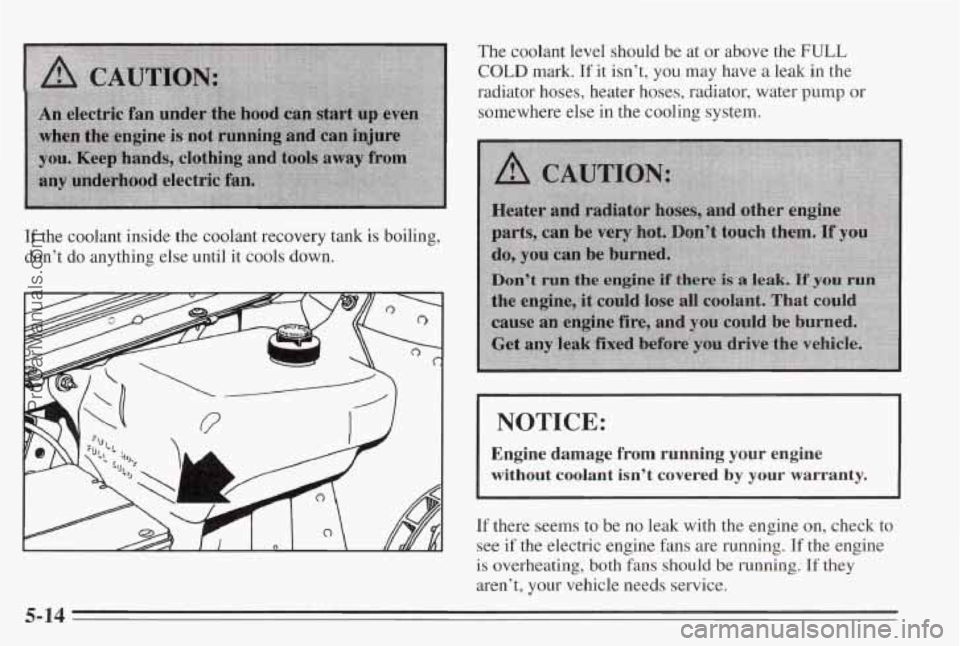
If the coolant inside the coolant recovery tank is boiling,
don’t
do anything else until it cools down.
The coolant level should be at or above the FULL
COLD mark. If it isn’t, you may have a leak in the
radiator hoses, heater hoses, radiator, water
pump or
somewhere else in the cooling system.
NOTICE:
Engine damage from running your engine
without coolant isn’t covered by your warranty.
If there seems to be no leak with the engine an, check to
see if the electric engine fans are running. If the engine
is overheating, both fans should be running. If they
aren’t,
your vehicle needs service.
5-14
ProCarManuals.com
Page 235 of 338
Engine Coolant
The following explains your cooling system and how to
add
coolant when it is low. If you have a problem with
engine overheating, see “Engine Overheating” in the
Index.
The proper co’olant for your Pontiac will:
0 Give freezing protection down to -34°F (-37°C).
0 Give boiling protection up to 262°F (128 “C).
0 Protect against rust and corrosion.
Help keep the proper engine temperature.
Let the warning Sights work as they should.
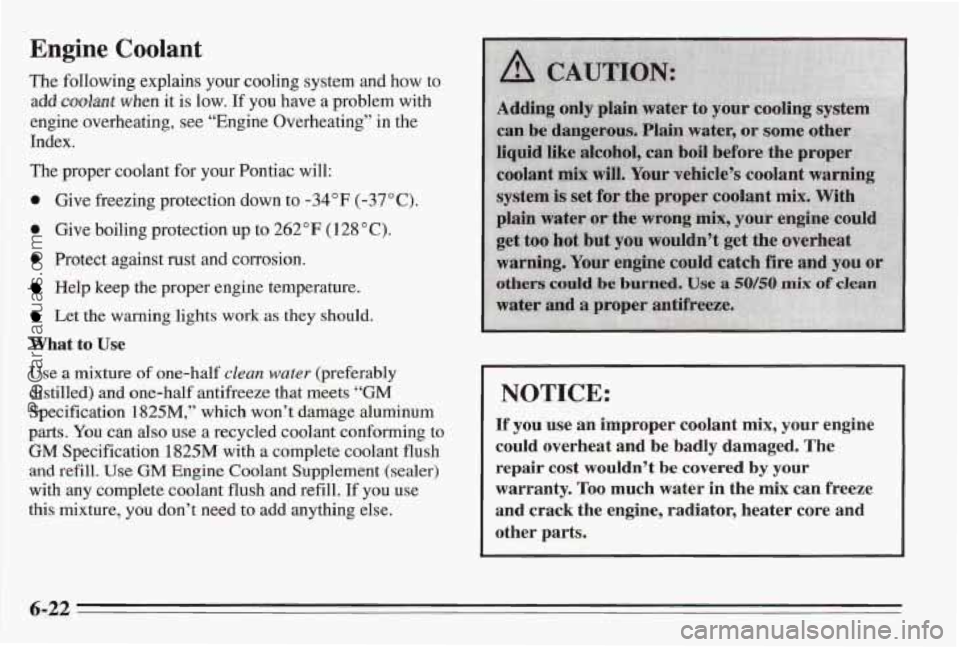
What to Use
Use a mixture of one-half clean water (preferably
distilled) and one-half antifreeze that meets
“GM
Specification 1825M,?’ which won’t damage aluminum
parts. You can also use a recycled coolant conforming to
GM specification 1825M with a complete coolant flush
and refill. Use GM Engine Coolant Supplement (sealer)
with
any complete coolant flush and refill. If you use
this mixture,
you don’t need to add anything else.
NOTICE:
If you use an improper coolant nrsix, yuur engine
could overheat and be badly damaged. The
repair cast wouldn’t be mvmd by your
warranty. T~o much water in the mix em freeze
and crack the engine, radiabl; heater core an’d
other
pa
6-22
ProCarManuals.com
Page 237 of 338
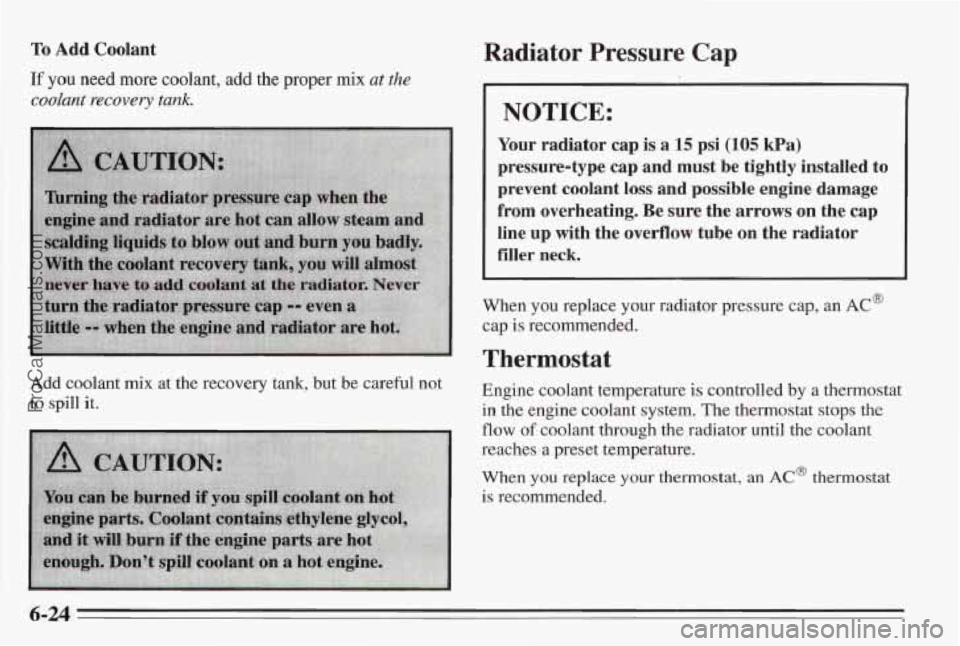
To Add Coolant
If you need more coolant, add the proper mix at the
coolant recovery tank.
Add coolant mix at the recovery tank, but be careful not
to spill it.
Radiator Pressure Cap
NOTICE:
Your radiator cap is a 15 psi (105 kPa)
pressure-type cap and must be tightly installed to
prevent coolant
loss and possible engine damage
from overheating. Be sure the arrows on the cap
line up with the overflow tube on the radiator
filler neck.
When you replace your radiator pressure cap, an AC@
cap is recommended.
Thermostat
Engine coolant temperature is controlled by a thermostat
in the engine coolant system. The thermostat stops
the
flow of coolant through the radiator until the coolant
reaches a preset temperature.
When you replace your thermostat, an AC@ thermostat
is recommended.
6-24
ProCarManuals.com