Page 72 of 338
Parking Brake
A
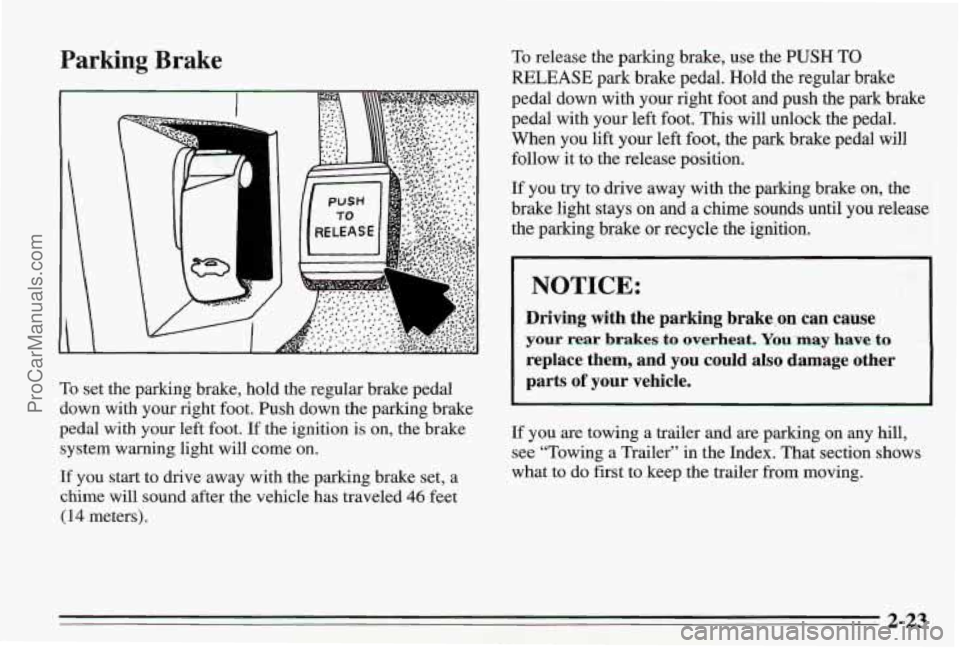
To set the parking brake, hold the regular brake pedal
down with your right foot. Push down the parking brake
pedal with your left foot.
If the ignition is on, the brake
system warning light will come on.
If you start to drive away with the parking brake set, a
chime
will sound after the vehicle has traveled 46 feet
(14 meters). To
release the parking brake, use the
PUSH TO
RELEASE park brake pedal. Hold the regular brake
pedal down with your right foot and push
the park brake
pedal with your left foot. This will unlock the pedal.
When you lift your left foot, the park brake pedal
will
follow it to the release position.
If you try to drive away with the parking brake on, the
brake light stays on and a chime sounds until you
release
the parking brake or recycle the ignition.
I NOTICE:
Driving with the parking brake,on can cause
your rear brakes to overheat. You may have to
replace them, and you could also damage other
parts
of your vehicle.
If you are towing a trailer and are parking. on any hill,
see “Towing a Trailer” in the Index. That section shows
what to do first to keep the trailer
from moving.
2-23
ProCarManuals.com
Page 73 of 338
Shifting Into PARK (P)
Steering Column Shift Lever
1. Hold the brake pedal down with your right foot and
set the parking brake.
3a '60 km/h 140
II I I1
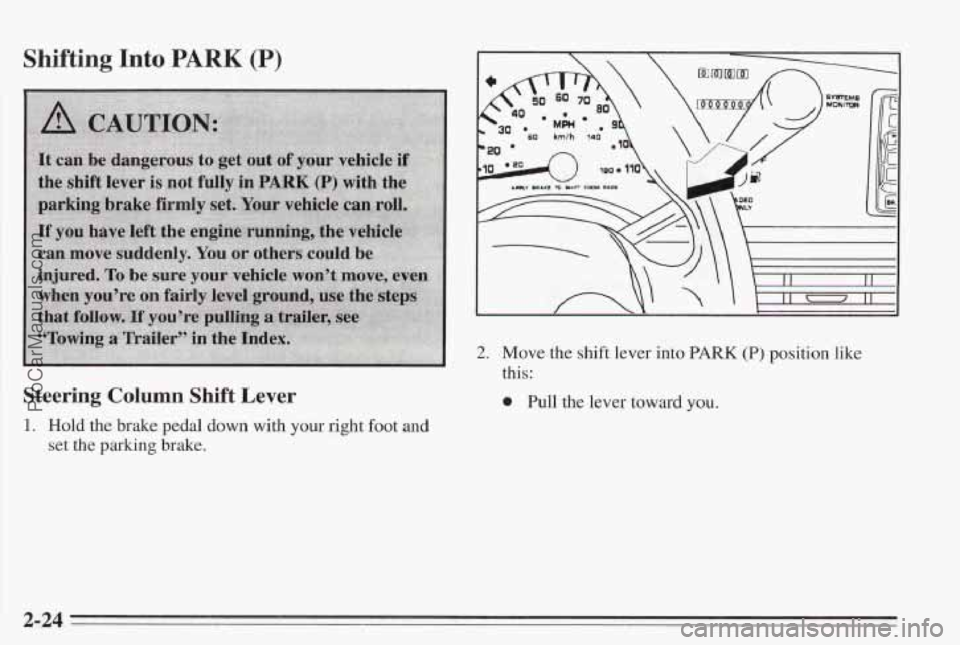
2. Move the shift lever into PARK (P) position like
this:
0 Pull the lever toward you.
2-24
ProCarManuals.com
Page 74 of 338
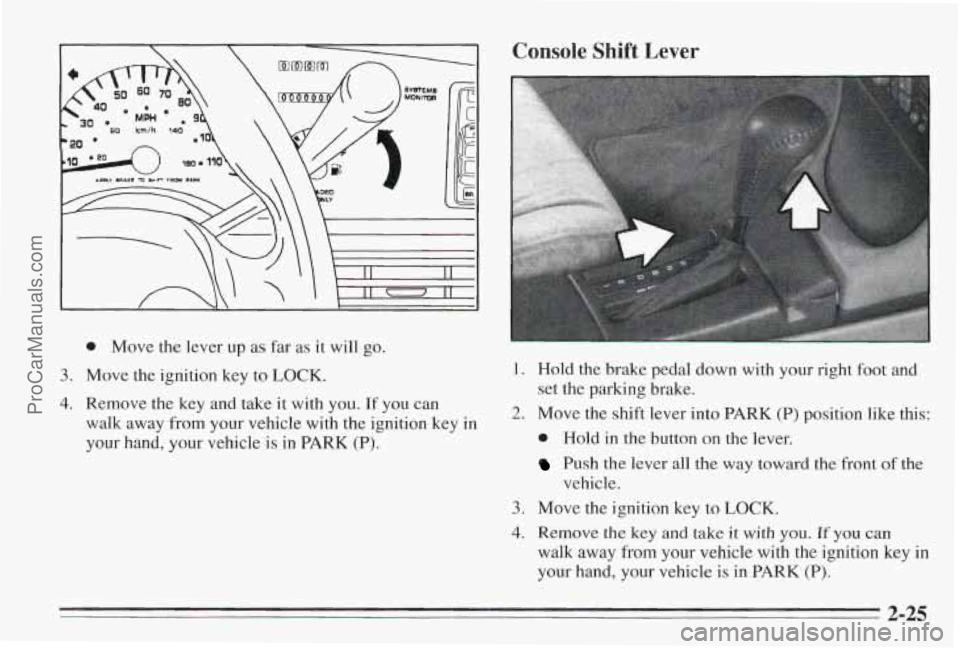
0 Move the lever up as far as it will go.
3. Move the ignition key to LOCK.
4. Remove the key and take it with you. If you can
walk away from your vehicle with the ignition key in
your hand, your vehicle
is in PARK (P).
Console Shift Lever
1. Hold the brake pedal down with your right foot and
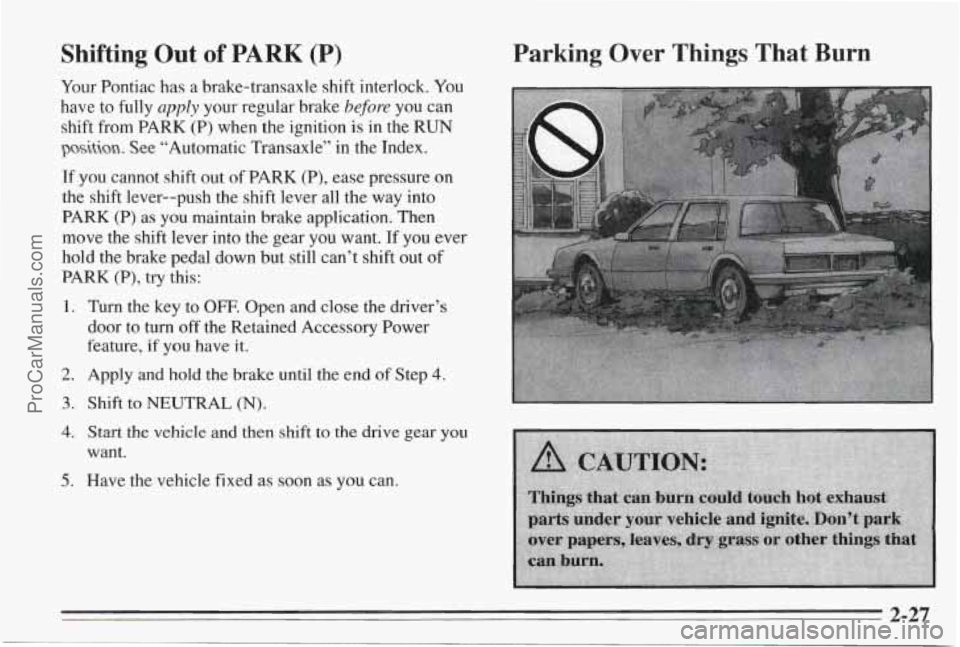
2. Move the shift lever into PARK (P) position like this:
set the parking brake.
0 Hold
in the button on the lever.
Push the lever all the way toward the front of the
vehicle.
3. Move the ignition key to LOCK.
4. Remove the key and take it with you. If you can
walk away from your vehicle with the ignition key in
your hand, your vehicle is in PARK (P).
2-25
ProCarManuals.com
Page 75 of 338
Leaving Your Vehicle With the Engine
Running
If yon have to leave your vehicle with the engine
running,
be sure your vehicle is in PARK (P) and your
parking bralae is fdy set before you leave it. After
you’ve moved the shift lever into the PARK (I?)
position, hold the regular brake pedal down. Then, see if
you can muve the shift lever away from PARK (P)
without first pulling it tow& you (or, if you have the
console shift lever, without first pushing.the button). If
yuu c-an, it mema that the shift lever- w&snB t fully locked
into PARK (P).
Torque Lock
If you are parking on a hill and you don’t shift your
transaxle into
PARK (P) properly, the weight of the
vehicle may put too much force on the
parking pawl in
the transaxle. You may find it difficult to pull the shift
lever out
of PARK (P). This is called “torque lock.” To
prevent torque lock, set the parking brake and then shift
into
PARK (P) properly before you leave the driver’s
seat.
To find out how, see “Shifting Into PARK (P)” in
the Index.
When
you are ready to drive, move the shift lever out of
PARK
(P) before you release the parking brake.
If “torque lock” does occur, you may need to have
another vehicle
push yours a little uphill to take some of
the pressure from the transaxle. so you can pull the shift
lever out of PARK (P).
2-26
ProCarManuals.com
Page 76 of 338
Shifting Out of PARK (P)
Your Pontiac has a brake-transaxle shift interlock. You
have to fully
apply your regular brake before you can
shift from PARK (P) when the ignition
is in the RUN
pition. See “Automatic Transaxle” in the Index.
If you cannot shift out of PARK (P), ease pressure on
the shift lever--push the shift lever all the way into
PARK (P) as you maintain brake application. Then
move the shift lever into the gear you want. If you ever
hold the brake pedal down but still can’t shift out
of
PARK (P), try this:
1. Turn the key to OFF. Open and close the driver’s
door to turn
off the Retained Accessory Power
feature,
if you have it.
2. Apply and hold the brake until the end of Step 4.
3. Shift to NEUTRAL (N).
4. Start the vehicle and then shift to the drive gear you
want.
5. Have the vehicle fixed as soon as you can.
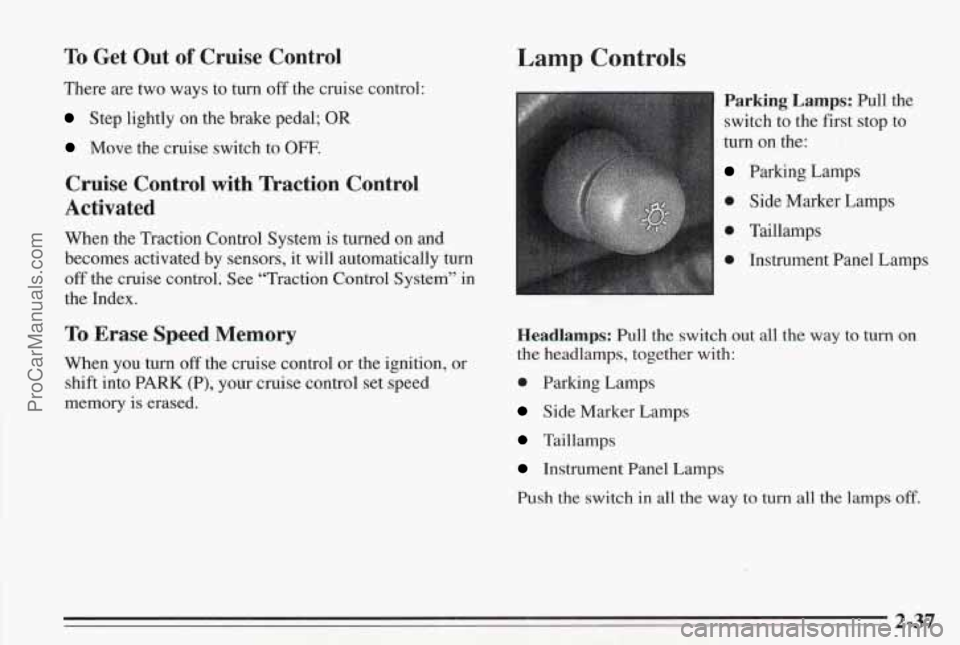
Parking Over Things That Burn
2-27
ProCarManuals.com
Page 86 of 338
To Get Out of Cruise Control
There are two ways to turn off the cruise control:
Step lightly on the brake pedal; OR
Move the cruise switch to OFF.
Cruise Control with Traction Control
Activated
When the Traction Control System is turned on and
becomes activated by sensors, it will automatically turn
off the cruise control. See “Traction Control System” in
the Index.
To Erase Speed Memory
When you turn off the cruise control or the ignition, or
shift into
PARK (P), your cruise control set speed
memory
is erased.
Lamp Controls
Parking Lamps: Pull the
switch to the first stop to
turn on the:
Parking Lamps
0 Side Marker Lamps
0 Taillamps
0 Instrument Panel Lamps
Headlamps: Pull the switch out all the way to turn on
the headlamps, together with:
0 Parking Lamps
Side Marker Lamps
Taillamps
Instrument Panel Lamps
Push the switch in all the way to turn all the lamps off.
2-37
ProCarManuals.com
Page 102 of 338
Brake System Warning Light
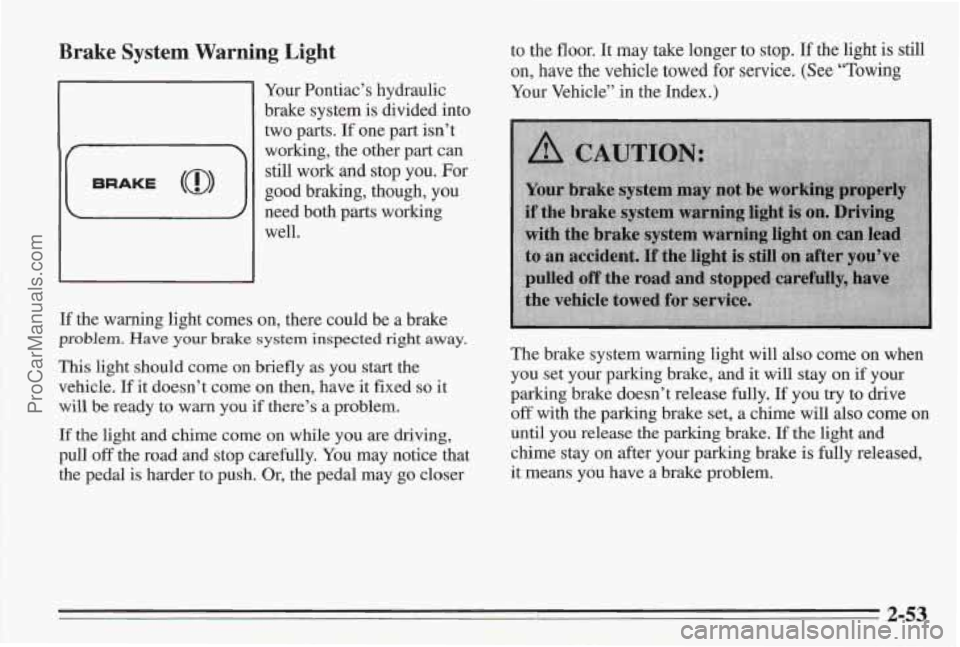
Your Pontiac’s hydraulic
brake system is divided into
two parts.
If one part isn’t
working, the other part can
still work and stop you.
For
good braking, though, you
need both parts working
well.
If the warning light comes on, there could be a brake
problem. Have your brake system inspected right awav.
This light should come on briefly as you start the
vehicle.
If it doesn’t come on then, have it fixed so it
will be ready to warn you if there’s a problem.
If the light and chime come on while you are driving,
pull
off the road and stop carefully. You may notice that
the pedal is harder to push. Or, the pedal may go closer to
the floor. It may take longer to stop. If the light
is still
on, have the vehicle towed for service. (See “Towing
Your Vehicle” in the Index.)
The brake system warning light will also come on when
you set your parking brake, and it will stay on if your
parking brake doesn’t release fully.
If you try to drive
off with the parking brake set, a chime will also come on
until you release the parking brake. If the light and
chime stay on after your parking brake is fully released,
it means you have a brake problem.
2-53
ProCarManuals.com
Page 152 of 338
Braking in Emergencies
Use your anti-lock braking system when you need to.
With anti-lock, you can steer and brake at the same
time. In many emergencies, steering can help you more
than even the very best braking.
Steering
Power Steering
If you lose power steering assist because the engine
stops or the system is not functioning, you can steer but
it will take much more effort.
Variable Effort Steering
If your vehicle is equipped with this option, you have a
variable
effort steering system that eases steering effort
at speeds less than 20 mph (32 km/h). This is
particularly useful when parking your vehicle.
Steering Tips
Driving on Curves
It’s important to take curves at a reasonable speed.
A lot of the “driver lost control” accidents mentioned on
the news happen on curves. Here’s why: Experienced driver
or beginner, each
of us is subject to
the same laws
of physics when driving on curves. The
traction of the tires against the road surface makes it
possible for the vehicle to change its path when you turn
the front wheels. If there’s no traction, inertia will keep
the vehicle going in the same direction.
If you’ve ever
tried
to steer a vehicle on wet ice, you’ll understand this.
The traction you can get in a curve depends
on the
condition
of your tires and the road surface, the angle at
which the curve is banked, and your speed. While you’re
in a curve, speed is the one factor you can control.
Suppose you’re steering through a sharp curve. Then you
suddenly accelerate. Both control systems
-- steering and
acceleration
-- have to do their work where the tires meet
the road. Unless you have traction control and the system
is on, adding the sudden acceleration can demand too
much of those places. You can lose control.
What should you do
if this ever happens? Ease up on the
accelerator pedal, steer the vehicle the way you want
it
to go, and slow down.
Speed limit signs near curves warn that you should
adjust your speed. Of course, the posted speeds are
based on good weather and road conditions. Under less
favorable conditions you’ll want to go slower.
4-9
ProCarManuals.com