Page 79 of 338
Horn
You can sound the horn by pressing the horn s’ymbols on
your steering wheel.
‘Tilt Wheel
Turn SignaVMultifunction Lever
The lever on the left side of the steering column
includes your:
Headlamp High-Low Beam
0 Windshield Wipers
a Windshield Washer
Cruise Control (Option)
@ Turn Signal and Lane Change Indicator
The high-low beam feature is discussed under
“Headlamps”. See “Headlamps” in the Index.
A tilt steering wheel allows you to adjust the steering
wheel before you drive.
You can
also raise it to the highest level to give your
legs more room when you exit and enter the vehicle.
To tilt the wheel, hold the steering wheel and pull the
lever.
Move the steering wheel to a comfortable level,
then release the lever to
lock the wheel m place.
2-30
ProCarManuals.com
Page 83 of 338
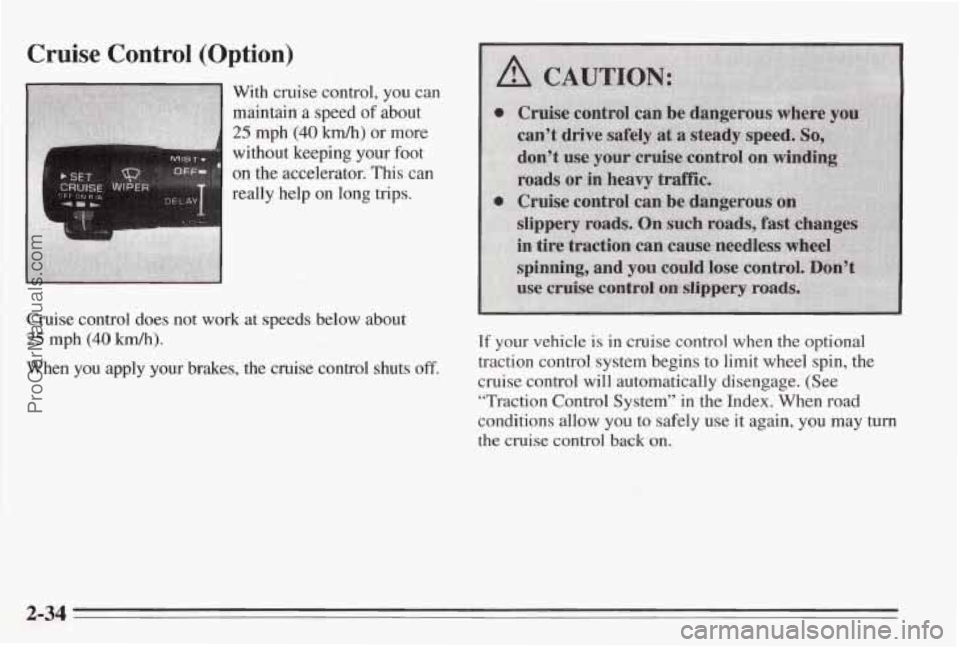
Cruise Control (Option)
With cruise control, you can
maintain
a speed of about
25 mph (40 kmh) or more
without keeping your foot
on the accelerator. This can
really help on long trips.
Cruise control does not
work at speeds below about
25 mph (40 km/h).
When you apply your brakes, the cruise control shuts off.
If your vehicle is in cruise control when the optional
tractison control system begins to limit wheel spin,
the
cruise control will automatically disengage. (See
“Traction Control
System” in the Index. When road
conditions allow
you to safely use it again, you may turn
the cruise control back on.
2-34
ProCarManuals.com
Page 84 of 338
To Set Cruise Control
1. Move the cruise control switch to ON.
2. Get up to the speed you want.
3. Push in the SET
at the end of the
and release
it.
4. Take your foot off the accelerator pedal. button
lever
To Resume a Set Speed
Suppose you set your cruise control at a desired speed
and then you apply the brake. This,
of course, shuts off
the cruise control. But you don’t need to reset it.
Once you’re going about
25 mph (40 km/h) or more,
you can move the cruise
control switch from
ON to
R/A (resume/accelerate)
for about half
a second.
You’ll
go right back up to your chosen speed and stay
there. Remember that if you hold the switch at
FUA
longer than half a second, the vehicle will keep going
faster until you release the switch or apply the brake.
You could be startled and even lose control.
So unless
you want
to go faster, don’t hold the switch at WA.
2-35
ProCarManuals.com
Page 85 of 338

To Increase Speed While Using Cruise
Control
There are two ways to go to a higher speed. Here’s the
first:
Use the accelerator pedal to get to the higher speed.
0 Push the button at the end of the lever, then release
the button and the accelerator pedal. You’ll now
cruise at the higher speed.
Here’s the second way to go to a higher speed:
Move the Cruise switch from ON to WA. Hold it
there until you get up
to the speed you want, and
then release the switch.
To increase your speed in very small amounts, move
the switch to
WA for less than half a second and then
release
it. Each time you do this, your vehicle will go
about 1 mph (1.6 km/h) faster.
The accelerate feature will only work after you have set
the cruise control speed by pushing the SET button.
To Reduce Speed While Using Cruise
Control
There are two ways to reduce your speed while using
cruise control:
Push in the button at the end of the lever until YOU
reach the lower speed you want, then release it.
0 To slow down in very small amounts, push the
button for less than half a second. Each time you do
this, you’ll
go 1 mph (1.6 km/h) slower.
Passing Another Vehicle While Using
Cruise Control
Use the accelerator pedal to increase your speed. When
you take your foot
off the pedal, your vehicle will slow
down to the cruise control speed you set earlier.
Using Cruise Control on Hills
How well your cruise control will work on hills depends
upon your speed, load, and the steepness
of the hills. When
going up steep hills, you may have to step on the
accelerator pedal to maintain your speed. When going
downhill, you may have to brake or shift to a lower gear to
keep your speed down.
Of course, applying the brake takes
you out
of cruise control. Many drivers find this to be too
much trouble and don’t use cruise control
on steep hills.
2-36
ProCarManuals.com
Page 86 of 338
To Get Out of Cruise Control
There are two ways to turn off the cruise control:
Step lightly on the brake pedal; OR
Move the cruise switch to OFF.
Cruise Control with Traction Control
Activated
When the Traction Control System is turned on and
becomes activated by sensors, it will automatically turn
off the cruise control. See “Traction Control System” in
the Index.
To Erase Speed Memory
When you turn off the cruise control or the ignition, or
shift into
PARK (P), your cruise control set speed
memory
is erased.
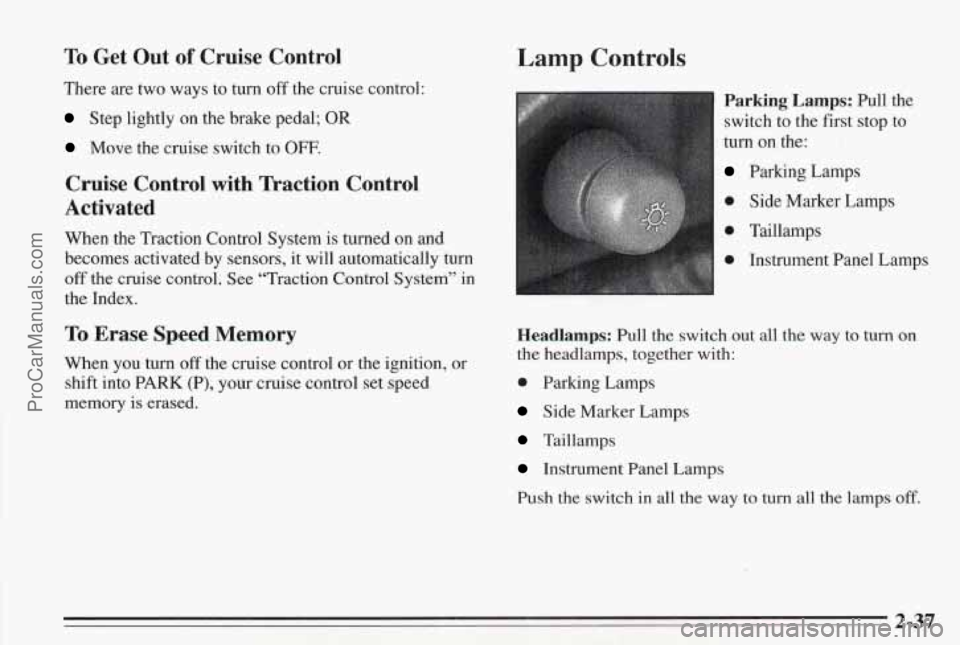
Lamp Controls
Parking Lamps: Pull the
switch to the first stop to
turn on the:
Parking Lamps
0 Side Marker Lamps
0 Taillamps
0 Instrument Panel Lamps
Headlamps: Pull the switch out all the way to turn on
the headlamps, together with:
0 Parking Lamps
Side Marker Lamps
Taillamps
Instrument Panel Lamps
Push the switch in all the way to turn all the lamps off.
2-37
ProCarManuals.com
Page 150 of 338

The anti-lock system can change the brake pressure
faster than any driver could. The computer is
programmed to make the most of available tire
and
road conditions.
You can steer around the obstacle while braking hard.
As you brake, your computer keeps receiving updates on
wheel speed and controls braking pressure accordingly.
Remember: Anti-lock doesn’t change the time you need
to get your foot up to the brake pedal. If you get too close to
the vehicle in front of you,
you won’t have time
to apply your brakes if that vehicle suddenly slows or
stops. Always leave enough room up ahead
to stop, even
though you have anti-lock brakes.
To Use Anti-Lock
Don’t pump the brakes. Just hold the brake pedal down
and let anti-lock work for you.
You may hear a motor or
clicking noise during a hard stop, but this is normal.
Traction Control System (Option)
Your vehicle may have a traction control system that
limits wheel
spin. This is especially useful in slippery
road conditions. The system operates only if it senses
that one or
both of the front wheels are spinning or
beginning to lose traction. When this happens, the
system works the front brakes and reduces engine power
(by shutting off fuel injectors and managing engine
spark) to limit wheel spin.
You may feel the system working, or you may notice
some noise, but this is normal. If your vehicle is in
cruise control when the traction control system begins to
limit wheel spin, the cruise control will automatically
disengage. When road conditions allow you
to safely
use it again, you may re-engage the cruise control. (See
“Cruise Control” in the Index.)
4-7
ProCarManuals.com
Page 224 of 338

Engine Accessory Belt
A
C
The 3800 (L36) engine uses an engine accessory belt.
This diagram shows the features connected by the belt
routing. See “Maintenance Schedule” in the Index for
when to check the belt.
A. Power Steering
B . Alternator
C. Air Conditioning
D. Crank
E. Coolant Pump
E Tensioner
3800 Supercharged (L67) Engine
(Option)
Your Bonneville may have a 3800 Supercharged engine.
The Supercharger is
a device which is designed to pump
more air into the engine than it would normally
use.
This air mixed with fuel, creates increased engine
power. Since the Supercharger is a pump and is driven
from an engine accessory drive belt, increased pressure
is available at all driving conditions.
The powertrain control module
(PCM), works with a
vacuum control to regulate the increased pressure
required during specific driving conditions. When this
increased pressure or boost is not desired, such as during
idling
and light throttle cruising, the excess air that the
Supercharger is pumping is routed through a bypass.
All
of these controls, working together provide high
performance character
and fuel efficiency in the
3800 V6 Supercharged engine.
The power steering pump uses a remote reservoir
mounted on the throttle and cruise control cable bracket.
See “Maintenance Schedule”
in the Index for when you
should check the fluid.
6-11
ProCarManuals.com
Page 265 of 338
Right Side Fuse Panel: Additional fuses are located in
the relay center, on the far right side, below the
instrument panel.
You must remove the sound insulator
on the right side
of the passenger foot well to replace
these fuses.
Replacing these fuses
is difficult. We recommend that
you see your dealer
if you need one replaced.
Position Circuitry
1 Door Locks
2 Power Antenna, Lock Switch
3 Horns
4 Not Used
5 Cruise Control, Misc. Engine
Controls
6 Fuel Pump
7 Injectors
8 Electronic Control Module,
9 Not Used
10 Not Used
11 A/C Programmer PASS-Key
@I1
12 Not Used
POSITIONS
r---------- I FUSE I I POSITIONS I
6-52
ProCarManuals.com