1995 Oldsmobile Cutlass Supreme ignition
[x] Cancel search: ignitionPage 74 of 340
~
~ ~~ ~~~ ~. - ~__~
I!” sure the shift lever
is fully into PARK (P) range
before starting the engine. Your Oldsmobile has a
!brake-transaxle shift interlock. You must fully apply
your regular brakes before you can shift from PARK (P)
Bwhen the ignition is in
RUN. If you cannot shift out of
PARK.(P), ease pressure on the shift lever by pushing
it all the way into PARK (P) while keeping the brake
pedal pushed down. Release the shift lever button
if you
have a console shift. Then move the shift lever out
of
PARK (P), being sure to press the shift lever button if
you have a console shift. See “Shifting Out of
PARK (P)” in the Index.
REVERSE (R): Use this gear to back up.
NOTICE:
Shifting’ to REVERSE (R) while your vehicle is :
moving forward could damage your transaxle.
Shift to REVERSE (R) only after your vehicle
is
stopped.
To rock your vehicle back and forth to get out of snow,
ice or sand without damaging your transaxle, see
“Stuck: In Sand, Mud, Ice or Snow” in the Index.
~ ~~~~
~~~ .
NEUTRAL (N): In this position, your engine doesn’t
connect with the wheels.
To restart when you’re
already moving, use NEUTRAL
(N) only. Also, use
NEUTRAL
(N) when your vehicle is being towed.
I NOTICE:
Damage to your transaxle caused by shifting out
of
PARK (P) or NEUTRAL (N) with the engine
racing isn’t covered by your warranty.
Page 79 of 340
Torque Lock
If you are parking on a hill and you don’t shift your
transaxle into PARK (P) properly, the weight of the
vehicle may put too much force on the parking pawl
in
the transaxle. You may find it difficult to pull the shift
lever out of PARK
(P). This is called “torque lock.” To
prevent torque lock, set the parking brake and then shift
into PARK (P) properly before you 1,eave the driver’s
seat.
To fmd out how, see “Shifting Into PARK (P)” in
the Index.
When you
are ready to drive, move the shift lever out of
PARK (P)
before you release the parking brake.
Shifting Out of PARK (P)
If “torque lock” does occur, you may need to. have ,
another vehicle push yours a little uphill to take some of
the pressdre from the transaxle,
so you can pull the shift .
lever out of PARK (P). Your
Oldsmobile has
a brake-transaxle shift. interlock.
You must fully apply your regular brakes before you can
shift from PARK (P) when the ignition is in RUN. See
“Automatic Transaxle”
in the Index.
If you cannot shift out of
PARK (P), ease pressure on
the shift lever by pushing it all the way into PARK (P)
whil‘e keeping the brake pedal pushed down. Release the
shift lever button if you have a console shift. Then move
the shift lever out
of PARK (P), being sure to press the
shift lever button’
if you have a console shift.
If you ever hold the brake pedal down but still can’t
shift out of PARK (P), try this:
1. Turn the key to OFF.
2. Apply and hold the brake until the end of step 4.
3. Shift to NEUTRAL (N).
4. Start the vehicle and shift to the drive gear you want.
5. Have the vehicle fixed as soon as you can.
2-21
Page 82 of 340
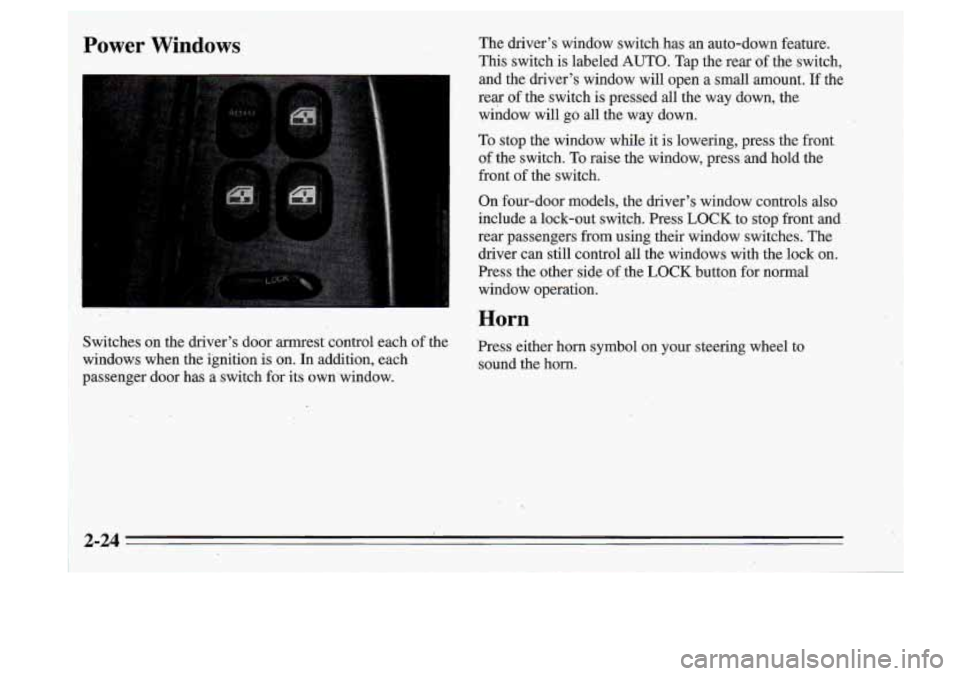
Power Windows The driver’s window switch has an auto-down feature.
This switch is labeled AUTO. Tap the rear of the switch,
and the driver’s window will open
a small amount. If the
rear
of the switch is pressed all the way down, the.
window will go all the way down.
I
3
To stop the window while it is lowering, press the front
of the switch. To raise the window, press and hold the
front of the switch.
On four-door models, the driver’s window controls also
include a lock-out, switch. Press
LOCK to stop’ front and
rear passengers from using. their window switches. The
driver can still control all the windows with the lock on.
Press the other side
of .the LOCK button for normal
window operation.
Horn
‘S*witches on the driver’s door armrest control each of the Press either horn symbol on your steering wheel to
windows when the ignition is on. In addition, each sound the horn.
passenger door has a switch for its own ‘window.
Page 90 of 340
Instrument Panel Lamps
You can brighten or dim the instrument panel lamps by
moving the dial. If you turn the dial all the way to INT,
your courtesy or interior lamps will come on.
Daytime Running Lamps (Canada Only)
Daytime Running Lamps (DRL) can make it easier for
others to see the front of your vehicle during the day.
DRL can be helpful in many different driving
conditions, but they can be especially helpful in the
short periods after dawn and before sunset.
A light sensor makes the DRL work, so be sure the light
sensor hole on top
of the instrument panel isn't covered. The
DRL system will make your low-beam headlamps
come on
at reduced brightness in daylight when:
0 The ignition is on,
0 The headlamp switch is off, and
0 The parking brake is released.
When the
DRL are on, only your low-beam headlamps
will be on. The taillamps, sidemarker and,other lamps
won't
be on. Your instrument panel won't be lit up
either.
When it's dark enough outside, your low-beam
headlamps will change
fo full brightness. The other
lamps that come on with your headlamps will also come
on.
When it's bright enough outside, the regular lamps will
.go
off, and your low-beam headlamps change to the
reduced brightness of
DRL.
; To idle your vehicle with the DRL off, set the parking
brake while the ignition is in
OFF or LOCK. Then start
your vehicle. The
DRL will stay off until you release the
parking brake.
As with any vehicle, you should turn on the regular
headlamp system any time you need it.
. 3 13
Page 91 of 340
Interior Lamps
When any door is opened, several lamps come on. These
lamps are courtesy lamps. They make it easy fo_r you to
enter and leave your vehicle. You can also turn these
lamps on by moving the dial near the headlamp knob all
the way up to INT.
Some of the lamps have switches
so you can turn them
on, even when the doors are closed. These lamps are
reading lamps: To avoid draining your battery, be sure to
turn
off all reading lamps when leaving your vehicle.
Battery Saver
Your vehicle has a feature to help prevent you from
draining the battery, in case you accidentally leave the
courtesy lamps on.
If you leave the dial turned all the
way up to
INT, or if you leave a door open, the lamps
will automatically turn
off after 10 minutes if the
ignition is
off.
This feature will not turn off the reading lamps, only .the
lamps controlled by the dial. Be sure to
turn off ‘my reading
lamps using
the switch before you leave the vehicle.
Illuminated Entry
Your courtesy lamps will come on and stay on for a set
time whenever you:
Pull a front door handle.
Press UNLOCK on the Remote Lock Control
0 Press DOOR on the Remote Lock Control
(if equipped).
’
(if equipped).
If you open a door, the
lamps will stay on while it’s open
I and then turn off automatically about 18 seconds after 1
you close it. If you don’t open a door, the lamps will ’
turn off after about 18 seconds, unless you pressed
UNLOCK on the Remote Lock Control.
If you pressed
UNLOCK and don’t open a door, the lamps will turn off
after about
55 seconds.
Illuminated entry includes a feature called theater
dimming. With theater dimming, the lamps don’t just
turn off at the end of the delay time. Instead, they slowly
dim during the delay time until they go out. The delay
time is cancelled
if you turn the ignition key to RUN or
START,
so the lamps will go out right away.
When the ignition is on, Illuminated Entry is inactive,
which means the courtesy
lamps won’t come on.
r
Page 98 of 340
Sunroof (Option)
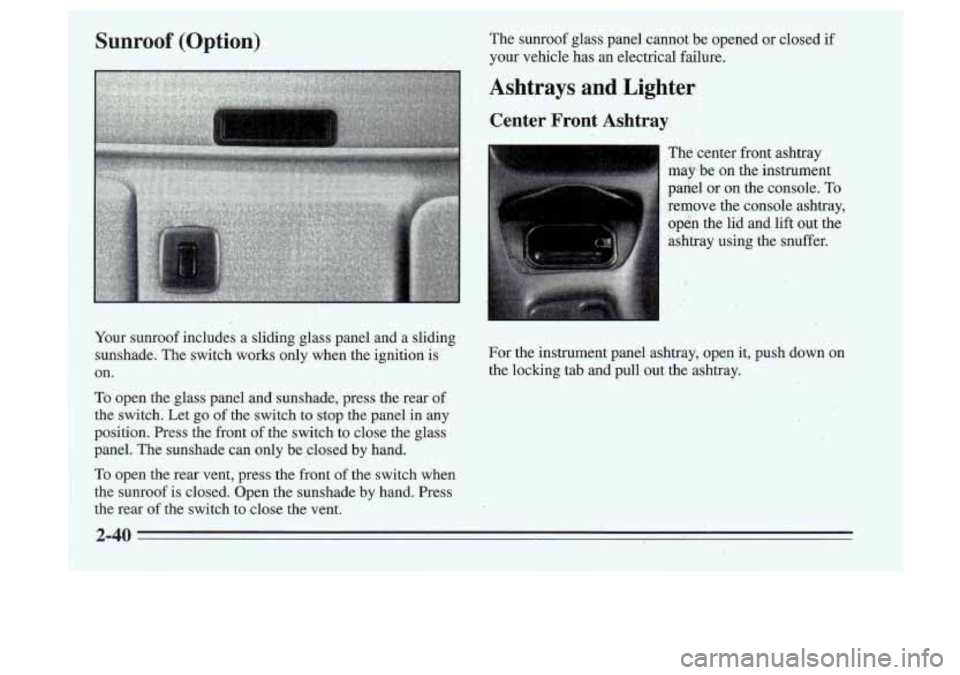
Your sunroof includes a sliding glass panel and a sliding sunshade. The switch works only when the ignition is
on.
To open the glass panel and sunshade, press the rear of
the switch. Let go of the switch to stop the panel in
any
position. Press the front of the switch to close the glass
panel. The sunshade can only be,closed by hand.
To open the rear vent, press the front
of the switch when
the sunroof is closed. Open the sunshade by hand. Press
the rear of the switch to close the vent.
.. ~~~ ~ ~.
The sunroof glass panel cannot be opened or closed if
your vehicle has an electrical failure.
I
Ashtrays and Lighter
Center Front Ashtray
The center front ashtray
may. be on the instrument
panel or on the console. To
'emove the console ashtray,
open the lid and lift out the
ashtray using the snuffer.
For the instrument panel ashtray, open it, push down on
the locking tab and pull out the ashtray.
2-40 . .
Page 103 of 340
Warning Lights, Gages and Indicators
This part describes the warning lights and,gages that
may be
on your vehicle. The pictures will help you
locate them.
Warning lights and gages can signal that something
is
wrong before it becomFs serious enough to cause an
expensive repair or replacement. Paying attention to
your warning.lights and gages could also save you or
others from injury.
Warning lights come on when there may be or is a
problem with one of your vehicle’s functions.
As you
will see in the details on the next few pages, some
warning lights come on briefly when you start the
engine just to let you know they’re working.
If you are
‘familiar with this section, you should not be alarmed
when this happens.
Gages can indicate when there may be or is a problem
with one-of your vehicle’s functions. Often gages and
warning lights work together to let you know when
there’s a problem with your vehicle.
When one
of the warning lights comes on and stays on
when you are driving, or when one of the gages shows
there may be a problem, check the section that
tells you
what to do about
it. Please follow this manual’s advice.
Waiting to do repairs can be costly
-- and even dangerous.
So please
get to know your warning lights
and gages. They’re
a big help.
Fuel Gage
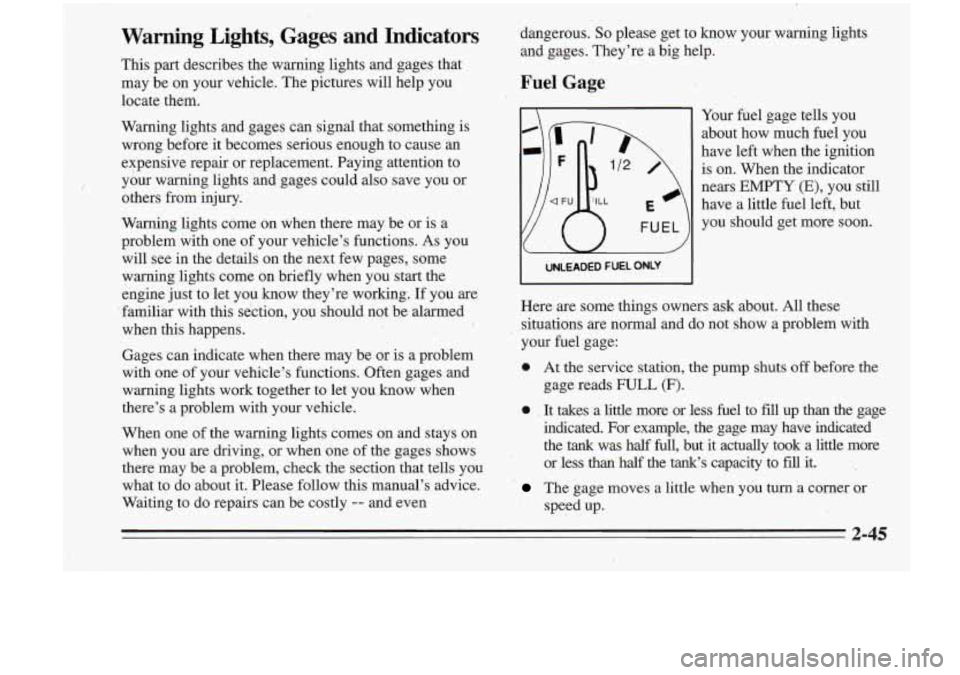
Your fuel gage tells you
about how much fuel
YOU
have left when the ignition
is on. When the indicator
nears
EMPTY (E), you still
have
a little fuel left, but
you should get more soon.
UNLEADED FUEL ONLY I
I
Here are some things owners ask about. All these
situations are normal and do not show a problem with
your fuel gage:
0 At the service station, the pump shuts off before the
gage reads
FULL (F).
0 . It takes a little more or less fuel to fill up than the gage
indicated. For example, the gage may have indicated
the
tank was half full, but it actually took a little more
or less
than half the tank‘s capacity to fill it.
The gage moves a little when you turn a corner or
speed up.
2-45
Page 104 of 340
I
Low Fuel Light
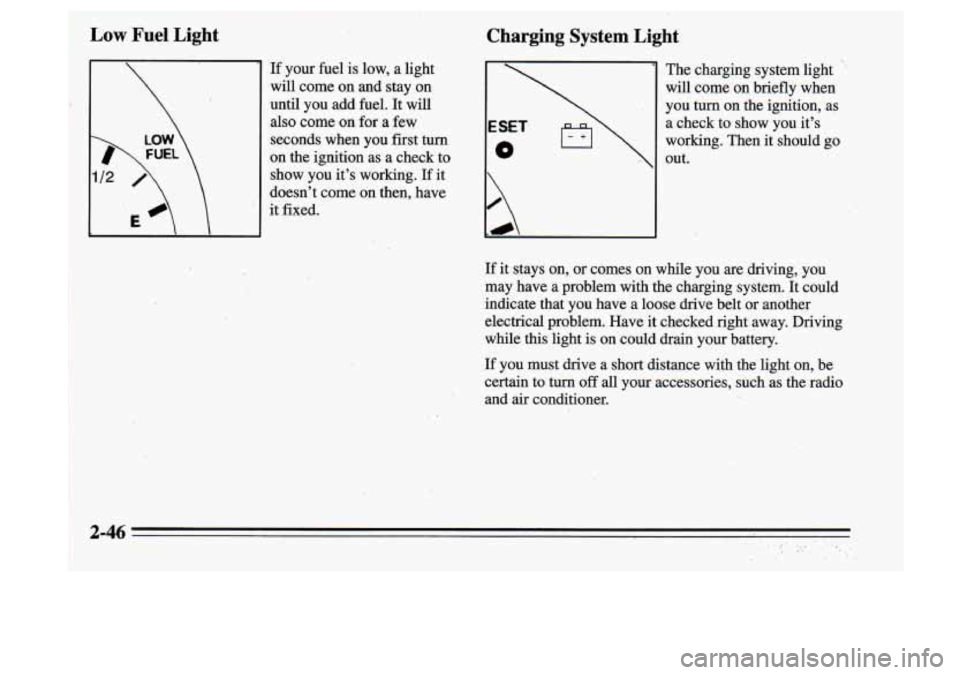
If your fuel is low, a light
will come on and stay on
until you add fuel. It will
also come on for a few
secQnds when you
first turn
on the ignition as a check to
show you it's working.
If it
doesn't come
on then, have
it fixed.