Page 473 of 873
REAR AXLE AND FINAL DRIVE
1
DESCRIPTION AND OPERATION DESCRIPTION
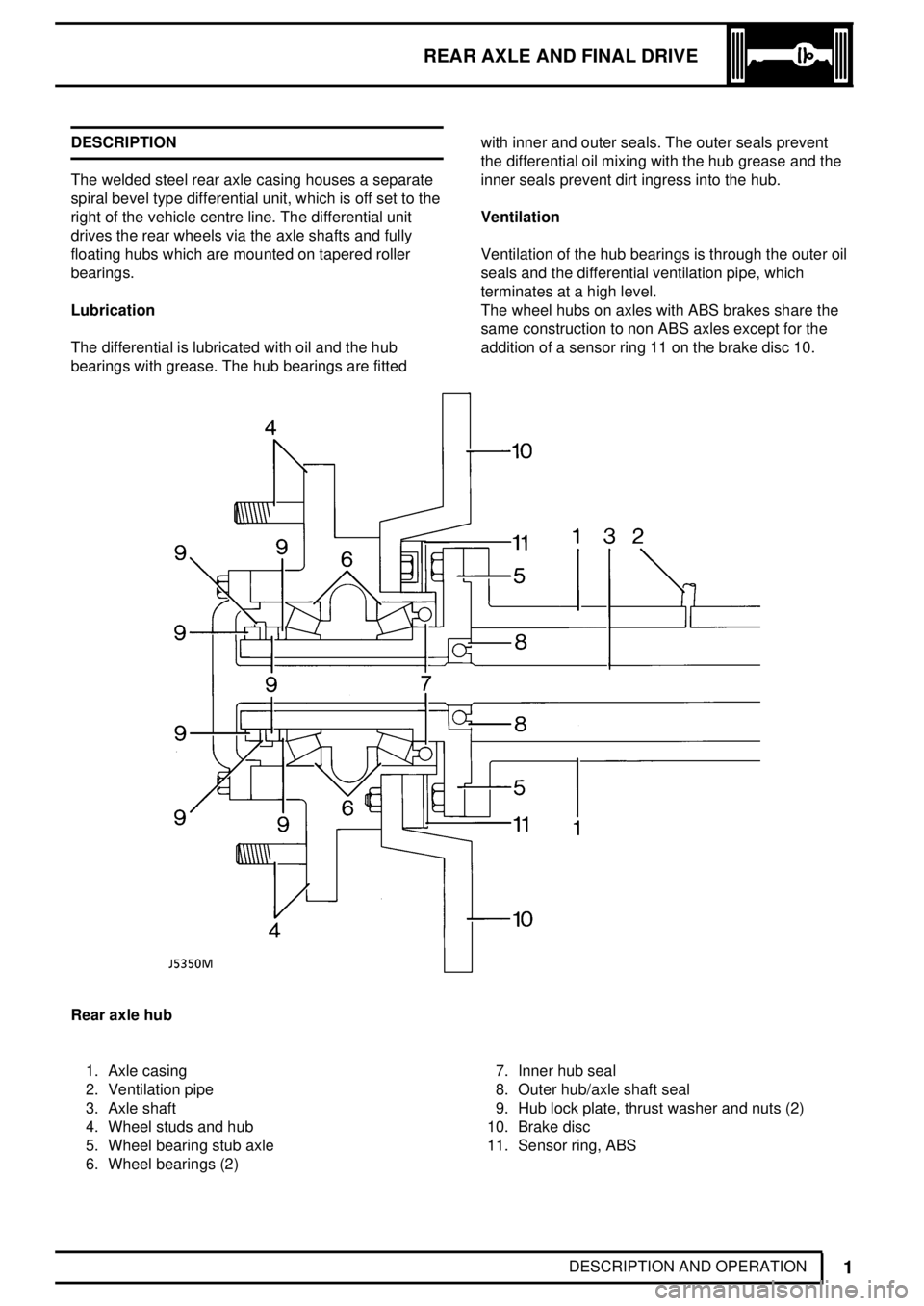
The welded steel rear axle casing houses a separate
spiral bevel type differential unit, which is off set to the
right of the vehicle centre line. The differential unit
drives the rear wheels via the axle shafts and fully
floating hubs which are mounted on tapered roller
bearings.
Lubrication
The differential is lubricated with oil and the hub
bearings with grease. The hub bearings are fittedwith inner and outer seals. The outer seals prevent
the differential oil mixing with the hub grease and the
inner seals prevent dirt ingress into the hub.
Ventilation
Ventilation of the hub bearings is through the outer oil
seals and the differential ventilation pipe, which
terminates at a high level.
The wheel hubs on axles with ABS brakes share the
same construction to non ABS axles except for the
addition of a sensor ring 11 on the brake disc 10.
Rear axle hub
1. Axle casing
2. Ventilation pipe
3. Axle shaft
4. Wheel studs and hub
5. Wheel bearing stub axle
6. Wheel bearings (2)7. Inner hub seal
8. Outer hub/axle shaft seal
9. Hub lock plate, thrust washer and nuts (2)
10. Brake disc
11. Sensor ring, ABS
Page 474 of 873

REAR AXLE AND FINAL DRIVE
1
FAULT DIAGNOSIS FAULT DIAGNOSIS
Complaint - Oil leaks
An external leak of lubrication from the hub seals can
be caused by a faulty internal seal. For example, if the
internal seals which separate the differential from the
hubs are faulty and the vehicle is operating or parked
on an embankment. Oil from the differential may flood
one hub causing a leak and leave the differential
lacking lubrication.
When a seal is found to be leaking check the axle
ventilation system, as a blockage can cause internal
pressure to force oil past the seals.
See 'Description and Operation' for illustrations of oil
seal locations.
When investigating hub seal leaks check the grease
for dilution with oil. Check also the differential level
and oil for metal particles and the condition of internal
seals.
If the vehicle is driven in deep water with defective oil
seals, water may contaminate the lubricants and raise
the differential level giving a false impression that the
housing has been overfilled with oil.
Do not assume that a high oil level in the
differential is due to over filling or, that a low level
is because of an external leak.
Page 475 of 873

REAR AXLE AND FINAL DRIVE
1
REPAIR REAR AXLE
Service repair no - 51.25.01
Remove
WARNING: Remove and refit of axle
requires a further two persons to steady
the axle when lowering or repositioning
axle.
1.Drain brake system.
2.Support chassis rear.
3.Remove road wheels.
4.Support axle weight with hydraulic jack.
5.Disconnect ABS wiring harness multi-plug at
jump hose bracket, if applicable.
6.Disconnect shock absorbers.
7.Disconnect flexible brake hose at connection
under floor.
8.Disconnect lower links at axle.
9.Mark differential and propeller shaft flanges with
identification marks for assembly. Remove four
nuts and bolts. Lower propeller shaft and tie to
one side.10.Disconnect pivot bracket ball joint at axle
bracket.
11.Release bolts and remove coil spring retaining
plates.
12.Lower axle and remove road springs.
13.Disconnect anti-roll[sway] bar links to axle.
See
REAR SUSPENSION, Repair, Anti-Roll[Sway]
Bar Ball Joint Links
14.Remove axle assembly.
Refit
15.Position axle and fit lower links. Tighten to
176
Nm
16.Reverse removal procedure.
17.Tighten pivot bracket ball joint to axle to
176 Nm.
18.Tighten propeller shaft to differential drive flange
to
47 Nm
19.Bleed brake system.See BRAKES, Repair,
Brake System Bleed
Page 479 of 873

REAR AXLE AND FINAL DRIVE
1
OVERHAUL AXLE DIFFERENTIAL ASSEMBLY
Service repair no - 51.15.07.
DISMANTLE
NOTE: Mark differential components so
their original positions relative to other
components is maintained. Bearing caps
must not be interchanged.
1.Remove axle shafts then differential assembly
fom axle.
2.Remove roll pin securing bearing nut locking
fingers to bearing caps. Remove locking fingers.
3.Loosen bearing cap bolts and mark caps for
assembly.
4.Using service tool LRT-54-508, remove bearing
adjusting nuts.
5.Remove bearing cap bolts and bearing caps.
6.Remove crown wheel differential unit and
bearings.
Remove pinion FRONT AXLE DIFFERENTIAL
ONLY
7.Remove pinion flange nut using service tool
LRT-51-003 to restrain flange.
8.Remove washer and pinion drive flange.
9.Remove pinion complete with bearing and outer
bearing shims.
10.Remove pinion flange oil seal, spacer and
bearing.
Remove pinion REAR AXLE DIFFERENTIAL ONLY
7.Remove pinion flange centralizing peg using
service tool LRT-51-008.
8.Remove pinion flange nut using service tool
LRT-51-003 to restrain flange.
9.Remove pinion complete with bearing and outer
bearing shims.
10.Remove pinion flange oil seal and bearing.
11.Using service tool LRT-54-505, remove pinion
head bearing track and shim and drive out outer
bearing of differential housing.
Page 482 of 873

51REAR AXLE AND FINAL DRIVE
4
OVERHAUL 35.Fit pinion outer bearing track to pinion housing.
Use service tools LRT-54-505 and LRT-54-507.
36.Fit pinion head bearing to pinion. Use service
tool LRT-54-502.
37.Fit pinion into its location without shims for
bearing pre-load.
38.Fit outer bearing, and spacer (front axle
differential only).
39.Fit driving flange, washer and nut.
40.Do not fit oil seal at this stage.
41.Tighten pinion flange nut until force required to
rotate pinion is
3Nmif new bearings are fitted.
This will pre-load bearings to check pinion height
dimension.
NOTE: If using original bearings, pre-load
figure is 1.5 Nm.
Drive pinion markings
NOTE: Markings on end face adjacent to
serial number are of no relevance to
servicing.
42.Figures marked on end face opposite to serial
number show in thousandths of an inch,
deviation from nominal, required to set pinion.
Pinions marked plus (+) must be set below
nominal. Pinions marked minus (-) must be set
above nominal. Unmarked pinions must be set at
nominal.
Page 484 of 873

51REAR AXLE AND FINAL DRIVE
6
OVERHAUL 48.Repeat on other bearing bore. Add readings
then halve sum to obtain mean reading. Note
whether trace pin has moved up or down from
zero.
A. Where trace pin moves down, reading is
equal to thickness of shims to remove, to
bring pinion to nominal.
B. Where trace pin moves up, reading is
equal to thickness of shims to add, to bring
pinion to nominal.
49.Before adjusting shim thickness: check pinion
face marking. If a plus (+) figure, subtract in
thousandths of an inch from shim thickness
figure.
50.If pinion has a minus (-) figure, add amount to
shim thickness figure.
Adjust shim thickness under pinion head bearing
track as necessary.
INCH MM
.001 = .025
.002 = .05
.003 = .075
.004 = .10
.005 = .125
.006 = .15
.007 = .175
.008 = .20
.009 = .225
.010 = .25
NOTE: Where dial indicator is metric
conversion must be made to inches when
measuring and selecting shims.
51.Recheck pinion height setting. If setting is
correct, mean reading of dial gauge will agree
with figure marked on pinion end face.
For example, with end face marking of +3, dial
gauge reading should indicate pinion is +0.003
in.Bearing pre-load adjustment
52.Remove the pinion flange, pinion, outer bearing
and spacer.
53.Slide new shim, of same thickness as original
(bearing pre-load) into position on pinion shaft. If
fitting a new shim use thickest shim 2.155 mm.
54.Fit pinion to pinion housing and fit outer bearing
and spacer (front differential only).
55.Fit driving flange, washer and nut.
56.Do not fit oil seal at this stage.
57.Tighten pinion flange nut to130 Nm.Force to
rotate pinion shaft is 3Nm using new bearings.
Change shim as necessary to obtain reading.
Thicker shim will reduce pre-load. Thinner shim
will increase pre-load.
NOTE: If using original bedded in
bearings, pre-load figure is 1.5 Nm.
58.Remove pinion flange.
Page 485 of 873

REAR AXLE AND FINAL DRIVE
7
OVERHAUL PINION PRELOAD SHIMS
PART No. INCH MM
FTC3869 .085 2.155
FTC3870 .084 2.130
FTC3871 .083 2.105
FTC3872 .082 2.080
FTC3873 .081 2.055
FTC3874 .080 2.030
FTC3875 .079 2.005
FTC3876 .078 1.980
FTC3877 .077 1.955
FTC3878 .076 1.930
FTC3879 .075 1.905
FTC3880 .074 1.880
FTC3881 .073 1.855
FTC3882 .072 1.830
FTC3883 .071 1.805
FTC3884 .070 1.780
FTC3885 .069 1.755
FTC3886 .068 1.730
FTC3887 .067 1.705
FTC3888 .066 1.680
FTC3889 .065 1.655
FTC3890 .064 1.630
FTC3891 .063 1.605
FTC3892 .062 1.580
FTC3893 .061 1.555
FTC3894 .060 1.530
FTC3895 .059 1.505
FTC3896 .058 1.480
Fitting Pinion Oil Seal
59.Coat outer diameter of seal with grease. Fit seal
lip side leading flush with end face of housing
using tool LRT-51-001.
Fit pinion drive flange - front axle differential
60.Lubricate seal lips with axle oil.
61.Fit spacer and pinion drive flange to differential.
62.Secure flange with washer and nylon nut.
Tighten to
130 Nm.
Fit pinion drive flange - rear axle differential
60.Lubricate seal lips with axle oil.
61.Fit pinion drive flange to differential and secure
with washer and nylon nut. Tighten to
130 Nm.
62.Coat centralizing peg with Loctite 601 or 638 and
fit over pinion retaining nut in drive flange.
Page 489 of 873
REAR AXLE AND FINAL DRIVE
11
OVERHAUL REAR STUB AXLE
Service repair no - 64.15.22.
STUB AXLE COMPONENTS
1. Rear axle shaft.
2. Stub axle to axle casing bolt.
3. Mudshield.
4. Stub axle.
5. Stub axle joint washer.
6. Axle case.
7. Sensor ABS.
Overhaul
1.Remove hub assembly.
See Repair, Rear Hub
Assembly
2.Remove six bolts from stub axle to axle casing.
3.Remove mudshield.
4.Remove stub axle and joint washer.
5.Remove rear axle shaft from axle casing.
Renew rear stub axle oil seal
6.Remove and discard oil seal. Lubricate seal and
lip with EP90 oil. Using special tool LST 138 fit
new oil seal lipside trailing so that seal is flush
with rear face of stub axle.
Refit
7.Fit new joint washer, stub axle and mudshield
with bolts. Tighten to
65 Nm.
8.Fit rear axle shaft avoid damaging stub axle
seal.
9.Refit rear hub assembly.
See Repair, Rear
Hub Assembly
