1995 JEEP CHEROKEE wiper motor
[x] Cancel search: wiper motorPage 392 of 2198
(5) The coil ground terminal (85) is connected to
the electromagnet in the relay. Check as follows:
(a) On YJ models, it is grounded at all times.
There should be continuity to ground at cavity for
relay terminal 85 at all times. If not, repair circuit
to ground as required.
(b) On XJ models, it is energized when the head-
lamp switch is on. There should be battery voltage
at cavity for relay terminal 85 with the headlamp
switch on. If not, repair circuit to headlamp switch
as required.
ANTENNA
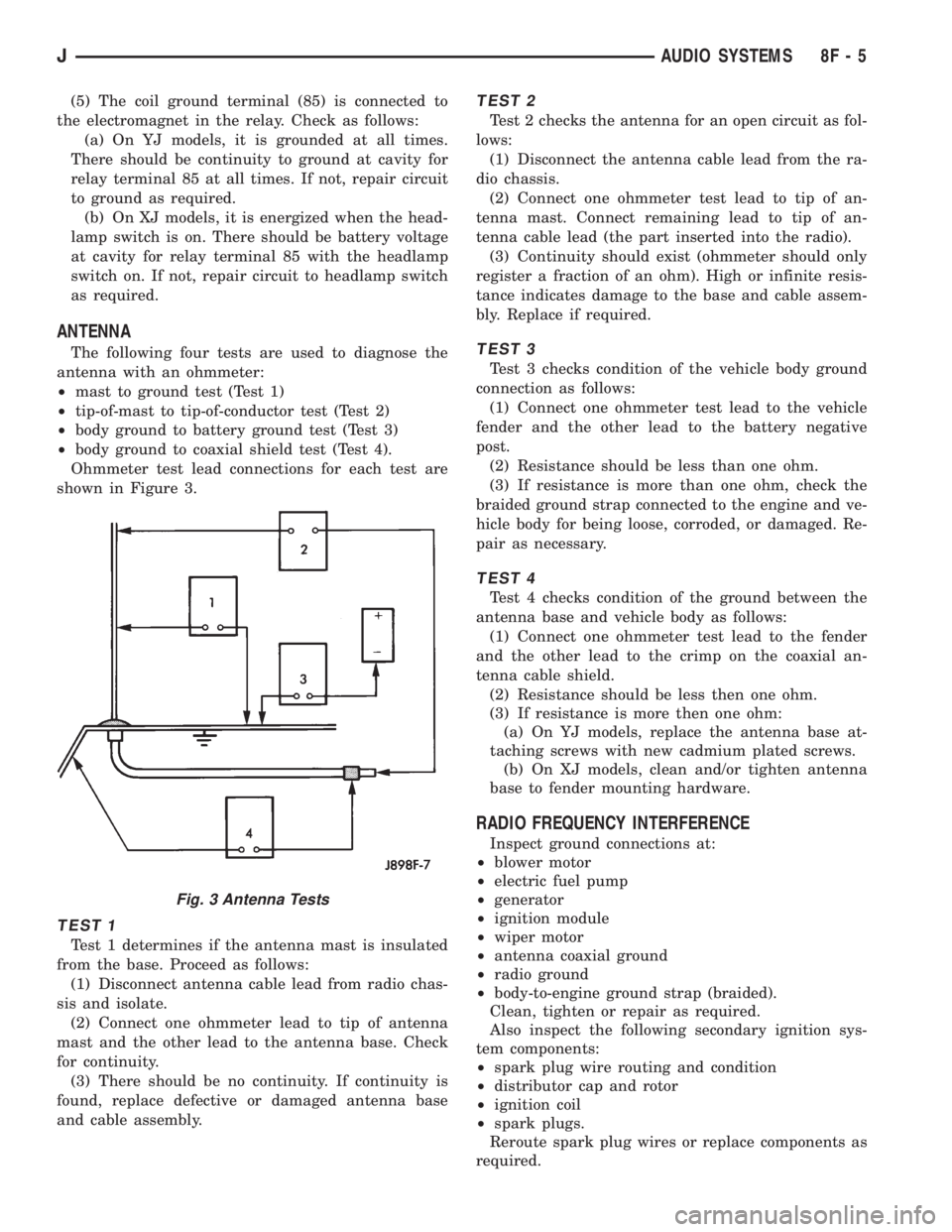
The following four tests are used to diagnose the
antenna with an ohmmeter:
²mast to ground test (Test 1)
²tip-of-mast to tip-of-conductor test (Test 2)
²body ground to battery ground test (Test 3)
²body ground to coaxial shield test (Test 4).
Ohmmeter test lead connections for each test are
shown in Figure 3.
TEST 1
Test 1 determines if the antenna mast is insulated
from the base. Proceed as follows:
(1) Disconnect antenna cable lead from radio chas-
sis and isolate.
(2) Connect one ohmmeter lead to tip of antenna
mast and the other lead to the antenna base. Check
for continuity.
(3) There should be no continuity. If continuity is
found, replace defective or damaged antenna base
and cable assembly.
TEST 2
Test 2 checks the antenna for an open circuit as fol-
lows:
(1) Disconnect the antenna cable lead from the ra-
dio chassis.
(2) Connect one ohmmeter test lead to tip of an-
tenna mast. Connect remaining lead to tip of an-
tenna cable lead (the part inserted into the radio).
(3) Continuity should exist (ohmmeter should only
register a fraction of an ohm). High or infinite resis-
tance indicates damage to the base and cable assem-
bly. Replace if required.
TEST 3
Test 3 checks condition of the vehicle body ground
connection as follows:
(1) Connect one ohmmeter test lead to the vehicle
fender and the other lead to the battery negative
post.
(2) Resistance should be less than one ohm.
(3) If resistance is more than one ohm, check the
braided ground strap connected to the engine and ve-
hicle body for being loose, corroded, or damaged. Re-
pair as necessary.
TEST 4
Test 4 checks condition of the ground between the
antenna base and vehicle body as follows:
(1) Connect one ohmmeter test lead to the fender
and the other lead to the crimp on the coaxial an-
tenna cable shield.
(2) Resistance should be less then one ohm.
(3) If resistance is more then one ohm:
(a) On YJ models, replace the antenna base at-
taching screws with new cadmium plated screws.
(b) On XJ models, clean and/or tighten antenna
base to fender mounting hardware.
RADIO FREQUENCY INTERFERENCE
Inspect ground connections at:
²blower motor
²electric fuel pump
²generator
²ignition module
²wiper motor
²antenna coaxial ground
²radio ground
²body-to-engine ground strap (braided).
Clean, tighten or repair as required.
Also inspect the following secondary ignition sys-
tem components:
²spark plug wire routing and condition
²distributor cap and rotor
²ignition coil
²spark plugs.
Reroute spark plug wires or replace components as
required.
Fig. 3 Antenna Tests
JAUDIO SYSTEMS 8F - 5
Page 410 of 2198
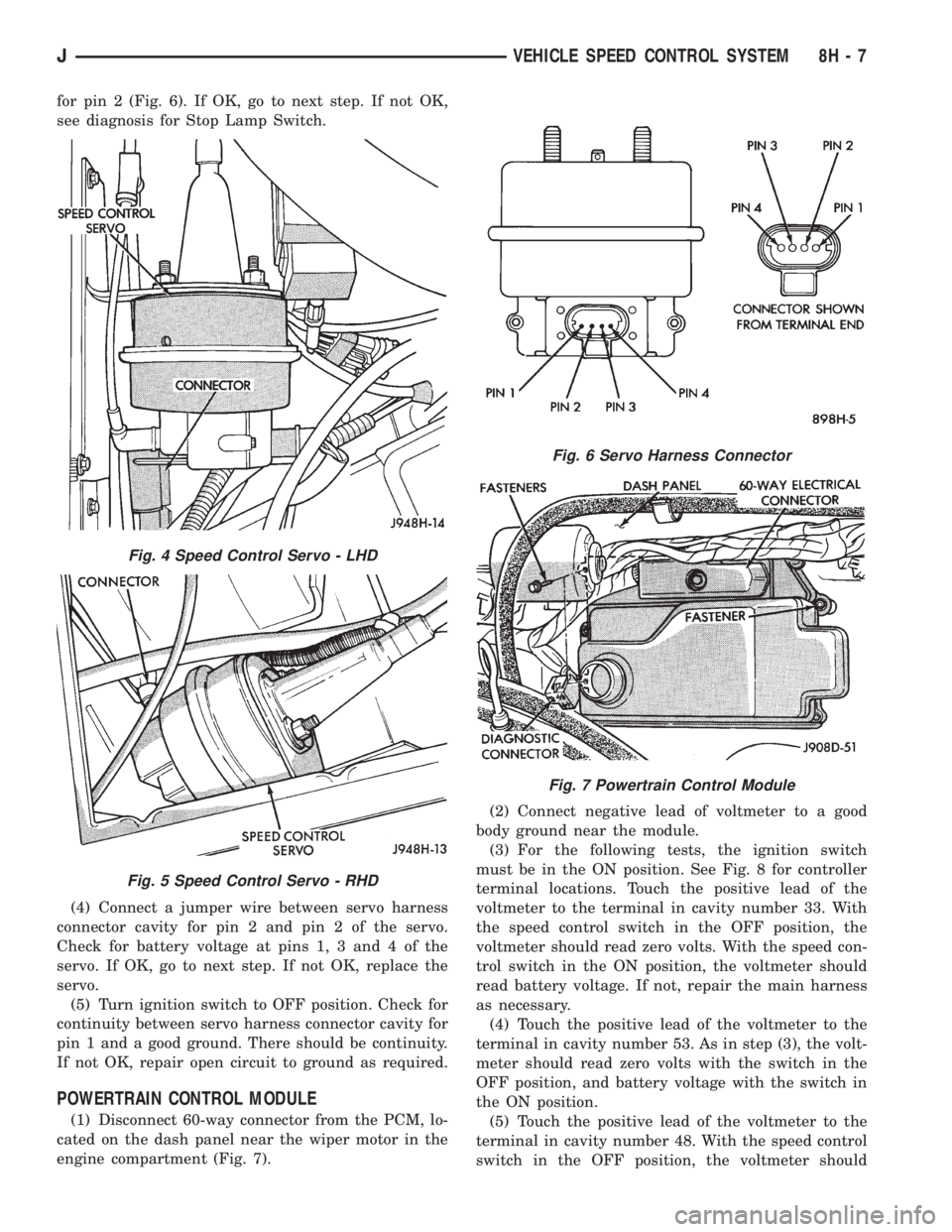
for pin 2 (Fig. 6). If OK, go to next step. If not OK,
see diagnosis for Stop Lamp Switch.
(4) Connect a jumper wire between servo harness
connector cavity for pin 2 and pin 2 of the servo.
Check for battery voltage at pins 1, 3 and 4 of the
servo. If OK, go to next step. If not OK, replace the
servo.
(5) Turn ignition switch to OFF position. Check for
continuity between servo harness connector cavity for
pin 1 and a good ground. There should be continuity.
If not OK, repair open circuit to ground as required.
POWERTRAIN CONTROL MODULE
(1) Disconnect 60-way connector from the PCM, lo-
cated on the dash panel near the wiper motor in the
engine compartment (Fig. 7).(2) Connect negative lead of voltmeter to a good
body ground near the module.
(3) For the following tests, the ignition switch
must be in the ON position. See Fig. 8 for controller
terminal locations. Touch the positive lead of the
voltmeter to the terminal in cavity number 33. With
the speed control switch in the OFF position, the
voltmeter should read zero volts. With the speed con-
trol switch in the ON position, the voltmeter should
read battery voltage. If not, repair the main harness
as necessary.
(4) Touch the positive lead of the voltmeter to the
terminal in cavity number 53. As in step (3), the volt-
meter should read zero volts with the switch in the
OFF position, and battery voltage with the switch in
the ON position.
(5) Touch the positive lead of the voltmeter to the
terminal in cavity number 48. With the speed control
switch in the OFF position, the voltmeter should
Fig. 4 Speed Control Servo - LHD
Fig. 5 Speed Control Servo - RHD
Fig. 6 Servo Harness Connector
Fig. 7 Powertrain Control Module
JVEHICLE SPEED CONTROL SYSTEM 8H - 7
Page 422 of 2198
WIPER AND WASHER SYSTEMS
CONTENTS
page page
DIAGNOSIS - XJ......................... 3
DIAGNOSIS - YJ........................ 12
GENERAL INFORMATION - XJ.............. 1GENERAL INFORMATION - YJ............. 10
SERVICE PROCEDURES - XJ............... 6
SERVICE PROCEDURES - YJ.............. 17
GENERAL INFORMATION - XJ
Following are general descriptions of the major
components in the XJ (Cherokee) wiper and washer
systems. Refer to Group 8W - Wiring Diagrams for
complete circuit descriptions and diagrams.
WINDSHIELD WIPER SYSTEM
A two-speed wiper system is standard equipment
on all left-hand drive XJ models. An optional inter-
mittent wipe system is available. The intermittent
wipe system is standard equipment on all right-hand
drive XJ models. The two-speed wiper system allows
the driver to select from two wiper speeds. The inter-
mittent wipe system allows the driver to select from
two wiper speeds or an intermittent wipe feature
that allows a delay between wipes of 2 to 15 seconds.
Refer to the owner's manual for more information on
wiper system controls and operation.
The wipers will operate only when the ignition
switch is in the ACCESSORY or ON position. A cir-
cuit breaker near the fuseblock module protects the
circuitry of the wiper system on left-hand drive mod-
els. The circuit breaker is in the fuseblock module on
right-hand drive models.
WINDSHIELD WASHER SYSTEM
A electrically-operated windshield washer system is
standard equipment on all XJ models. The washers will
operate only when the ignition switch is in the ACCES-
SORY or ON position. A circuit breaker near the fuse-
block module protects the circuitry of the washer
system. Refer to the owner's manual for more informa-
tion on washer system controls and operation.
LIFTGATE WIPER/WASHER SYSTEM
A liftgate wiper/washer system is an available op-
tion on XJ models. The liftgate wiper is a fixed cycle
intermittent wipe system. A single switch on the in-
strument panel controls both the liftgate wiper and
washer functions. These systems will operate only
when the ignition switch is in the ON position. Fuse
1 in the fuseblock module protects the circuitry ofboth the liftgate wiper and washer. Refer to the own-
er's manual for more information on liftgate wiper/
washer system controls and operation.
WIPER ARMS, BLADES, AND ELEMENTS
All XJ models have two 18-inch windshield wiper
blades with replaceable rubber elements (squeegees).
Models with the liftgate wiper option use a single 12-
inch wiper blade with a replaceable rubber element
(squeegee).
Caution should be exercised to protect the rubber
squeegees from any petroleum-based cleaners or con-
taminants, which will rapidly deteriorate the squee-
gee rubber. If squeegees are damaged, worn or
contaminated they must be replaced.
Wiper squeegees exposed to the weather for a long
time tend to lose their wiping effectiveness. Periodic
cleaning of the squeegees is suggested to remove de-
posits of salt and road film. The wiper blades, arms
and windshield or liftgate glass should be cleaned
with a sponge or cloth and a mild detergent or non-
abrasive cleaner. If the squeegees continue to streak
or smear, they should be replaced.
The blades are mounted to spring-loaded wiper
arms. Spring tension of the wiper arms controls the
pressure applied to the blades on the glass. The
windshield wiper arms are attached by an integral
latch to the two wiper pivots on the cowl grille panel
at the base of the windshield. The liftgate wiper arm
is attached by an integral latch directly to the lift-
gate wiper motor output shaft on the liftgate panel.
The wiper arms and blades can not be adjusted or re-
paired. If faulty, they must be replaced.
WIPER LINKAGE AND PIVOTS
The wiper pivots are fastened to the cowl top panel
with screws beneath the cowl cover/grille panel. Each
pivot assembly can be replaced by removing the cowl
grille panel, unsnapping the linkage bushing(s) from
the pivot crank arm pins, and removing the mount-
ing screws.
JWIPER AND WASHER SYSTEMS 8K - 1
Page 423 of 2198
The two pivot cranks are joined by a connecting link,
and a drive link connects the motor crank to the drive
link near the left pivot. Pressed-in plastic bushings in
the ends of the links can be replaced if worn or dam-
aged.
WINDSHIELD WIPER MOTOR
The two-speed permanent magnet wiper motor has
an integral transmission and park switch. The motor
is mounted to the engine side of the cowl panel with
a reinforcement/stud plate and a rubber-isolated
mounting bracket. The wiper motor output shaft
passes through the cowl panel into the cowl plenum
area, where a crank arm attached to the output shaft
drives the wiper drive link.
Wiper speed is controlled by current flow to the ap-
propriate set of brushes. The wiper motor completes
its wipe cycle when the switch is turned OFF, and
parks the blades in the lowest portion of the wipe
pattern. The wiper motor assembly can not be re-
paired. If faulty, the entire motor assembly must be
replaced. The crank arm, mounting bracket, and re-
inforcement/stud plate are available for service.
LIFTGATE WIPER MOTOR
The liftgate wiper motor contains integral elec-
tronic controls and a transmission to provide three
operating modes:
²intermittent wipe with a fixed 5 to 8 second delay
between wipes
²constant wipe that operates when the liftgate
washer is operated
²a park mode that runs the motor until the wiper
blade reaches the park position after the liftgate
wiper switch or ignition switch is turned OFF.
The liftgate wiper motor can not be repaired. If
faulty, the entire assembly must be replaced.
WINDSHIELD WIPER/WASHER SWITCH
Controls for the windshield wiper and washer sys-
tems are contained in the multi-function switch con-
trol lever. The multi-function switch is mounted on
the left side of the steering column between the
steering wheel and the instrument panel. This switch
also controls many other functions. The multi-func-
tion switch can not be repaired. If any function of the
switch is faulty, the entire switch must be replaced.
LIFTGATE WIPER/WASHER SWITCH
The single two-function switch on the instrument
panel right of the steering column controls the lift-
gate wiper and washer functions. The rocker-type
switch features a detent in the WIPE position, but
only momentary contact in the WASH position. Both
the liftgate wiper and liftgate washer motors will op-
erate continuously for as long as the switch is held in
the WASH position. The switch can not be repaired;
if faulty, it must be replaced.
INTERMITTENT WIPE MODULE
In addition to low and high speed, the optional inter-
mittent wipe system has a delay mode. The delay mode
has a range of 2 to 15 seconds. The length of the delay
is selected with a variable resistor in the wiper (multi-
function) switch and is accomplished by electronic cir-
cuitry within the intermittent wipe module. If the
washer knob is depressed while the wiper (multi-func-
tion) switch is in the OFF position, the intermittent
wipe module will operate the wiper motor for approxi-
mately 2 wipes and automatically turn the motor off.
The intermittent wipe module is mounted to the
lower instrument panel, behind the knee blocker and
near the steering column with a hook and loop fas-
tener patch. The module can not be repaired.
WINDSHIELD WASHER NOZZLES
The two fluidic washer nozzles are riveted into
openings in the cowl grille panel below the wind-
shield and are not adjustable. Washer fluid is fed to
the nozzles through hoses clipped to the underside of
the cowl grille panel. The nozzles can not be repaired
and, if faulty, should be replaced.
LIFTGATE WASHER NOZZLE
The single liftgate washer nozzle snaps into place
on the liftgate wiper arm. Washer fluid is fed to the
nozzle from the washer reservoir in the engine com-
partment. A liftgate washer hose system is routed
through the body of the vehicle with the body wiring
harness from the reservoir to the liftgate. The fluid
passes through a nipple on the liftgate wiper motor
output shaft bezel to a hose clipped to the underside
of the wiper arm. The nozzle can not be repaired and,
if faulty, should be replaced.
WASHER RESERVOIR
The washer solvent reservoir is mounted to the left
front inner fender shield near the cowl panel. The
same reservoir is used for both the standard front
and optional liftgate washer systems. It also has a
provision for a low washer fluid level sensor. Refer to
Group 8E - Instrument Panel and Gauges for diagno-
sis and service of the sensor. The reservoir and filler
cap are available for service.
WASHER PUMPS
The washer pump and motor are press-fit into a
rubber grommet near the bottom of the washer res-
ervoir. Vehicles with the optional liftgate wiper/
washer system have two pumps installed in the
single reservoir. A permanently lubricated and sealed
motor is coupled to a rotor-type pump. Washer fluid
is gravity fed from the reservoir to the pump. The
pump then pressurizes the fluid and forces it through
the plumbing to the nozzles when the motor is ener-
gized. The pump and motor can not be repaired. If
faulty, the entire assembly must be replaced.
8K - 2 WIPER AND WASHER SYSTEMS - XJJ
Page 424 of 2198
DIAGNOSIS - XJ
WINDSHIELD WIPER SYSTEM
(1) Remove in-line circuit breaker near fuseblock
module and turn ignition switch to ACCESSORY or
ON.
(a) Measure voltage at battery side of circuit
breaker cavity. Meter should read battery voltage.
If not OK, repair wiring from ignition switch.
(b) Measure resistance across circuit breaker ter-
minals. Meter should read zero ohms. If not OK,
replace failed circuit breaker.
(2) Unplug wiper motor side of wiring harness con-
nector (gray) from wiper (multi-function) switch side
of wiring harness connector (black), or from intermit-
tent wipe module (if equipped) at base of steering col-
umn. Turn ignition switch to ACCESSORY or ON.
(a) Measure voltage at unplugged wiper motor
side of wiring harness connector (gray) terminal D.
Meter should read battery voltage. If not OK, re-
pair wiring from circuit breaker.
(b) Turn ignition switch to OFF and measure re-
sistance from unplugged wiper motor side of wiring
harness connector (gray) terminal G to ground.
Meter should read zero ohms. If not OK, repair
wiring to ground.
(3) Leave ignition switch in OFF, and back probe
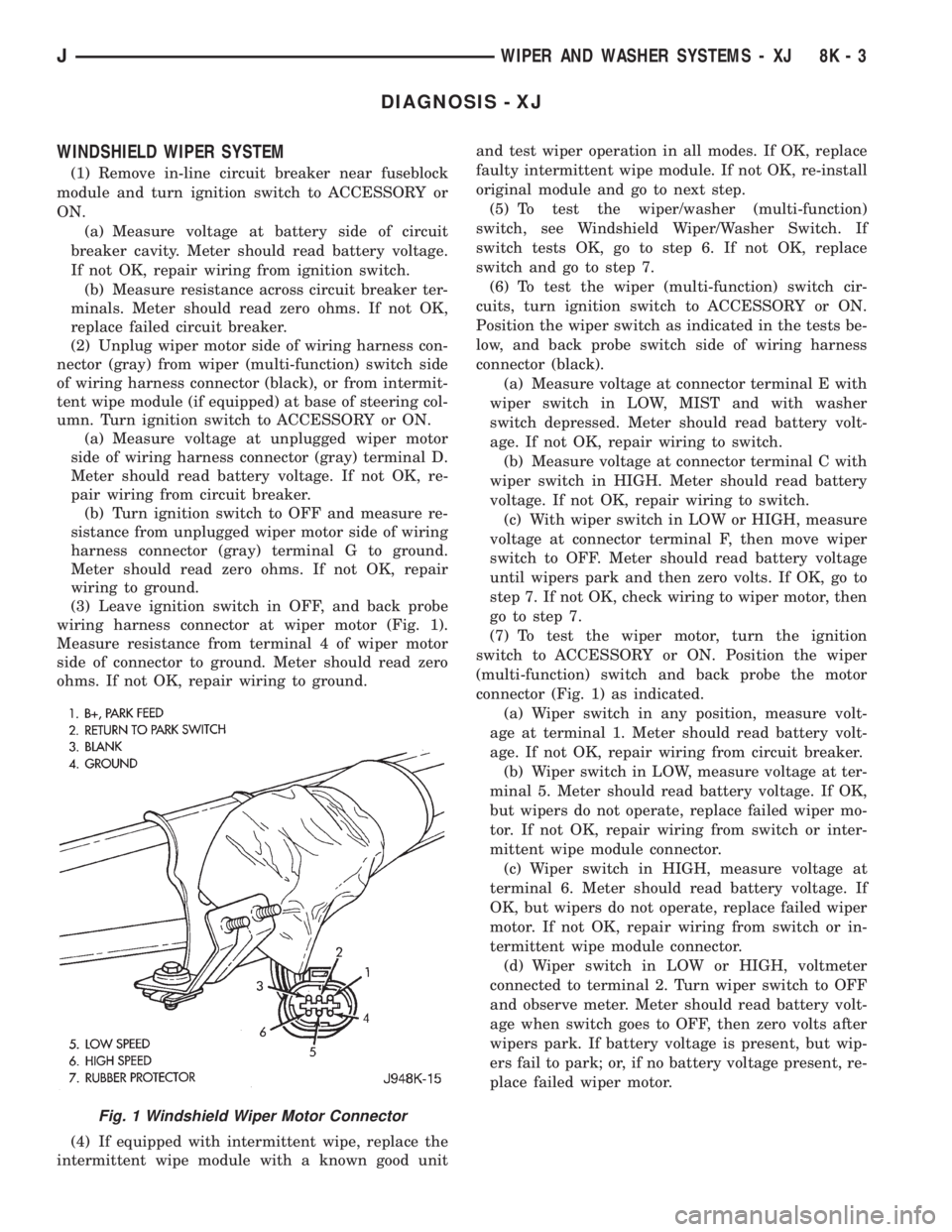
wiring harness connector at wiper motor (Fig. 1).
Measure resistance from terminal 4 of wiper motor
side of connector to ground. Meter should read zero
ohms. If not OK, repair wiring to ground.
(4) If equipped with intermittent wipe, replace the
intermittent wipe module with a known good unitand test wiper operation in all modes. If OK, replace
faulty intermittent wipe module. If not OK, re-install
original module and go to next step.
(5) To test the wiper/washer (multi-function)
switch, see Windshield Wiper/Washer Switch. If
switch tests OK, go to step 6. If not OK, replace
switch and go to step 7.
(6) To test the wiper (multi-function) switch cir-
cuits, turn ignition switch to ACCESSORY or ON.
Position the wiper switch as indicated in the tests be-
low, and back probe switch side of wiring harness
connector (black).
(a) Measure voltage at connector terminal E with
wiper switch in LOW, MIST and with washer
switch depressed. Meter should read battery volt-
age. If not OK, repair wiring to switch.
(b) Measure voltage at connector terminal C with
wiper switch in HIGH. Meter should read battery
voltage. If not OK, repair wiring to switch.
(c) With wiper switch in LOW or HIGH, measure
voltage at connector terminal F, then move wiper
switch to OFF. Meter should read battery voltage
until wipers park and then zero volts. If OK, go to
step 7. If not OK, check wiring to wiper motor, then
go to step 7.
(7) To test the wiper motor, turn the ignition
switch to ACCESSORY or ON. Position the wiper
(multi-function) switch and back probe the motor
connector (Fig. 1) as indicated.
(a) Wiper switch in any position, measure volt-
age at terminal 1. Meter should read battery volt-
age. If not OK, repair wiring from circuit breaker.
(b) Wiper switch in LOW, measure voltage at ter-
minal 5. Meter should read battery voltage. If OK,
but wipers do not operate, replace failed wiper mo-
tor. If not OK, repair wiring from switch or inter-
mittent wipe module connector.
(c) Wiper switch in HIGH, measure voltage at
terminal 6. Meter should read battery voltage. If
OK, but wipers do not operate, replace failed wiper
motor. If not OK, repair wiring from switch or in-
termittent wipe module connector.
(d) Wiper switch in LOW or HIGH, voltmeter
connected to terminal 2. Turn wiper switch to OFF
and observe meter. Meter should read battery volt-
age when switch goes to OFF, then zero volts after
wipers park. If battery voltage is present, but wip-
ers fail to park; or, if no battery voltage present, re-
place failed wiper motor.
Fig. 1 Windshield Wiper Motor Connector
JWIPER AND WASHER SYSTEMS - XJ 8K - 3
Page 425 of 2198
WINDSHIELD WASHER SYSTEM
WITH NON-INTERMITTENT WIPE
(1) Unplug washer pump connector. Measure resis-
tance between terminal B at pump and a clean chas-
sis ground. Meter should read zero ohms. If not OK,
repair open to ground.
(2) Turn ignition switch to ACCESSORY and
washer (multi-function) switch to ON.
(a) Measure voltage at washer pump connector
terminal A. Meter should read battery voltage. If
OK, replace washer pump. If not OK, go to next
step.
(b) Measure voltage at wiper/washer switch con-
nector terminal B. Meter should read battery volt-
age. If OK, repair open to washer pump. If not OK,
replace switch.
WITH INTERMITTENT WIPE
(1) Unplug washer pump connector. Measure resis-
tance between terminal B at pump and a clean chas-
sis ground. Meter should read zero ohms. If not OK,
repair open to ground.
(2) Turn ignition switch to ACCESSORY and
washer (multi-function) switch to ON.
(a) Measure voltage at intermittent wipe module
switch connector terminal B (pink wire). Meter
should read battery voltage. If not OK, replace
wiper switch.
(b) Measure voltage at wipe module motor con-
nector terminal B (brown wire). Meter should read
battery voltage. If not OK, replace module.
(c) Measure voltage at washer pump connector
terminal A at pump. Meter should read battery
voltage. If OK, replace pump. If not OK, repair
open from wipe module.
WINDSHIELD WIPER/WASHER SWITCH
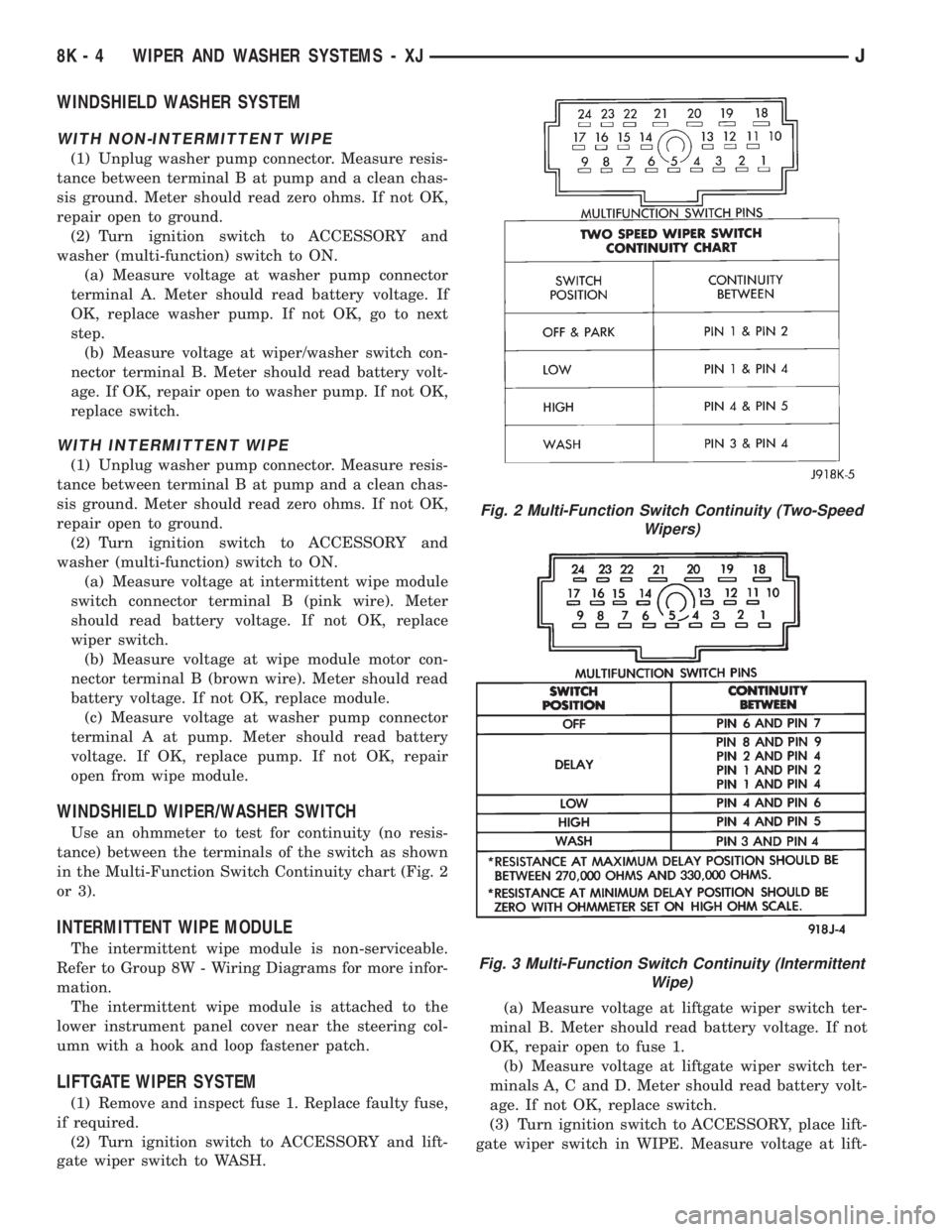
Use an ohmmeter to test for continuity (no resis-
tance) between the terminals of the switch as shown
in the Multi-Function Switch Continuity chart (Fig. 2
or 3).
INTERMITTENT WIPE MODULE
The intermittent wipe module is non-serviceable.
Refer to Group 8W - Wiring Diagrams for more infor-
mation.
The intermittent wipe module is attached to the
lower instrument panel cover near the steering col-
umn with a hook and loop fastener patch.
LIFTGATE WIPER SYSTEM
(1) Remove and inspect fuse 1. Replace faulty fuse,
if required.
(2) Turn ignition switch to ACCESSORY and lift-
gate wiper switch to WASH.(a) Measure voltage at liftgate wiper switch ter-
minal B. Meter should read battery voltage. If not
OK, repair open to fuse 1.
(b) Measure voltage at liftgate wiper switch ter-
minals A, C and D. Meter should read battery volt-
age. If not OK, replace switch.
(3) Turn ignition switch to ACCESSORY, place lift-
gate wiper switch in WIPE. Measure voltage at lift-
Fig. 2 Multi-Function Switch Continuity (Two-Speed
Wipers)
Fig. 3 Multi-Function Switch Continuity (Intermittent
Wipe)
8K - 4 WIPER AND WASHER SYSTEMS - XJJ
Page 426 of 2198
gate wiper switch terminal C. Meter should read
battery voltage. If not OK, replace switch.
(4) Remove liftgate cover and measure resistance
from liftgate wiper motor terminal 1 to a good
ground. Meter should read zero ohms. If not OK, re-
pair open to ground splice.
(5) Turn ignition switch to ACCESSORY and lift-
gate wiper switch to WASH. Measure voltage at mo-
tor connector terminals 2, 3 and 4. Meter should read
battery voltage. If OK, replace wiper motor. If not
OK, repair open(s) to liftgate wiper switch.
LIFTGATE WASHER SYSTEM
(1) Turn ignition switch to ACCESSORY and place
liftgate wiper/washer switch in WASH. Operate lift-
gate wiper motor. If motor does not operate check
fuse 1. Replace faulty fuse, if required.
(2) Turn ignition switch to ACCESSORY and un-
plug liftgate washer pump connector.
(a) Measure resistance at pump connector termi-
nal B (ignition switch OFF). Meter should read
zero ohms. If not OK, repair open to ground.
(b) Measure voltage at pump connector terminal
A, switch in WASH. Meter should read battery
voltage. If OK, replace pump. If not OK, go to step
3.
(3) Remove switch and reconnect below instrument
panel. Backprobe switch connector with ignition
switch in ACCESSORY.
(a) Measure voltage at switch connector terminal
B. Meter should read battery voltage. If not OK, re-
pair open to fuse.
(b) Measure voltage at switch connector terminal
A, switch in WASH. Meter should read battery
voltage. If not OK, replace switch.
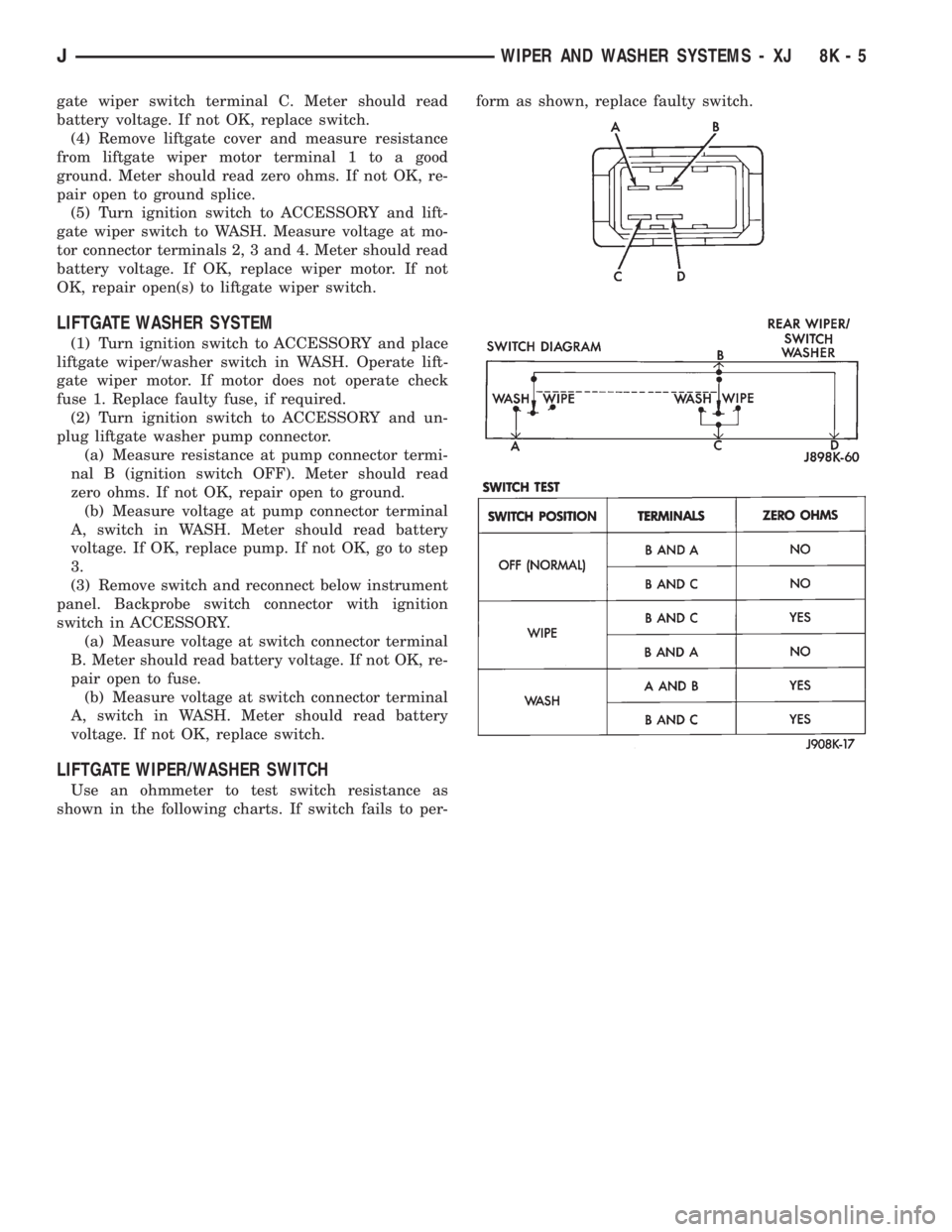
LIFTGATE WIPER/WASHER SWITCH
Use an ohmmeter to test switch resistance as
shown in the following charts. If switch fails to per-form as shown, replace faulty switch.
JWIPER AND WASHER SYSTEMS - XJ 8K - 5
Page 427 of 2198
SERVICE PROCEDURES - XJ
WINDSHIELD WIPER MOTOR REMOVE/INSTALL
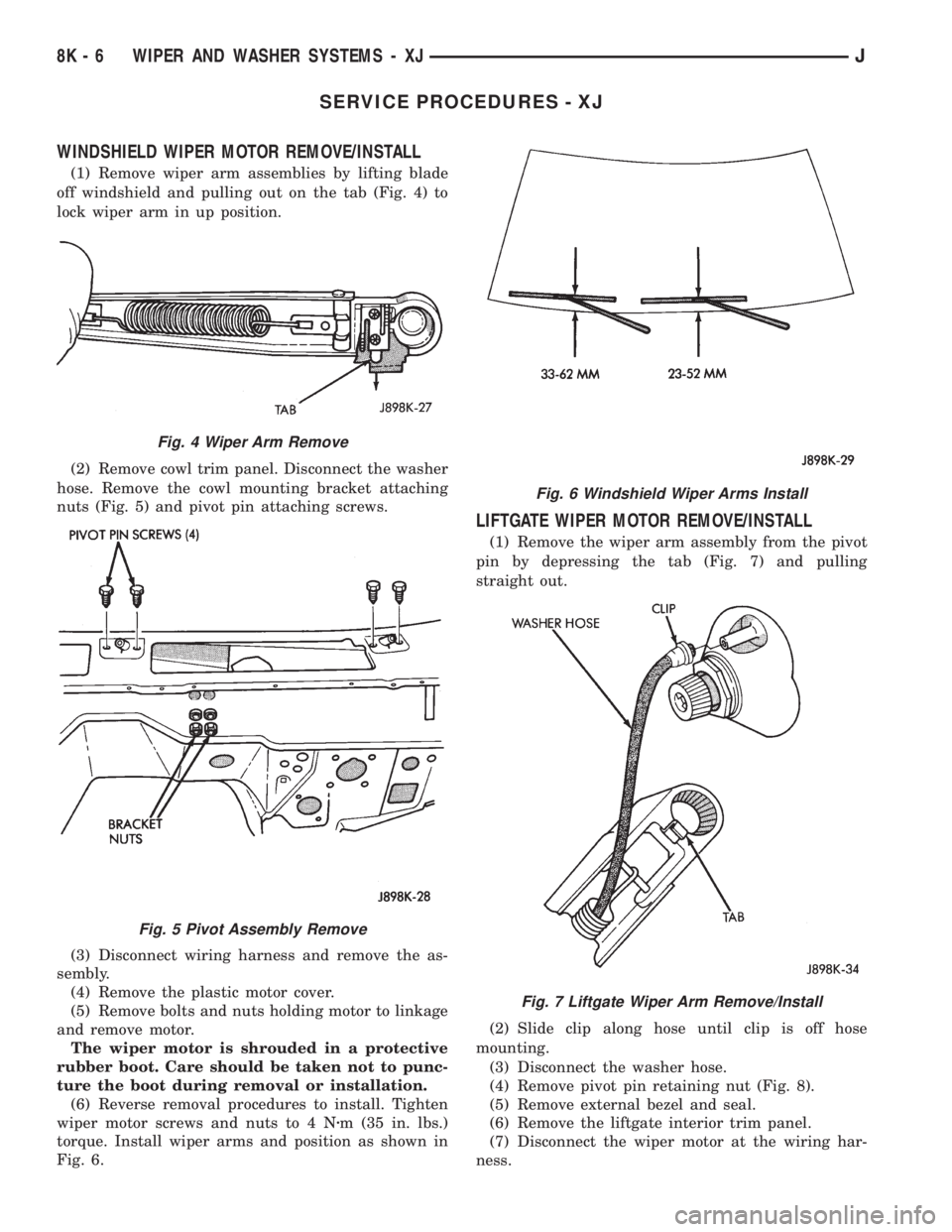
(1) Remove wiper arm assemblies by lifting blade
off windshield and pulling out on the tab (Fig. 4) to
lock wiper arm in up position.
(2) Remove cowl trim panel. Disconnect the washer
hose. Remove the cowl mounting bracket attaching
nuts (Fig. 5) and pivot pin attaching screws.
(3) Disconnect wiring harness and remove the as-
sembly.
(4) Remove the plastic motor cover.
(5) Remove bolts and nuts holding motor to linkage
and remove motor.
The wiper motor is shrouded in a protective
rubber boot. Care should be taken not to punc-
ture the boot during removal or installation.
(6) Reverse removal procedures to install. Tighten
wiper motor screws and nuts to 4 Nzm (35 in. lbs.)
torque. Install wiper arms and position as shown in
Fig. 6.
LIFTGATE WIPER MOTOR REMOVE/INSTALL
(1) Remove the wiper arm assembly from the pivot
pin by depressing the tab (Fig. 7) and pulling
straight out.
(2) Slide clip along hose until clip is off hose
mounting.
(3) Disconnect the washer hose.
(4) Remove pivot pin retaining nut (Fig. 8).
(5) Remove external bezel and seal.
(6) Remove the liftgate interior trim panel.
(7) Disconnect the wiper motor at the wiring har-
ness.
Fig. 4 Wiper Arm Remove
Fig. 5 Pivot Assembly Remove
Fig. 6 Windshield Wiper Arms Install
Fig. 7 Liftgate Wiper Arm Remove/Install
8K - 6 WIPER AND WASHER SYSTEMS - XJJ