1995 JEEP CHEROKEE hinge
[x] Cancel search: hingePage 1774 of 2198
DOOR ALIGNMENT ADJUSTMENTÐMAJOR
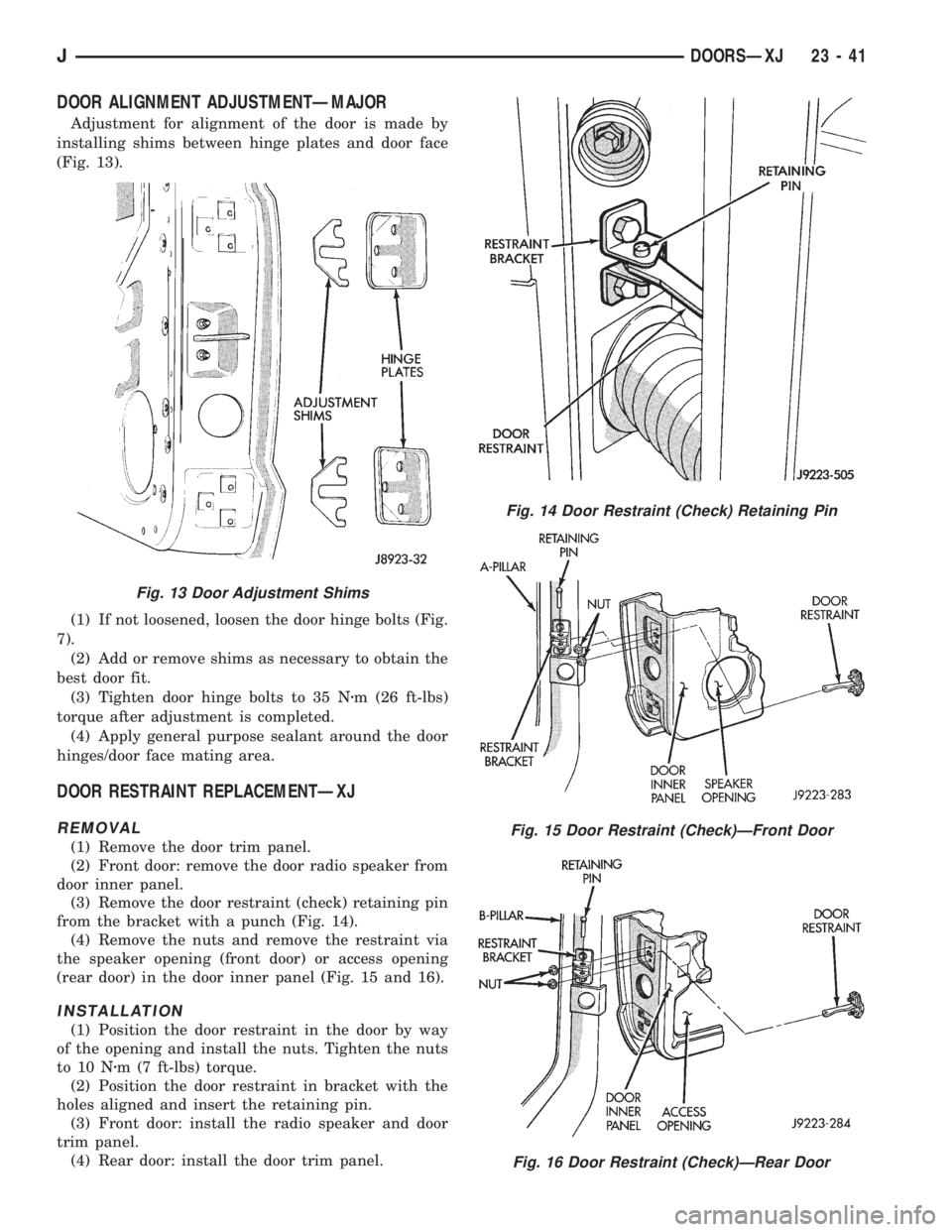
Adjustment for alignment of the door is made by
installing shims between hinge plates and door face
(Fig. 13).
(1) If not loosened, loosen the door hinge bolts (Fig.
7).
(2) Add or remove shims as necessary to obtain the
best door fit.
(3) Tighten door hinge bolts to 35 Nzm (26 ft-lbs)
torque after adjustment is completed.
(4) Apply general purpose sealant around the door
hinges/door face mating area.
DOOR RESTRAINT REPLACEMENTÐXJ
REMOVAL
(1) Remove the door trim panel.
(2) Front door: remove the door radio speaker from
door inner panel.
(3) Remove the door restraint (check) retaining pin
from the bracket with a punch (Fig. 14).
(4) Remove the nuts and remove the restraint via
the speaker opening (front door) or access opening
(rear door) in the door inner panel (Fig. 15 and 16).
INSTALLATION
(1) Position the door restraint in the door by way
of the opening and install the nuts. Tighten the nuts
to 10 Nzm (7 ft-lbs) torque.
(2) Position the door restraint in bracket with the
holes aligned and insert the retaining pin.
(3) Front door: install the radio speaker and door
trim panel.
(4) Rear door: install the door trim panel.
Fig. 14 Door Restraint (Check) Retaining Pin
Fig. 15 Door Restraint (Check)ÐFront Door
Fig. 16 Door Restraint (Check)ÐRear Door
Fig. 13 Door Adjustment Shims
JDOORSÐXJ 23 - 41
Page 1785 of 2198
DOOR HINGE/HINGE PIN REPLACEMENTÐXJ
REMOVAL
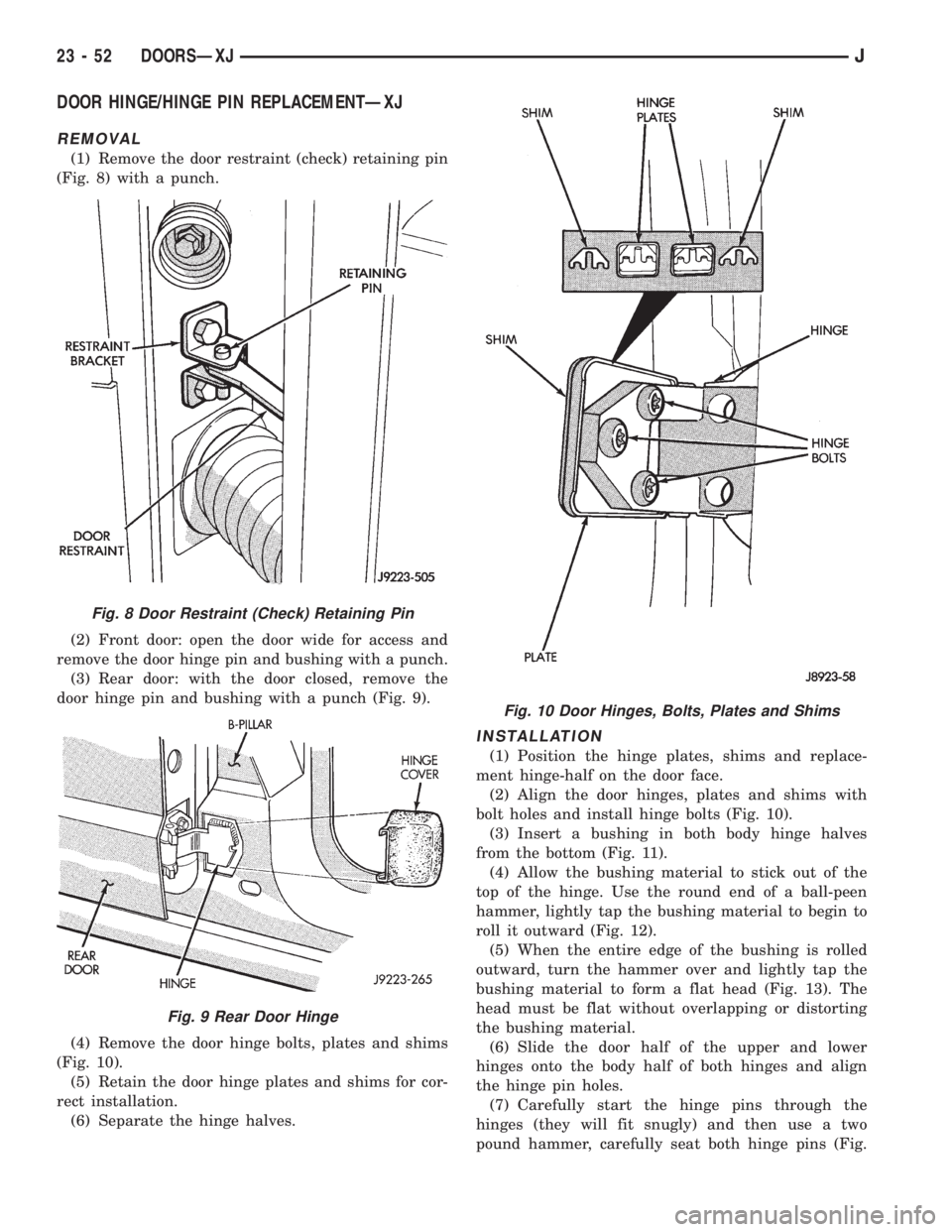
(1) Remove the door restraint (check) retaining pin
(Fig. 8) with a punch.
(2) Front door: open the door wide for access and
remove the door hinge pin and bushing with a punch.
(3) Rear door: with the door closed, remove the
door hinge pin and bushing with a punch (Fig. 9).
(4) Remove the door hinge bolts, plates and shims
(Fig. 10).
(5) Retain the door hinge plates and shims for cor-
rect installation.
(6) Separate the hinge halves.
INSTALLATION
(1) Position the hinge plates, shims and replace-
ment hinge-half on the door face.
(2) Align the door hinges, plates and shims with
bolt holes and install hinge bolts (Fig. 10).
(3) Insert a bushing in both body hinge halves
from the bottom (Fig. 11).
(4) Allow the bushing material to stick out of the
top of the hinge. Use the round end of a ball-peen
hammer, lightly tap the bushing material to begin to
roll it outward (Fig. 12).
(5) When the entire edge of the bushing is rolled
outward, turn the hammer over and lightly tap the
bushing material to form a flat head (Fig. 13). The
head must be flat without overlapping or distorting
the bushing material.
(6) Slide the door half of the upper and lower
hinges onto the body half of both hinges and align
the hinge pin holes.
(7) Carefully start the hinge pins through the
hinges (they will fit snugly) and then use a two
pound hammer, carefully seat both hinge pins (Fig.
Fig. 8 Door Restraint (Check) Retaining Pin
Fig. 9 Rear Door Hinge
Fig. 10 Door Hinges, Bolts, Plates and Shims
23 - 52 DOORSÐXJJ
Page 1786 of 2198
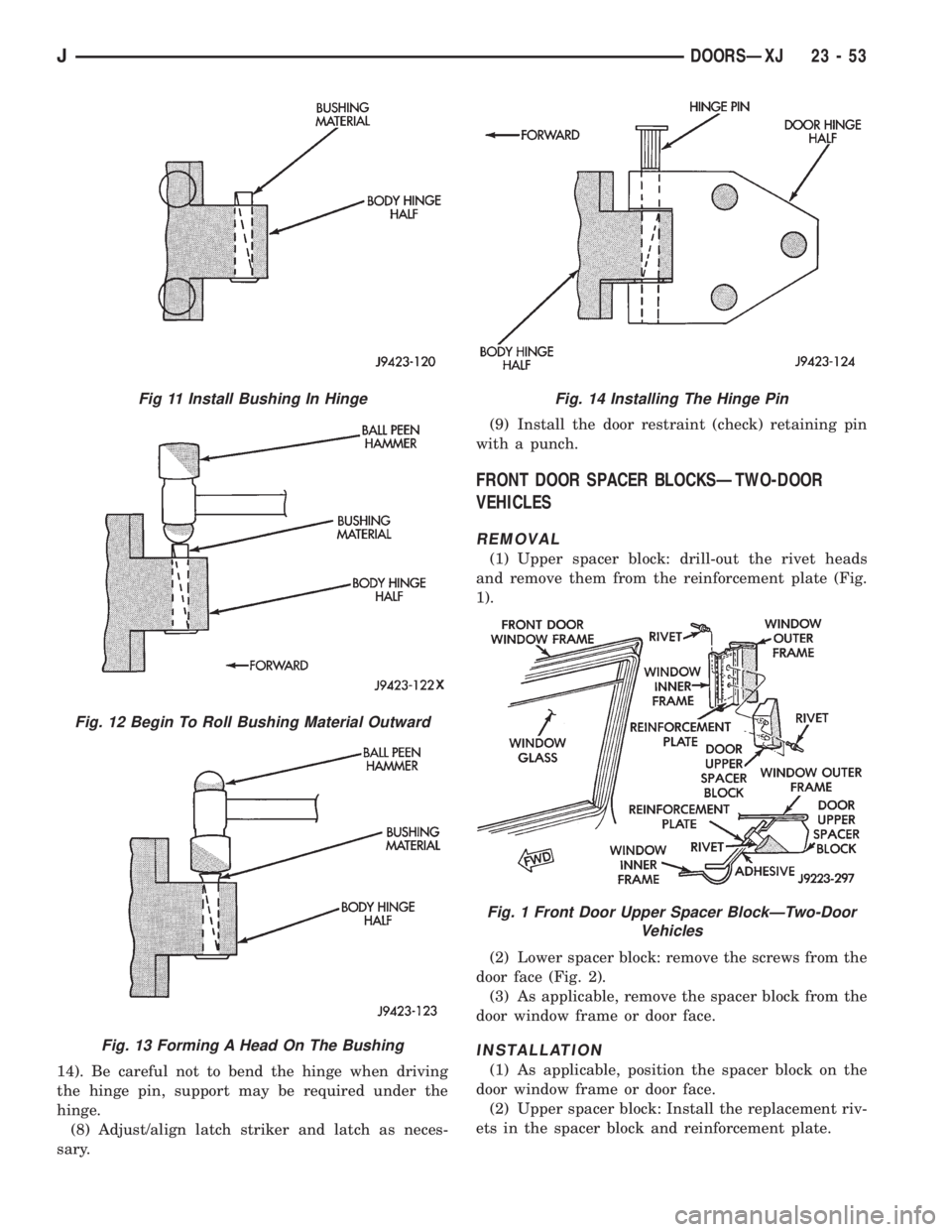
14). Be careful not to bend the hinge when driving
the hinge pin, support may be required under the
hinge.
(8) Adjust/align latch striker and latch as neces-
sary.(9) Install the door restraint (check) retaining pin
with a punch.
FRONT DOOR SPACER BLOCKSÐTWO-DOOR
VEHICLES
REMOVAL
(1) Upper spacer block: drill-out the rivet heads
and remove them from the reinforcement plate (Fig.
1).
(2) Lower spacer block: remove the screws from the
door face (Fig. 2).
(3) As applicable, remove the spacer block from the
door window frame or door face.
INSTALLATION
(1) As applicable, position the spacer block on the
door window frame or door face.
(2) Upper spacer block: Install the replacement riv-
ets in the spacer block and reinforcement plate.
Fig 11 Install Bushing In Hinge
Fig. 12 Begin To Roll Bushing Material Outward
Fig. 13 Forming A Head On The Bushing
Fig. 14 Installing The Hinge Pin
Fig. 1 Front Door Upper Spacer BlockÐTwo-Door
Vehicles
JDOORSÐXJ 23 - 53
Page 1792 of 2198
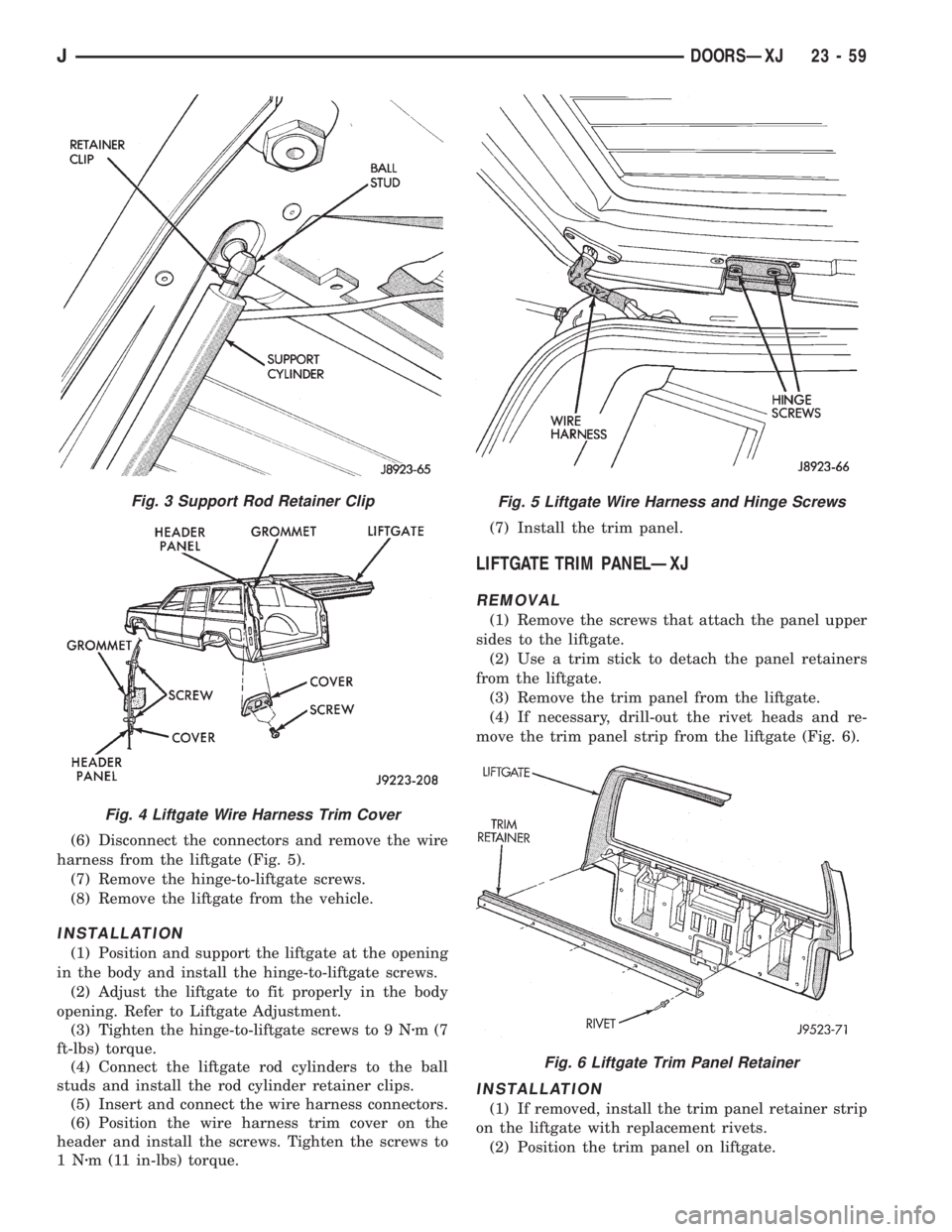
(6) Disconnect the connectors and remove the wire
harness from the liftgate (Fig. 5).
(7) Remove the hinge-to-liftgate screws.
(8) Remove the liftgate from the vehicle.
INSTALLATION
(1) Position and support the liftgate at the opening
in the body and install the hinge-to-liftgate screws.
(2) Adjust the liftgate to fit properly in the body
opening. Refer to Liftgate Adjustment.
(3) Tighten the hinge-to-liftgate screws to 9 Nzm(7
ft-lbs) torque.
(4) Connect the liftgate rod cylinders to the ball
studs and install the rod cylinder retainer clips.
(5) Insert and connect the wire harness connectors.
(6) Position the wire harness trim cover on the
header and install the screws. Tighten the screws to
1Nzm (11 in-lbs) torque.(7) Install the trim panel.
LIFTGATE TRIM PANELÐXJ
REMOVAL
(1) Remove the screws that attach the panel upper
sides to the liftgate.
(2) Use a trim stick to detach the panel retainers
from the liftgate.
(3) Remove the trim panel from the liftgate.
(4) If necessary, drill-out the rivet heads and re-
move the trim panel strip from the liftgate (Fig. 6).
INSTALLATION
(1) If removed, install the trim panel retainer strip
on the liftgate with replacement rivets.
(2) Position the trim panel on liftgate.
Fig. 3 Support Rod Retainer Clip
Fig. 4 Liftgate Wire Harness Trim Cover
Fig. 5 Liftgate Wire Harness and Hinge Screws
Fig. 6 Liftgate Trim Panel Retainer
JDOORSÐXJ 23 - 59
Page 1793 of 2198
(3) Align the trim panel retainers with the holes in
the liftgate inner panel and force the trim panel in-
ward.
(4) Install the screws to attach the panel upper
sides to the liftgate.
LIFTGATE HINGEÐXJ
REMOVAL
It is not necessary to remove the liftgate to replace
one or both hinges.
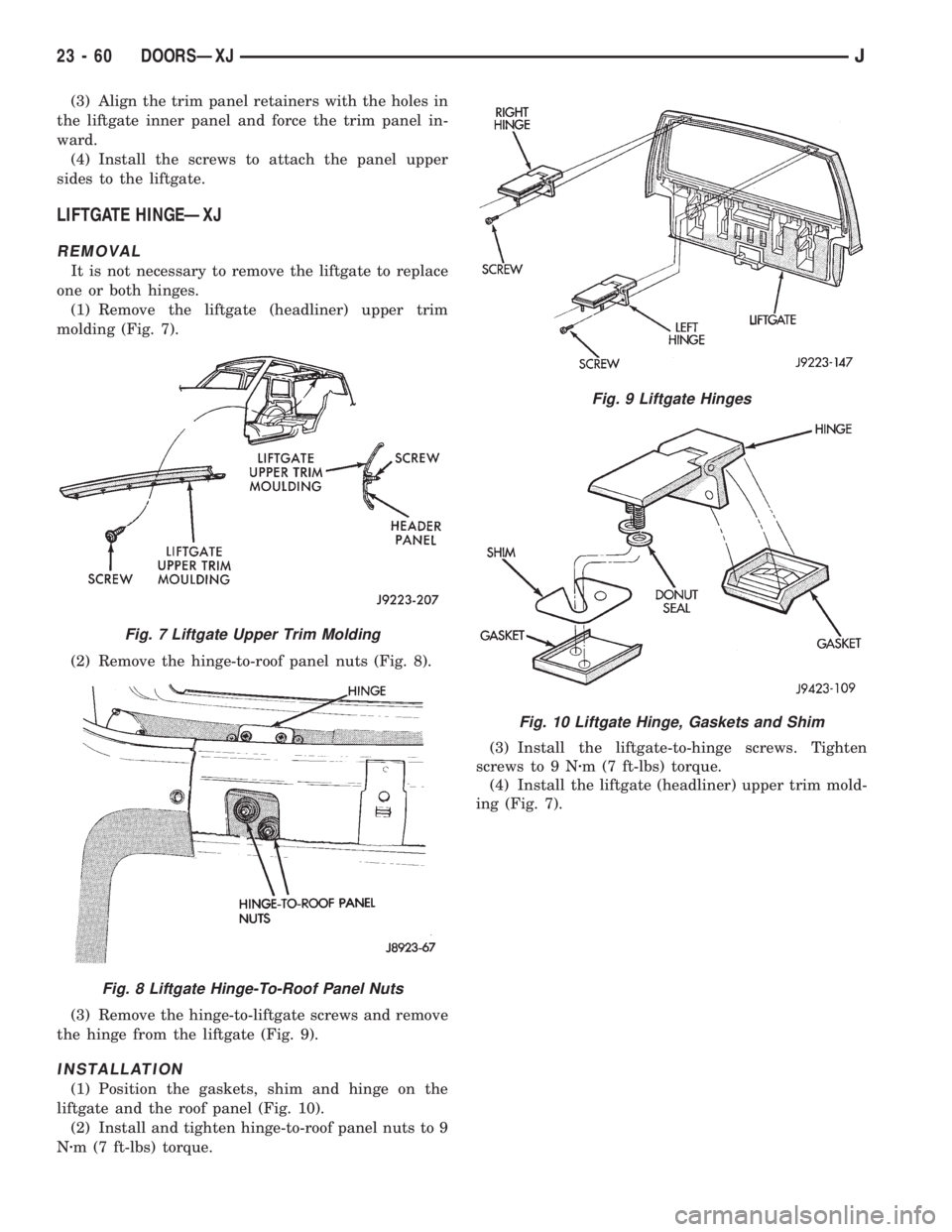
(1) Remove the liftgate (headliner) upper trim
molding (Fig. 7).
(2) Remove the hinge-to-roof panel nuts (Fig. 8).
(3) Remove the hinge-to-liftgate screws and remove
the hinge from the liftgate (Fig. 9).
INSTALLATION
(1) Position the gaskets, shim and hinge on the
liftgate and the roof panel (Fig. 10).
(2) Install and tighten hinge-to-roof panel nuts to 9
Nzm (7 ft-lbs) torque.(3) Install the liftgate-to-hinge screws. Tighten
screws to 9 Nzm (7 ft-lbs) torque.
(4) Install the liftgate (headliner) upper trim mold-
ing (Fig. 7).
Fig. 7 Liftgate Upper Trim Molding
Fig. 8 Liftgate Hinge-To-Roof Panel Nuts
Fig. 9 Liftgate Hinges
Fig. 10 Liftgate Hinge, Gaskets and Shim
23 - 60 DOORSÐXJJ
Page 1796 of 2198
LIFTGATE SUPPORT ROD CYLINDER DISPOSALÐ
XJ
WARNING: SAFETY GOGGLES MUST BE WORN
DURING THE DISPOSAL PROCEDURE. THE HIGH
PRESSURE GAS CHARGE IN THE SUPPORT ROD
CYLINDERS WILL BE RELEASED DURING THE
PROCEDURE.
(1) Remove the support rod cylinder(s) from the
liftgate.
(2) Position the support rod cylinder horizontally
in a vise and clamp the cylinder securely.
(3) Wrap the cylinder with 4-5 layers of shop tow-
els.
(4) Measure 1 and 1/2 inches inward from the end
of the cylinder. Mark this location on the towels with
chalk. The cylinder will be punctured at this location
to release the gas charge.
(5) Use a punch and hammer to puncture cylinder.
Force the punch through towels and into the cylinder
with a hammer. Continue striking the punch until
the gas begins to escapebut do not remove the
punch.
(6) Hold the towels and punch in position until all
the gas has escaped. Complete de-pressurization will
require about 4 to 10 seconds. After all the gas has
escaped, slowly remove the punch.
(7) Hold a towel over the hole in cylinder and press
the support rod piston all the way into the cylinder
to purge remaining oil.
(8) Remove the support rod cylinder from the vise
and discard it.
(9) If both support rod cylinders are being re-
placed, repeat this procedure for the remaining cylin-
der.
LIFTGATE SUPPORT ROD BALL STUD
REPLACEMENTÐXJ
REMOVAL
(1) Open the liftgate.
(2) Support the liftgate in the open position.
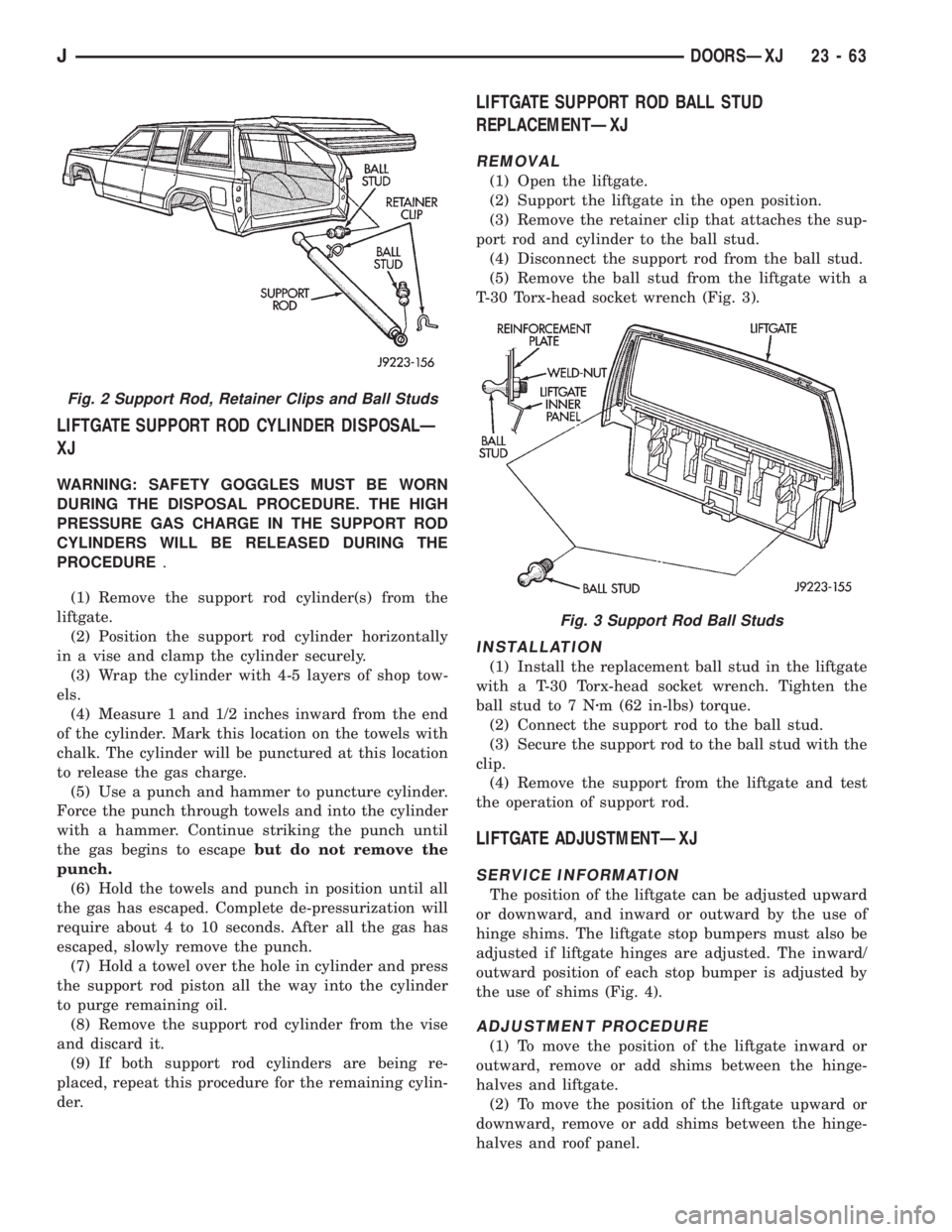
(3) Remove the retainer clip that attaches the sup-
port rod and cylinder to the ball stud.
(4) Disconnect the support rod from the ball stud.
(5) Remove the ball stud from the liftgate with a
T-30 Torx-head socket wrench (Fig. 3).
INSTALLATION
(1) Install the replacement ball stud in the liftgate
with a T-30 Torx-head socket wrench. Tighten the
ball stud to 7 Nzm (62 in-lbs) torque.
(2) Connect the support rod to the ball stud.
(3) Secure the support rod to the ball stud with the
clip.
(4) Remove the support from the liftgate and test
the operation of support rod.
LIFTGATE ADJUSTMENTÐXJ
SERVICE INFORMATION
The position of the liftgate can be adjusted upward
or downward, and inward or outward by the use of
hinge shims. The liftgate stop bumpers must also be
adjusted if liftgate hinges are adjusted. The inward/
outward position of each stop bumper is adjusted by
the use of shims (Fig. 4).
ADJUSTMENT PROCEDURE
(1) To move the position of the liftgate inward or
outward, remove or add shims between the hinge-
halves and liftgate.
(2) To move the position of the liftgate upward or
downward, remove or add shims between the hinge-
halves and roof panel.
Fig. 2 Support Rod, Retainer Clips and Ball Studs
Fig. 3 Support Rod Ball Studs
JDOORSÐXJ 23 - 63
Page 1806 of 2198
REAR QUARTER VENT WINDOW GLASSÐXJ
REMOVAL
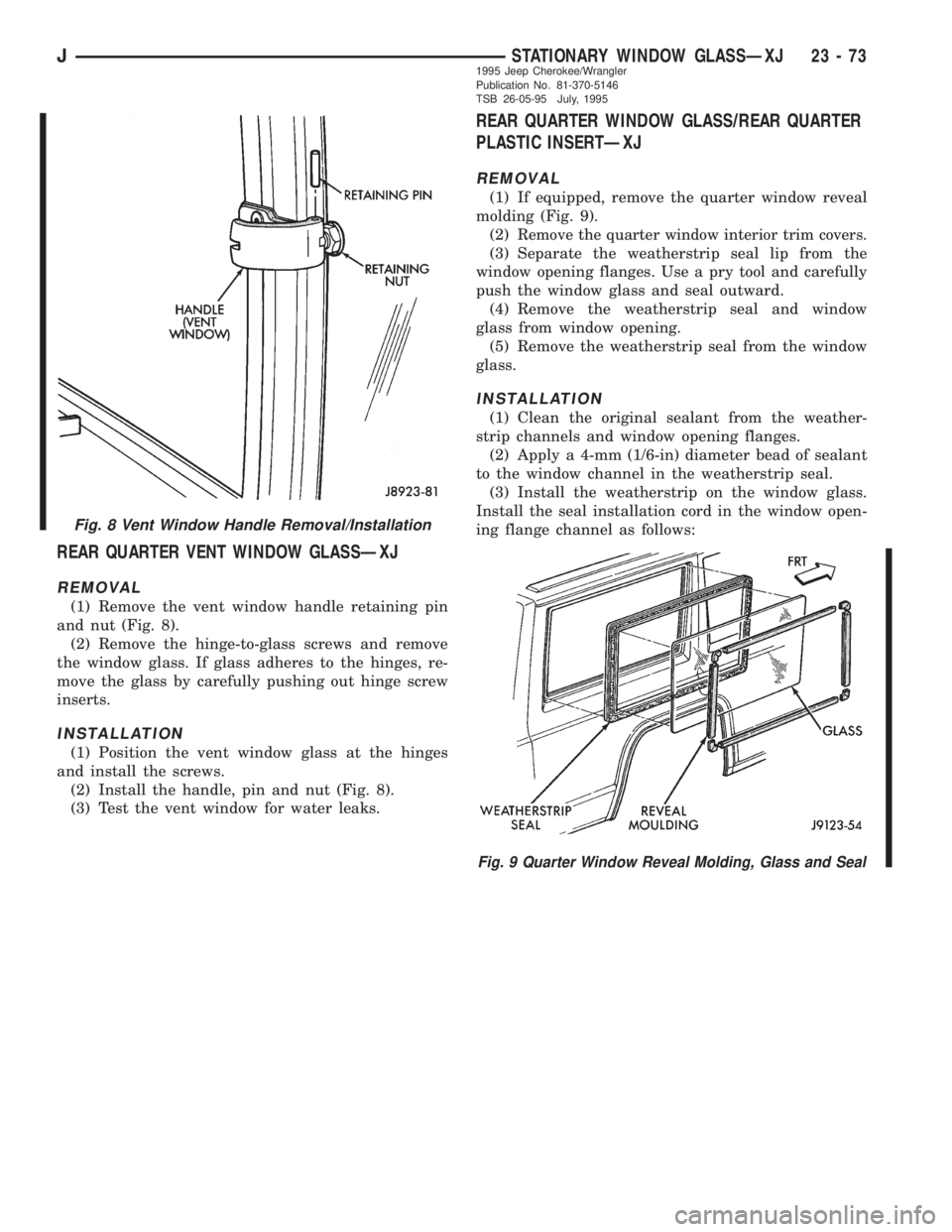
(1) Remove the vent window handle retaining pin
and nut (Fig. 8).
(2) Remove the hinge-to-glass screws and remove
the window glass. If glass adheres to the hinges, re-
move the glass by carefully pushing out hinge screw
inserts.
INSTALLATION
(1) Position the vent window glass at the hinges
and install the screws.
(2) Install the handle, pin and nut (Fig. 8).
(3) Test the vent window for water leaks.
REAR QUARTER WINDOW GLASS/REAR QUARTER
PLASTIC INSERTÐXJ
REMOVAL
(1) If equipped, remove the quarter window reveal
molding (Fig. 9).
(2)
Remove the quarter window interior trim covers.
(3) Separate the weatherstrip seal lip from the
window opening flanges. Use a pry tool and carefully
push the window glass and seal outward.
(4) Remove the weatherstrip seal and window
glass from window opening.
(5) Remove the weatherstrip seal from the window
glass.
INSTALLATION
(1) Clean the original sealant from the weather-
strip channels and window opening flanges.
(2) Apply a 4-mm (1/6-in) diameter bead of sealant
to the window channel in the weatherstrip seal.
(3) Install the weatherstrip on the window glass.
Install the seal installation cord in the window open-
ing flange channel as follows:
Fig. 8 Vent Window Handle Removal/Installation
Fig. 9 Quarter Window Reveal Molding, Glass and Seal
JSTATIONARY WINDOW GLASSÐXJ 23 - 731995 Jeep Cherokee/Wrangler
Publication No. 81-370-5146
TSB 26-05-95 July, 1995
Page 1837 of 2198
EXTERIOR COMPONENTS
INDEX
page page
Battery TrayÐYJ......................... 110
Body Side Step MoldingÐYJ................ 115
Body Stripes/DecalsÐYJ................... 116
Cowl Grille and ScreenÐYJ................ 109
Cowl Weatherstrip SealÐYJ................ 109
Exterior Nameplates (Adhesive-Backed)ÐYJ.... 120
External Spare/Wheel Tire CarrierÐYJ........ 133
Fender FlareÐYJ........................ 114
Fender Inner Splash ShieldsÐYJ............. 116
Fender Splash ApronsÐYJ................. 115
FendersÐYJ............................ 110
Fuel Filler Protector/NozzleÐYJ............. 121
Half Metal Door Mirror (External)ÐYJ......... 121
Hard Top Liftgate GlassÐYJ................ 124
Hard Top RepairÐYJ..................... 127
Hard Top Roof VentÐYJ................... 127
Hard TopÐYJ........................... 126Hood AlignmentÐYJ...................... 107
Hood Insulator PanelÐYJ.................. 107
Hood Safety LatchÐYJ.................... 109
HoodÐYJ.............................. 107
Liftgate Glass Weatherstrip Seal ReplacementÐYJ. 125
Radiator Grille AppliqueÐYJ................ 104
Soft Top Service InformationÐYJ............. 127
Soft Top ServiceÐYJ..................... 129
Sport BarÐYJ........................... 132
Tailgate AdjustmentÐYJ................... 121
Tailgate HingeÐYJ....................... 121
Tailgate Latch and Release HandleÐYJ........ 122
Tailgate Latch StrikerÐYJ.................. 123
Tailgate Lock CylinderÐYJ................. 122
Tailgate Weatherstrip SealÐYJ.............. 123
TailgateÐYJ............................ 121
Wheelhouse Splash LinersÐYJ.............. 115
RADIATOR GRILLE APPLIQUEÐYJ
REMOVAL
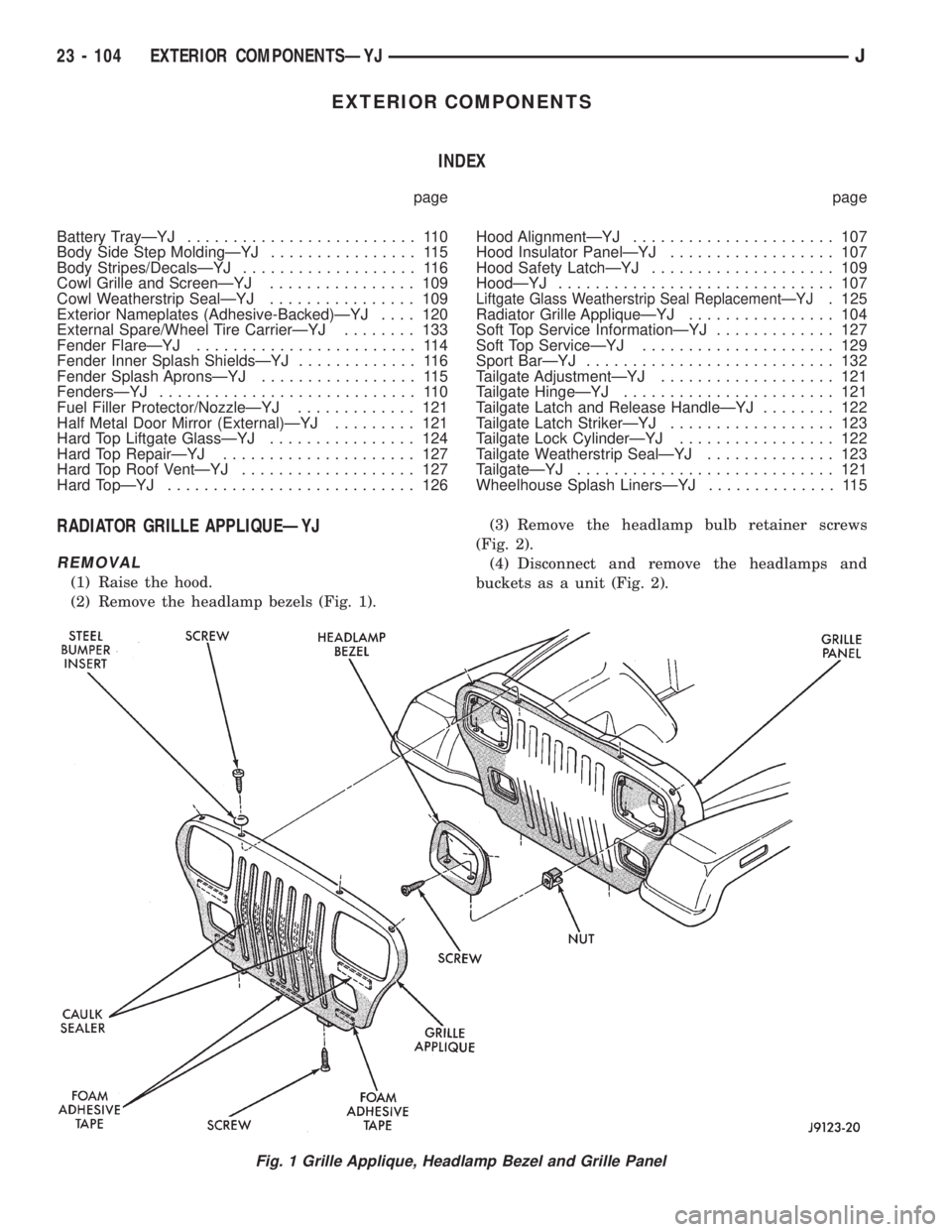
(1) Raise the hood.
(2) Remove the headlamp bezels (Fig. 1).(3) Remove the headlamp bulb retainer screws
(Fig. 2).
(4) Disconnect and remove the headlamps and
buckets as a unit (Fig. 2).
Fig. 1 Grille Applique, Headlamp Bezel and Grille Panel
23 - 104 EXTERIOR COMPONENTSÐYJJ