1995 JEEP CHEROKEE hinge
[x] Cancel search: hingePage 1740 of 2198
INSTALLATION
(1) If removed, install the horns, baffle braces and
the wire harnesses on the baffles (Fig. 11).
(2) Position the radiator and the radiator support
crossmember at the front of vehicle (Fig. 10). Install
and tighten screws to 9 Nzm (76 in-lbs) torque.
(3) For 2.5L engines, install the power steering
pump reservoir on the left filler panel (Fig. 9).
(4) Install the grille opening panel (GOP).
HOODÐXJ
The hood service procedures included in this sec-
tion include:
²Hood removal and installation.
²Hood adjustment.
²HingeÐlatchÐstriker service (Fig. 12).
²Latch release cable service.
JEXTERIOR COMPONENTSÐXJ 23 - 7
Page 1742 of 2198
HOOD REMOVAL
(1) Raise hood.
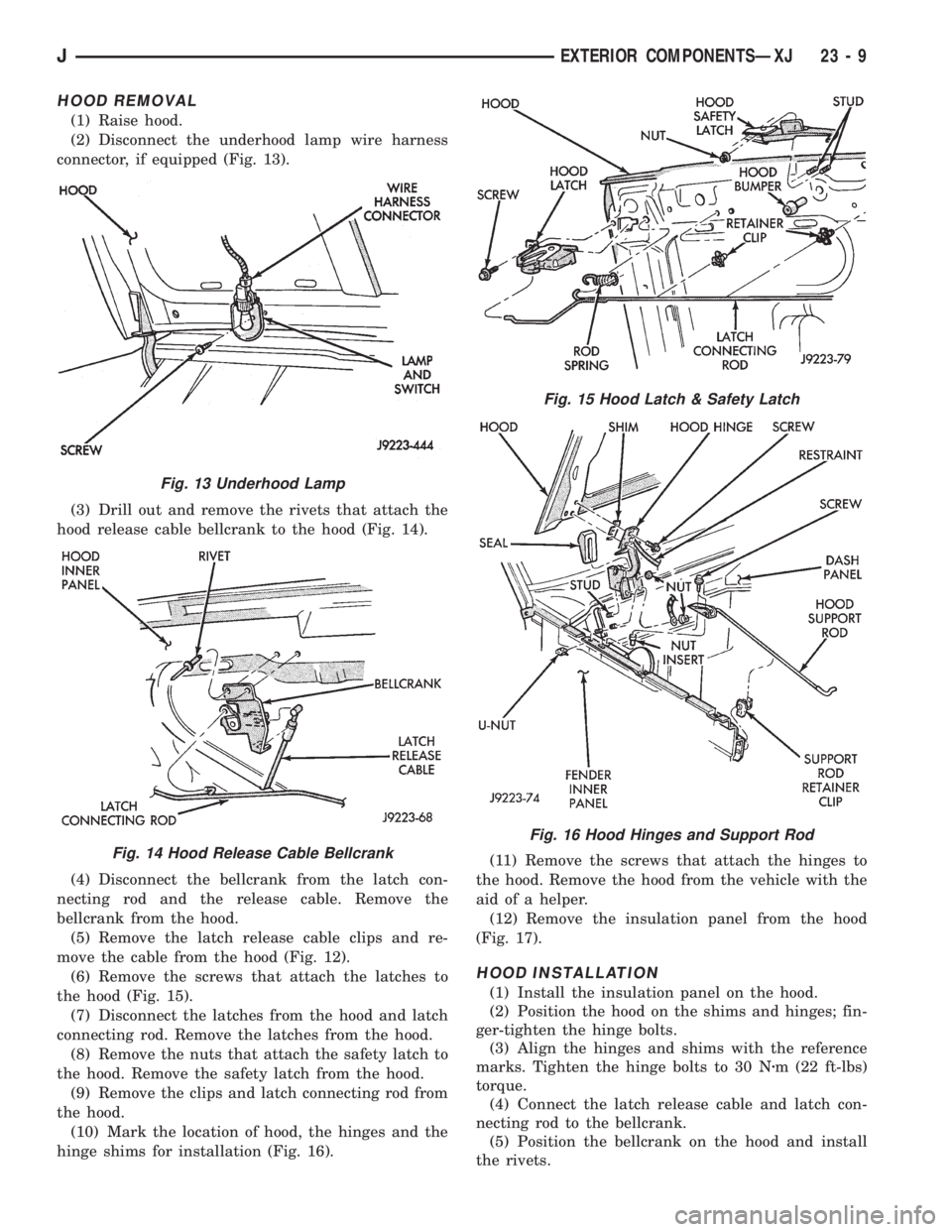
(2) Disconnect the underhood lamp wire harness
connector, if equipped (Fig. 13).
(3) Drill out and remove the rivets that attach the
hood release cable bellcrank to the hood (Fig. 14).
(4) Disconnect the bellcrank from the latch con-
necting rod and the release cable. Remove the
bellcrank from the hood.
(5) Remove the latch release cable clips and re-
move the cable from the hood (Fig. 12).
(6) Remove the screws that attach the latches to
the hood (Fig. 15).
(7) Disconnect the latches from the hood and latch
connecting rod. Remove the latches from the hood.
(8) Remove the nuts that attach the safety latch to
the hood. Remove the safety latch from the hood.
(9) Remove the clips and latch connecting rod from
the hood.
(10) Mark the location of hood, the hinges and the
hinge shims for installation (Fig. 16).(11) Remove the screws that attach the hinges to
the hood. Remove the hood from the vehicle with the
aid of a helper.
(12) Remove the insulation panel from the hood
(Fig. 17).
HOOD INSTALLATION
(1) Install the insulation panel on the hood.
(2) Position the hood on the shims and hinges; fin-
ger-tighten the hinge bolts.
(3) Align the hinges and shims with the reference
marks. Tighten the hinge bolts to 30 Nzm (22 ft-lbs)
torque.
(4) Connect the latch release cable and latch con-
necting rod to the bellcrank.
(5) Position the bellcrank on the hood and install
the rivets.
Fig. 13 Underhood Lamp
Fig. 14 Hood Release Cable Bellcrank
Fig. 15 Hood Latch & Safety Latch
Fig. 16 Hood Hinges and Support Rod
JEXTERIOR COMPONENTSÐXJ 23 - 9
Page 1743 of 2198
(6) Attach the latch release cable to the clips.
(7) Connect the latches to the latch rod and posi-
tion them on the hood.
(8) Install the screws to attach the latches to the
hood.
Tighten the screws to 9 Nzm (77 in-lbs) torque.
(9) Position the safety latch on the hood and install
the attaching nuts. Tighten the screws to 13 Nzm
(115 in-lbs) torque.
(10) Test latch release cable and latches for proper
operation.
(11) Connect the underhood lamp wire harness
connector.
(12) Inspect the hood for proper alignment and ad-
just as necessary.
HOOD ADJUSTMENTÐXJ
The hood bolt holes are elongated for fore and aft
and side-to-side adjustment.
(1) If hood is low to the cowl panel, insert shims
between the hinge and hood at the rear hinge bolts.
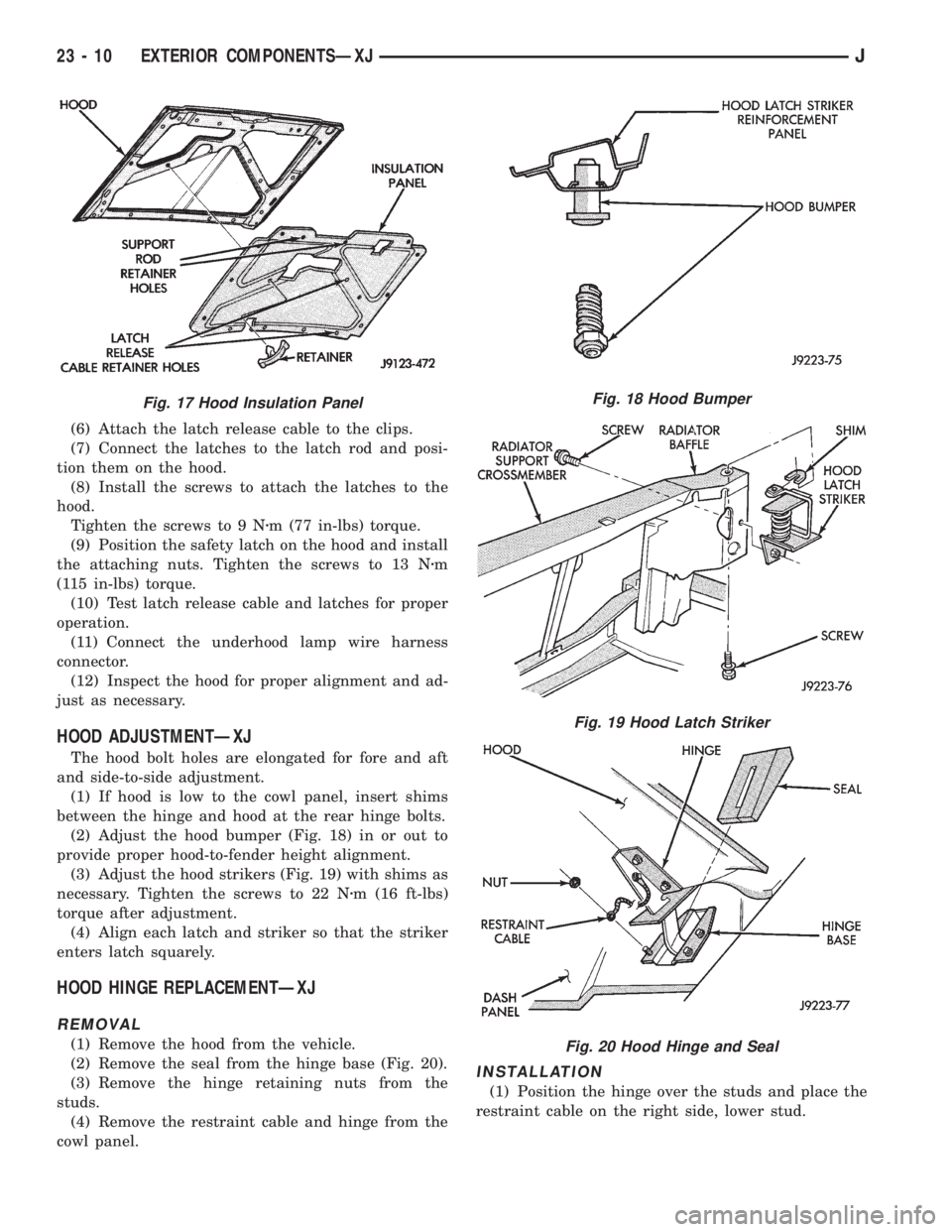
(2) Adjust the hood bumper (Fig. 18) in or out to
provide proper hood-to-fender height alignment.
(3) Adjust the hood strikers (Fig. 19) with shims as
necessary. Tighten the screws to 22 Nzm (16 ft-lbs)
torque after adjustment.
(4) Align each latch and striker so that the striker
enters latch squarely.
HOOD HINGE REPLACEMENTÐXJ
REMOVAL
(1) Remove the hood from the vehicle.
(2) Remove the seal from the hinge base (Fig. 20).
(3) Remove the hinge retaining nuts from the
studs.
(4) Remove the restraint cable and hinge from the
cowl panel.
INSTALLATION
(1) Position the hinge over the studs and place the
restraint cable on the right side, lower stud.
Fig. 17 Hood Insulation PanelFig. 18 Hood Bumper
Fig. 19 Hood Latch Striker
Fig. 20 Hood Hinge and Seal
23 - 10 EXTERIOR COMPONENTSÐXJJ
Page 1744 of 2198
(2) Install the hinge nuts on the studs. Tighten the
restraint cable nut to 4 Nzm (38 in-lbs) torque.
Tighten the remaining nuts to 9 Nzm (77 in-lbs)
torque.
If a replacement hinge seal is being installed,
position it around the hinge arm, force it
against the hinge base.
(3) Position the hinge seal around the hinge arm
and on hinge base.
(4) Install the hood.
(5) Adjust the hood as necessary.
HOOD LATCH REPLACEMENTÐXJ
REMOVAL
(1) Remove the screw that attaches the latch to the
hood inner panel (Fig. 15).
(2) Disconnect the latch from the hood and latch
connecting rod. Remove the latch from the hood.
INSTALLATION
(1) Connect the latch to the latch connecting rod
and position it on the hood inner panel.
(2) Install the screw that attaches the latch to the
hood inner panel.
(3) Tighten the screw to 9 Nzm (77 in-lbs) torque.
(4) Test the operation of the latch release cable and
latch.
HOOD LATCH STRIKER REPLACEMENTÐXJ
REMOVE
(1) Remove the grille opening panel (GOP).
(2) Remove the screws that attach the striker to
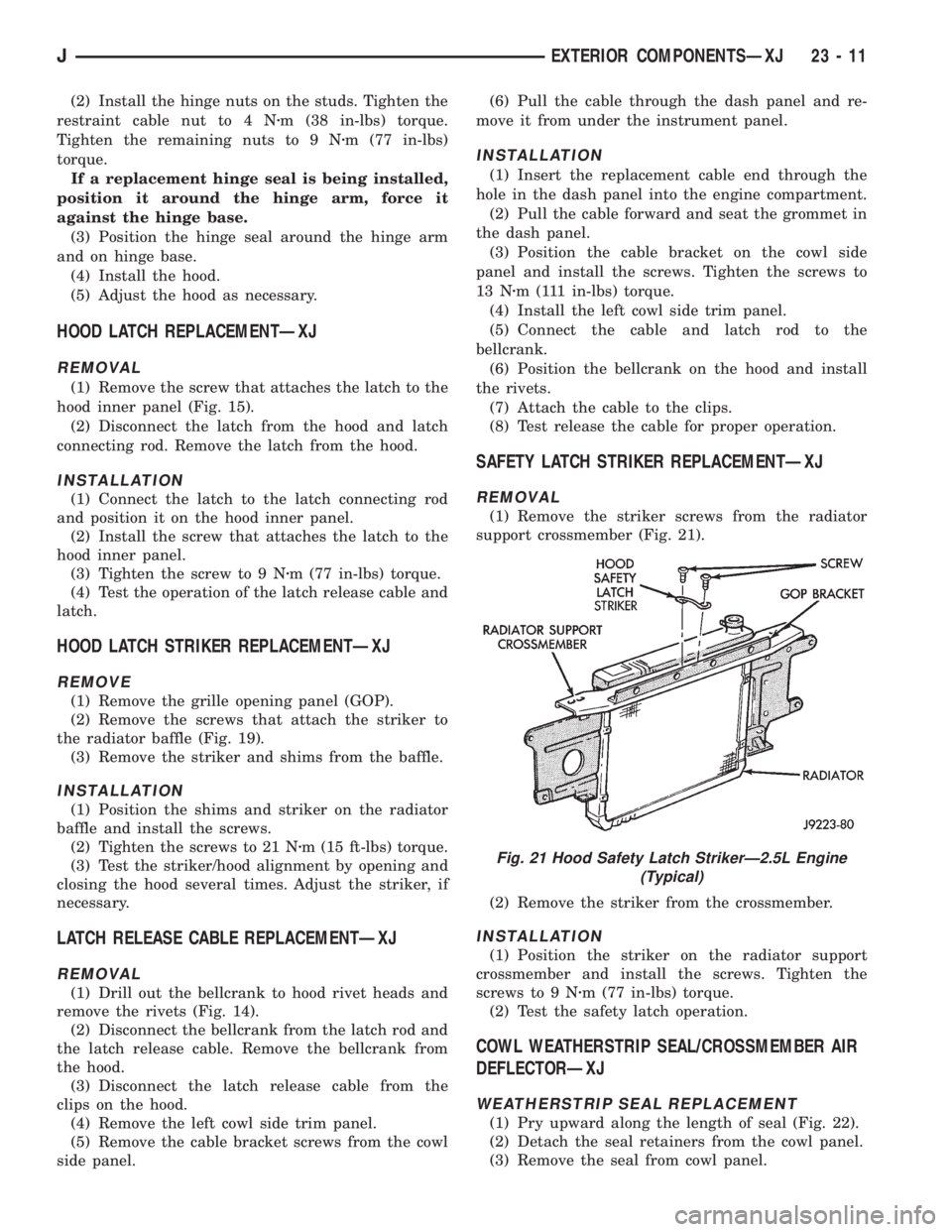
the radiator baffle (Fig. 19).
(3) Remove the striker and shims from the baffle.
INSTALLATION
(1) Position the shims and striker on the radiator
baffle and install the screws.
(2) Tighten the screws to 21 Nzm (15 ft-lbs) torque.
(3) Test the striker/hood alignment by opening and
closing the hood several times. Adjust the striker, if
necessary.
LATCH RELEASE CABLE REPLACEMENTÐXJ
REMOVAL
(1) Drill out the bellcrank to hood rivet heads and
remove the rivets (Fig. 14).
(2) Disconnect the bellcrank from the latch rod and
the latch release cable. Remove the bellcrank from
the hood.
(3) Disconnect the latch release cable from the
clips on the hood.
(4) Remove the left cowl side trim panel.
(5) Remove the cable bracket screws from the cowl
side panel.(6) Pull the cable through the dash panel and re-
move it from under the instrument panel.
INSTALLATION
(1) Insert the replacement cable end through the
hole in the dash panel into the engine compartment.
(2) Pull the cable forward and seat the grommet in
the dash panel.
(3) Position the cable bracket on the cowl side
panel and install the screws. Tighten the screws to
13 Nzm (111 in-lbs) torque.
(4) Install the left cowl side trim panel.
(5) Connect the cable and latch rod to the
bellcrank.
(6) Position the bellcrank on the hood and install
the rivets.
(7) Attach the cable to the clips.
(8) Test release the cable for proper operation.
SAFETY LATCH STRIKER REPLACEMENTÐXJ
REMOVAL
(1) Remove the striker screws from the radiator
support crossmember (Fig. 21).
(2) Remove the striker from the crossmember.
INSTALLATION
(1) Position the striker on the radiator support
crossmember and install the screws. Tighten the
screws to 9 Nzm (77 in-lbs) torque.
(2) Test the safety latch operation.
COWL WEATHERSTRIP SEAL/CROSSMEMBER AIR
DEFLECTORÐXJ
WEATHERSTRIP SEAL REPLACEMENT
(1) Pry upward along the length of seal (Fig. 22).
(2) Detach the seal retainers from the cowl panel.
(3) Remove the seal from cowl panel.
Fig. 21 Hood Safety Latch StrikerÐ2.5L Engine
(Typical)
JEXTERIOR COMPONENTSÐXJ 23 - 11
Page 1755 of 2198
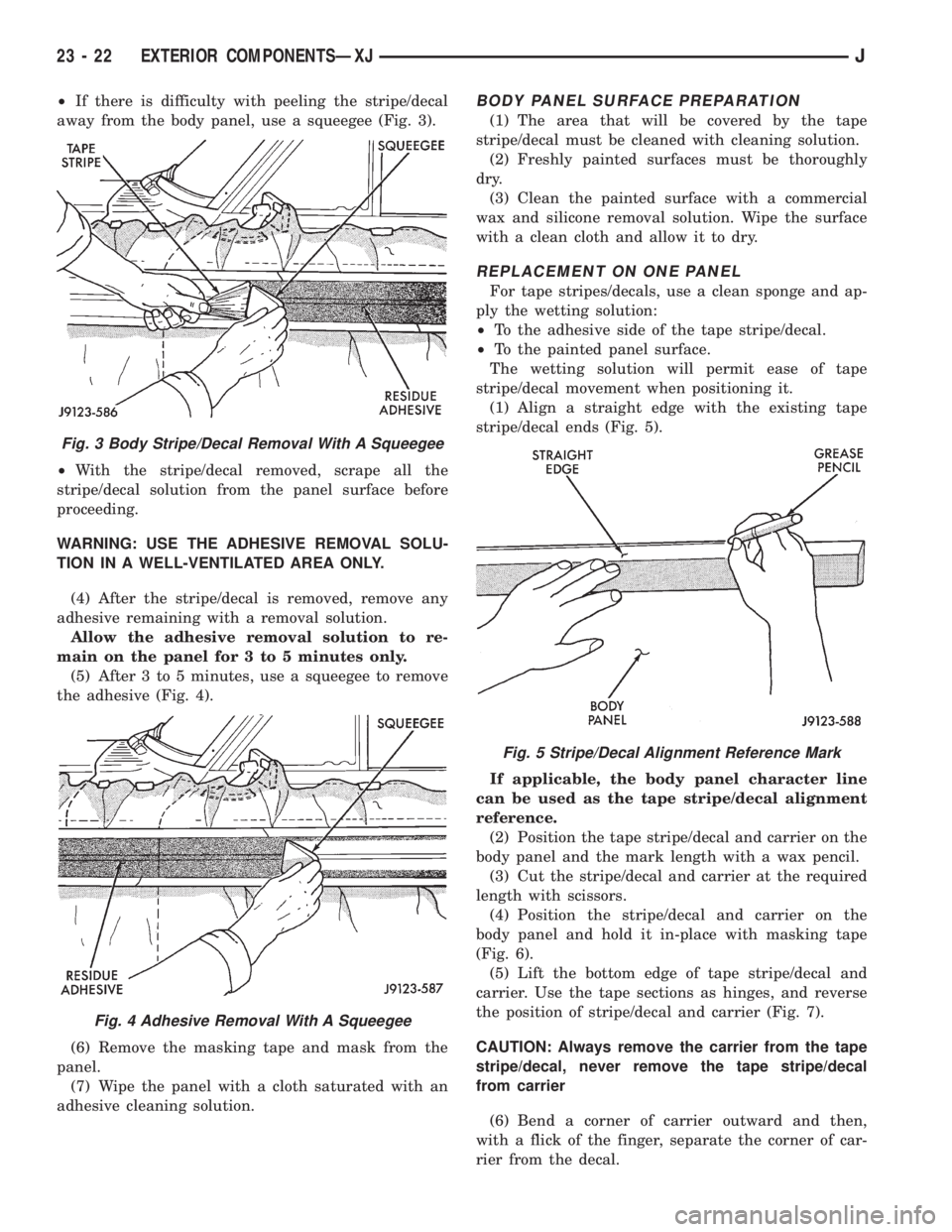
²If there is difficulty with peeling the stripe/decal
away from the body panel, use a squeegee (Fig. 3).
²With the stripe/decal removed, scrape all the
stripe/decal solution from the panel surface before
proceeding.
WARNING: USE THE ADHESIVE REMOVAL SOLU-
TION IN A WELL-VENTILATED AREA ONLY.
(4) After the stripe/decal is removed, remove any
adhesive remaining with a removal solution.
Allow the adhesive removal solution to re-
main on the panel for 3 to 5 minutes only.
(5) After 3 to 5 minutes, use a squeegee to remove
the adhesive (Fig. 4).
(6) Remove the masking tape and mask from the
panel.
(7) Wipe the panel with a cloth saturated with an
adhesive cleaning solution.BODY PANEL SURFACE PREPARATION
(1) The area that will be covered by the tape
stripe/decal must be cleaned with cleaning solution.
(2) Freshly painted surfaces must be thoroughly
dry.
(3) Clean the painted surface with a commercial
wax and silicone removal solution. Wipe the surface
with a clean cloth and allow it to dry.
REPLACEMENT ON ONE PANEL
For tape stripes/decals, use a clean sponge and ap-
ply the wetting solution:
²To the adhesive side of the tape stripe/decal.
²To the painted panel surface.
The wetting solution will permit ease of tape
stripe/decal movement when positioning it.
(1) Align a straight edge with the existing tape
stripe/decal ends (Fig. 5).
If applicable, the body panel character line
can be used as the tape stripe/decal alignment
reference.
(2) Position the tape stripe/decal and carrier on the
body panel and the mark length with a wax pencil.
(3) Cut the stripe/decal and carrier at the required
length with scissors.
(4) Position the stripe/decal and carrier on the
body panel and hold it in-place with masking tape
(Fig. 6).
(5) Lift the bottom edge of tape stripe/decal and
carrier. Use the tape sections as hinges, and reverse
the position of stripe/decal and carrier (Fig. 7).
CAUTION: Always remove the carrier from the tape
stripe/decal, never remove the tape stripe/decal
from carrier
(6) Bend a corner of carrier outward and then,
with a flick of the finger, separate the corner of car-
rier from the decal.
Fig. 3 Body Stripe/Decal Removal With A Squeegee
Fig. 4 Adhesive Removal With A Squeegee
Fig. 5 Stripe/Decal Alignment Reference Mark
23 - 22 EXTERIOR COMPONENTSÐXJJ
Page 1763 of 2198
DOORS
INDEX
page page
Door Alignment AdjustmentÐMajor............ 41
Door Alignment AdjustmentÐMinor............ 37
Door Edge Guard/Edge Protector StripÐXJ...... 54
Door External HandleÐXJ................... 48
Door Hinge/Hinge Pin ReplacementÐXJ........ 52
Door Inside Latch Release and Lock RodsÐXJ . . . 50
Door Key Lock CylinderÐXJ................. 47
Door Latch AdjustmentÐXJ.................. 48
Door LatchÐXJ.......................... 49
Door Removal/InstallationÐXJ............... 35
Door Restraint ReplacementÐXJ............. 41
Door Trim PanelÐXJ...................... 31
Door Window Exterior MoldingsÐXJ........... 54
Door Window Glass and Door Opening
Weatherstrip SealsÐXJ................... 55
Front Door Spacer BlocksÐTwo-Door Vehicles . . . 53
Front Door Window Glass RegulatorÐXJ........ 42Front Door Window GlassÐXJ............... 43
Liftgate AdjustmentÐXJ.................... 63
Liftgate HingeÐXJ........................ 60
Liftgate Latch/Key Lock Cylinder/StrikerÐXJ..... 61
Liftgate License Plate Lamp HousingÐXJ....... 65
Liftgate License Plate Screw Anchor and BumperÐXJ.65
Liftgate Opening Weatherstrip SealÐXJ........ 64
Liftgate Support Rod Ball Stud ReplacementÐXJ . 63
Liftgate Support Rod Cylinder DisposalÐXJ...... 63
Liftgate Support Rod CylinderÐXJ............. 62
Liftgate Trim PanelÐXJ..................... 59
LiftgateÐXJ............................. 58
Rear Door Stationary Window GlassÐXJ........ 46
Rear Door Window Glass RegulatorÐXJ........ 44
Rear Door Window GlassÐXJ................ 45
Service Information........................ 30
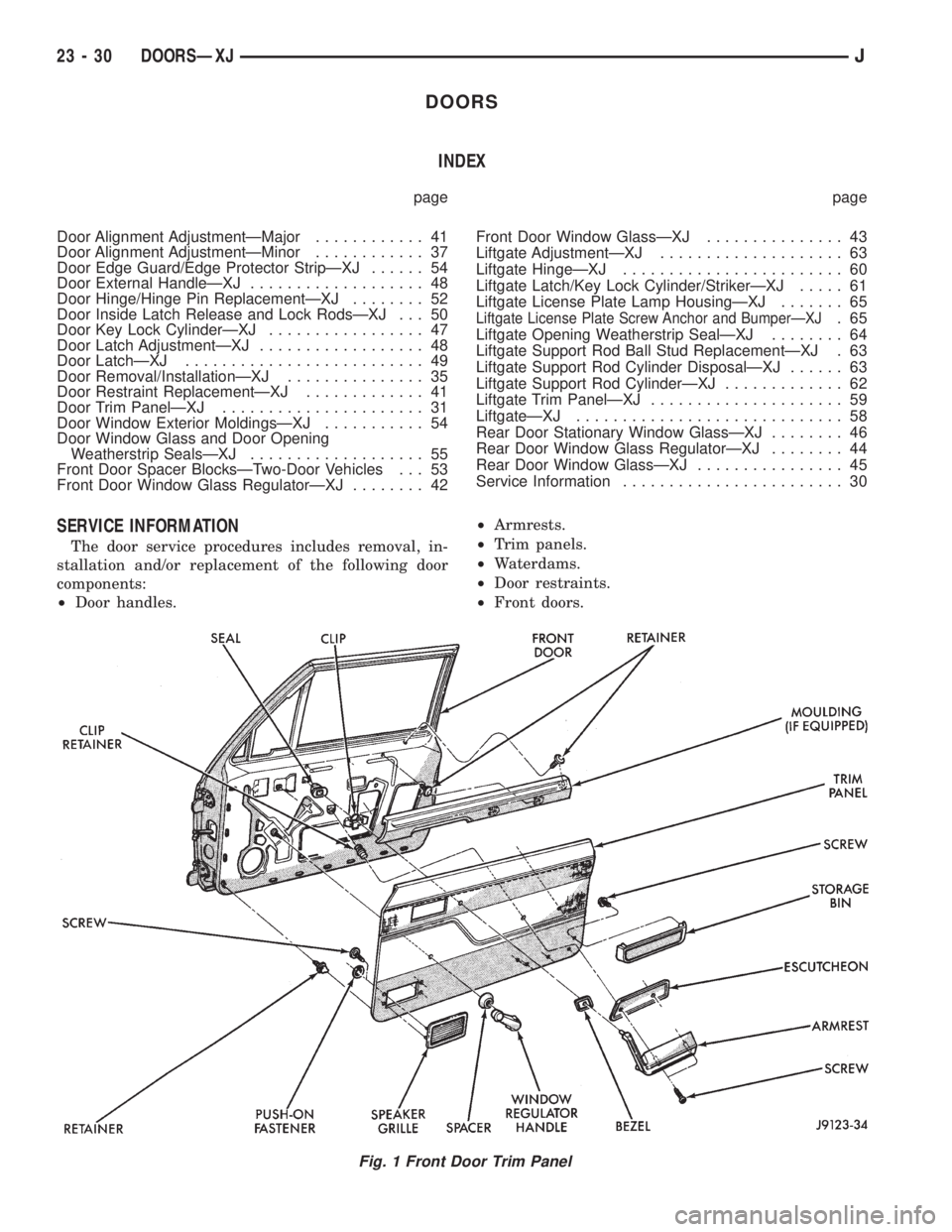
SERVICE INFORMATION
The door service procedures includes removal, in-
stallation and/or replacement of the following door
components:
²Door handles.²Armrests.
²Trim panels.
²Waterdams.
²Door restraints.
²Front doors.
Fig. 1 Front Door Trim Panel
23 - 30 DOORSÐXJJ
Page 1764 of 2198
²Rear doors.
²Window glass regulators.
²Key lock cylinders.
²Door half-hinges.
²Liftgate.
²Liftgate hinges.
²Liftgate gas support rod cylinders.
²Rocker panel seals.
²Moldings/weatherstrip seals.DOOR TRIM PANELÐXJ
SERVICE INFORMATION
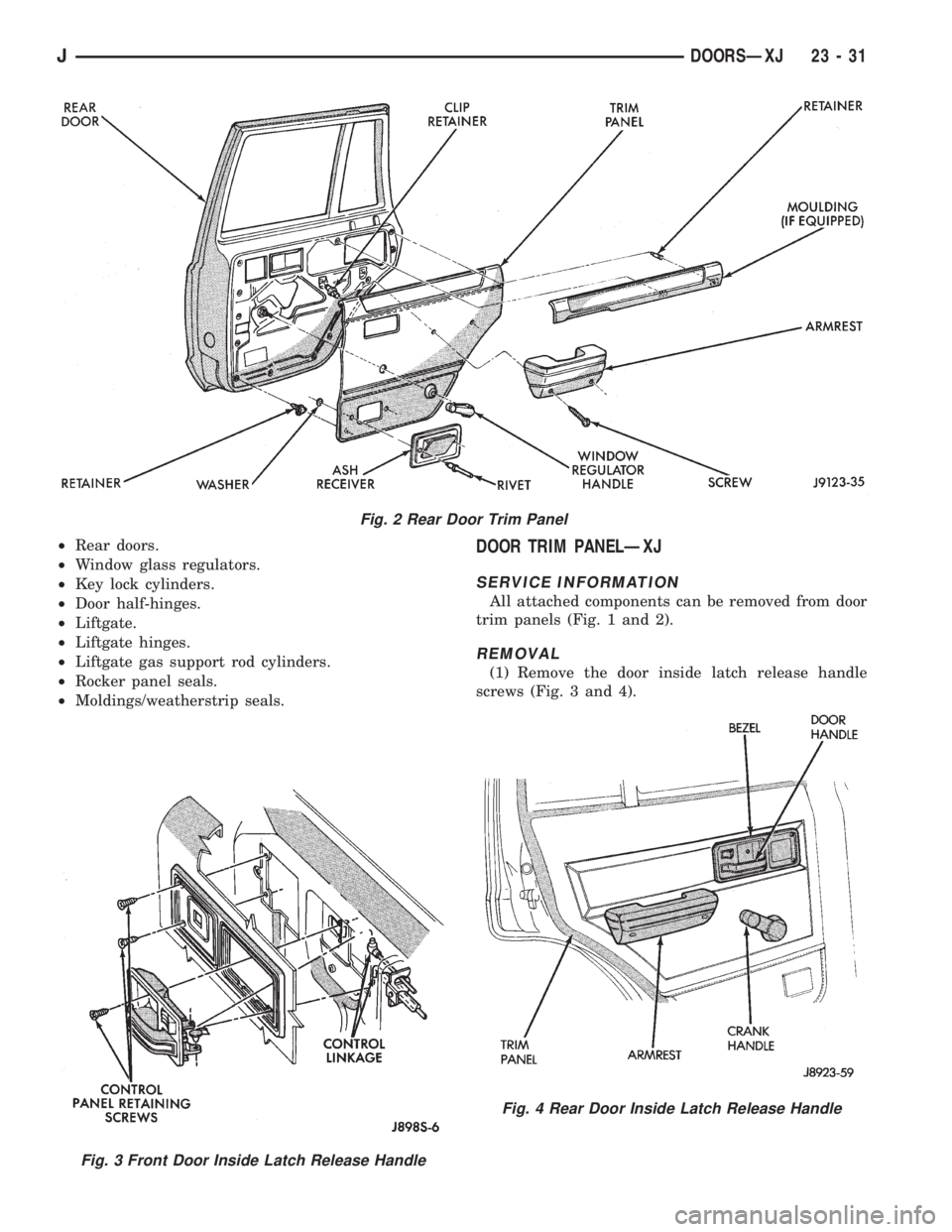
All attached components can be removed from door
trim panels (Fig. 1 and 2).
REMOVAL
(1) Remove the door inside latch release handle
screws (Fig. 3 and 4).
Fig. 2 Rear Door Trim Panel
Fig. 3 Front Door Inside Latch Release Handle
Fig. 4 Rear Door Inside Latch Release Handle
JDOORSÐXJ 23 - 31
Page 1770 of 2198
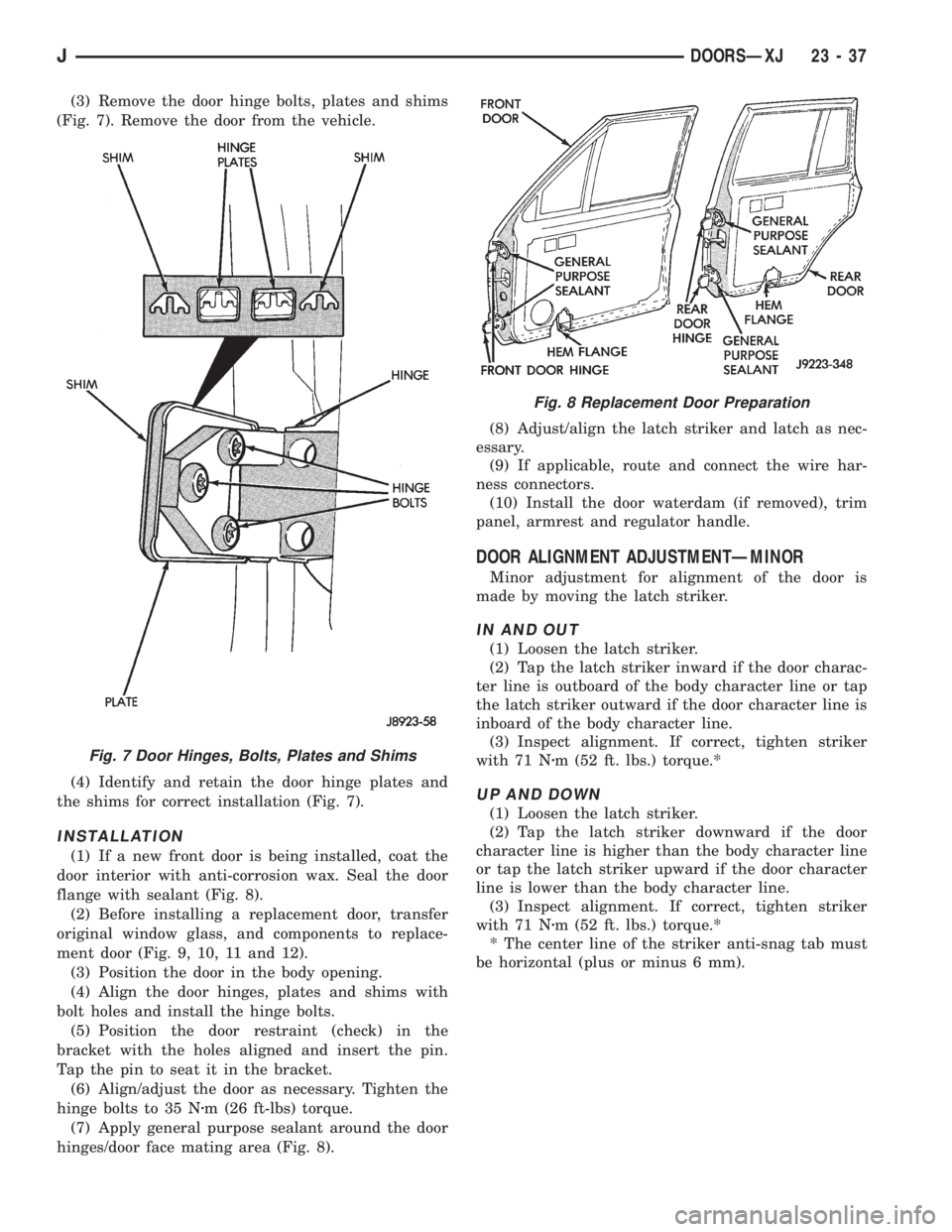
(3) Remove the door hinge bolts, plates and shims
(Fig. 7). Remove the door from the vehicle.
(4) Identify and retain the door hinge plates and
the shims for correct installation (Fig. 7).
INSTALLATION
(1) If a new front door is being installed, coat the
door interior with anti-corrosion wax. Seal the door
flange with sealant (Fig. 8).
(2) Before installing a replacement door, transfer
original window glass, and components to replace-
ment door (Fig. 9, 10, 11 and 12).
(3) Position the door in the body opening.
(4) Align the door hinges, plates and shims with
bolt holes and install the hinge bolts.
(5) Position the door restraint (check) in the
bracket with the holes aligned and insert the pin.
Tap the pin to seat it in the bracket.
(6) Align/adjust the door as necessary. Tighten the
hinge bolts to 35 Nzm (26 ft-lbs) torque.
(7) Apply general purpose sealant around the door
hinges/door face mating area (Fig. 8).(8) Adjust/align the latch striker and latch as nec-
essary.
(9) If applicable, route and connect the wire har-
ness connectors.
(10) Install the door waterdam (if removed), trim
panel, armrest and regulator handle.
DOOR ALIGNMENT ADJUSTMENTÐMINOR
Minor adjustment for alignment of the door is
made by moving the latch striker.
IN AND OUT
(1) Loosen the latch striker.
(2) Tap the latch striker inward if the door charac-
ter line is outboard of the body character line or tap
the latch striker outward if the door character line is
inboard of the body character line.
(3) Inspect alignment. If correct, tighten striker
with 71 Nzm (52 ft. lbs.) torque.*
UP AND DOWN
(1) Loosen the latch striker.
(2) Tap the latch striker downward if the door
character line is higher than the body character line
or tap the latch striker upward if the door character
line is lower than the body character line.
(3) Inspect alignment. If correct, tighten striker
with 71 Nzm (52 ft. lbs.) torque.*
* The center line of the striker anti-snag tab must
be horizontal (plus or minus 6 mm).
Fig. 7 Door Hinges, Bolts, Plates and Shims
Fig. 8 Replacement Door Preparation
JDOORSÐXJ 23 - 37