Page 192 of 240
Changing a Flat Tire
If you have a flat tire while driving, stop in a safe place to change it.
Stopping in traffic or on the shoulder of a busy road is dangerous. Drive
slowly along the shoulder until you
get to an exit or an area to stop that
is far away from the traffic lanes.
1. Park the car on firm, level groundaway from traffic. Turn on the
hazard warning lights and turn the ignition to LOCK (0).
2. Put the transmission in Park. Set the parking brake. 3. Open the tailgate. Fold down the
third seat's seat-back (see page
62).
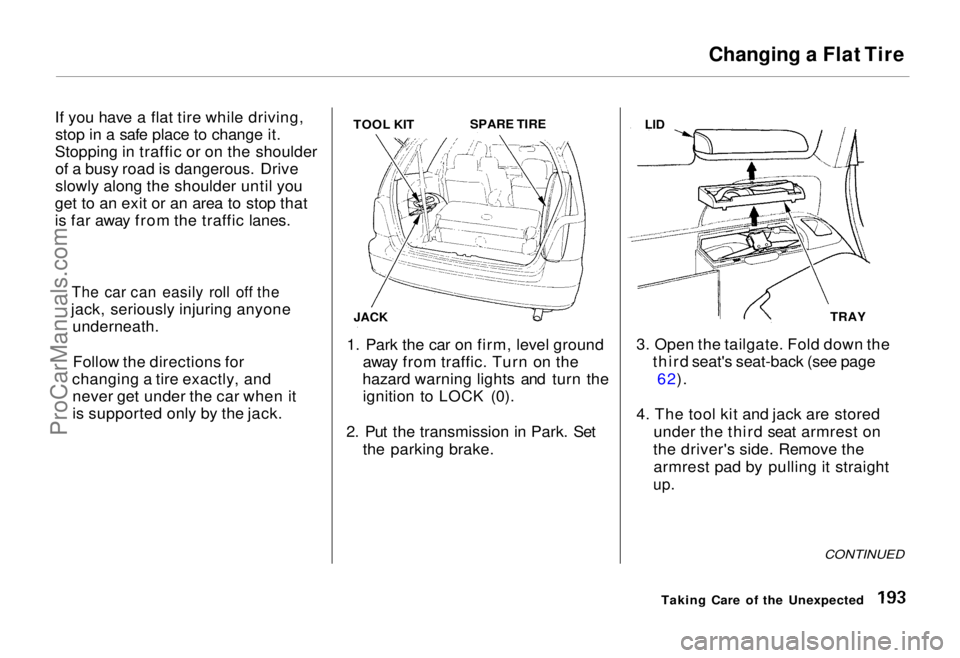
4. The tool kit and jack are stored under the third seat armrest on
the driver's side. Remove the armrest pad by pulling it straight
up.
Taking Care of the Unexpected
CONTINUED
The car can easily roll off the
jack, seriously injuring anyone underneath.
Follow the directions for
changing a tire exactly, and never get under the car when it
is supported only by the jack. TOOL KIT
JACK
SPARE TIRE
TRAY
LIDProCarManuals.comMain Menu Table of Contents s t
Page 193 of 240
Changing a Flat Tire
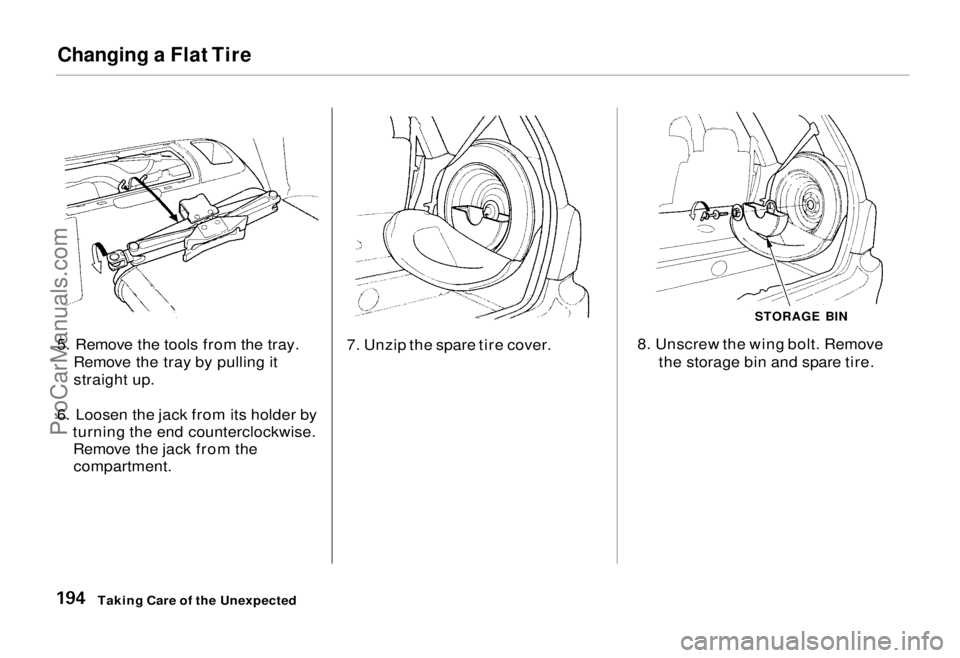
5. Remove the tools from the tray. Remove the tray by pulling it
straight up.
6. Loosen the jack from its holder by turning the end counterclockwise.Remove the jack from thecompartment. 7. Unzip the spare tire cover.
8. Unscrew the wing bolt. Remove
the storage bin and spare tire.
Taking Care of the Unexpected
STORAGE BINProCarManuals.comMain Menu Table of Contents s t
Page 194 of 240
Changing a Flat Tire
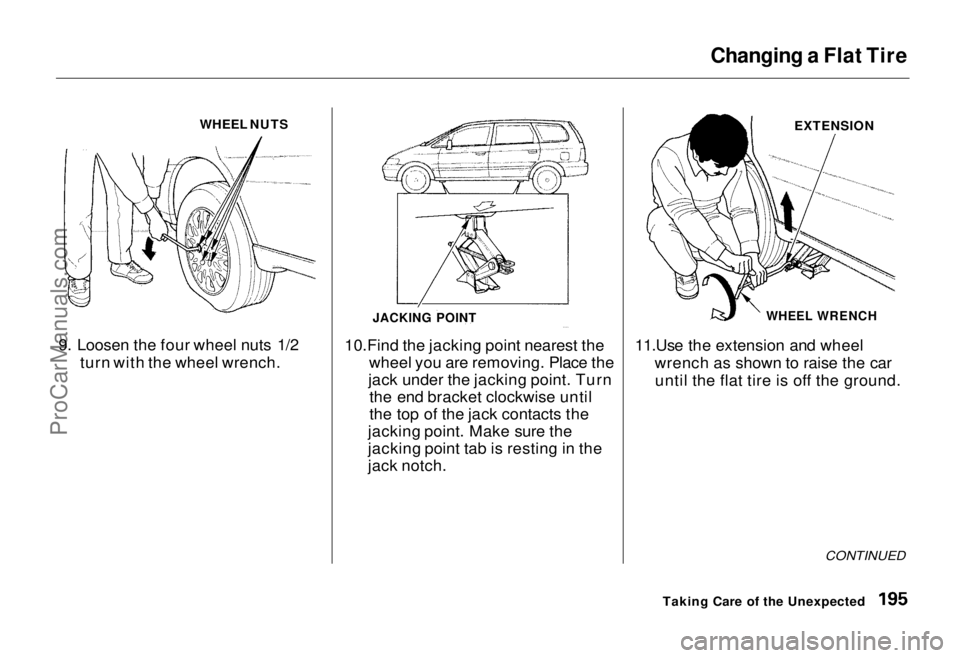
9. Loosen the four wheel nuts 1/2 turn with the wheel wrench. 10.Find the jacking point nearest the
wheel you are removing. Place the
jack under the jacking point. Turn the end bracket clockwise until
the top of the jack contacts the
jacking point. Make sure the
jacking point tab is resting in the
jack notch. 11.Use the extension and wheel
wrench as shown to raise the caruntil the flat tire is off the ground.
CONTINUED
Taking Care of the Unexpected
WHEEL NUTS
JACKING POINT
EXTENSION
WHEEL WRENCHProCarManuals.comMain Menu Table of Contents s t
Page 197 of 240
Changing a Flat Tire
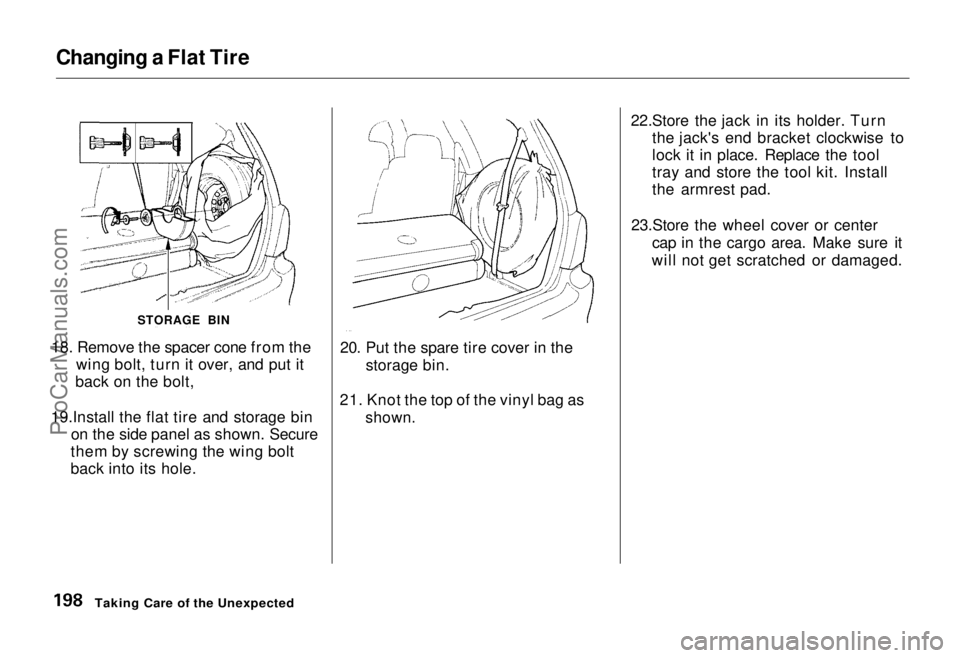
18. Remove the spacer cone from the wing bolt, turn it over, and put it
back on the bolt,
19.Install the flat tire and storage bin on the side panel as shown. Secure
them by screwing the wing bolt
back into its hole. 20. Put the spare tire cover in the
storage bin.
21. Knot the top of the vinyl bag as
shown.
22.Store the jack in its holder. Turn
the jack's end bracket clockwise to
lock it in place. Replace the tool
tray and store the tool kit. Install
the armrest pad.
23.Store the wheel cover or center cap in the cargo area. Make sure it
will not get scratched or damaged.
Taking Care of the Unexpected
STORAGE BINProCarManuals.comMain Menu Table of Contents s t
Page 198 of 240
If Your Engine Won't Start
Diagnosing why your engine won't
start falls into two areas, depending
on what you hear when you turn the
key to START (III):
You hear nothing, or almostnothing. The engine's starter
motor does not operate at all, or operates very slowly.
You can hear the starter motor operating normally, but the engine
does not start up and run. Nothing Happens or the Starter
Motor Operates Very Slowly
When you turn the ignition switch to START (III), you do not hear the
normal noise of the engine trying to start. You may hear a clicking sound
or series of clicks, or nothing at all.
Check these things:
Check the transmission interlock.
The transmission must be in Park or Neutral or the starter will not
operate.
Turn the ignition switch to ON (II).
Turn on the headlights and check their brightness. If the headlights
are very dim or don't light at all,
the battery is discharged. See
Jump Starting on page 200 .
Turn the ignition switch to START
(III). If the headlights do not dim,
check the condition of the fuses. If
the fuses are OK, there is proba-
bly something wrong with the electrical circuit for the ignition
switch or starter motor. You will
need a qualified technician to determine the problem. (See
Towing on page 213 .)
If the headlights dim noticeably or
go out when you try to start the engine, either the battery is dis-
charged or the connections are
corroded. Check the condition of
the battery and terminal connec-
tions (see page 162 ). You can
then try jump starting the car from a booster battery (see page 200 ).
Taking Care of the UnexpectedProCarManuals.comMain Menu Table of Contents s t
Page 202 of 240
If Your Engine Overheats
4. If the temperature gauge stays at the red mark, turn off the engine.
5. Wait until you see no more signs of steam or spray, then open the
hood.
6. Look for any obvious coolant leaks, such as a split radiator hose.
Everything is still extremely hot, so use caution. If you find a leak, it
must be repaired before you
continue driving (see Towing on
page 213).
7. If you don't find an obvious leak, check the coolant level in the
radiator reserve tank (see page 150). If the level is below the
MIN mark, add coolant to half-way
between the MIN and MAX marks.
8. If there was no coolant in the reserve tank, you may also have to
add coolant to the radiator. Let the
engine cool down until the pointer reaches the middle of the tempera-
ture gauge, or lower, before check-
ing the radiator.
9. Using gloves or a large heavy cloth, turn the radiator cap
counterclockwise, without pushing
down, to the first stop. This
releases any remaining pressure in
the cooling system. After the
pressure releases, push down on
the cap and turn it until it comes
off.
10.Start the engine and set the
temperature control lever to
maximum. Add coolant to the
radiator up to the base of the filler
neck. If you do not have the proper coolant mixture available,
you can add plain water. Remember to have the coolingsystem drained and refilled with
the proper mixture as soon as you
can.
11. Put the radiator cap back on tightly. Run the engine and watch
the temperature gauge. If it goes
back to the red mark, the engine needs repair. (See Towing on
page 213.)
12.If the temperature stays normal, check the coolant level in the
radiator reserve tank. If it has
gone down, add coolant to the MAX mark. Put the cap back on
tightly.
Taking Care of the Unexpected
Removing the radiator cap
while the engine is hot can cause the coolant to spray out,
seriously scalding you.
Always let the engine and radiator cool down before
removing the radiator cap.ProCarManuals.comMain Menu Table of Contents s t
Page 208 of 240
Fuses
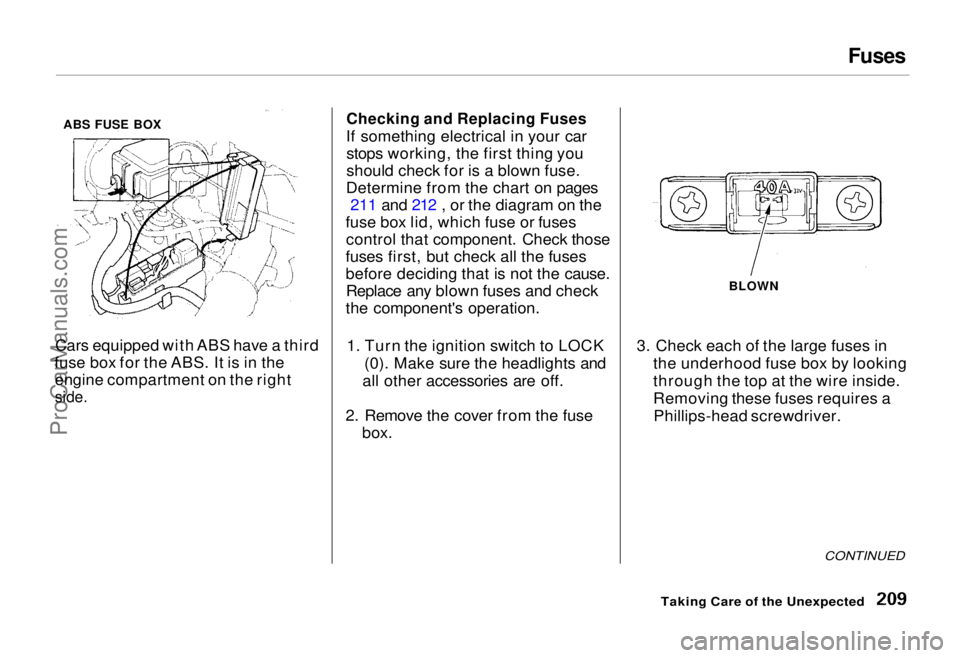
Cars equipped with ABS have a third
fuse box for the ABS. It is in the engine compartment on the right
side.
Checking and Replacing Fuses
If something electrical in your car stops working, the first thing you
should check for is a blown fuse.
Determine from the chart on pages 211 and 212 , or the diagram on the
fuse box lid, which fuse or fuses control that component. Check those
fuses first, but check all the fuses
before deciding that is not the cause. Replace any blown fuses and check
the component's operation.
1. Turn the ignition switch to LOCK (0). Make sure the headlights and
all other accessories are off.
2. Remove the cover from the fuse box. 3. Check each of the large fuses in
the underhood fuse box by looking
through the top at the wire inside.
Removing these fuses requires aPhillips-head screwdriver.
CONTINUED
Taking Care of the Unexpected
BLOWN
ABS FUSE BOXProCarManuals.comMain Menu Table of Contents s t
Page 213 of 240
Technical Information
The diagrams in this section give you the dimensions and capacities of
your Honda, and the locations of theidentification numbers. The expla-
nations of several electronic and
mechanical systems on your Hondaare for the more technically-oriented
owner. Identification Numbers................. 216
Specifications................................. 218
Anti-lock Brake System................ 220
Tire Information............................ 221 Tire Size Designation................ 221Wheel Size Designation............ 221
Tire Speed Ratings.................... 221
Tire Pressure Adjustment For High Speed Driving........ 222
DOT Tire Quality Grading....... 222 Treadwear.............................. 222
Traction.................................. 223
Temperature.......................... 223 Emission Controls......................... 224
The Clean Air Act...................... 224Crankcase Emission Control System..................................... 224
Evaporative Emission Control System..................................... 224
Exhaust Emission Controls...... 225 PGM-FI System..................... 225
Ignition Timing Control
System................................ 225
Exhaust Gas Recirculation (EGR) System.................... 225
Three Way Catalytic
Converter............................ 225
Replacement Parts..................... 225
Three Way Catalytic Converter... 226
Technical InformationProCarManuals.comMain Menu s t