Page 134 of 240
Maintenance
This section explains why it is important to keep your car well
maintained and to follow basic
maintenance safety precautions.
This section also includes Maintenance Schedules for normal
driving and severe driving conditions,
a Maintenance Record, and
instructions for simple maintenance
tasks you may want to take care of
yourself.
If you have the skills and tools
required to perform more complex
maintenance tasks on your Honda,
you may want to purchase the Service Manual. See page 233 for
information on how to obtain a copy, or see your Honda dealer.
Maintenance Safety....................... 136
Maintenance Schedule.................. 138
Maintenance Record..................... 142
Periodic Checks............................. 144
Fluid Locations............................... 145
Engine Oil....................................... 146
Checking Engine Oil................. 146
Adding......................................... 146
Recommended Oil..................... 147
Additives..................................... 148
Oil and Filter Changes.............. 148
Cooling System.............................. 150
Checking the Engine Coolant
Level........................................ 150
Adding Engine Coolant............. 151
Replacing Engine Coolant........ 152
Windshield Washers..................... 154
Automatic Transmission Fluid..... 155
Brake Fluid..................................... 156
Brake System............................. 156
Anti-lock Brake System............ 157
Power Steering............................... 157
Air Cleaner..................................... 158
Spark Plugs..................................... 160
Replacement............................... 160
Specification............................... 161
Battery............................................ 162
Windshield Wipers........................ 165
Air Conditioning............................. 168 Drive Belts...................................... 169
Tires................................................ 169 Inflation....................................... 170
Inspection................................... 171
Maintenance............................... 171
Tire Rotation.............................. 172 Replacing Tires and Wheels .... 172
Wheels and Tires....................... 173
Winter Driving........................... 173 Snow Tires.............................. 174
Tire Chains............................. 174
Lights.............................................. 175 Headlight Aiming...................... 175
Replacing Bulbs......................... 177
Storing Your Car............................ 182
MaintenanceProCarManuals.comMain Menu s t
Page 144 of 240
Fluid Locations
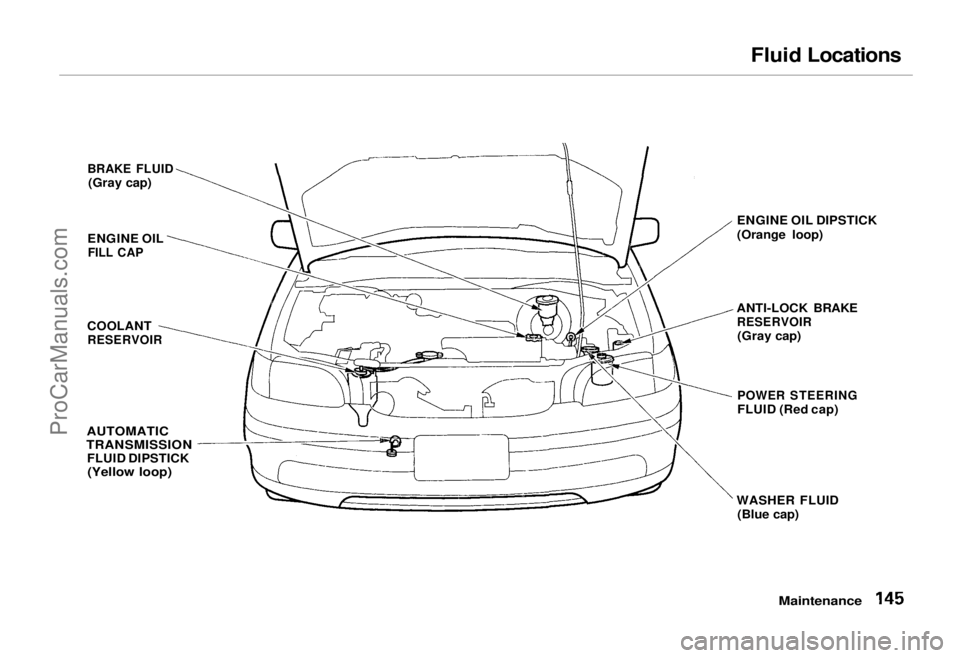
BRAKE FLUID
(Gray cap)
ENGINE OIL
FILL CAP
COOLANT
RESERVOIR
AUTOMATIC
TRANSMISSION
FLUID DIPSTICK
(Yellow loop)
ENGINE OIL DIPSTICK
(Orange loop)
ANTI-LOCK BRAKE
RESERVOIR
(Gray cap)
POWER STEERING
FLUID (Red cap)
WASHER FLUID (Blue cap)
MaintenanceProCarManuals.comMain Menu Table of Contents s t
Page 150 of 240
Cooling System
Adding Engine Coolant If the reserve tank is completelyempty, you should also check the
coolant level in the radiator.
1. Make sure the engine and radiator
are cool.
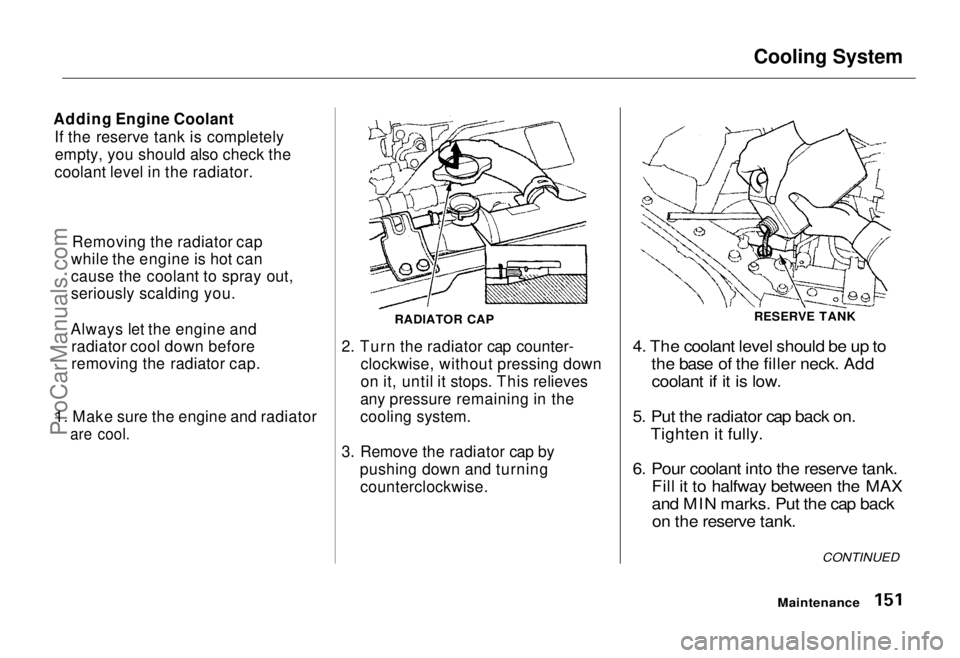
RADIATOR CAP
2. Turn the radiator cap counter- clockwise, without pressing down
on it, until it stops. This relieves
any pressure remaining in the
cooling system.
3. Remove the radiator cap by pushing down and turningcounterclockwise.
4. The coolant level should be up to
the base of the filler neck. Addcoolant if it is low.
5. Put the radiator cap back on. Tighten it fully.
6. Pour coolant into the reserve tank. Fill it to halfway between the MAX
and MIN marks. Put the cap backon the reserve tank.
Maintenance
RESERVE TANK
Removing the radiator cap
while the engine is hot can
cause the coolant to spray out,
seriously scalding you.
Always let the engine and radiator cool down before
removing the radiator cap.
CONTINUEDProCarManuals.comMain Menu Table of Contents s t
Page 151 of 240
Cooling System
Do not add any rust inhibitors or other additives to your car's cooling
system. They may not be compatible
with the coolant or engine compo- nents.
Replacing Engine Coolant
The cooling system should be completely drained and refilled with
new coolant according to the time
and distance recommendations in
the maintenance schedule. Only use
recommended antifreeze.
Draining the coolant requires access
to the underside of the car. Unless
you have the tools and knowledge,
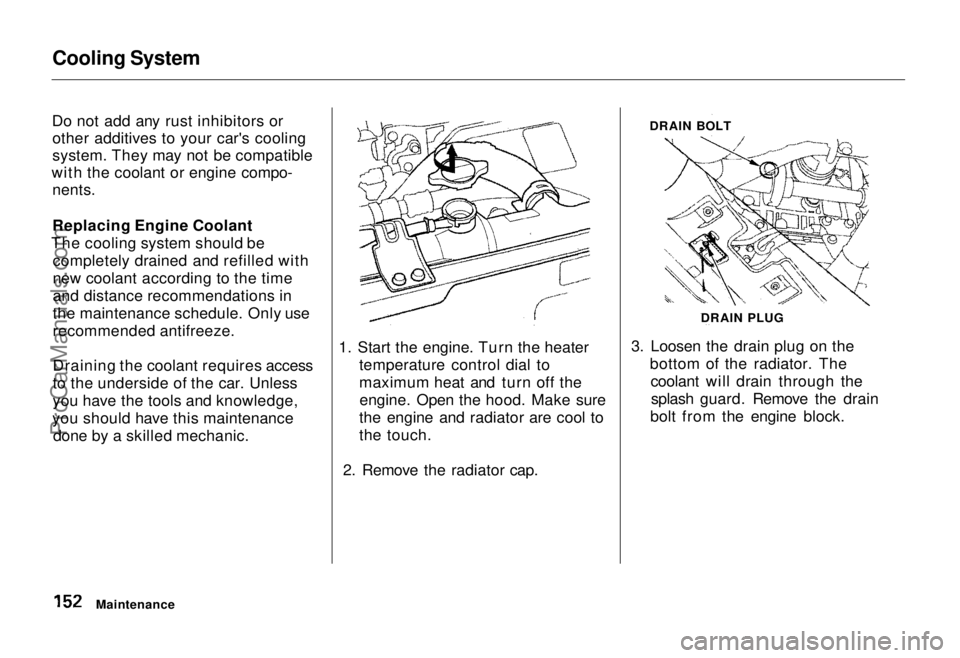
you should have this maintenance done by a skilled mechanic. 1. Start the engine. Turn the heater
temperature control dial to
maximum heat and turn off theengine. Open the hood. Make sure
the engine and radiator are cool to
the touch.
2. Remove the radiator cap. DRAIN BOLT
3. Loosen the drain plug on the bottom of the radiator. Thecoolant will drain through thesplash guard. Remove the drain
bolt from the engine block.
Maintenance DRAIN PLUGProCarManuals.comMain Menu Table of Contents s t
Page 152 of 240
Cooling System
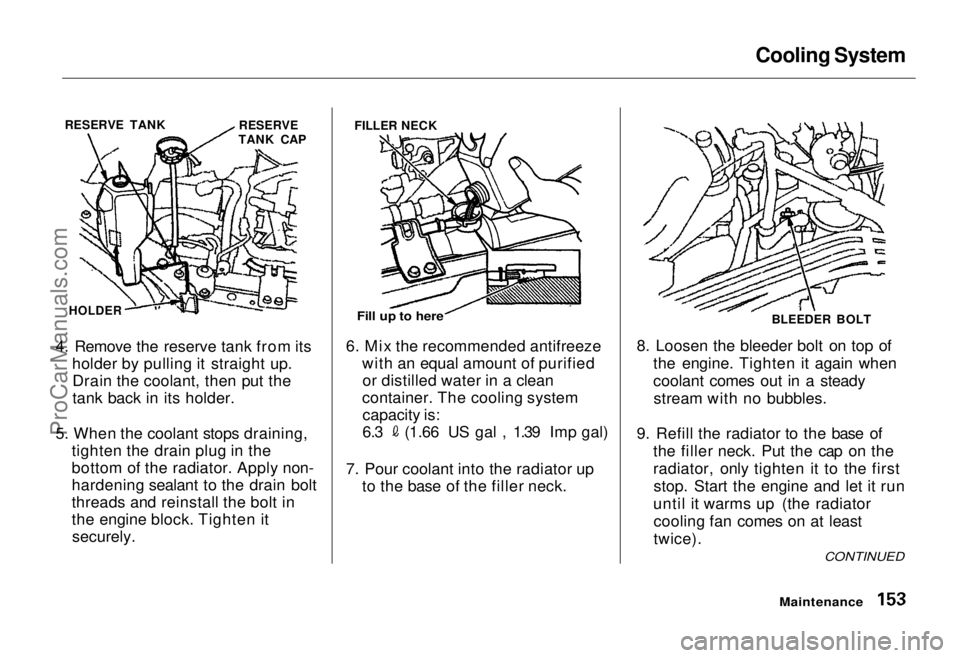
RESERVE TANK RESERVE
TANK CAP
HOLDER
4. Remove the reserve tank from its holder by pulling it straight up.Drain the coolant, then put the
tank back in its holder.
5. When the coolant stops draining, tighten the drain plug in the
bottom of the radiator. Apply non-
hardening sealant to the drain bolt
threads and reinstall the bolt in
the engine block. Tighten it
securely.
FILLER NECK
Fill up to here
6. Mix the recommended antifreeze with an equal amount of purifiedor distilled water in a clean
container. The cooling system capacity is: 6.3
(1.66 US gal , 1.39 Imp gal)
7. Pour coolant into the radiator up to the base of the filler neck. 8. Loosen the bleeder bolt on top of
the engine. Tighten it again when
coolant comes out in a steadystream with no bubbles.
9. Refill the radiator to the base of the filler neck. Put the cap on the
radiator, only tighten it to the firststop. Start the engine and let it run
until it warms up (the radiator cooling fan comes on at least
twice).
Maintenance
BLEEDER BOLT
CONTINUEDProCarManuals.comMain Menu Table of Contents s t
Page 155 of 240
Brake Fluid
Check the fluid level in the reser-
voirs monthly. There are one or two reservoirs, depending on model.
They are: Brake fluid reservoir (all models)
ABS reservoir (cars with ABS)
The brake fluid in the brake and Anti-lock brake systems should be
replaced every 2 years or 48,000 km
(30,000 miles), whichever comes
first.
Brake System
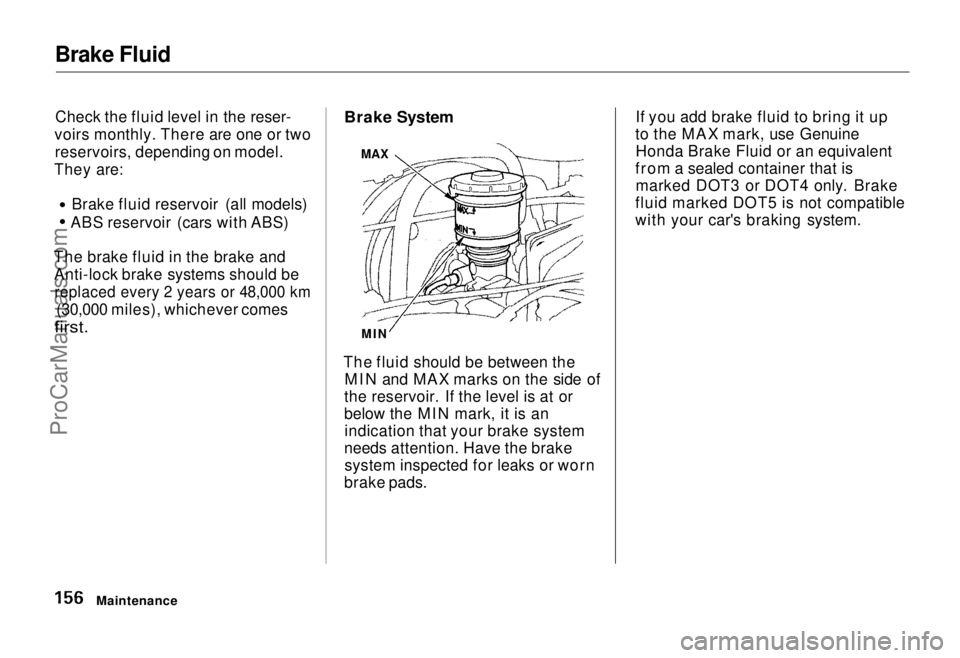
MAX
MIN
The fluid should be between the MIN and MAX marks on the side of
the reservoir. If the level is at or
below the MIN mark, it is an indication that your brake system
needs attention. Have the brake system inspected for leaks or worn
brake pads. If you add brake fluid to bring it up
to the MAX mark, use Genuine Honda Brake Fluid or an equivalent
from a sealed container that is marked DOT3 or DOT4 only. Brake
fluid marked DOT5 is not compatible
with your car's braking system.
MaintenanceProCarManuals.comMain Menu Table of Contents s t
Page 156 of 240
Brake Fluid, Power Steering
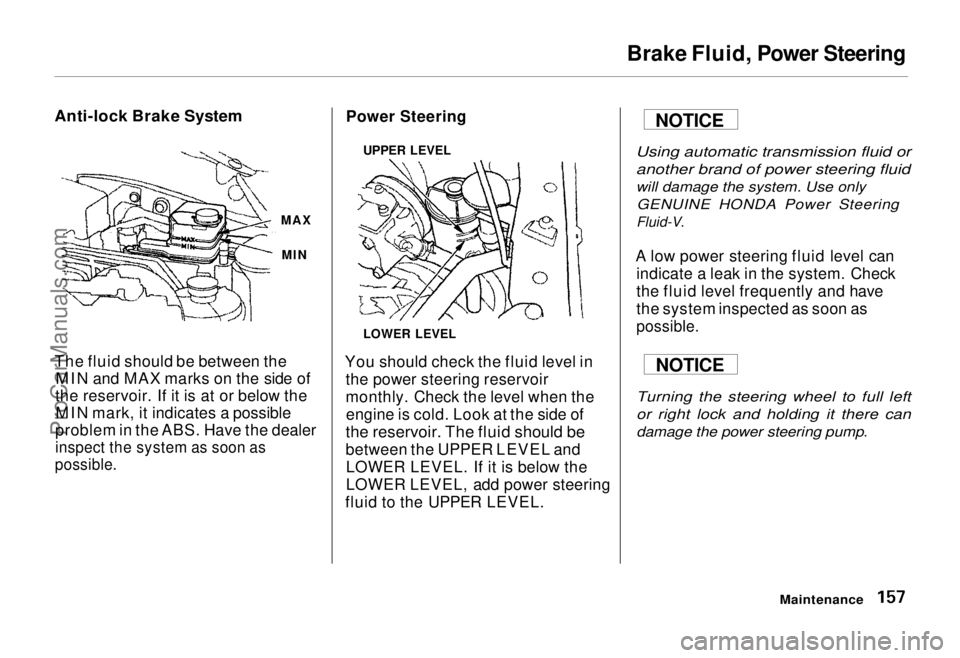
Anti-lock Brake System
The fluid should be between the MIN and MAX marks on the side of
the reservoir. If it is at or below the MIN mark, it indicates a possible
problem in the ABS. Have the dealer
inspect the system as soon as
possible.
Power Steering
You should check the fluid level in the power steering reservoir
monthly. Check the level when theengine is cold. Look at the side of
the reservoir. The fluid should be
between the UPPER LEVEL and LOWER LEVEL. If it is below the
LOWER LEVEL, add power steering
fluid to the UPPER LEVEL. A low power steering fluid level can
indicate a leak in the system. Check
the fluid level frequently and have
the system inspected as soon as
possible.
Maintenance
NOTICETurning the steering wheel to full left
or right lock and holding it there can
damage the power steering pump.
NOTICE
UPPER LEVE
L
MAX MIN
LOWER LEVEL
Using automatic transmission fluid or
another brand of power steering fluid
will damage the system. Use only
GENUINE HONDA Power Steering
Fluid-V.
ProCarManuals.comMain Menu Table of Contents s t
Page 158 of 240
Air Cleaner
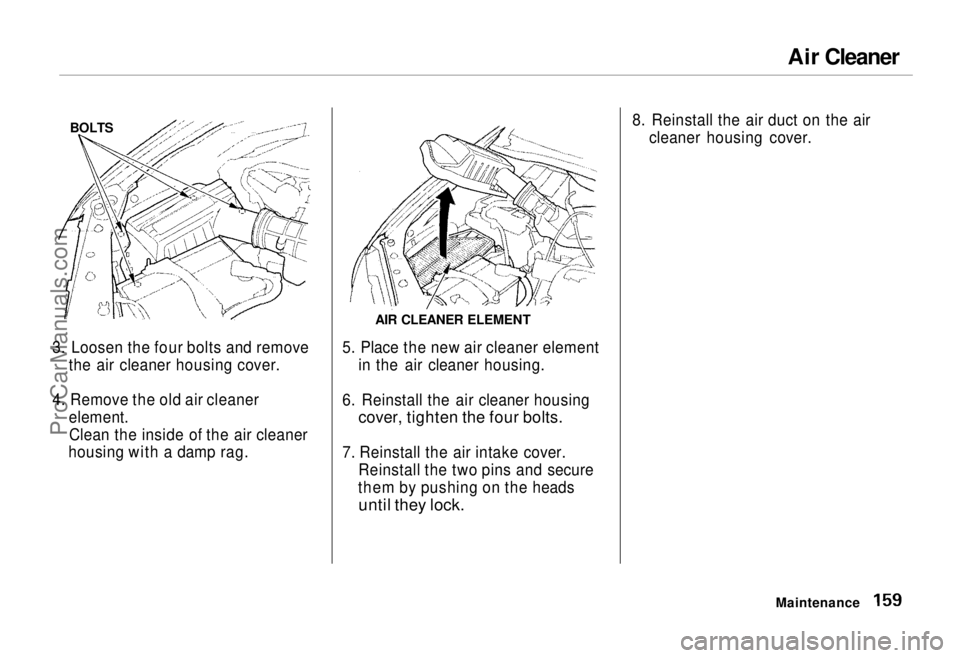
3. Loosen the four bolts and remove the air cleaner housing cover.
4. Remove the old air cleaner element.Clean the inside of the air cleaner
housing with a damp rag.
AIR CLEANER ELEMENT
5. Place the new air cleaner element in the air cleaner housing.
6. Reinstall the air cleaner housing
cover, tighten the four bolts.
7. Reinstall the air intake cover. Reinstall the two pins and secure
them by pushing on the heads
until they lock.
8. Reinstall the air duct on the air
cleaner housing cover.
Maintenance
BOLTSProCarManuals.comMain Menu Table of Contents s t