Page 198 of 240
If Your Engine Won't Start
Diagnosing why your engine won't
start falls into two areas, depending
on what you hear when you turn the
key to START (III):
You hear nothing, or almostnothing. The engine's starter
motor does not operate at all, or operates very slowly.
You can hear the starter motor operating normally, but the engine
does not start up and run. Nothing Happens or the Starter
Motor Operates Very Slowly
When you turn the ignition switch to START (III), you do not hear the
normal noise of the engine trying to start. You may hear a clicking sound
or series of clicks, or nothing at all.
Check these things:
Check the transmission interlock.
The transmission must be in Park or Neutral or the starter will not
operate.
Turn the ignition switch to ON (II).
Turn on the headlights and check their brightness. If the headlights
are very dim or don't light at all,
the battery is discharged. See
Jump Starting on page 200 .
Turn the ignition switch to START
(III). If the headlights do not dim,
check the condition of the fuses. If
the fuses are OK, there is proba-
bly something wrong with the electrical circuit for the ignition
switch or starter motor. You will
need a qualified technician to determine the problem. (See
Towing on page 213 .)
If the headlights dim noticeably or
go out when you try to start the engine, either the battery is dis-
charged or the connections are
corroded. Check the condition of
the battery and terminal connec-
tions (see page 162 ). You can
then try jump starting the car from a booster battery (see page 200 ).
Taking Care of the UnexpectedProCarManuals.comMain Menu Table of Contents s t
Page 199 of 240
If Your Engine Won't Start, Jump Starting
The Starter Operates Normally In this case, the starter motorsounds normal when you turn the
ignition switch to START (III), but
the engine does not run.
Are you using the proper startingprocedure? Refer to Starting the
Engine on page 119 .
Do you have fuel? Turn the
ignition switch to ON (II) for a
minute and watch the fuel gauge.
The low fuel level warning light may not be working, so you were
not reminded to fill the tank.
There may be an electrical problem, such as no power to the
fuel pump. Check all the fuses (see page 208 ).
If you find nothing wrong, you will
need a qualified technician to find
the problem. See Towing on page 213. Jump Starting
If your car's battery has run clown,
you may be able to start the engine by using a booster battery. Although
this seems like a simple procedure,
there are several precautions youshould take. Follow the directions
closely.
You cannot start a Honda by pushing or pulling it. To jump start your car:
1. Open the hood and check the physical condition of the battery(see page 162 ). In very cold
weather, check the condition of
the electrolyte. If it seems slushy or like ice, do not try jump starting
until it thaws.
Taking Care of the Unexpected
If a battery sits in extreme cold, the
electrolyte inside can freeze.
Attempting to lump start with a frozen battery can cause it to rupture or
explode.
2. Turn off all the electrical acces- sories: heater, A/C, stereo system,
lights, etc.
Put the transmission in Neutral or
Park and set the parking brake.
A battery can explode if you do
not follow the correct procedure,
seriously injuring anyone nearby.
Keep all sparks, open flames,
and smoking materials away
from the battery.ProCarManuals.comMain Menu Table of Contents s t
Page 200 of 240
Jump Starting
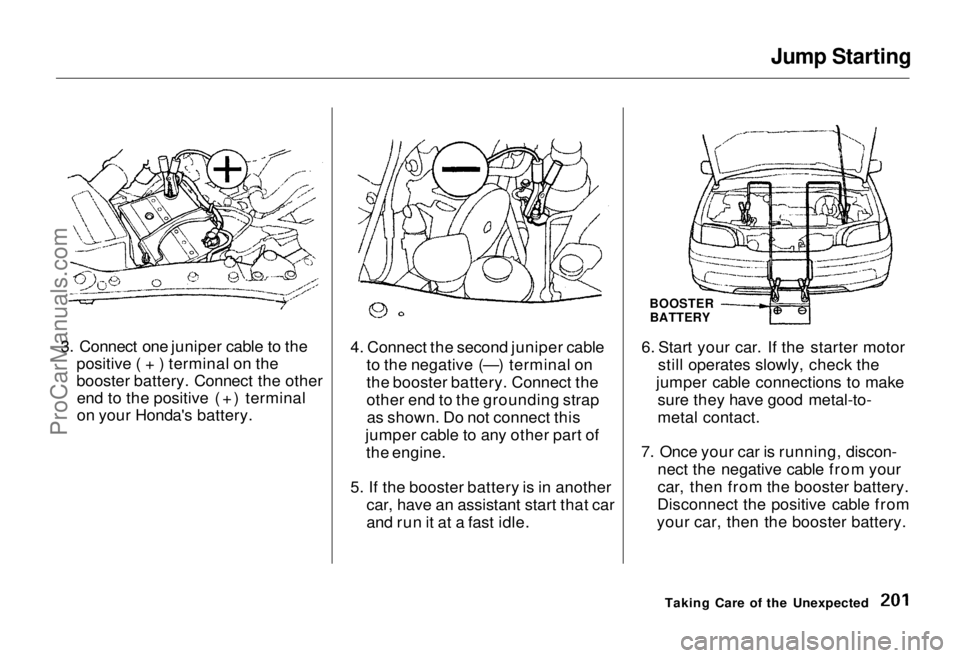
3. Connect one juniper cable to the positive ( + ) terminal on the
booster battery. Connect the otherend to the positive (+) terminal
on your Honda's battery. 4. Connect the second juniper cable
to the negative (—) terminal on
the booster battery. Connect the
other end to the grounding strapas shown. Do not connect this
jumper cable to any other part of the engine.
5. If the booster battery is in another car, have an assistant start that car
and run it at a fast idle. 6. Start your car. If the starter motor
still operates slowly, check the
jumper cable connections to make sure they have good metal-to-
metal contact.
7. Once your car is running, discon- nect the negative cable from your
car, then from the booster battery.
Disconnect the positive cable from
your car, then the booster battery.
Taking Care of the Unexpected
BOOSTER
BATTERYProCarManuals.comMain Menu Table of Contents s t
Page 201 of 240
If Your Engine Overheats
The pointer of your car's tempera- ture gauge should stay in the mid-
range under most conditions. It may
go higher if you are driving up a long steep hill on a very hot day. If it
climbs to the red mark, you should
determine the reason.
Driving with the temperature gauge
pointer at the red mark can cause serious damage to your engine. Your car can overheat for several
reasons, such as lack of coolant or a
mechanical problem. The only
indication may be the temperature
gauge climbing to or above the red mark. Or you may sec steam or
spray coming from under the hood.
In either case, you should take
immediate action.
1. Safely pull to the side of the road.
Put the transmission in neutral or
park and set the parking brake.
Turn off the heating and cooling system and all other accessories.
Turn on the hazard warning indicators.
2. If you see steam and/or spray coming from under the hood, turn
off the engine.
3. If you do not see steam or spray, leave the engine running and
watch the temperature gauge. If the high heat is due to overloading (climbing a long, steep hill on a
hot day with the A/C running, for example), the engine should start
to cool down almost immediately. If it does, wait until the tempera-
ture gauge comes down to the mid-
point then continue driving.
Taking Care of the Unexpected
NOTICE
Steam and spray from an
overheated engine can
seriously scald you.Do not open the hood if steam
is coming out.ProCarManuals.comMain Menu Table of Contents s t
Page 202 of 240
If Your Engine Overheats
4. If the temperature gauge stays at the red mark, turn off the engine.
5. Wait until you see no more signs of steam or spray, then open the
hood.
6. Look for any obvious coolant leaks, such as a split radiator hose.
Everything is still extremely hot, so use caution. If you find a leak, it
must be repaired before you
continue driving (see Towing on
page 213).
7. If you don't find an obvious leak, check the coolant level in the
radiator reserve tank (see page 150). If the level is below the
MIN mark, add coolant to half-way
between the MIN and MAX marks.
8. If there was no coolant in the reserve tank, you may also have to
add coolant to the radiator. Let the
engine cool down until the pointer reaches the middle of the tempera-
ture gauge, or lower, before check-
ing the radiator.
9. Using gloves or a large heavy cloth, turn the radiator cap
counterclockwise, without pushing
down, to the first stop. This
releases any remaining pressure in
the cooling system. After the
pressure releases, push down on
the cap and turn it until it comes
off.
10.Start the engine and set the
temperature control lever to
maximum. Add coolant to the
radiator up to the base of the filler
neck. If you do not have the proper coolant mixture available,
you can add plain water. Remember to have the coolingsystem drained and refilled with
the proper mixture as soon as you
can.
11. Put the radiator cap back on tightly. Run the engine and watch
the temperature gauge. If it goes
back to the red mark, the engine needs repair. (See Towing on
page 213.)
12.If the temperature stays normal, check the coolant level in the
radiator reserve tank. If it has
gone down, add coolant to the MAX mark. Put the cap back on
tightly.
Taking Care of the Unexpected
Removing the radiator cap
while the engine is hot can cause the coolant to spray out,
seriously scalding you.
Always let the engine and radiator cool down before
removing the radiator cap.ProCarManuals.comMain Menu Table of Contents s t
Page 203 of 240
Low Oil Pressure
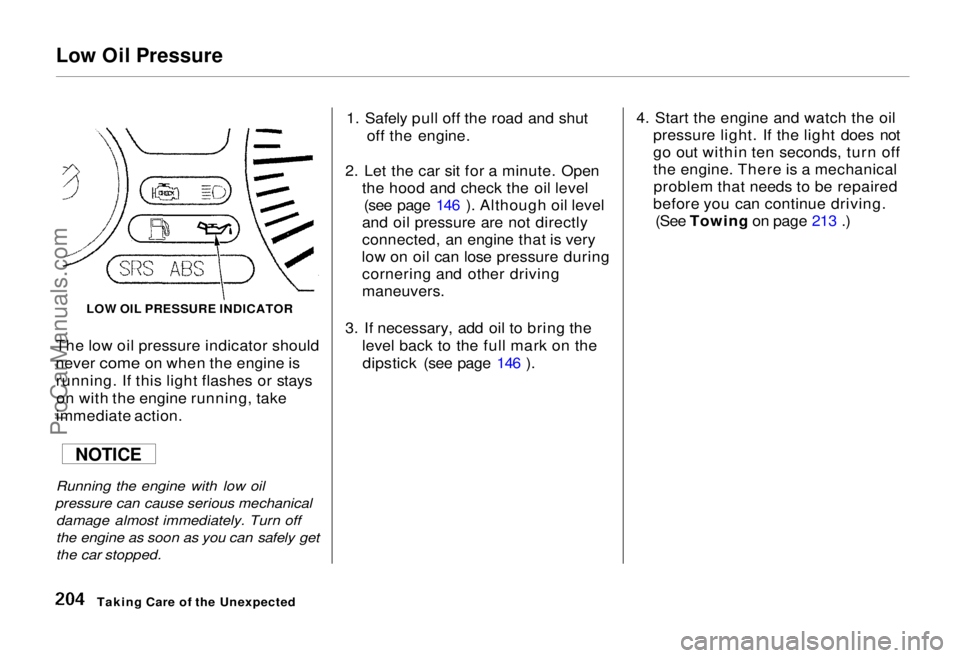
The low oil pressure indicator should
never come on when the engine is
running. If
this light flashes or stays
on with the engine running, take
immediate action.
Running the engine with low oil
pressure can cause serious mechanical
damage almost immediately. Turn off
the engine as soon as you can safely get
the car stopped.
1. Safely pull off the road and shut
off the engine.
2. Let the car sit for a minute. Open the hood and check the oil level(see page 146 ). Although oil level
and oil pressure are not directly
connected, an engine that is very
low on oil can lose pressure during cornering and other driving
maneuvers.
3. If necessary, add oil to bring the level back to the full mark on thedipstick (see page 146 ). 4. Start the engine and watch the oil
pressure light. If the light does not
go out within ten seconds, turn off
the engine. There is a mechanicalproblem that needs to be repaired
before you can continue driving. (See Towing on page 213 .)
Taking Care of the Unexpected
LOW OIL PRESSURE INDICATOR
NOTICEProCarManuals.comMain Menu Table of Contents s t
Page 204 of 240
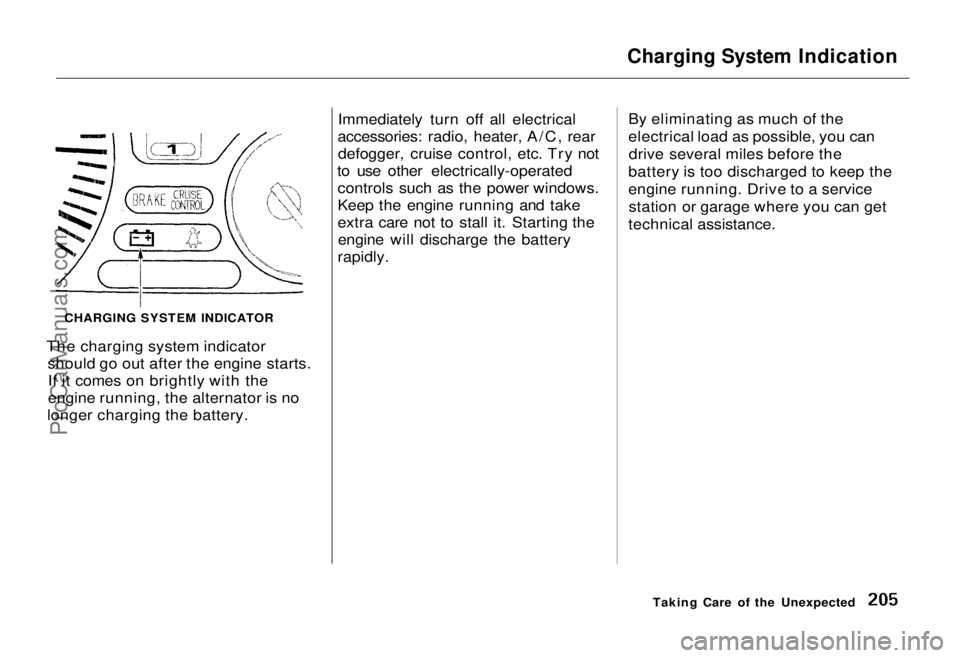
Charging System Indication
The charging system indicator should go out after the engine starts.If it comes on brightly with the
engine running, the alternator is no
longer charging the battery. Immediately turn off all electrical
accessories: radio, heater, A/C, rear defogger, cruise control, etc. Try not
to use other electrically-operated controls such as the power windows.
Keep the engine running and take
extra care not to stall it. Starting theengine will discharge the battery
rapidly. By eliminating as much of the
electrical load as possible, you can
drive several miles before the
battery is too discharged to keep the
engine running. Drive to a service station or garage where you can get
technical assistance.
Taking Care of the Unexpected
CHARGING SYSTEM INDICATORProCarManuals.comMain Menu Table of Contents s t
Page 205 of 240
Malfunction Indicator Lamp/Check Engine Light
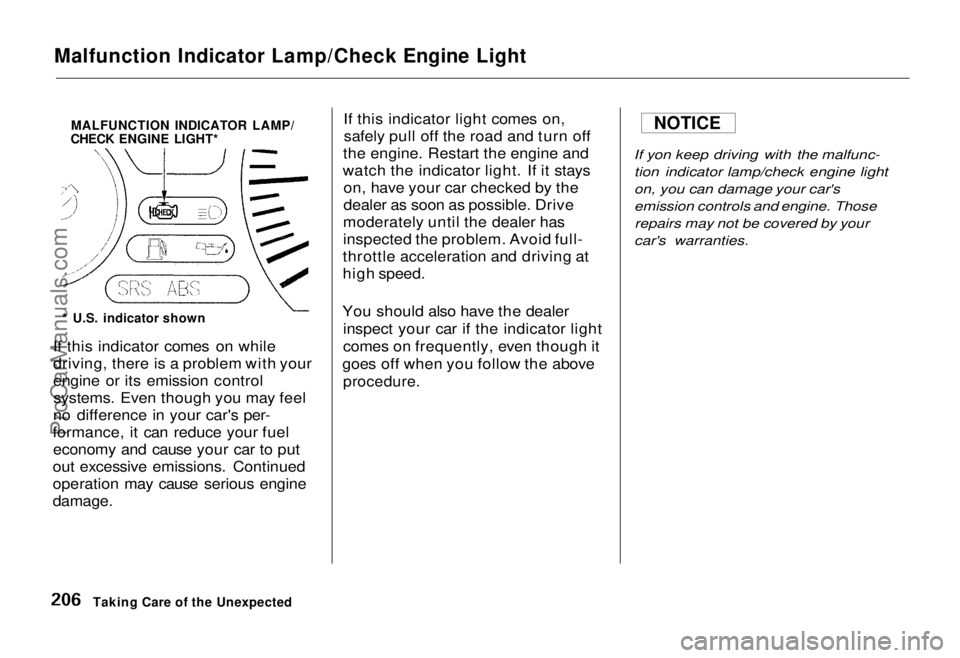
MALFUNCTION INDICATOR LAMP/
CHECK ENGINE LIGHT*
* U.S. indicator shown
If this indicator comes on while
driving, there is a problem with your
engine or its emission control systems. Even though you may feel
no difference in your car's per-
formance, it can reduce your fuel economy and cause your car to put
out excessive emissions. Continued
operation may cause serious engine
damage.
If this indicator light comes on,
safely pull off the road and turn off
the engine. Restart the engine and
watch the indicator light. If it stays on, have your car checked by the
dealer as soon as possible. Drive
moderately until the dealer has
inspected the problem. Avoid full-
throttle acceleration and driving at
high speed.
You should also have the dealer inspect your car if the indicator light
comes on frequently, even though it
goes off when you follow the above
procedure.
If yon keep driving with the malfunc-
tion indicator lamp/check engine light
on, you can damage your car's
emission controls and engine. Thoserepairs may not be covered by your
car's warranties.
Taking Care of the Unexpected NOTICEProCarManuals.comMain Menu Table of Contents s t