Page 148 of 240
Engine Oil
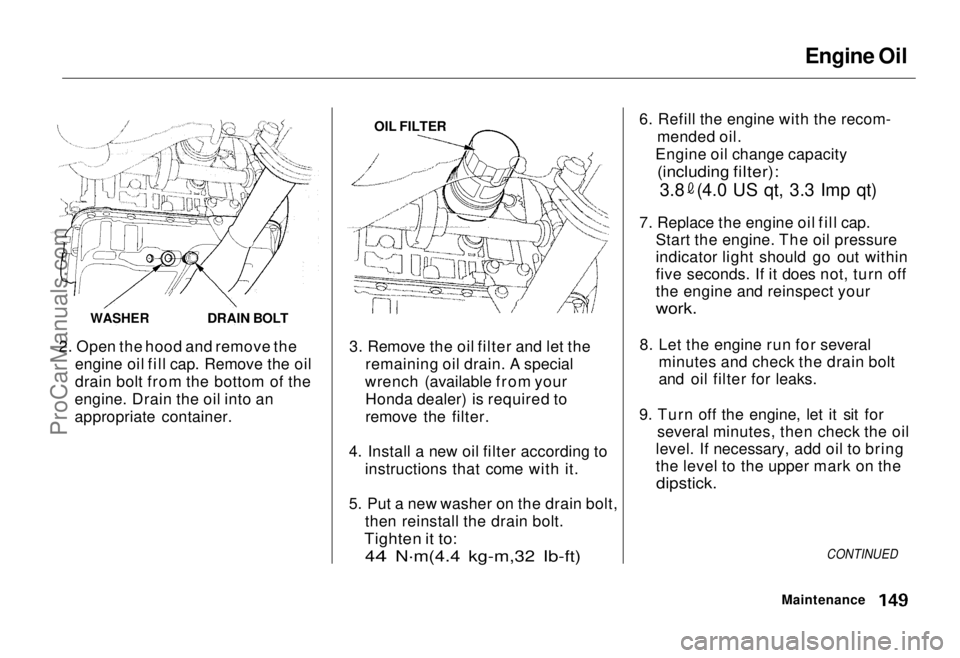
WASHER
DRAIN BOLT
2. Open
the hood and remove the
engine oil fill cap. Remove the oil
drain bolt from the bottom of the
engine. Drain the oil into an
appropriate container. OIL FILTER
3. Remove the oil filter and let the remaining oil drain. A special
wrench (available from your Honda dealer) is required to
remove the filter.
4. Install a new oil filter according to instructions that come with it.
5. Put a new washer on the drain bolt, then reinstall the drain bolt.
Tighten it to:
44 N .
m(4.4 kg-m,32 Ib-ft)
6. Refill the engine with the recom-
mended oil.
Engine oil change capacity
(including filter):
3.8 (4.0 US qt, 3.3 Imp qt)
7. Replace the engine oil fill cap.
Start the engine. The oil pressure
indicator light should go out within
five seconds. If it does not, turn off
the engine and reinspect your
work.
8. Let the engine run for several minutes and check the drain bolt
and oil filter for leaks.
9. Turn off the engine, let it sit for several minutes, then check the oil
level. If necessary, add oil to bring
the level to the upper mark on the
dipstick.
Maintenance
CONTINUED
ProCarManuals.comMain Menu Table of Contents s t
Page 149 of 240
Engine Oil, Cooling System
If you change Your own oil, please
dispose of the used oil properly. Put it
in a sealed container and take it to a
recycling center. Do not discard it in a
trash bin or dump it on the ground.
The oil and filter should be changed every 6 months or 12,000 km (7,500
miles), whichever comes first. Under severe driving conditions, they
should be changed every 3 months
or 6,000 km (3,750 miles). See page 137 for a description of severe
driving conditions. Checking the Engine Coolant
Level
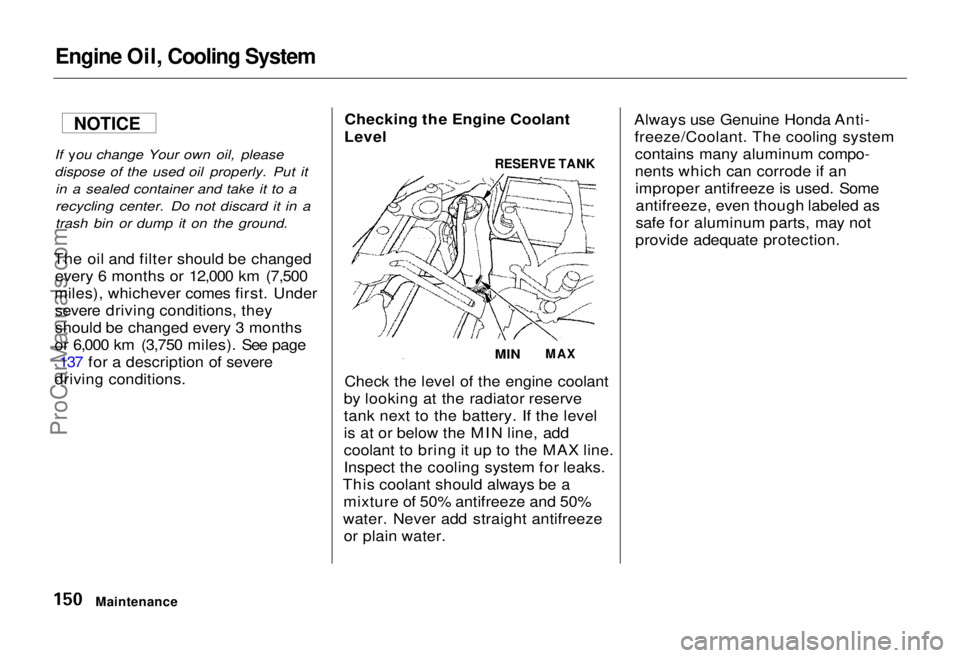
Check the level of the engine coolant
by looking at the radiator reserve
tank next to the battery. If the level
is at or below the MIN line, add
coolant to bring it up to the MAX line.
Inspect the cooling system for leaks.
This coolant should always be a mixture of 50% antifreeze and 50%
water. Never add straight antifreeze or plain water. Always use Genuine Honda Anti-
freeze/Coolant. The cooling systemcontains many aluminum compo-
nents which can corrode if animproper antifreeze is used. Someantifreeze, even though labeled as
safe for aluminum parts, may not
provide adequate protection.
Maintenance
NOTICE
RESERVE TANK
MIN
MAX
ProCarManuals.comMain Menu Table of Contents s t
Page 150 of 240
Cooling System
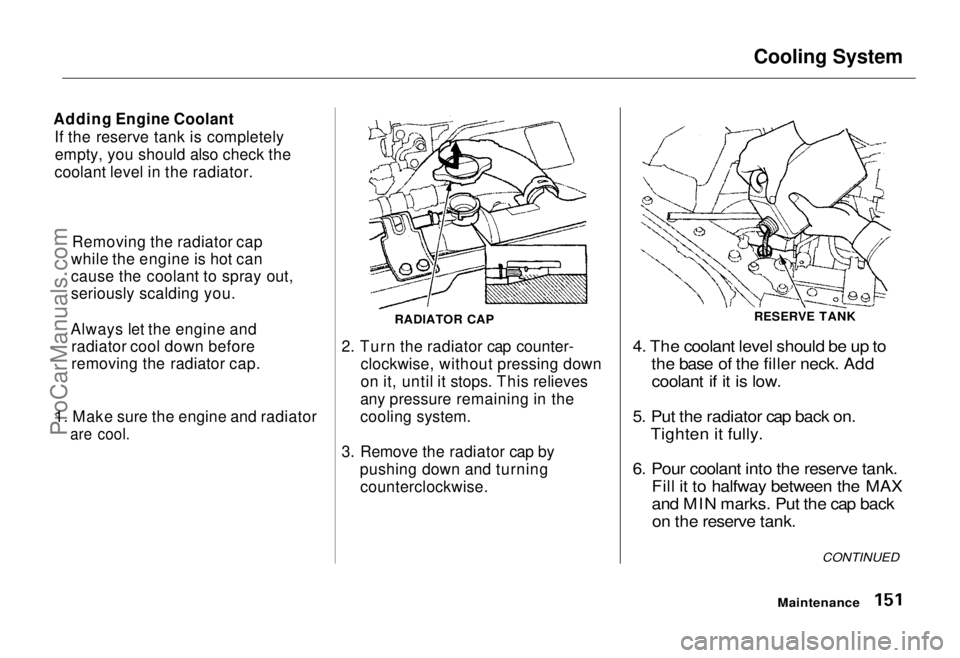
Adding Engine Coolant If the reserve tank is completelyempty, you should also check the
coolant level in the radiator.
1. Make sure the engine and radiator
are cool.
RADIATOR CAP
2. Turn the radiator cap counter- clockwise, without pressing down
on it, until it stops. This relieves
any pressure remaining in the
cooling system.
3. Remove the radiator cap by pushing down and turningcounterclockwise.
4. The coolant level should be up to
the base of the filler neck. Addcoolant if it is low.
5. Put the radiator cap back on. Tighten it fully.
6. Pour coolant into the reserve tank. Fill it to halfway between the MAX
and MIN marks. Put the cap backon the reserve tank.
Maintenance
RESERVE TANK
Removing the radiator cap
while the engine is hot can
cause the coolant to spray out,
seriously scalding you.
Always let the engine and radiator cool down before
removing the radiator cap.
CONTINUEDProCarManuals.comMain Menu Table of Contents s t
Page 151 of 240
Cooling System
Do not add any rust inhibitors or other additives to your car's cooling
system. They may not be compatible
with the coolant or engine compo- nents.
Replacing Engine Coolant
The cooling system should be completely drained and refilled with
new coolant according to the time
and distance recommendations in
the maintenance schedule. Only use
recommended antifreeze.
Draining the coolant requires access
to the underside of the car. Unless
you have the tools and knowledge,
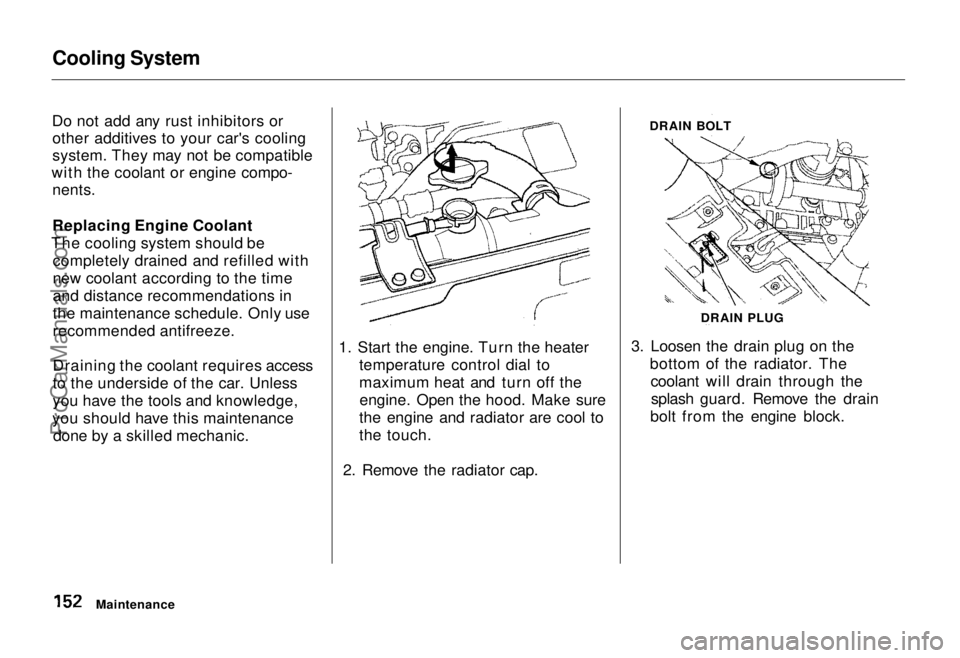
you should have this maintenance done by a skilled mechanic. 1. Start the engine. Turn the heater
temperature control dial to
maximum heat and turn off theengine. Open the hood. Make sure
the engine and radiator are cool to
the touch.
2. Remove the radiator cap. DRAIN BOLT
3. Loosen the drain plug on the bottom of the radiator. Thecoolant will drain through thesplash guard. Remove the drain
bolt from the engine block.
Maintenance DRAIN PLUGProCarManuals.comMain Menu Table of Contents s t
Page 152 of 240
Cooling System
RESERVE TANK RESERVE
TANK CAP
HOLDER
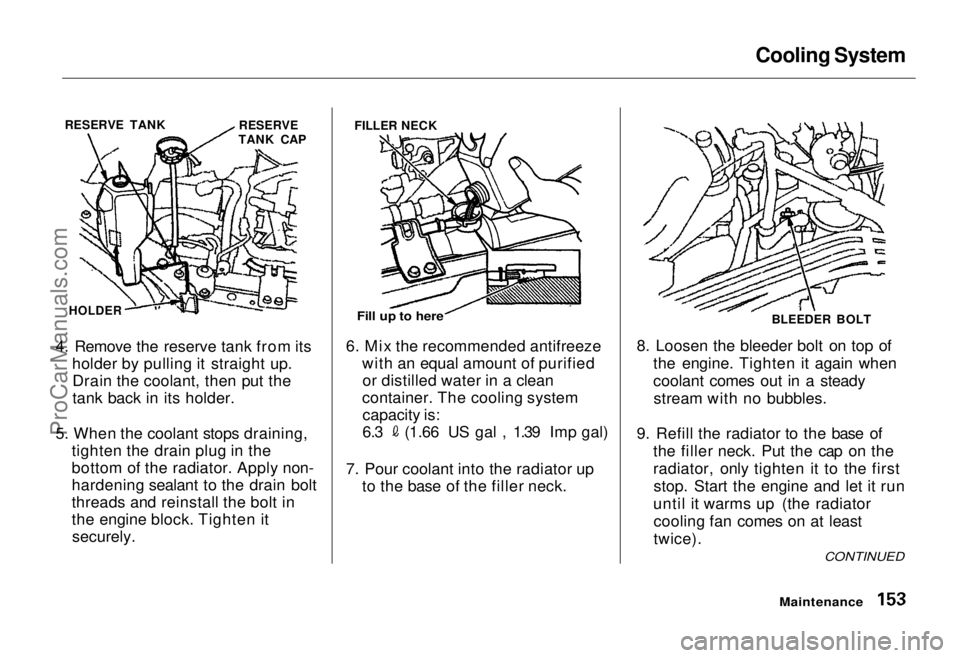
4. Remove the reserve tank from its holder by pulling it straight up.Drain the coolant, then put the
tank back in its holder.
5. When the coolant stops draining, tighten the drain plug in the
bottom of the radiator. Apply non-
hardening sealant to the drain bolt
threads and reinstall the bolt in
the engine block. Tighten it
securely.
FILLER NECK
Fill up to here
6. Mix the recommended antifreeze with an equal amount of purifiedor distilled water in a clean
container. The cooling system capacity is: 6.3
(1.66 US gal , 1.39 Imp gal)
7. Pour coolant into the radiator up to the base of the filler neck. 8. Loosen the bleeder bolt on top of
the engine. Tighten it again when
coolant comes out in a steadystream with no bubbles.
9. Refill the radiator to the base of the filler neck. Put the cap on the
radiator, only tighten it to the firststop. Start the engine and let it run
until it warms up (the radiator cooling fan comes on at least
twice).
Maintenance
BLEEDER BOLT
CONTINUEDProCarManuals.comMain Menu Table of Contents s t
Page 153 of 240
Cooling System, Windshield Washers
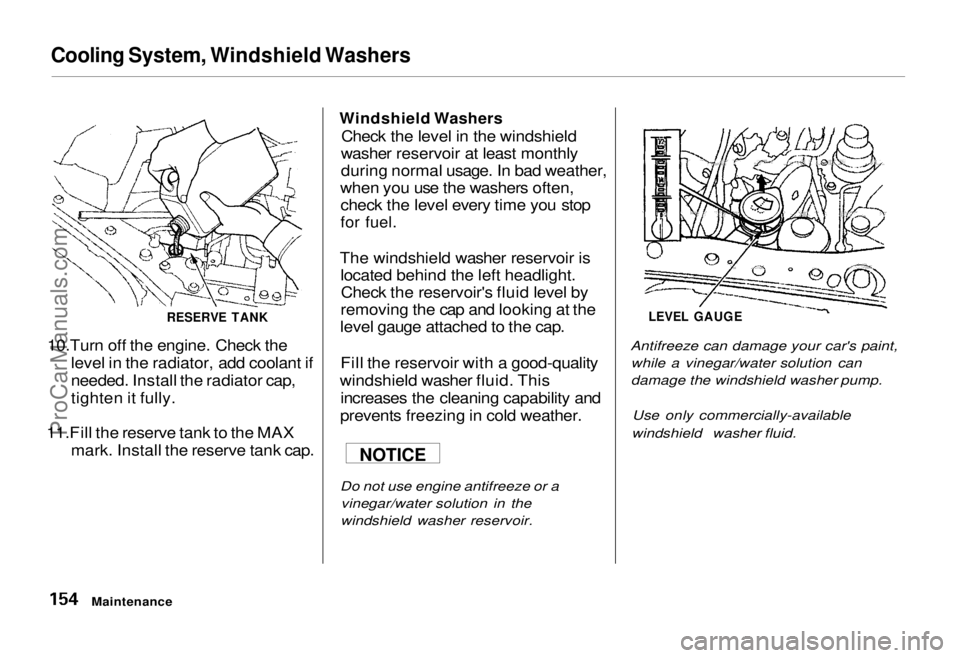
10.Turn off the engine. Check the level in the radiator, add coolant if needed. Install the radiator cap,
tighten it fully.
11.Fill the reserve tank to the MAX mark. Install the reserve tank cap.
Windshield Washers
Check the level in the windshield
washer reservoir at least monthly
during normal usage. In bad weather,
when you use the washers often, check the level every time you stop
for fuel.
The windshield washer reservoir is located behind the left headlight.Check the reservoir's fluid level by
removing the cap and looking at the
level gauge attached to the cap.
Fill the reservoir with a good-quality
windshield washer fluid. This increases the cleaning capability and
prevents freezing in cold weather.
Do not use engine antifreeze or a vinegar/water solution in the
windshield washer reservoir.
LEVEL GAUGE
Antifreeze can damage your car's paint, while a vinegar/water solution can
damage the windshield washer pump.
Use only commercially-available
windshield washer fluid.
Maintenance
RESERVE TANK
NOTICEProCarManuals.comMain Menu Table of Contents s t
Page 154 of 240
Automatic Transmission Fluid
Check the fluid level with the engine
at normal operating temperature.
1. Park the car on level ground. Shut off the engine.
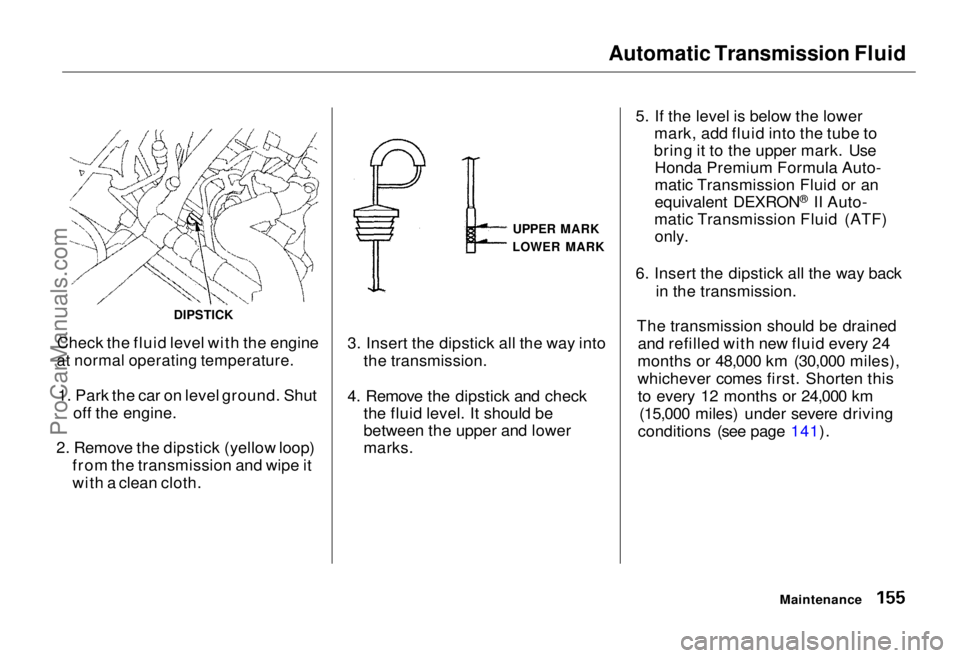
2. Remove the dipstick (yellow loop) from the transmission and wipe it
with a clean cloth.
UPPER MARK
3. Insert the dipstick all the way into the transmission.
4. Remove the dipstick and check the fluid level. It should be
between the upper and lower
marks. 5. If the level is below the lower
mark, add fluid into the tube to
bring it to the upper mark. Use Honda Premium Formula Auto-
matic Transmission Fluid or an
equivalent DEXRON ®
II Auto-
matic Transmission Fluid (ATF) only.
6. Insert the dipstick all the way back in the transmission.
The transmission should be drained and refilled with new fluid every 24
months or 48,000 km (30,000 miles),
whichever comes first. Shorten this to every 12 months or 24,000 km (15,000 miles) under severe driving
conditions (see page 141).
Maintenance
DIPSTICK
LOWER MARKProCarManuals.comMain Menu Table of Contents s t
Page 155 of 240
Brake Fluid
Check the fluid level in the reser-
voirs monthly. There are one or two reservoirs, depending on model.
They are: Brake fluid reservoir (all models)
ABS reservoir (cars with ABS)
The brake fluid in the brake and Anti-lock brake systems should be
replaced every 2 years or 48,000 km
(30,000 miles), whichever comes
first.
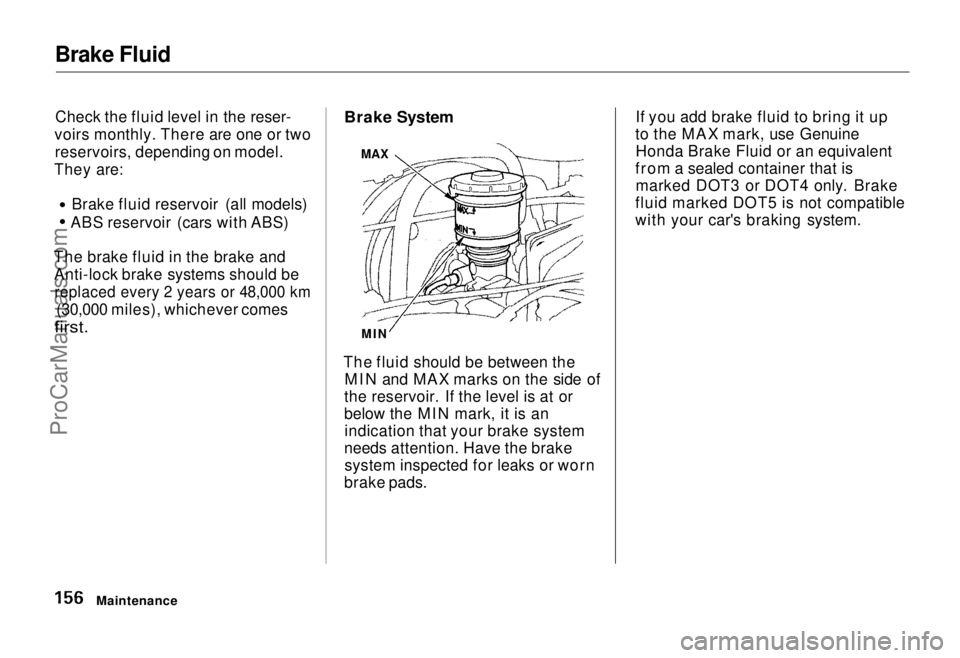
Brake System
MAX
MIN
The fluid should be between the MIN and MAX marks on the side of
the reservoir. If the level is at or
below the MIN mark, it is an indication that your brake system
needs attention. Have the brake system inspected for leaks or worn
brake pads. If you add brake fluid to bring it up
to the MAX mark, use Genuine Honda Brake Fluid or an equivalent
from a sealed container that is marked DOT3 or DOT4 only. Brake
fluid marked DOT5 is not compatible
with your car's braking system.
MaintenanceProCarManuals.comMain Menu Table of Contents s t