Page 140 of 240
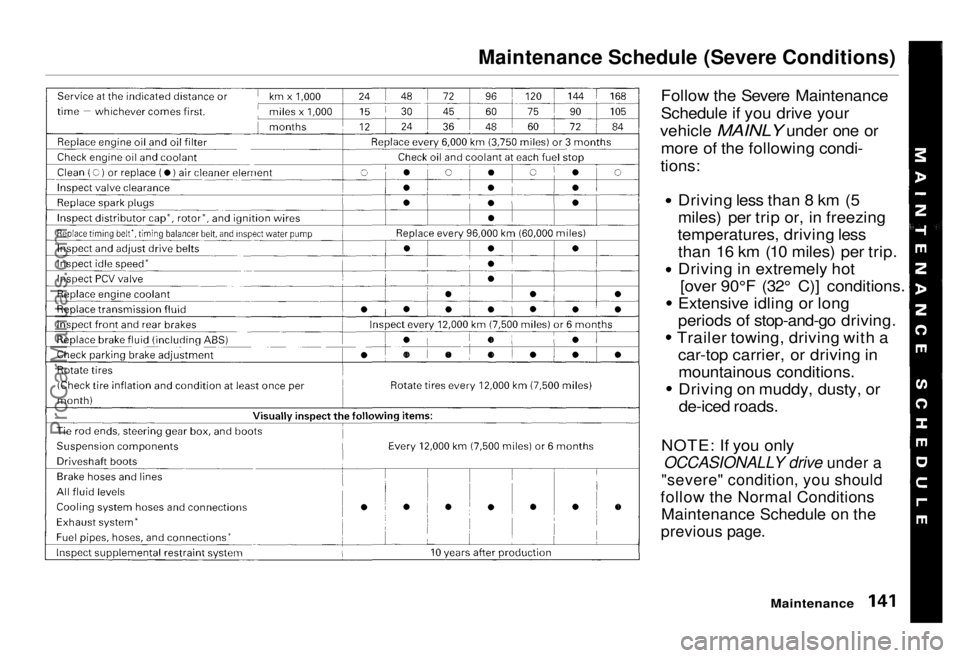
Maintenance Schedule (Severe Conditions)
Follow the Severe Maintenance
Schedule if you drive your
vehicle MAINLY under one or
more of the following condi-
tions:
Driving less than 8 km (5
miles) per trip or, in freezing
temperatures, driving less than 16 km (10 miles) per trip. Driving in extremely hot
[over 90°F (32° C)] conditions.
Extensive idling or long
periods of stop-and-go driving. Trailer towing, driving with a
car-top carrier, or driving inmountainous conditions. Driving on muddy, dusty, or
de-iced roads.
NOTE: If you only
OCCASIONALLY drive under a
"severe" condition, you should
follow the Normal Conditions Maintenance Schedule on the
previous page.
Maintenance
ProCarManuals.comMain Menu Table of Contents s t
Page 141 of 240
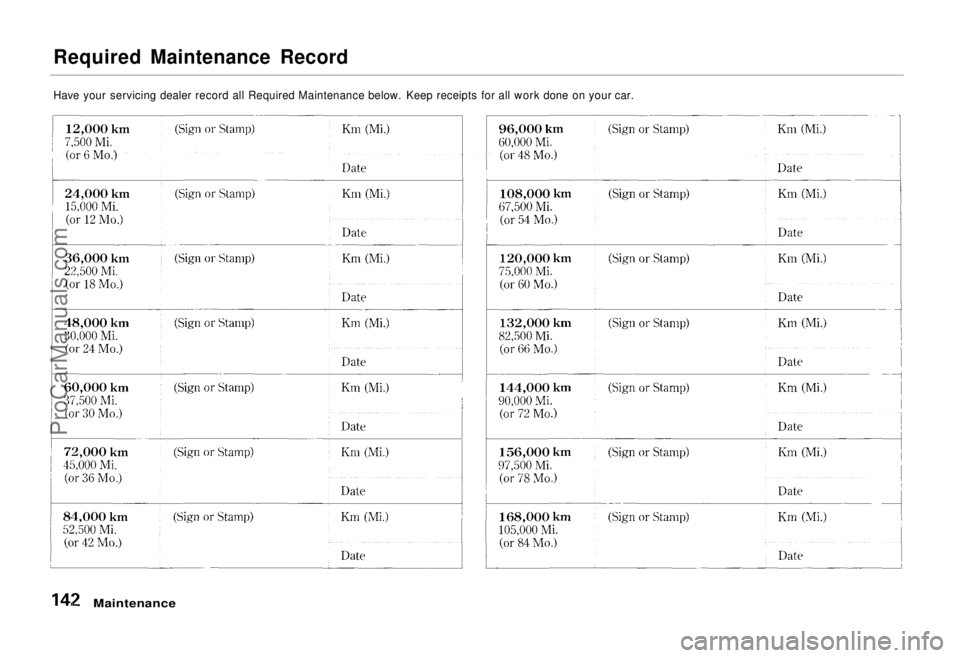
Required Maintenance Record
Maintenance
Have your servicing dealer record all Required Maintenance below. Keep receipts for all work done on your car.ProCarManuals.comMain Menu Table of Contents s t
Page 142 of 240
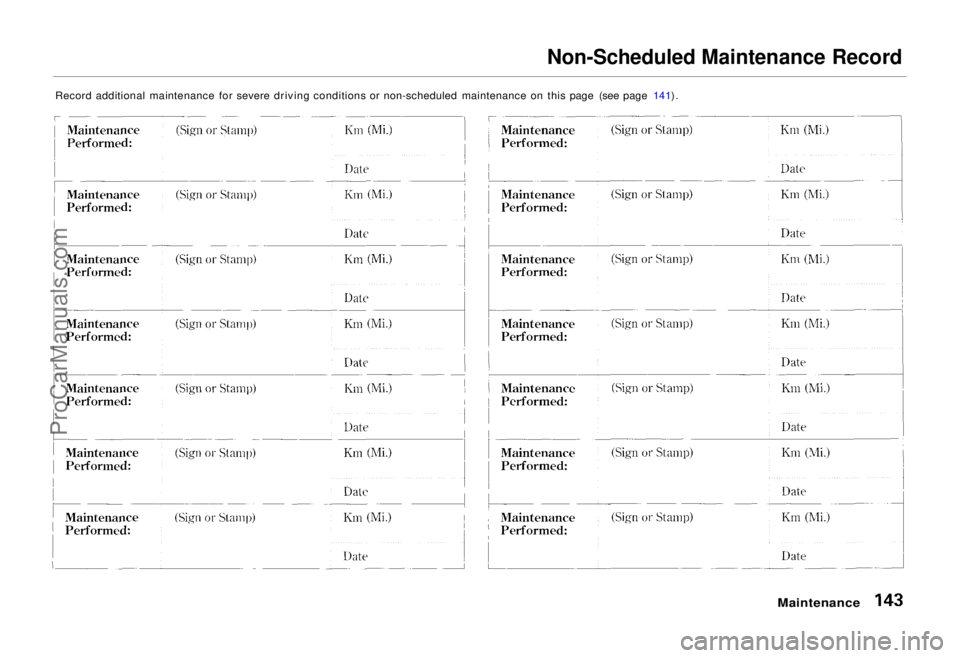
Non-Scheduled Maintenance Record
Maintenance
Record additional maintenance for severe driving conditions or non-scheduled maintenance on this page (see page 141).ProCarManuals.comMain Menu Table of Contents s t
Page 143 of 240
Periodic Checks
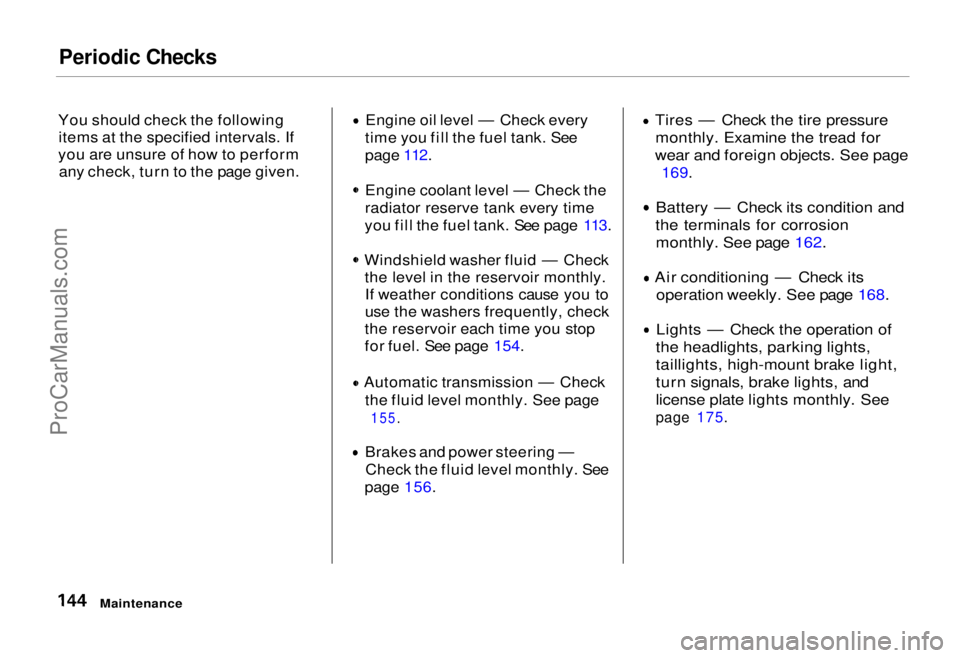
You should check the following items at the specified intervals. If
you are unsure of how to perform any check, turn to the page given. Engine oil level — Check every
time you fill the fuel tank. See
page 112.
Engine coolant level — Check the
radiator reserve tank every time
you fill the fuel tank. See page 113.
Windshield washer fluid — Check the level in the reservoir monthly.If weather conditions cause you to
use the washers frequently, check
the reservoir each time you stop
for fuel. See page 154. Automatic transmission — Check
the fluid level monthly. See page
155.
Brakes and power steering —
Check the fluid level monthly. See
page 156.
Tires — Check the tire pressure
monthly. Examine the tread for
wear and foreign objects. See page
169.
Battery — Check its condition and
the terminals for corrosion monthly. See page 162. Air conditioning — Check its
operation weekly. See page 168. Lights — Check the operation of
the headlights, parking lights,
taillights, high-mount brake light,
turn signals, brake lights, and
license plate lights monthly. See
page 175.
Maintenance
ProCarManuals.comMain Menu Table of Contents s t
Page 144 of 240
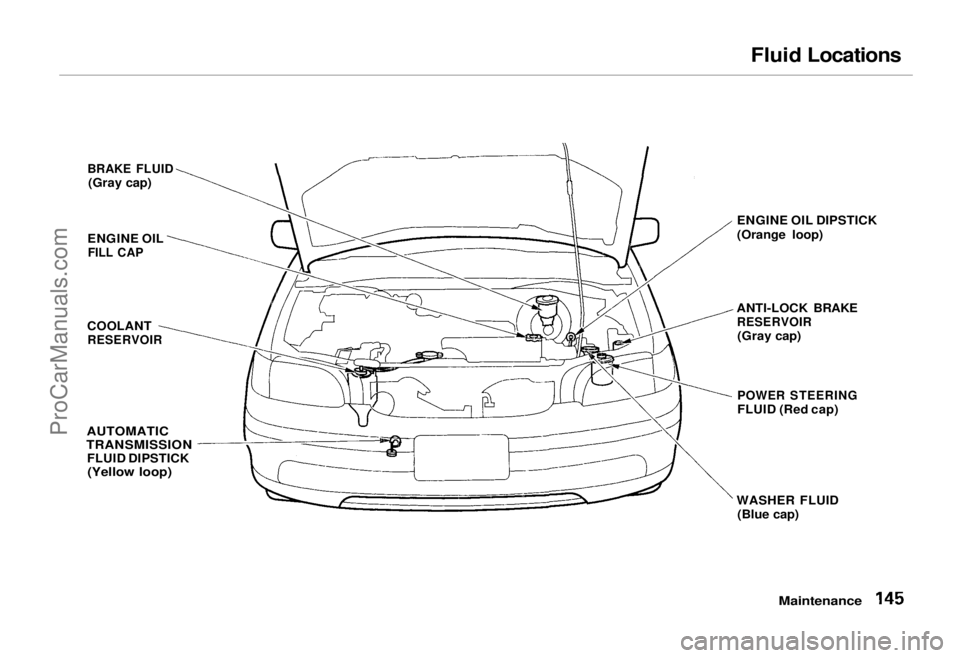
Fluid Locations
BRAKE FLUID
(Gray cap)
ENGINE OIL
FILL CAP
COOLANT
RESERVOIR
AUTOMATIC
TRANSMISSION
FLUID DIPSTICK
(Yellow loop)
ENGINE OIL DIPSTICK
(Orange loop)
ANTI-LOCK BRAKE
RESERVOIR
(Gray cap)
POWER STEERING
FLUID (Red cap)
WASHER FLUID (Blue cap)
MaintenanceProCarManuals.comMain Menu Table of Contents s t
Page 145 of 240
Engine Oil
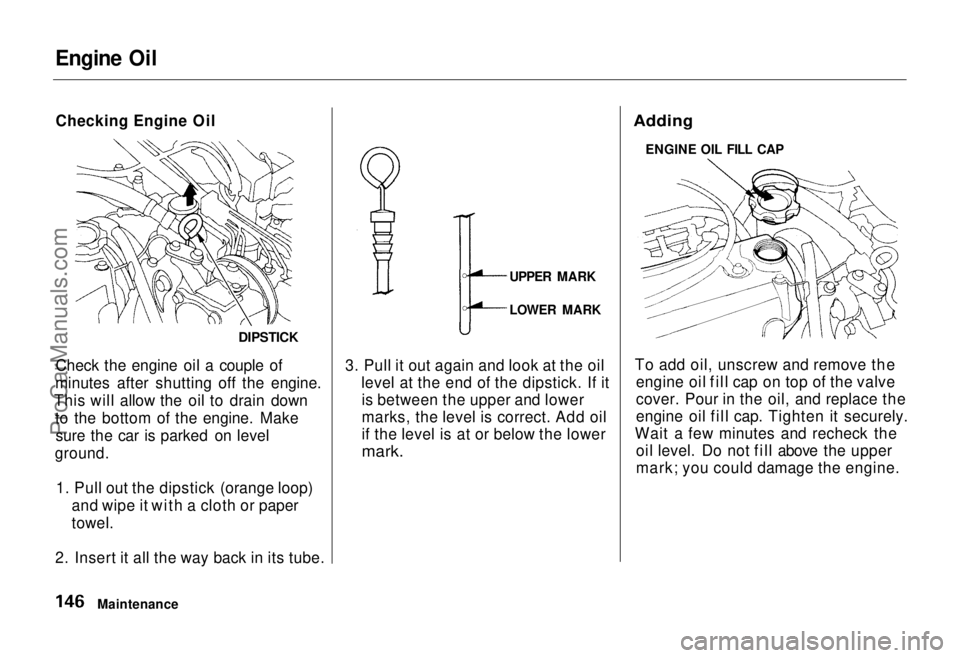
Checking Engine Oil
Check the engine oil a couple of
minutes after shutting off the engine.
This will allow the oil to drain down to the bottom of the engine. Makesure the car is parked on level
ground.
1. Pull out the dipstick (orange loop) and wipe it with a cloth or paper
towel.
2. Insert it all the way back in its tube. UPPER MARK
3. Pull it out again and look at the oil level at the end of the dipstick. If itis between the upper and lower
marks, the level is correct. Add oil
if the level is at or below the lower
mark.
Adding
To add oil, unscrew and remove theengine oil fill cap on top of the valve
cover. Pour in the oil, and replace the
engine oil fill cap. Tighten it securely.
Wait a few minutes and recheck the oil level. Do not fill above the upper
mark; you could damage the engine.
Maintenance LOWER MARK
DIPSTICK
ENGINE OIL FILL CAPProCarManuals.comMain Menu Table of Contents s t
Page 146 of 240
Engine Oil
Recommended Oil Oil is a major contributor to your
engine's performance and longevity.
Always use a premium-grade deter- gent oil.
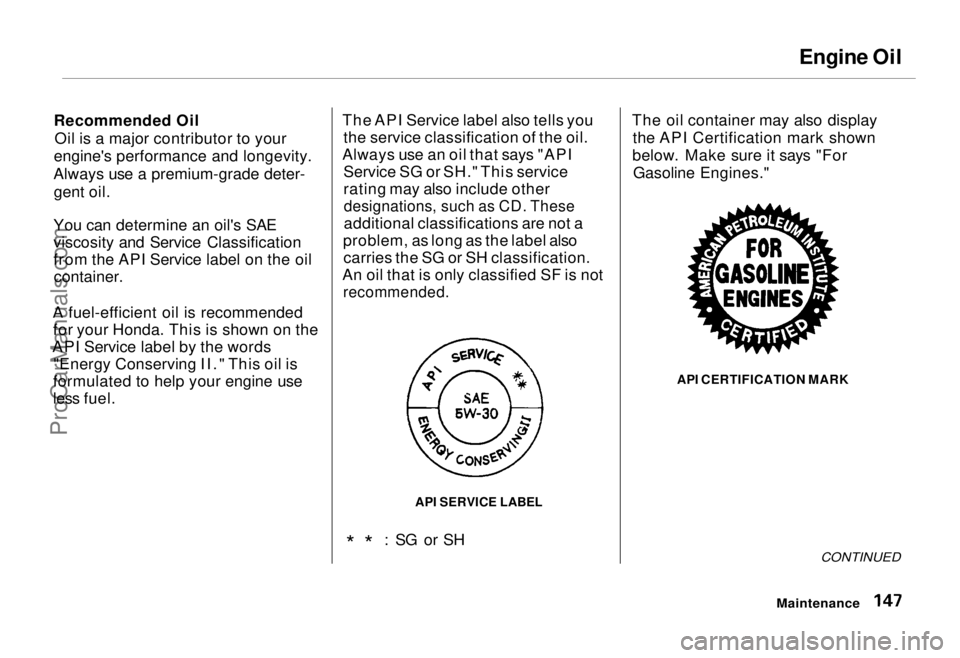
You can determine an oil's SAE
viscosity and Service Classification
from the API Service label on the oil container.
A fuel-efficient oil is recommended for your Honda. This is shown on the
API Service label by the words "Energy Conserving II." This oil is
formulated to help your engine use
less fuel. The API Service label also tells you
the service classification of the oil.
Always use an oil that says "API Service SG or SH." This service
rating may also include other
designations, such as CD. These
additional classifications are not a
problem, as long as the label also carries the SG or SH classification.
An oil that is only classified SF is not
recommended.
* * : SG or SH The oil container may also display
the API Certification mark shown
below. Make sure it says "For Gasoline Engines."
API CERTIFICATION MARK
CONTINUED
Maintenance
API SERVICE LABELProCarManuals.comMain Menu Table of Contents s t
Page 147 of 240
Engine Oil
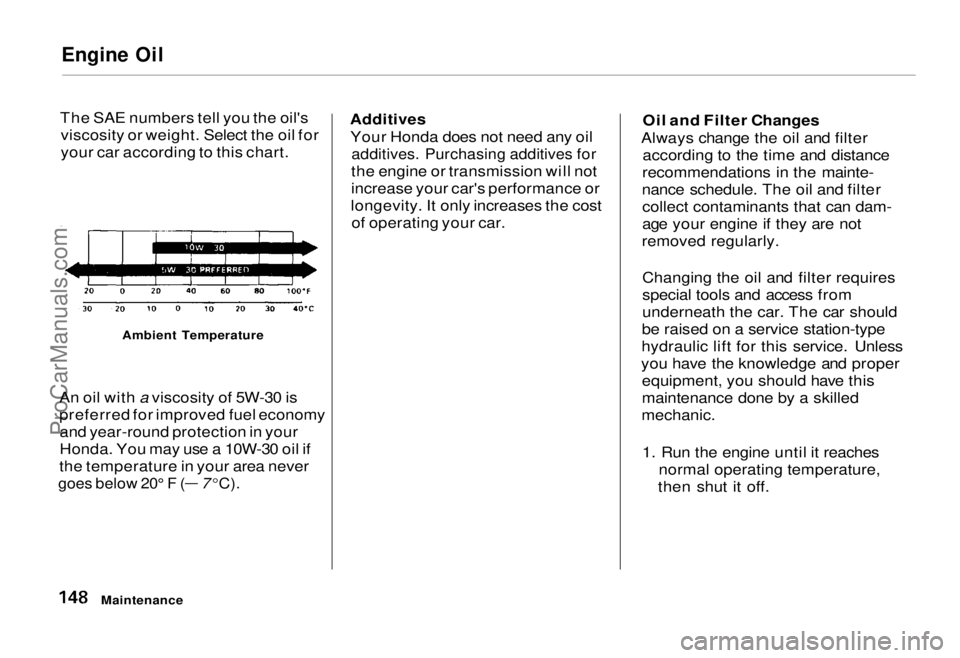
The SAE numbers tell you the oil's viscosity or weight. Select the oil for
your car according to this chart.
Ambient Temperature
An oil with a viscosity of 5W-30 is
preferred for improved fuel economy and year-round protection in your
Honda. You may use a 10W-30 oil if
the temperature in your area never
goes below 20° F ( —
7° C).
Additives
Your Honda does not need any oil
additives. Purchasing additives for
the engine or transmission will not
increase your car's performance or
longevity. It only increases the cost of operating your car. Oil and Filter Changes
Always change the oil and filter according to the time and distance
recommendations in the mainte-
nance schedule. The oil and filter collect contaminants that can dam-
age your engine if they are not
removed regularly.
Changing the oil and filter requires
special tools and access from
underneath the car. The car should
be raised on a service station-type
hydraulic lift for this service. Unless
you have the knowledge and proper equipment, you should have this
maintenance done by a skilled
mechanic.
1. Run the engine until it reaches normal operating temperature,
then shut it off.
MaintenanceProCarManuals.comMain Menu Table of Contents s t