Page 118 of 240
Preparing to Drive
You should do the following checks and adjustments every day before
you drive your car.
1. Make sure all windows, mirrors, and outside lights are clean and
unobstructed. Remove frost, snow,
or ice.
2. Check that the hood and tailgate are fully closed.
3. Visually check the tires. If a tire looks low, use a gauge to check its
pressure.
4. Check that any items you may be carrying with you inside are stored
properly or fastened down
securely. 5. Check the adjustment of the seat
(see page 56).
6. Check the adjustment of the inside and outside mirrors (see
page 66).
7. Check the adjustment of the steering wheel (see page 46).
8. Make sure the doors are securely closed and locked.
9. Fasten your seat belt. Check that your passengers have fastened
their seat belts (see page 7). 10. Turn the ignition ON (II). Check
the indicator lights in the instru-
ment panel.
11. Start the engine (see page 119).
12. Check the gauges and indicator lights in the instrument panel (see
page 35).
DrivingProCarManuals.comMain Menu Table of Contents s t
Page 130 of 240
Towing a Trailer
MirrorsMany states and provinces have laws
requiring special outside mirrors
when you are towing a trailer. Check
the laws in your area. You may want
to install mirrors, even if they are not required. Hook up the trailer and see
how much it obscures your ability to see behind you with the standard
mirrors. If you cannot see directly
behind you, or have a large blind spot next to the trailer or the car,
you should install mirrors intended for towing.
Connecting the Trailer
Most trailers that have a gross
weight of 450 kg (1,000 Ibs) do not have their own braking system. If
you are thinking of getting a trailer that does have brakes, make sure
they are electrically-operated. There
are no provisions in your car to tap
into its hydraulic braking system.
Any attempt to attach the trailer's brakes to your car's hydraulicsystem, no matter how successful it
may seem, will lower braking effectiveness and create a potential
hazard.
Always use a safety chain when
towing a trailer. Connect the safetychain securely at both ends. Makesure the chain crosses under the
tongue so it will catch the trailer if it
becomes unhitched. Leave enough slack in the chain so it can't bind in asharp turn. Do not let it drag on the
ground.
DrivingProCarManuals.comMain Menu Table of Contents s t
Page 131 of 240
Towing a Trailer
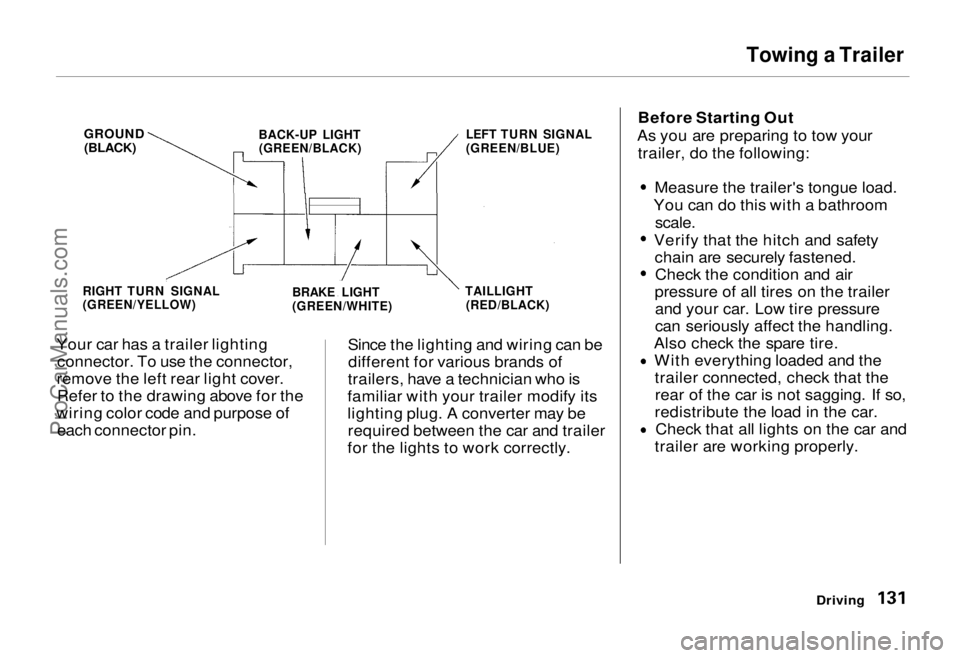
Your car has a trailer lighting connector. To use the connector,
remove the left rear light cover. Refer to the drawing above for the
wiring color code and purpose of each connector pin. Since the lighting and wiring can be
different for various brands of
trailers, have a technician who is
familiar with your trailer modify its
lighting plug. A converter may be required between the car and trailer
for the lights to work correctly. Before Starting Out
As you are preparing to tow your trailer, do the following:
Measure the trailer's tongue load.
You can do this with a bathroom
scale.
Verify that the hitch and safety chain are securely fastened.Check the condition and air
pressure of all tires on the trailer and your car. Low tire pressure
can seriously affect the handling.
Also check the spare tire. With everything loaded and thetrailer connected, check that therear of the car is not sagging. If so,
redistribute the load in the car. Check that all lights on the car and
trailer are working properly.
Driving
RIGHT TURN SIGNAL
(GREEN/YELLOW)
BRAKE LIGHT
(GREEN/WHITE)TAILLIGHT
(RED/BLACK) LEFT TURN SIGNAL
(GREEN/BLUE)
BACK-UP LIGHT
(GREEN/BLACK)
GROUND
(BLACK)ProCarManuals.comMain Menu Table of Contents s t
Page 145 of 240
Engine Oil
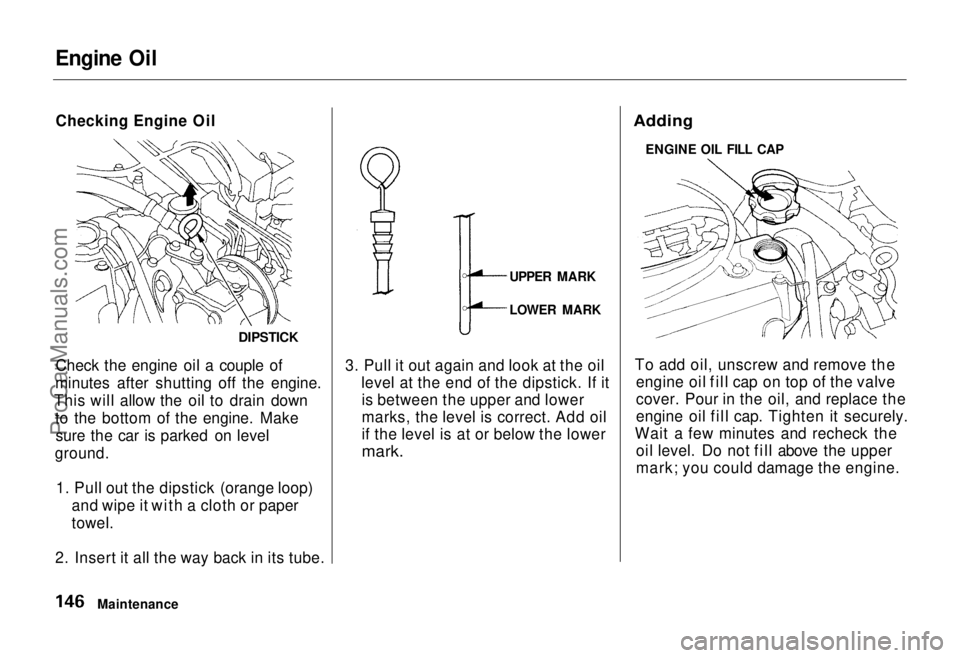
Checking Engine Oil
Check the engine oil a couple of
minutes after shutting off the engine.
This will allow the oil to drain down to the bottom of the engine. Makesure the car is parked on level
ground.
1. Pull out the dipstick (orange loop) and wipe it with a cloth or paper
towel.
2. Insert it all the way back in its tube. UPPER MARK
3. Pull it out again and look at the oil level at the end of the dipstick. If itis between the upper and lower
marks, the level is correct. Add oil
if the level is at or below the lower
mark.
Adding
To add oil, unscrew and remove theengine oil fill cap on top of the valve
cover. Pour in the oil, and replace the
engine oil fill cap. Tighten it securely.
Wait a few minutes and recheck the oil level. Do not fill above the upper
mark; you could damage the engine.
Maintenance LOWER MARK
DIPSTICK
ENGINE OIL FILL CAPProCarManuals.comMain Menu Table of Contents s t
Page 152 of 240
Cooling System
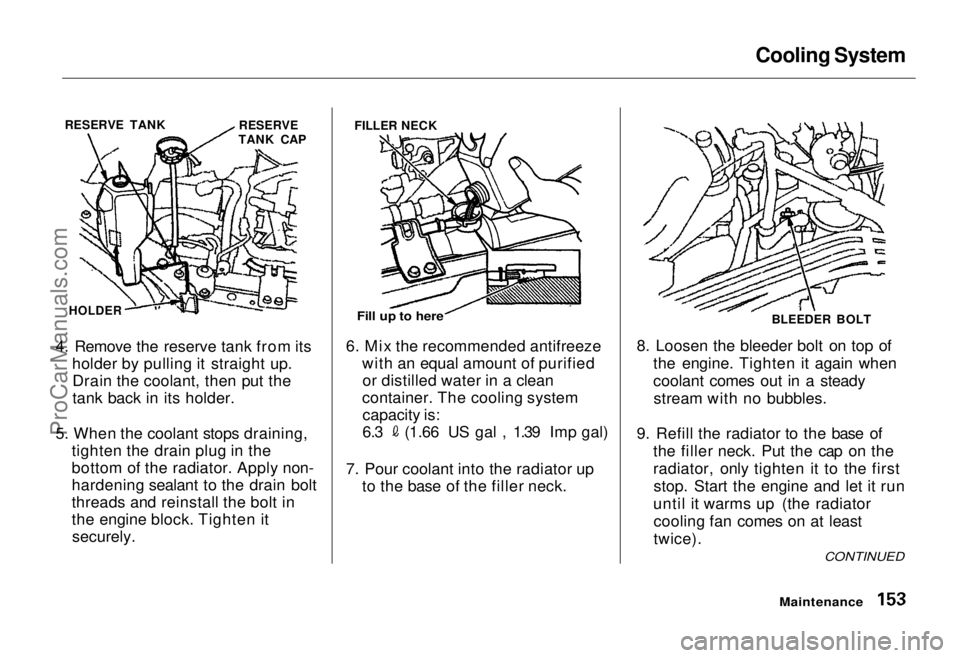
RESERVE TANK RESERVE
TANK CAP
HOLDER
4. Remove the reserve tank from its holder by pulling it straight up.Drain the coolant, then put the
tank back in its holder.
5. When the coolant stops draining, tighten the drain plug in the
bottom of the radiator. Apply non-
hardening sealant to the drain bolt
threads and reinstall the bolt in
the engine block. Tighten it
securely.
FILLER NECK
Fill up to here
6. Mix the recommended antifreeze with an equal amount of purifiedor distilled water in a clean
container. The cooling system capacity is: 6.3
(1.66 US gal , 1.39 Imp gal)
7. Pour coolant into the radiator up to the base of the filler neck. 8. Loosen the bleeder bolt on top of
the engine. Tighten it again when
coolant comes out in a steadystream with no bubbles.
9. Refill the radiator to the base of the filler neck. Put the cap on the
radiator, only tighten it to the firststop. Start the engine and let it run
until it warms up (the radiator cooling fan comes on at least
twice).
Maintenance
BLEEDER BOLT
CONTINUEDProCarManuals.comMain Menu Table of Contents s t
Page 158 of 240
Air Cleaner
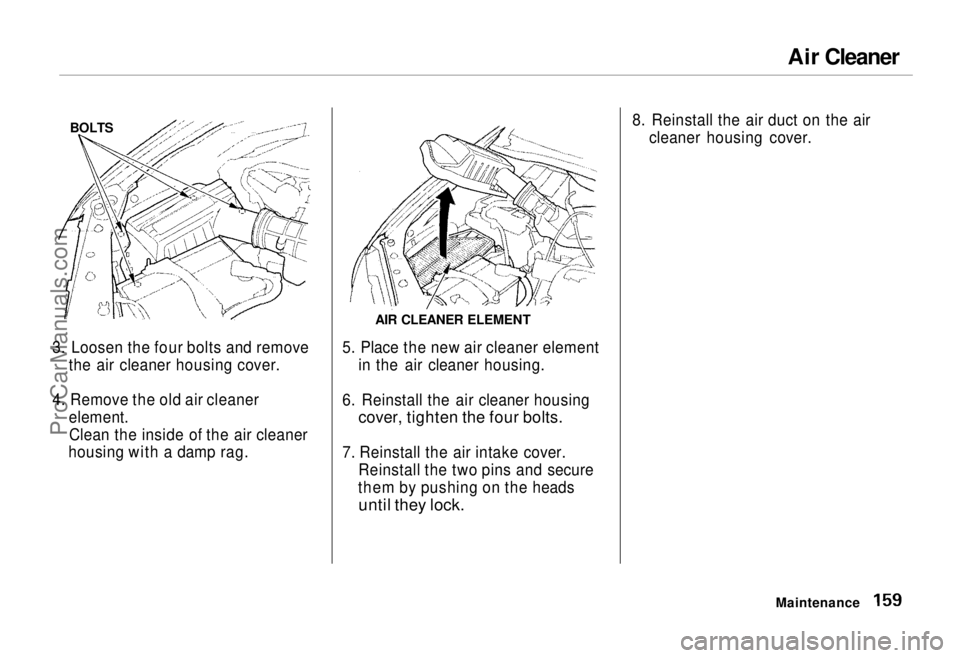
3. Loosen the four bolts and remove the air cleaner housing cover.
4. Remove the old air cleaner element.Clean the inside of the air cleaner
housing with a damp rag.
AIR CLEANER ELEMENT
5. Place the new air cleaner element in the air cleaner housing.
6. Reinstall the air cleaner housing
cover, tighten the four bolts.
7. Reinstall the air intake cover. Reinstall the two pins and secure
them by pushing on the heads
until they lock.
8. Reinstall the air duct on the air
cleaner housing cover.
Maintenance
BOLTSProCarManuals.comMain Menu Table of Contents s t
Page 166 of 240
Windshield Wipers
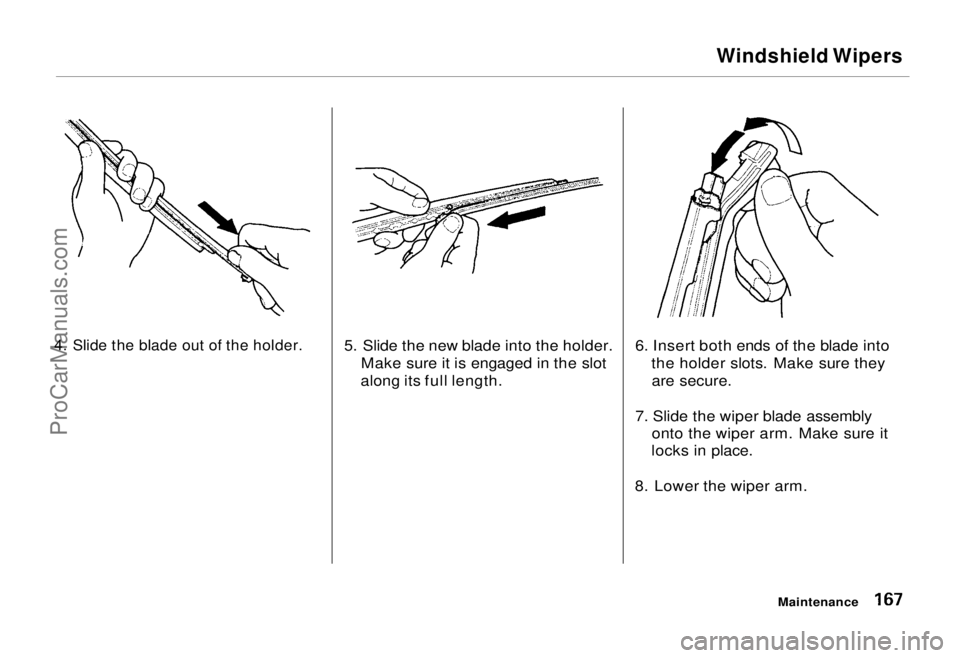
4. Slide the blade out of the holder.
5. Slide the new blade into the holder.
Make sure it is engaged in the slot
along its full length. 6. Insert both ends of the blade into
the holder slots. Make sure theyare secure.
7. Slide the wiper blade assembly onto the wiper arm. Make sure it
locks in place.
8. Lower the wiper arm.
MaintenanceProCarManuals.comMain Menu Table of Contents s t
Page 177 of 240
Lights
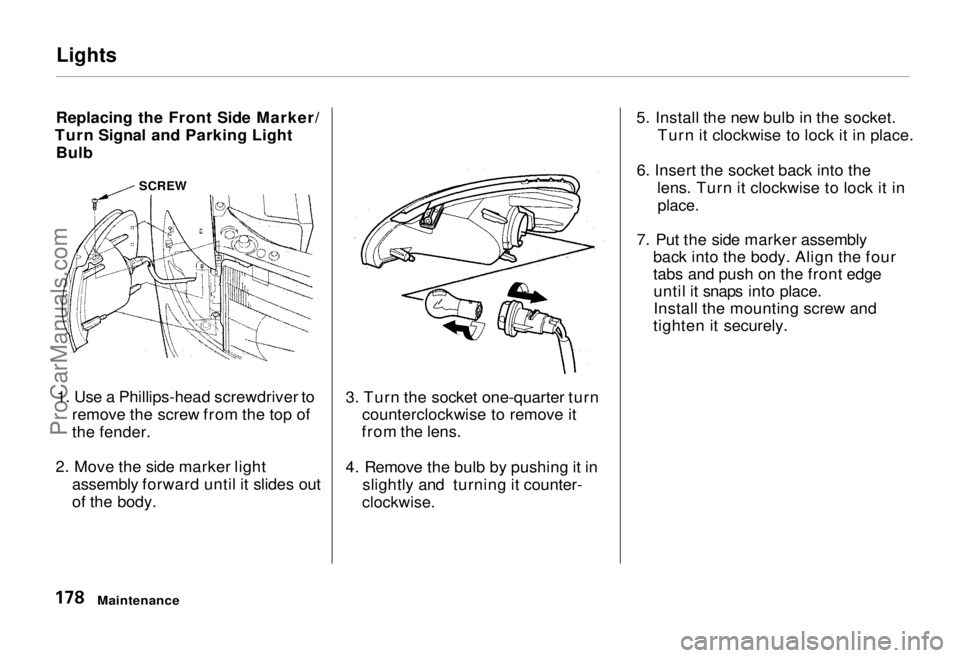
Replacing the Front Side Marker/
Turn Signal and Parking Light Bulb
SCREW
1. Use a Phillips-head screwdriver to remove the screw from the top of
the fender.
2. Move the side marker light assembly forward until it slides out
of the body. 3. Turn the socket one-quarter turn
counterclockwise to remove it
from the lens.
4. Remove the bulb by pushing it in slightly and turning it counter-
clockwise.
5. Install the new bulb in the socket.
Turn it clockwise to lock it in place.
6. Insert the socket back into the lens. Turn it clockwise to lock it in
place.
7. Put the side marker assembly back into the body. Align the four
tabs and push on the front edgeuntil it snaps into place.
Install the mounting screw and
tighten it securely.
MaintenanceProCarManuals.comMain Menu Table of Contents s t