Page 26 of 240
Child Safety
Securing a Child Seat with a Lap/
Shoulder Belt
The lap/shoulder belt retractors in the passenger seating positions havea built-in locking mechanism
intended to secure a child seat. If
you are placing a child seat in one of the outside seating positions, do the
following: 1. Place the child restraint in the
desired seating position. Route the
lap/shoulder belt through the seat according to the seat manufac-
turer's instructions.
2. Insert the latch plate into the buckle. Make sure it is fully
latched.
3. Slowly pull the shoulder portion of the belt out of the retractor until it
stops.
4. Allow the belt to slowly feed back into the retractor. You should heara clicking noise that indicates the
locking mechanism has engaged.
5. After the belt has retracted fully, pull up on the shoulder portion to
remove any slack.
6. Push and pull on the child seat to
verify that it is held firmly in place.
If not, unlatch the seat belt, allow
it to retract fully, and repeat these
steps.
To unlatch the seat belt, push the
red PRESS button on the buckle.
Guide the belt across to the door
pillar. If the belt doesn't retract
easily, pull it out and check for twists
or kinks.
Driver and Passenger SafetyProCarManuals.comMain Menu Table of Contents s t
Page 28 of 240
Child Safety
Second Seat Installation:
There are three attachment points available for the seven-passenger
model, and two attachment points
available for the six-passenger model.
To install a child seat in the second seat, fold the third seat into the floor
recess (see page 62). You will find a
U-shaped slit
in the carpeting at each
attachment point. Select the attach-
ment point you want to use, and pull
up the carpeting at the slit.
Third Seat Installation:
There are two attachment points onthe tailgate sill. Select the attach-
ment point you want use, and
remove the plug with a small flat-
tipped screwdriver or a fingernail file.
Install the tether hardware that came
with the child seat.
Tighten to:
22 N .
m (2.2 kg-m, 16 Ib-ft)
If you are not sure how to install the
bracket, have it installed by your Honda dealer. Storing a Child Seat
When you are not using an infant seat or other child restraint, either
remove it or make sure it is properly secured so it cannot be thrown
around the car during a crash.
Driver and Passenger Safety
ProCarManuals.comMain Menu Table of Contents s t
Page 47 of 240
Controls Near the Steering Wheel
Instruments and Controls
3. Move the steering wheel up or
down to the desired position.
Position the wheel so you can see
all the instrument panel gauges
and warning lights. Push the lever
up to lock the steering wheel in
that position.
4. Make sure you have securely locked the steering wheel in place
by trying to move it up and down.ProCarManuals.comMain Menu Table of Contents s t
Page 59 of 240
Seats
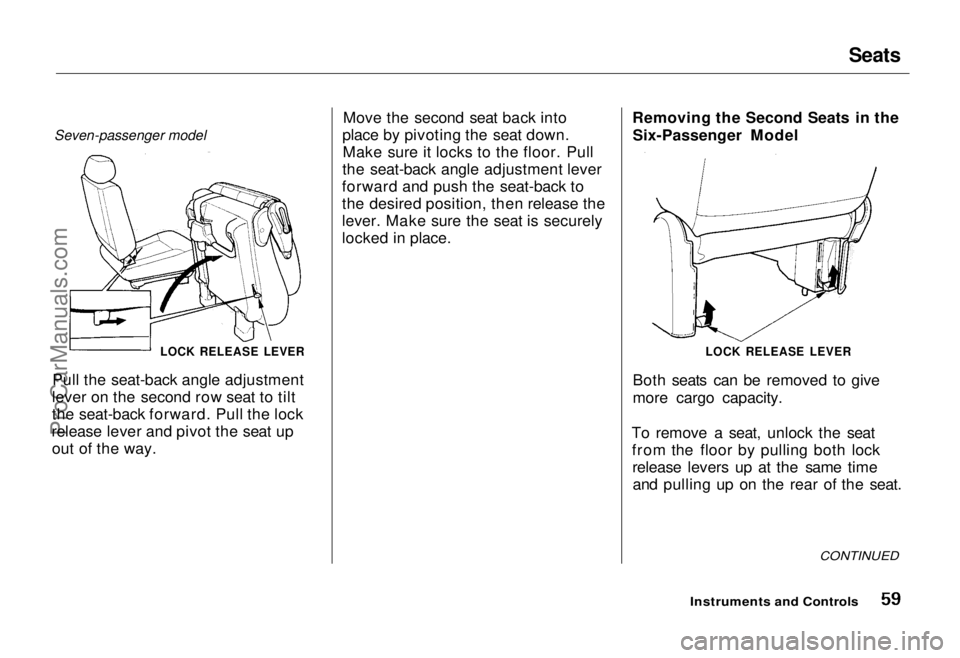
Seven-passenger model
LOCK RELEASE LEVER
Pull the seat-back angle adjustment
lever on the second row seat to tilt
the seat-back forward. Pull the lock
release lever and pivot the seat up out of the way. Move the second seat back into
place by pivoting the seat down. Make sure it locks to the floor. Pull
the seat-back angle adjustment lever
forward and push the seat-back to
the desired position, then release the
lever. Make sure the seat is securely
locked in place. Removing the Second Seats in the
Six-Passenger Model
Both seats can be removed to give
more cargo capacity.
To remove a seat, unlock the seat from the floor by pulling both lockrelease levers up at the same timeand pulling up on the rear of the seat.
CONTINUED
Instruments and Controls
LOCK RELEASE LEVERProCarManuals.comMain Menu Table of Contents s t
Page 60 of 240
Seats
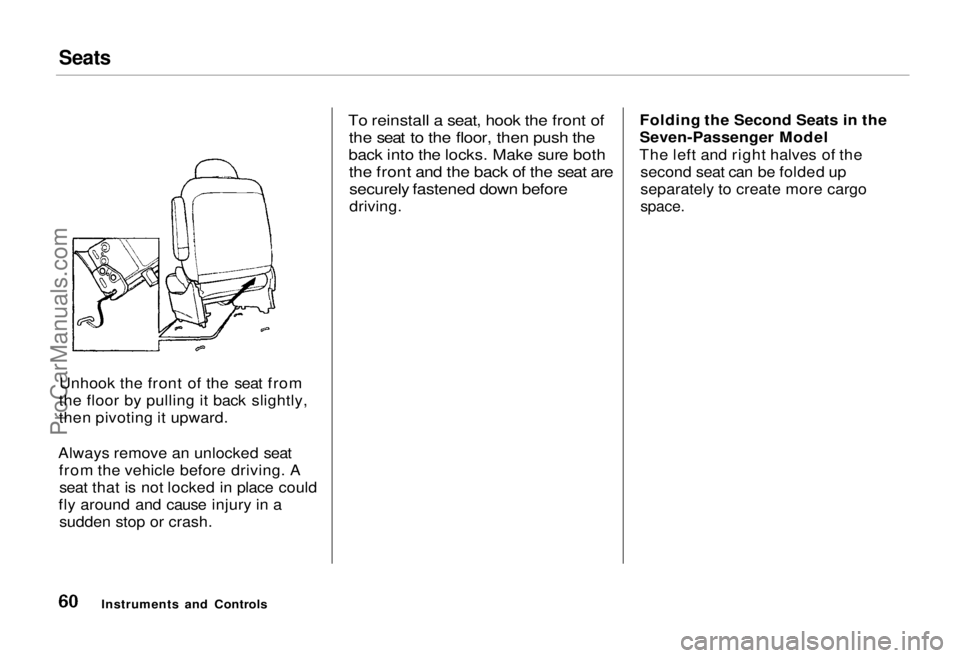
Unhook the front of the seat from
the floor by pulling it back slightly,
then pivoting it upward.
Always remove an unlocked seat from the vehicle before driving. Aseat that is not locked in place could
fly around and cause injury in a sudden stop or crash.
To reinstall a seat, hook the front of
the seat to the floor, then push the
back into the locks. Make sure both
the front and the back of the seat aresecurely fastened down before
driving. Folding the Second Seats in the
Seven-Passenger Model
The left and right halves of the second seat can be folded up
separately to create more cargo
space.
Instruments and ControlsProCarManuals.comMain Menu Table of Contents s t
Page 61 of 240
Seats
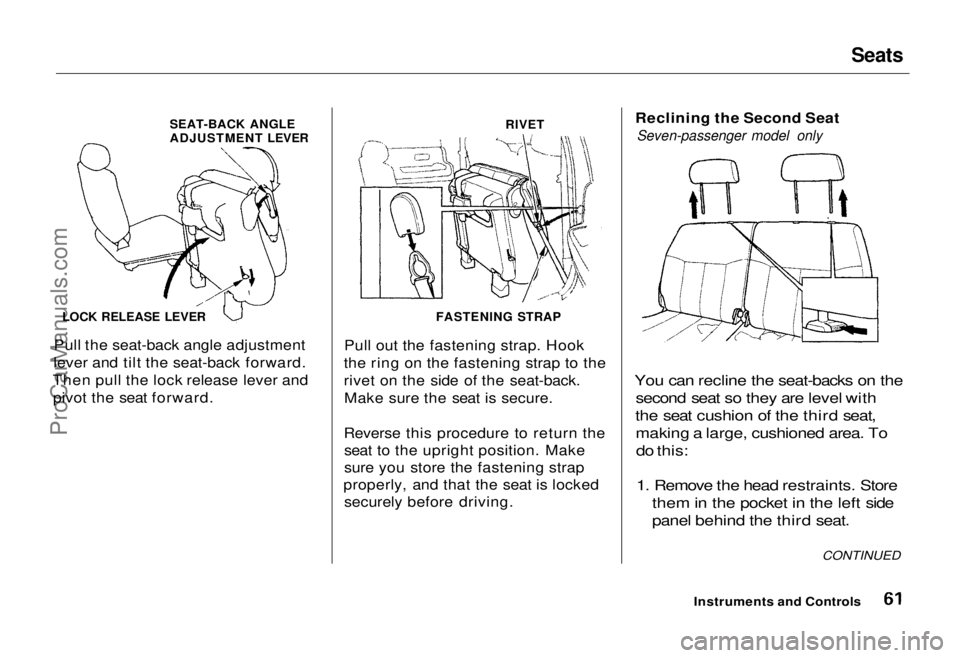
SEAT-BACK ANGLE
ADJUSTMENT LEVER
RIVET
LOCK RELEASE LEVER
Pull the seat-back angle adjustment
lever and tilt the seat-back forward.
Then pull the lock release lever and pivot the seat forward. Pull out the fastening strap. Hook
the ring on the fastening strap to the
rivet on the side of the seat-back. Make sure the seat is secure.
Reverse this procedure to return the seat to the upright position. Make
sure you store the fastening strap
properly, and that the seat is locked securely before driving. Reclining the Second Seat
Seven-passenger model only
You can recline the seat-backs on the second seat so they are level with
the seat cushion of the third seat, making a large, cushioned area. Todo this:
1. Remove the head restraints. Store them in the pocket in the left side
panel behind the third seat.
Instruments and Controls CONTINUED
FASTENING STRAPProCarManuals.comMain Menu Table of Contents s t
Page 63 of 240
Seats
KNOB
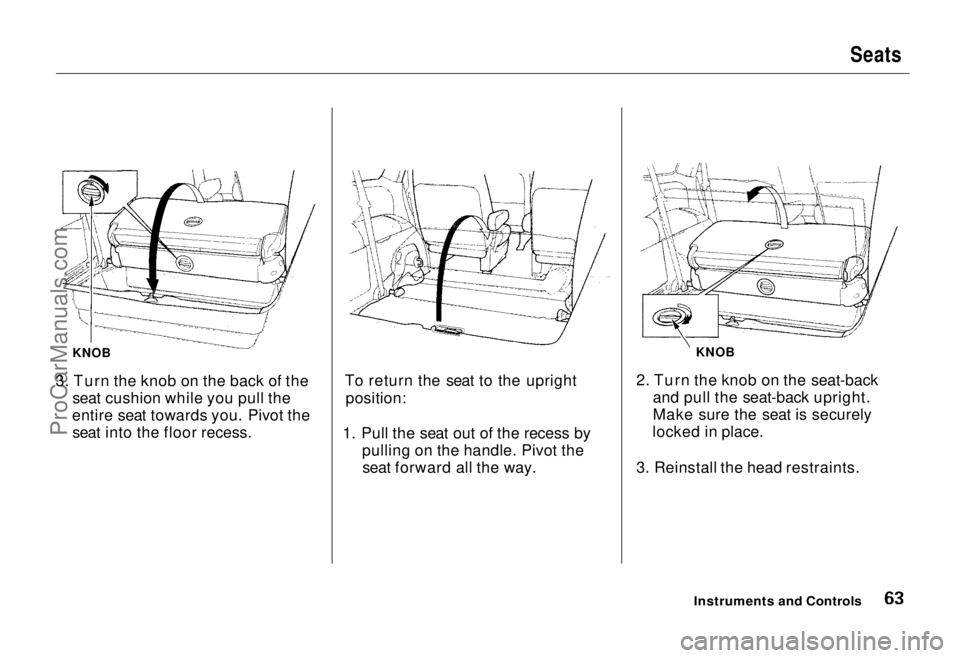
3. Turn the knob on the back of the seat cushion while you pull the
entire seat towards you. Pivot the seat into the floor recess. To return the seat to the upright
position:
1. Pull the seat out of the recess by pulling on the handle. Pivot theseat forward all the way. KNOB
2. Turn the knob on the seat-back and pull the seat-back upright.
Make sure the seat is securely
locked in place.
3. Reinstall the head restraints.
Instruments and ControlsProCarManuals.comMain Menu Table of Contents s t
Page 116 of 240
Loading Cargo
The maximum load you can carry in your Honda is 535 kg (1,150 Ibs). Itincludes the total weight of all
passengers and their belongings, any accessories, and the tongue weight
of a trailer. This 535 kg (1,150 Ibs)
figure is shown as the Vehicle Capacity Weight on the tire infor-
mation label attached to the driver's
doorjamb.
To figure out how much cargo you
can carry:
Figure the total "occupant weight"
you will be transporting. To do this,
multiply the number of people (driver and all passengers) by 70
kg
(150
Ibs).
Subtract this number from the
Vehicle Capacity Weight (535 kg/
1,150 Ibs).
If you are towing a trailer, subtract
the tongue weight. See Towing a
Trailer on page 128.
This final number is the total weight of cargo you can load in or on the car.
With seven occupants (driver and six
passengers), the maximum recom -
mended weight
for cargo is 45 kg
(100 Ibs).
Where you store this cargo, and how well you secure it, are just asimportant as how much it weighs.
Make sure you load cargo so it will not shift while driving. Items stored
in the cargo area behind the thirdseat should be placed as far forward
as possible. You could store addi-
tional items on the floor behind the
front seats. Make sure they cannot roll under the front seat and
interfere with the pedals.
For greater cargo capacity, the thirdseat can be folded into the floor and
the second row seats can either be
removed or folded up (depending on
model). Passengers should never sit in the open cargo area while the car
is moving. They should sit in one of
the seats and wear their seat belts.
If you must carry large objects that
prevent you from closing the tailgate,
be aware that exhaust gas can enter
the interior. See Carbon Monoxide
Hazard on page 29.
Before DrivingProCarManuals.comMain Menu Table of Contents s t