Page 190 of 240
Taking Care of the Unexpected
This section covers the more- common problems that motorists
experience with their cars. It gives
you information about how to safely evaluate the problem and what to do
to correct it. If the problem has stranded you on the side of the road,
you may be able to get going again. If not, you will also find instructions
on getting your car towed. Compact Spare Tire....................... 192
Changing a Flat Tire..................... 193
If Your Engine Won't Start........... 199 Nothing Happens....................... 199
The Starter Operates
Normally................................ 200
Jump Starting................................. 200 If Your Engine Overheats............. 202Low Oil Pressure........................... 204
Charging System Indication......... 205
Malfunction Indicator Lamp/ Check Engine Light.................. 206
Closing the Sunroof....................... 207
Fuses............................................... 208
Checking and Replacing........... 209
Towing............................................ 213
Taking Care of the UnexpectedProCarManuals.comMain Menu s t
Page 198 of 240
If Your Engine Won't Start
Diagnosing why your engine won't
start falls into two areas, depending
on what you hear when you turn the
key to START (III):
You hear nothing, or almostnothing. The engine's starter
motor does not operate at all, or operates very slowly.
You can hear the starter motor operating normally, but the engine
does not start up and run. Nothing Happens or the Starter
Motor Operates Very Slowly
When you turn the ignition switch to START (III), you do not hear the
normal noise of the engine trying to start. You may hear a clicking sound
or series of clicks, or nothing at all.
Check these things:
Check the transmission interlock.
The transmission must be in Park or Neutral or the starter will not
operate.
Turn the ignition switch to ON (II).
Turn on the headlights and check their brightness. If the headlights
are very dim or don't light at all,
the battery is discharged. See
Jump Starting on page 200 .
Turn the ignition switch to START
(III). If the headlights do not dim,
check the condition of the fuses. If
the fuses are OK, there is proba-
bly something wrong with the electrical circuit for the ignition
switch or starter motor. You will
need a qualified technician to determine the problem. (See
Towing on page 213 .)
If the headlights dim noticeably or
go out when you try to start the engine, either the battery is dis-
charged or the connections are
corroded. Check the condition of
the battery and terminal connec-
tions (see page 162 ). You can
then try jump starting the car from a booster battery (see page 200 ).
Taking Care of the UnexpectedProCarManuals.comMain Menu Table of Contents s t
Page 199 of 240
If Your Engine Won't Start, Jump Starting
The Starter Operates Normally In this case, the starter motorsounds normal when you turn the
ignition switch to START (III), but
the engine does not run.
Are you using the proper startingprocedure? Refer to Starting the
Engine on page 119 .
Do you have fuel? Turn the
ignition switch to ON (II) for a
minute and watch the fuel gauge.
The low fuel level warning light may not be working, so you were
not reminded to fill the tank.
There may be an electrical problem, such as no power to the
fuel pump. Check all the fuses (see page 208 ).
If you find nothing wrong, you will
need a qualified technician to find
the problem. See Towing on page 213. Jump Starting
If your car's battery has run clown,
you may be able to start the engine by using a booster battery. Although
this seems like a simple procedure,
there are several precautions youshould take. Follow the directions
closely.
You cannot start a Honda by pushing or pulling it. To jump start your car:
1. Open the hood and check the physical condition of the battery(see page 162 ). In very cold
weather, check the condition of
the electrolyte. If it seems slushy or like ice, do not try jump starting
until it thaws.
Taking Care of the Unexpected
If a battery sits in extreme cold, the
electrolyte inside can freeze.
Attempting to lump start with a frozen battery can cause it to rupture or
explode.
2. Turn off all the electrical acces- sories: heater, A/C, stereo system,
lights, etc.
Put the transmission in Neutral or
Park and set the parking brake.
A battery can explode if you do
not follow the correct procedure,
seriously injuring anyone nearby.
Keep all sparks, open flames,
and smoking materials away
from the battery.ProCarManuals.comMain Menu Table of Contents s t
Page 200 of 240
Jump Starting
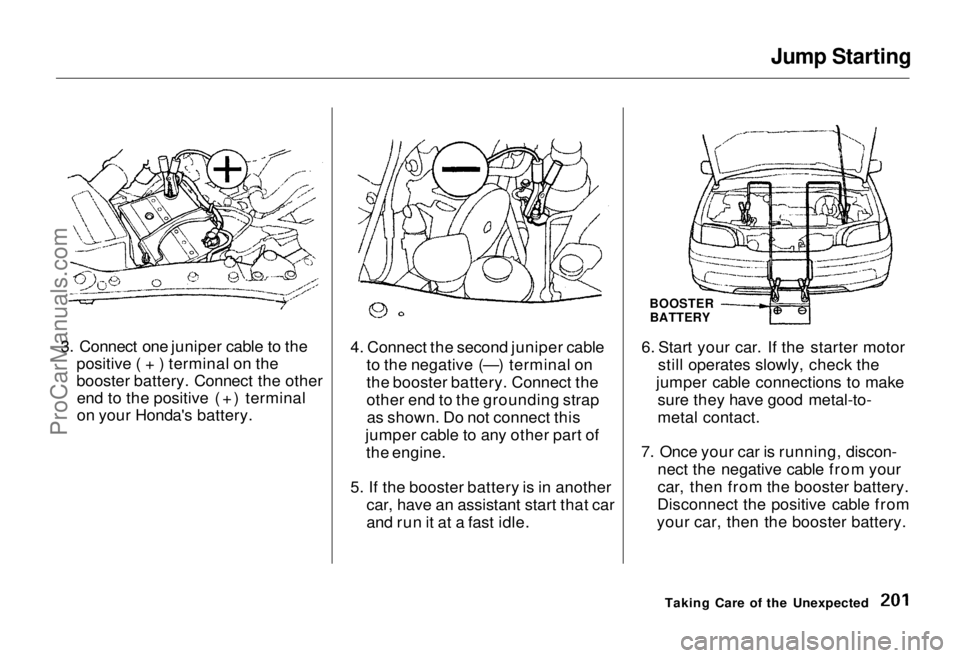
3. Connect one juniper cable to the positive ( + ) terminal on the
booster battery. Connect the otherend to the positive (+) terminal
on your Honda's battery. 4. Connect the second juniper cable
to the negative (—) terminal on
the booster battery. Connect the
other end to the grounding strapas shown. Do not connect this
jumper cable to any other part of the engine.
5. If the booster battery is in another car, have an assistant start that car
and run it at a fast idle. 6. Start your car. If the starter motor
still operates slowly, check the
jumper cable connections to make sure they have good metal-to-
metal contact.
7. Once your car is running, discon- nect the negative cable from your
car, then from the booster battery.
Disconnect the positive cable from
your car, then the booster battery.
Taking Care of the Unexpected
BOOSTER
BATTERYProCarManuals.comMain Menu Table of Contents s t