1995 GMC SIERRA wheel
[x] Cancel search: wheelPage 195 of 488
Stalling on an lncline
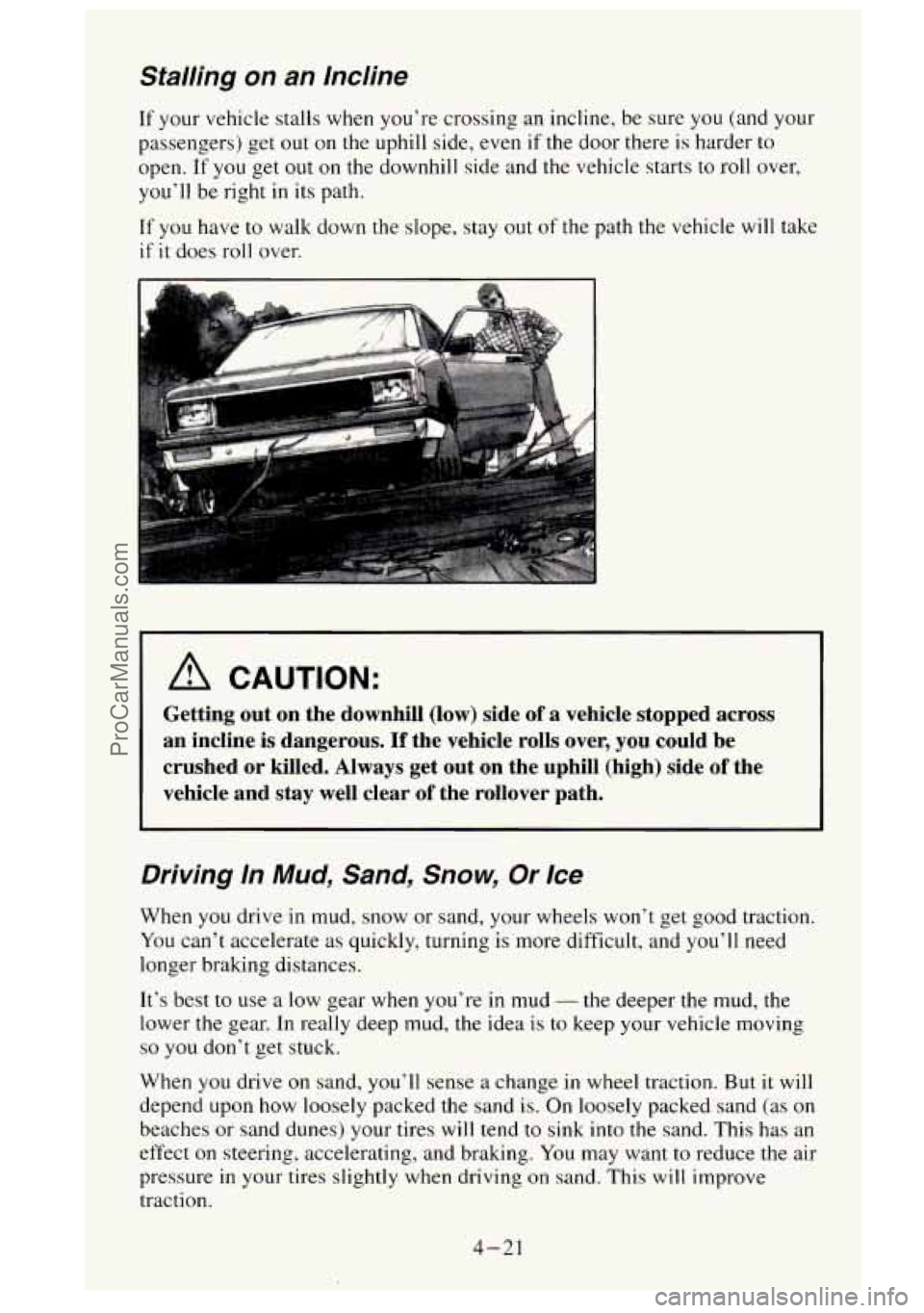
If your vehicle stalls when you’re crossing an incline, be sure you (and your
passengers) get out on the uphill side,
even if the door there is harder to
open.
If you get out on the downhill side and the vehicle starts to roll over,
you’ll be right in its path.
If you have to walk down the slope, stay out of the path the vehicle will take
if it does roll over.
1 A CAUTION:
Getting out on the downhill (low) side of a vehicle stopped across
an incline is dangerous.
If the vehicle rolls over, you could be
crushed or killed. Always get out on the uphill (high) side of the
vehicle and stay well clear
of the rollover path.
Driving In Mud, Sand, Snow, Or Ice
When you drive in mud, snow or sand, your wheels won’t get good traction.
You can’t accelerate
as quickly, turning is more difficult, and you’ll need
longer braking distances.
It’s best
to use a low gear when you’re in mud - the deeper the mud, the
lower
the gear. In really deep mud, the idea is to keep your vehicle moving
so you don’t get stuck.
When you drive on sand, you‘ll sense
a change in wheel traction. But it will
depend upon how loosely packed the sand
is. On loosely packed sand (as on
beaches or sand dunes) your tires will tend to sink into the sand. This has an
effect on steering, accelerating, and braking.
You may want to reduce the air
pressure in your tires slightly when driving
on sand. This will improve
traction.
4-21
ProCarManuals.com
Page 196 of 488
Hard packed snow and ice offer the worst tire traction. On these surfaces,
it’s very easy
to lose control. On wet ice, for example, the traction is so poor
that you will have difficulty accelerating. And if you do get moving, poor
steering and difficult braking can cause you to slide
out of control.
A CAUTION:
Driving on frozen lakes, ponds or rivers can be dangerous.
Underwater springs, currents under the ice, or sudden thaws
can weaken the ice. Your vehicle could fall through the ice and
you and your passengers could drown. Drive your vehicle on
safe surfaces only.
Driving In Water
Light rain causes no special off-road driving problems. But heavy rain can
mean flash flooding, and flood waters demand extreme caution.
Find out how deep the water is before
you drive through it. If it’s deep
enough to cover your wheel hubs, axles, or exhaust pipe, don’t try
it - you
probably won’t get through. Also, water that deep can darnage your axle and
other vehicle parts.
If the water isn’t too deep, then drive through
it slowly. At fast speeds, water
splashes
on your ignition system and your vehicle can stall. Stalling can also
occur if you get your tailpipe under water. And, as long as your tailpipe is
under water, you’ll never be able to start your engine. When
you go through
water, remember that when your brakes get wet,
it may take you longer to
stop.
A CAUTION:
Driving through rushing water can be dangerous. Deep water
can sweep your vehicle downstream and you and your
passengers could drown.
If it’s only inches deep, it can still wash
away the ground
from under your tires, and you could lose
l traction and roll the vehicle over. Don’t drive through rushing
water.
If you have a diesel engme, see “Driving Through Water (Diesel Engines)”
in the Index for more information on driving through water.
4-22
ProCarManuals.com
Page 197 of 488
After Off-Road Driving
Remove any brush or debris that has collected on the underbody, chassis or
under the hood. These accumulations can be
a fire hazard.
After operation
in mud or sand, have the brake linings cleaned and checked.
These substances can cause glazing and uneven braking. Check the body
structure, steering, suspension. wheels, tires, and exhaust system for
damage.
Also, check the fuel lines and cooling system for any leakage.
Your vehicle
will require more frequent service due to off-road use. Refer
to the Maintenance Schedule for additional information.
Driving at Night
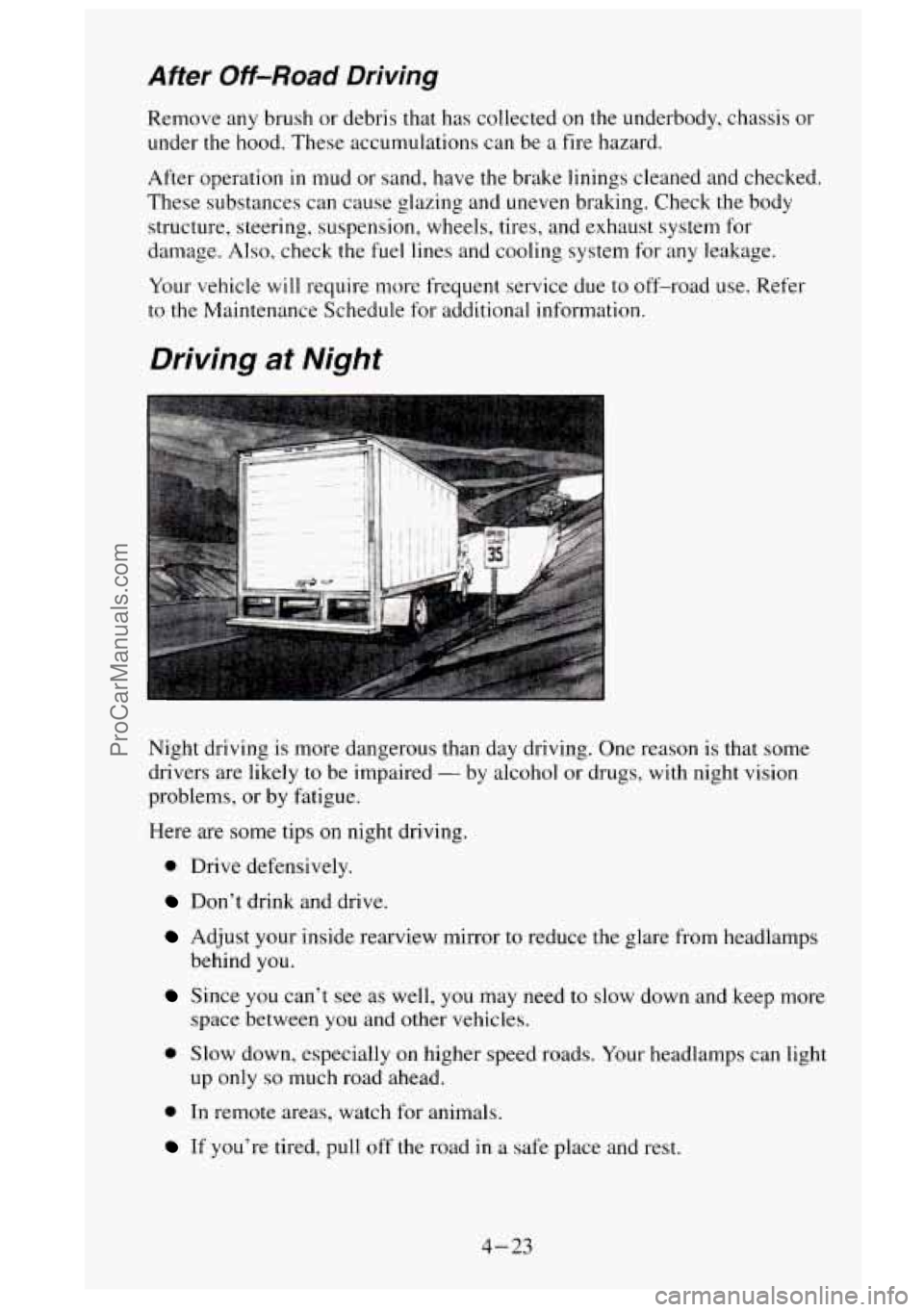
Night driving is more dangerous than day driving. One reason is that some
drivers are likely
to be impaired - by alcohol or drugs, with night vision
problems,
or by fatigue.
Here are some tips on night driving.
0 Drive defensively.
Don’t drink and drive.
Adjust your inside rearview mirror to reduce the glare from headlamps
Since you can’t see as well, you may need to slow down and keep more
behind
you.
space
between you and other vehicles.
a Slow down, especially on higher speed roads. Your headlamps can light
up only
so much road ahead.
0 In remote areas, watch for animals.
If you’re tired, pull off the road in a safe place and rest.
4-23
ProCarManuals.com
Page 202 of 488
When you want to leave the freeway, move to the proper lane well in
advance. If
you miss your exit do not, under any circumstances, stop and
back up. Drive on
to the next exit.
The exit ramp can be curved, sometimes quite sharply.
The
exit speed is usually posted.
Reduce your speed according to your speedometer, not to your sense
of
motion. After driving for any distance at higher speeds, you may tend to
think you are going slower than you actually are.
Before Leaving on a Long Trip
Make sure you’re ready. Try to be well rested. If you must start when you’re
not fresh
- such as after a day’s work - don’t plan to make too many
miles that first part
of the journey. Wear comfortable clothing and shoes you
can easily drive
in.
Is your vehicle ready for a long trip‘? If you keep it serviced and maintained,
it’s ready to go.
If it needs service, have it done before starting out. Of
course, you’ll find experienced and able service experts
in GM dealers all
across North America. They’ll be ready and willing to help if you need it.
Here are some things you can check before a trip:
0
0
0
0
0
a
0
Windshield Washer Fluid: Is the reservoir full? Are all windows clean
inside and outside?
Wiper Blades: Are they in good shape?
FueZ, Engine Oil, Other Fluids: Have you checked all levels?
Lamps: Are they all working? Are the lenses clean?
Tires: They are vitally important to a safe, trouble-free trip. Is the tread
good enough for long-distance driving? Are
the tires all inflated to the
recommended pressure?
Weather Forecasts: What’s the weather outlook along your route?
Should
you delay your trip a short time to avoid a major storm system?
Maps: Do you have up-to-date maps?
Highway Hypnosis
Is there actually such a condition as “highway hypnosis”? Or is it just plain
falling asleep at the wheel? Call it highway hypnosis, lack of awareness, or
whatever.
There
is something about an easy stretch of road with the same scenery,
along with the
hum of the tires on the road, the drone of the engine, and the
rush
of the wind against the vehicle that can make you sleepy. Don’t let it
happen
to you! If it does, your vehicle can leave the road in less than a
second, and you could crash and be injured.
4-28
ProCarManuals.com
Page 206 of 488
be
What’s
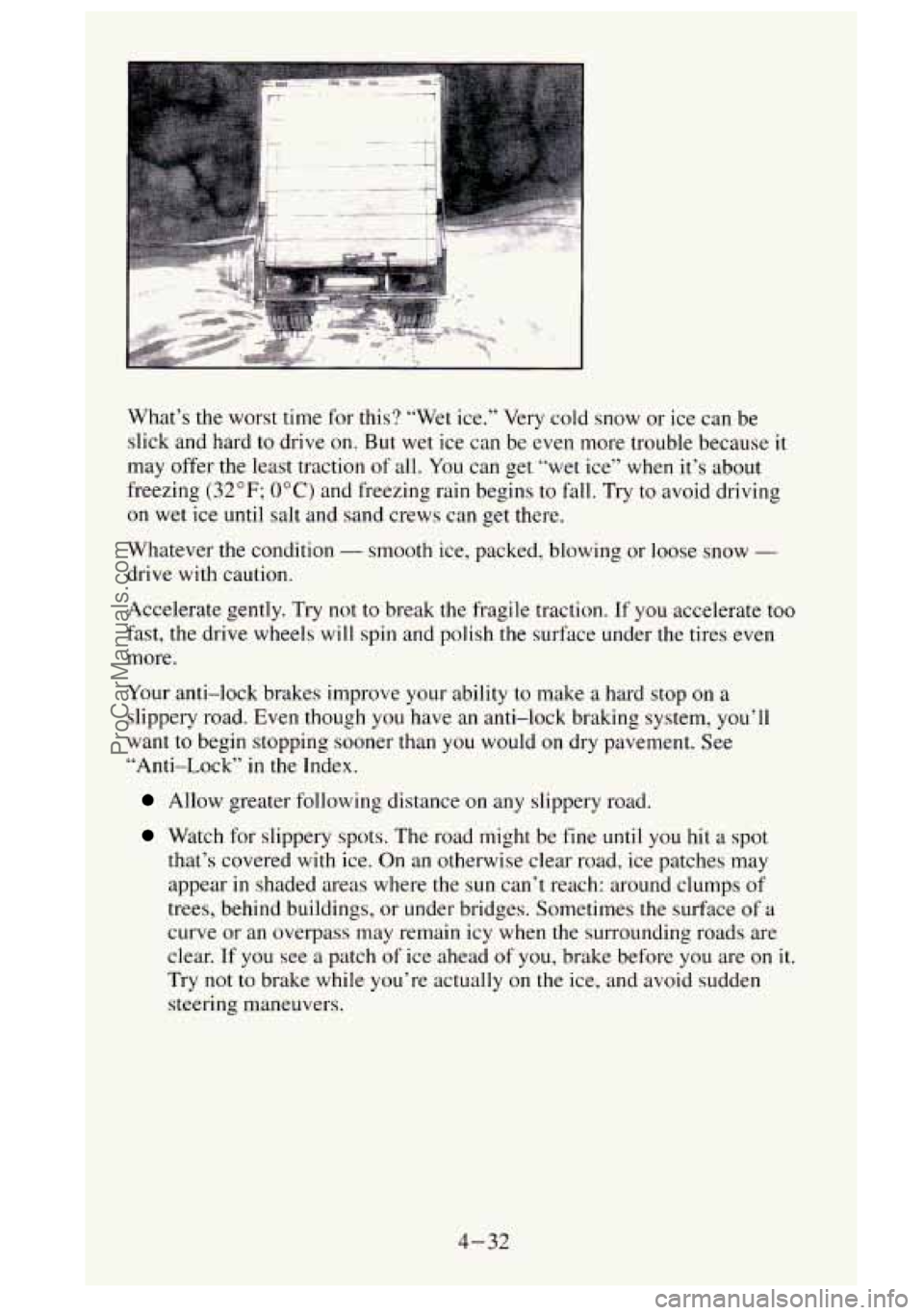
the worst time for this? “Wet ice.” Very cold snow or ice can
slick and hard to drive
on. But wet ice can be even more trouble because it
may offer the least traction of all. You can get “wet ice” when it’s about
freezing
(32°F; OOC) and freezing rain begins to fall. Try to avoid driving
on wet ice until salt and sand crews can get there.
Whatever the condition
- smooth ice, packed, blowing or loose snow -
drive with caution.
Accelerate gently. Try not to break the fragile traction.
If you accelerate too
fast, the drive wheels will spin and polish the surface under the tires even
more.
Your anti-lock brakes improve your ability
to make a hard stop on a
slippery road. Even though you have an anti-lock braking system, you’ll
want to begin stopping sooner than you would on dry pavement. See
“Anti-Lock”
in the Index.
Allow greater following distance on any slippery road.
Watch for slippery spots. The road might be fine until you hit a spot
that’s covered with ice.
On an otherwise clear road, ice patches may
appear in shaded areas where the sun can’t reach: around clumps of
trees, behind buildings, or under bridges. Sometimes the surface
of a
curve or an overpass may remain icy when the surrounding roads are
clear. If
you see a patch of ice ahe.ad of you, brake before you are on it.
Try not to brake while you’re actually on the ice, and avoid sudden
steering maneuvers.
4-32
ProCarManuals.com
Page 208 of 488
c
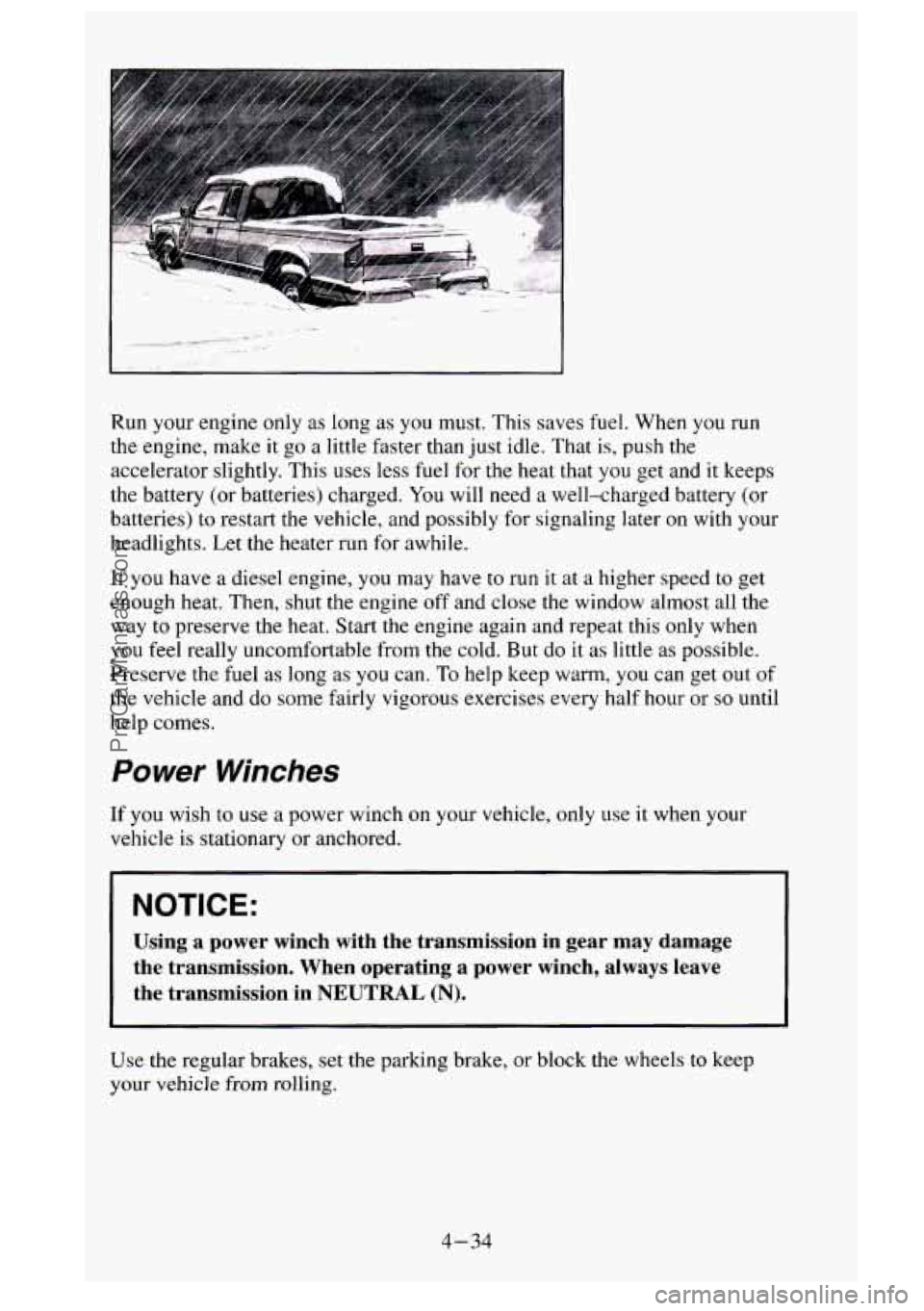
Run your engine only as long as you must. This saves fuel. When you run
the engine, make
it go a little faster than just idle. That is, push the
accelerator slightly. This uses less fuel for the heat that
you get and it keeps
the battery (or batteries) charged. You will need a well-charged battery (or
batteries) to restart the vehicle, and possibly for signaling later on with your
headlights. Let the heater run for awhile.
If you have a diesel engine, you may have to run it at a higher speed to get
enough heat. Then, shut the engine off and close the window almost all the
way
to preserve the heat. Start the engine again and repeat this only when
you feel really uncomfortable from the cold. But do it as little as possible.
Preserve the fuel as long
as you can. To help keep warm, you can get out of
the vehicle and do some fairly vigorous exercises every half hour or so until
help comes.
Power Winches
If you wish to use a power winch on your vehicle, only use it when your
vehicle
is stationary or anchored.
NOTICE:
Using a power winch with the transmission in gear may damage
the transmission. When operating a power winch, always leave
the transmission in NEUTRAL
(N).
Use the regular brakes, set the parking brake, or block the wheels to keep
your vehicle
from rolling.
4-34
ProCarManuals.com
Page 209 of 488
Power Take-Off (PTO)
NOTICE:
If you have a PTO that will exceed 35 horsepower installed on
your vehicle, it could damage the transfer case or transmission.
When having
a PTO installed on your vehicle, make sure that it
will not exceed 35 horsepower.
Before using a power take-off, refer to the manufacturer’s or installer’s
instructions.
NOTICE:
Using a PTO while operating in one place before the vehicle has
reached normal operating temperature can damage the transfer
case or transmission.
If you will be using the PTO while
operating in one place, drive and warm up the vehicle before
using the PTO.
To engage a power take-off
1. Set the parking brake.
2. Shift the transmission into NEUTRAL (N).
3. Hold the clutch pedal down and engage the power take-off.
I NOTICE:
Using a PTO for more than four hours without driving your
vehicle can damage the transfer case or transmission.
If using a
PTO for more than four hours without dr$ving your vehicle,
drive your vehicle for
a while to allow the transfer case and
transmission to cool.
If you are going to drive the vehicle, shift the transmission into the gear
you want. Then shift the transfer case into the range you want (if you
have four-wheel drive), apply the regular brakes and release the
parking brake.
4. Release the clutch (and the regular brakes) as you normally would.
When you release the clutch, the power take-off will start.
4-35
ProCarManuals.com
Page 215 of 488
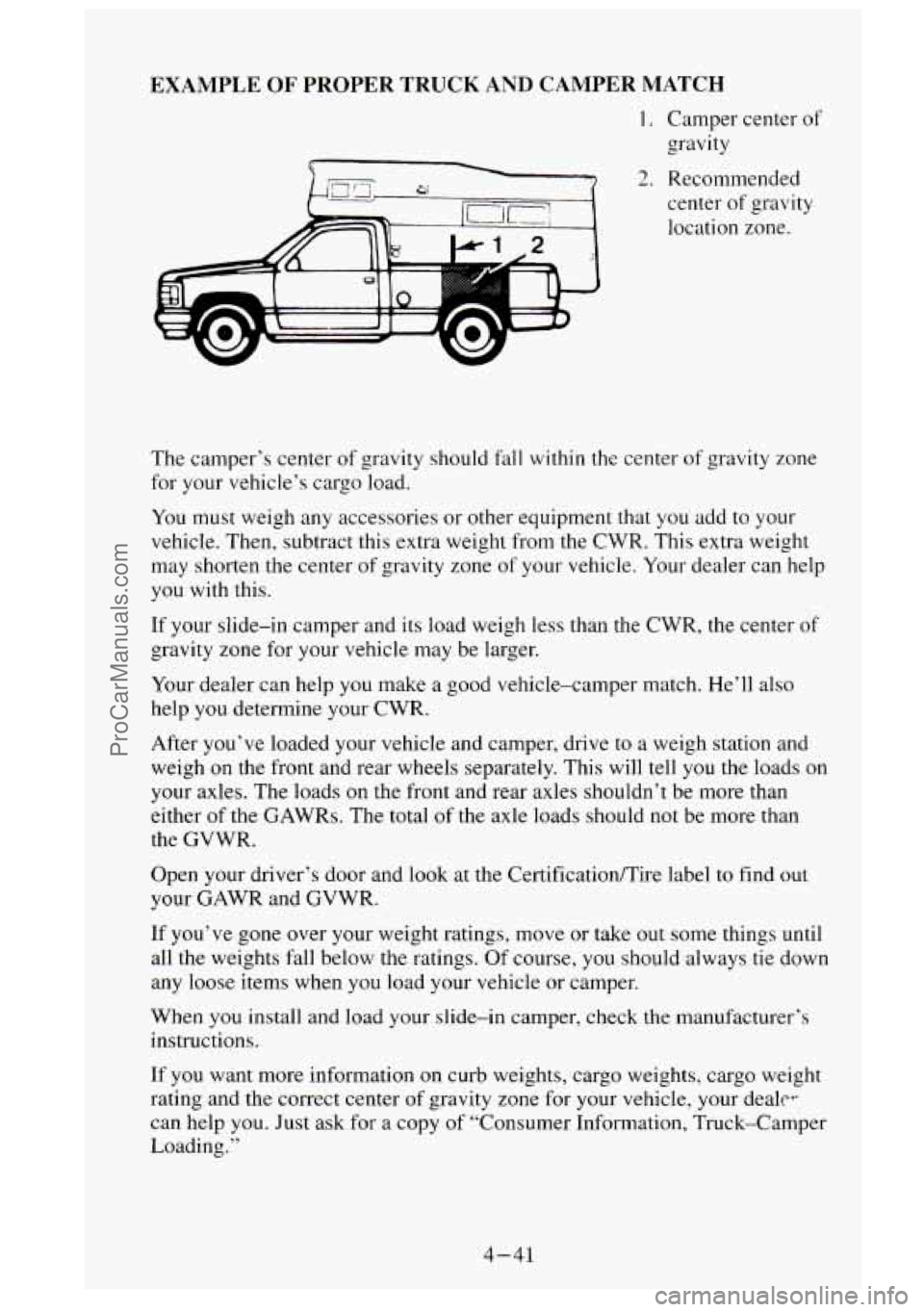
EXAMPLE OF PROPER TRUCK AND CAMPER MATCH
I. Camper center of
gravity
2. Recommended
center
of gravity
location zone.
The camper’s center of gravity should fall within the center
of gravity zone
for your vehicle’s cargo load.
You must weigh any accessories or other equipment that you add to your
vehicle. Then, subtract this extra weight from the
CWR. This extra weight
may shorten the center
of gravity zone of your vehicle. Your dealer can help
you with this.
If your slide-in camper and its load weigh less than the CWR, the center
of
gravity zone for your vehicle may be larger.
Your dealer can help you make a good vehicle-camper match. He’ll also
help you determine your CWR.
After you’ve loaded your vehicle and camper, drive
to a weigh station and
weigh
on the front and rear wheels separately. This will tell you the loads on
your axles. The loads on the front and rear axles shouldn’t be more than
either of the GAWRs. The total
of the axle loads should not be more than
the
GVWR.
Open your driver’s door and look at the CertificatiodTire label to find out
your
GAWR and GVWR.
If you’ve gone over your weight ratings, move or take out some things until
all the weights fall below the ratings.
Of course, you should always tie down
any loose items when you load your vehicle
or camper.
When you install and load your slide-in &‘@er, check the manufacturer’s
instructions.
If you want more information on curb weights, cargo weights, cargo weight
rating
and the correct center of gravity zone for your vehicle, your dealer
can help you. Just ask for a copy of “Consumer Information, Truck-Camper
Loading.”
4-41
ProCarManuals.com