1995 CHEVROLET TRACKER tires
[x] Cancel search: tiresPage 167 of 354
I
NOTICE:
The front wheels transmit shocks during towing.
The steering column may not be strong enough to
withstand the shocks. Always unlock the steering
wheel before towing.
Loading Your Vehicle
I NOTICE:
Make sure that the towing speed does not exceed
damaged.
I 50 mph (SO kmh), or your Geo could be badly
f
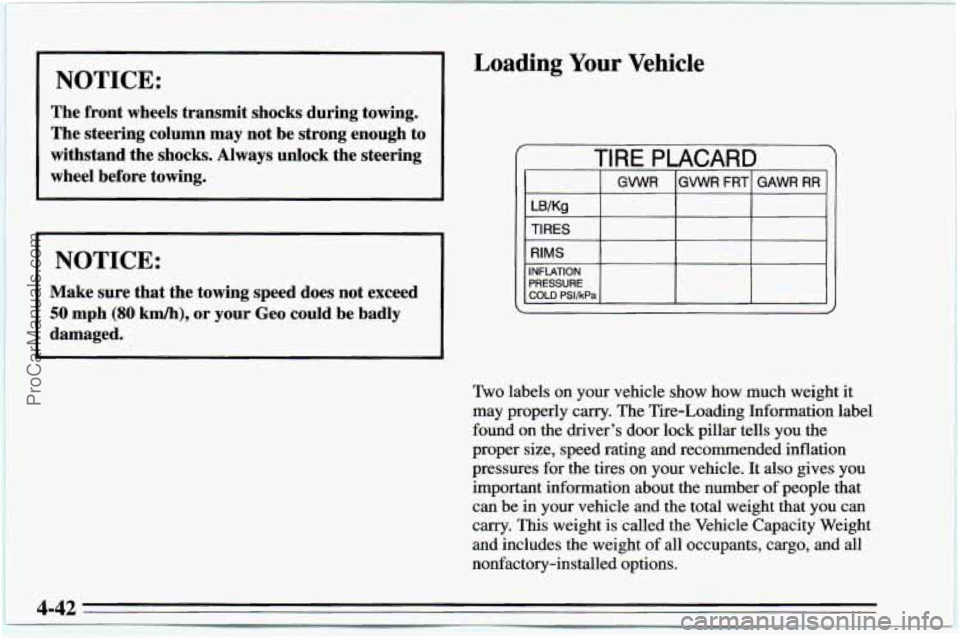
TIRE PLACARD
GhR GWVR FRT GAWR RR
WKg
TIRES
RIMS
INFLATION PRESSURE COLD PSVkPa
Two labels on your vehicle show how much weight it
may properly carry. The Tire-Loading Information label
found on the driver’s door lock pillar tells you the
proper size, speed rating and recommended inflation
pressures for the tires on your vehicle. It also gives you
important information about the number of people that
can be in your vehicle and the total weight that
you can
carry.
This weight is called the Vehicle Capacity Weight
and includes the weight of all occupants, cargo, and all
nonfactory-installed options.
4-42
ProCarManuals.com
Page 170 of 354
Your vehicle can tow a trailer. To identify what the
vehicle trailering capacity
is for your vehicle, you
should read the information in “Weight of the Trailer”
that
appears later in this section. But trailering is
different than just driving your vehicle by itself.
Trailering means changes in handling, durability, and
fuel economy. Successful, safe trailering takes correct
equipment, and it has to be used properly.
That’s the reason for this section. In it are many
time-tested, important trailering tips and safety rules.
Many
of these are important for your safety and that of
your passengers.
So please read this section carefully
before you pull a trailer.
Load-pulling components such as the engine,
transmission, wheel assemblies, and tires are forced
to
work harder against the drag of the added weight. The
engine
is required to operate at relatively higher speeds
and under greater loads, generating extra heat. What’s
more, the trailer adds considerably
to wind resistance,
increasing the pulling requirements.
If You Do Decide To Pull A Trailer
If you do, here are some important points.
0
0
0
0
There are many different laws, including speed limit
restrictions, having
to do with trailering. Make sure
your rig will
be legal, not only where you live but
also where
you’ll be driving. A good source for this
information can be state or provincial police.
Consider using a sway control. You
can ask a hitch
dealer about sway controls.
Don’t tow a trailer at all during the first
500 miles
(800 km) your new vehicle is driven. Your engine,
axle or other parts could be damaged.
Then, during the first
500 miles (800 km) that you
tow a trailer, don’t drive over
50 mph (80 km/h) and
don’t make starts at full throttle. This helps your
engine and other parts of your vehicle wear
in at the
heavier loads.
If
you have an automatic transmission, you should use
DRIVE (D) (or, as
you need to, a lower gear) when
towing
a trailer. Operating your vehicle in DRIVE (D)
when towing a trailer will minimize heat build-up and
extend the
life of your transmission. If you have a
manual transmission and
you are towing a trailer, it’s
better
not to use FIFTH (5) gear. Just drive in
FOURTH (4) gear (or, as you need to, a lower gear).
ProCarManuals.com
Page 172 of 354
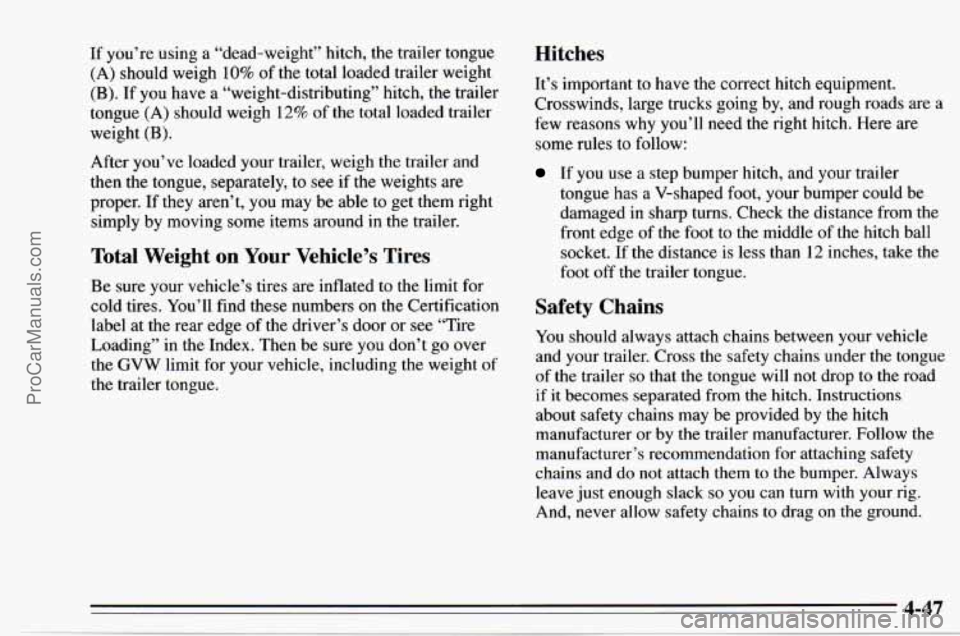
If you’re using a “dead-weight” hitch, the trailer tongue
(A) should weigh 10% of the total loaded trailer weight
(B). If you have a “weight-distributing” hitch, the trailer
tongue
(A) should weigh 12% of the total loaded trailer
weight
(B).
After you’ve loaded your trailer, weigh the trailer and
then the tongue, separately,
to see if the weights are
proper. If they aren’t, you may be able to get them right
simply by moving some items around in the trailer.
Total Weight on Your Vehicle’s Tires
Be sure your vehicle’s tires are inflated to the limit for
cold tires. You’ll find these numbers on the Certification
label at the rear edge of the driver’s door or see “Tire
Loading” in the Index. Then be sure you don’t go over
the
GVW limit for your vehicle, including the weight of
the trailer tongue.
Hitches
It’s important to have the correct hitch equipment.
Crosswinds, large trucks going by, and rough roads are
a
few reasons why you’ll need the right hitch. Here are
some rules
to follow:
If you use a step bumper hitch, and your trailer
tongue has a V-shaped foot, your bumper could be
damaged in sharp turns. Check the distance from the
front edge of the foot to the middle of the hitch ball
socket. If the distance is less than 12 inches, take the
foot off the trailer tongue.
Safety Chains
You should always attach chains between your vehicle
and your trailer.
Cross the safety chains under the tongue
of the trailer
so that the tongue will not drop to the road
if it becomes separated from the hitch. Instructions
about safety chains may be provided by the hitch
manufacturer or by
the trailer manufacturer. Follow the
manufacturer’s recommendation for attaching safety
chains and
do not attach them to the bumper. Always
leave just enough slack
so you can turn with your rig.
And, never allow safety chains to drag on the ground.
ProCarManuals.com
Page 173 of 354
nailer Brakes
If your trailer weighs more than 1,000 pounds (450 kg)
loaded, then it needs its own brakes -- and they must be
adequate. Be sure to read and follow the instructions for
the trailer brakes
so you’ll be able to install, adjust and
maintain them properly.
Driving with a Trailer
0
0
0
Don’t tap into your vehicle’s brake system if the
trailer’s brake system will use more than
0.02 cubic
inch
(0.3 cc) of fluid from your vehicle’s master
cylinder.
If it does, both systems won’t work well.
You could even lose your brakes.
Will the trailer brake parts take
3,000 psi
(20 650 kPa) of pressure? If not, the trailer brake
system must not be used with your vehicle.
If everything checks out this far, then make the brake
fluid tap at the port on the master cylinder that sends
fluid to the rear brakes. But don’t use copper tubing
for this.
If you do, it will bend and finally break off.
Use steel brake tubing. Towing
a trailer requires a certain amount of experience.
Before setting out for the open road, you’ll
want to get
to know your rig. Acquaint yourself with the feel of
handling and braking with the added weight
of the
trailer. And always keep in mind that the vehicle you
are
driving is now a good deal longer and not nearly as
responsive as your vehicle
is by itself.
Before you start, check the trailer hitch and platform
(and attachments), safety chains, electrical connector,
lamps, tires and mirror adjustment.
If the trailer has
electric brakes, start your vehicle and trailer moving and
then apply the trailer brake controller by hand to be sure
the brakes are working. This lets
you check your
electrical connection at the same time.
During your trip, check occasionally to be sure that the
load is secure, and that the lamps and any trailer brakes
are still working.
ProCarManuals.com
Page 183 of 354
Towing Your Vehicle
I
I
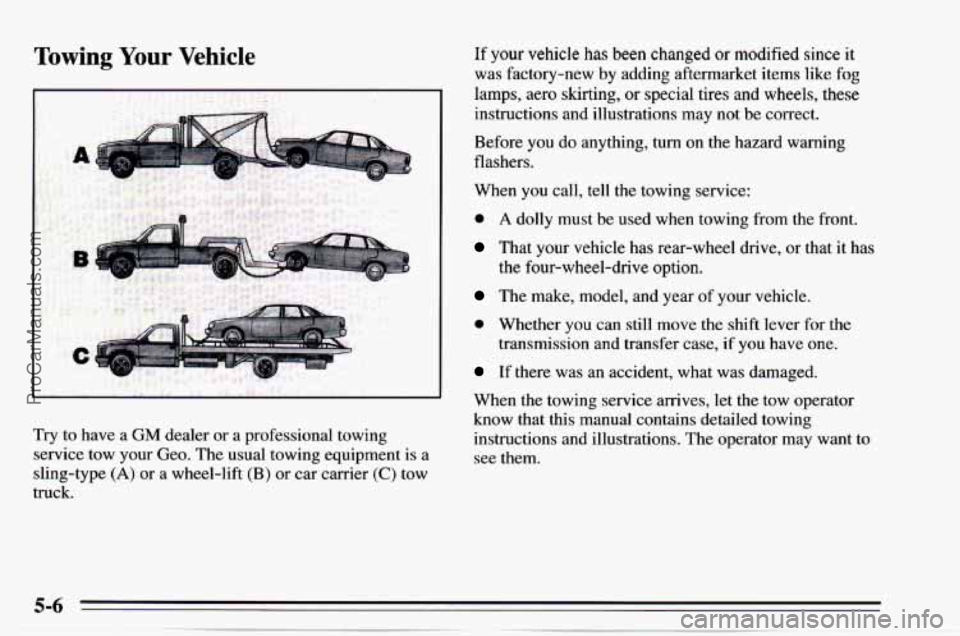
Try to have a GM dealer or a professional towing
service tow your Geo. The usual towing equipment is
a
sling-type (A) or a wheel-lift (B) or car carrier (C) tow
truck.
If your vehicle has been changed or modified since it
was factory-new by adding aftermarket items
like fog
lamps, aero skirting, or special tires and wheels, these
instructions and illustrations may not be correct.
Before you do anything, turn on the hazard warning
flashers.
When
you call, tell the towing service:
0 A dolly must be used when towing from the front.
That your vehicle has rear-wheel drive, or that it has
The make, model, and year of your vehicle.
0 Whether you can still move the shift lever for the
transmission and transfer case, if you have
one.
the four-wheel-drive option.
If there was an accident, what was damaged.
When the towing service arrives, let the tow operator
know that this manual contains detailed towing
instructions and illustrations. The operator may want
to
see them.
ProCarManuals.com
Page 198 of 354
If a Tire Goes Flat
It’s unusual for a tire to “blow out’‘ while you’re driving,
especially if you maintain your
tires properly. If air goes
out of
a tire, it’s much more likely to leak out slowly.
But if you should ever have a “blowout,” here are a few
tips about what to expect and what
to do:
If a front tire fails, the flat tire will create a drag that
pulls
the vehicle toward that side. Take your foot off the
accelerator pedal and grip
the steering wheel firmly.
Steer
to maintain lane position, then gently brake to a
stop well out of the traffic lane.
A rear blowout, particularly on a curve, acts much like a
skid and may require the same correction you’d use in a
skid. In any rear blowout, remove your foot from the
accelerator pedal. Get the vehicle under control by
steering the way you want the vehicle to
go. It may be
very bumpy and noisy, but you can still steer. Gently
brake
to a stop, well off the road if possible.
If a tire goes flat, the next part shows how to use your
jacking equipment to change a flat tire safely.
Changing a Flat Tire
If a tire goes flat, avoid further tire and wheel damage
by driving slowly
to a level place. Turn on your hazard
warning flashers.
5-21
ProCarManuals.com
Page 208 of 354
If You’re Stuck: In Sand, Mud, Ice or
Snow
What you don’t want to do when your vehicle is stuck is
to spin
your wheels too fast. The method known as
“rocking” can help you get out when you’re stuck, but
you must use caution.
I NOTICE:
Spinning your wheels can destroy parts of your
vehicle as well as the tires. If you spin the wheels
too fast while shifting your transmission back
and forth, you can destroy your transmission.
For information about using tire chains on your vehicle,
see
‘“Tire Chains” in the Index.
ProCarManuals.com
Page 244 of 354
Brake Wear
Your Geo has front disc brakes and rear drum brakes.
Disc brake pads have built-in wear indicators that make
a high-pitched warning sound when the brake pads
are
worn and new pads are needed. The sound may come
and go or be heard all the time your velvcle is moving
(except when you are pushing on the brake pedal
firmly).
NOTICE:
Continuing to drive with worn-out brake pads
could result in costly brake repair.
Some driving conditions or climates rSray C2iQSg si brake
squeal when the brakes are first applied or lightly
applied. This does not mean something is wrong with
your brakes.
Your rear drum brakes don’t have wear indicators, but if
you ever hear a rear brake rubbing noise, have the rear
brake linings inspected. Also, the rear brake drums
should be removed and inspected each time the tires are
removed for rotation or changing. When you have the
front brakes replaced, have the rear brakes inspected,
too.
Brake linings should always be replaced as complete
axle sets.
Brake Pedal Travel
See your dealer if the brake pedal does not return to
normal height, or
if there is a rapid increase in pedal
travel. This could be a sign
of brake trouble.
Brake Adjustment
Every time you make a brake stop, your disc brakes
adjust for wear.
If your brake pedal goes down farther than normal, your
rear drum brakes
may need adjustment. Adjust them by
backing up and firmly applying the brakes a few times.
ProCarManuals.com