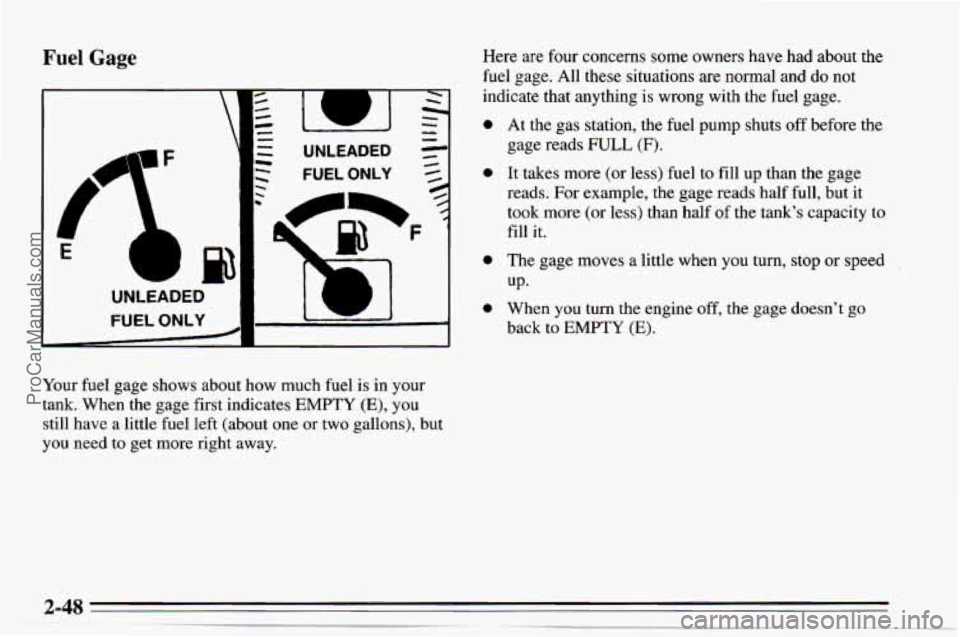
Fuel Gage Here are four concerns some owners have had about the
fuel gage. All these situations are normal and do not
indicate that anything is wrong with the fuel gage.
0
0
0
e
Your fuel gage shows about how much fuel is in your
tank. When the gage first indicates
EMPTY (E), you
still have a little fuel left (about one or two gallons), but
you need
to get more right away. At
the gas station, the fuel pump shuts off before the
gage reads
FULL (F).
It takes more (or less) fuel to fill up than the gage
reads. For example, the gage reads half full, but it
took more (or less) than half
of the tank’s capacity to
fill it.
The gage moves a little when you turn, stop or speed
UP-
When you turn the engine off, the gage doesn’t go
back to EMPTY (E).
ProCarManuals.com
Fuel
NOTICE:
If you try to do your own service work without
knowing enough about it, your vehicle could be
damaged.
Use regular unleaded gasoline rated at 87 octane or
higher. It should meet specifications ASTM D4814 in
the United States and CGSB
3.5-92 in Canada. These
fuels should have the proper additives,
so you should not
have
to add anything to the fuel.
In the United States and Canada, it’s easy to be sure you
get the right kind of gasoline (unleaded). You’ll
see
UNLEADED right on the pump. And only unleaded
nozzles will fit into your vehicle’s filler neck.
Be sure the posted octane is at least
87. If the octane is
less than 87, you may get a heavy knocking noise when
you drive. If it’s bad enough,
it can damage your engine.
If you’re using fuel rated at 87 octane or higher and you
still hear heavy knocking, your engine needs service.
But don’t worry if
you hear a little pinging noise when
you’re accelerating or driving up a hill. That’s normal,
and you don’t have
to buy a higher octane fuel to get rid
of pinging. It’s the heavy, constant knock that means
you have a problem.
ProCarManuals.com