Page 251 of 486
Cooling System - Diesel Engines
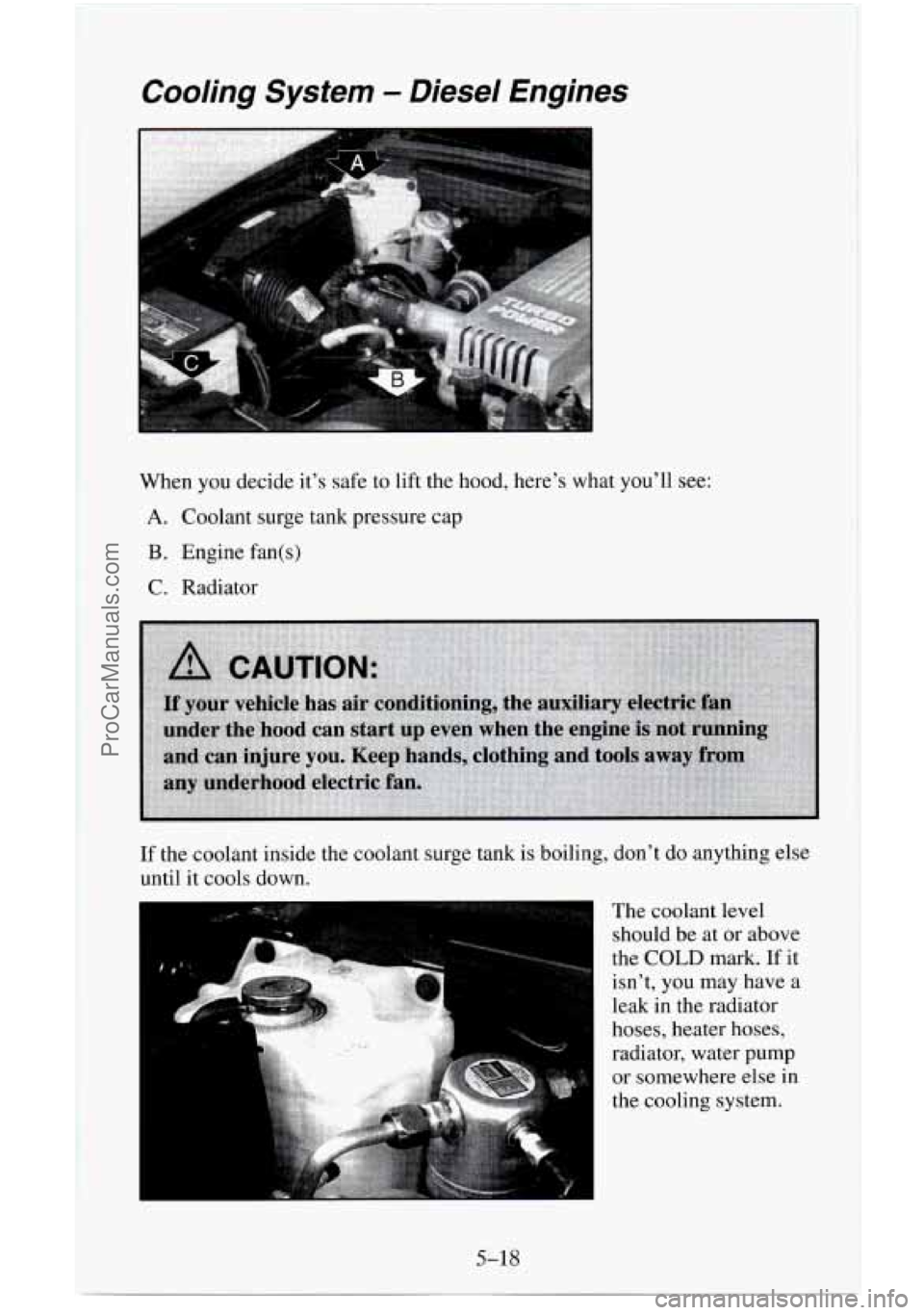
When you decide it’s safe to lift the hood, here’s what you’ll see:
A. Coolant surge tank pressure cap
B. Engine fan(s)
C. Radiator
If the coolant inside the coolant surge tank is boiling, don’t do anything else
until
it cools down.
The coolant level
should be at or above
the
COLD mark. If it
isn’t,
you may have a
leak in the radiator
hoses, heater hoses,
radiator, water pump
1 or somewhere else in
the cooling system.
5-18
ProCarManuals.com
Page 252 of 486
NOTICE:
Engine damage from running your engine without coolant isn’t \
covered by your warranty.
If there seems to be no leak, start the engine again. See if the fan speed
increases
when idle speed is doubled by pushing the accelerator pedal down.
If it doesn’t, your vehicle needs service. Turn
off the engine.
How to Add Coolant to the Coolant Surge Tank
NOTICE:
The diesel engine has a specific coolant fill procedure. Failur\
e to
follow this procedure could cause your engine to overheat and \
be
severely damaged.
If you haven’t found a problem yet, but the coolant level isn’t at the COLD
mark, add a 50/50 mixture of clean water (preferably distilled) and a proper
antifreeze at the coolant surge tank, but be sure the cooling system,
including the coolant surge tank pressure cap, is cool before you do it. (See
“Engine Coolant” in the Index for more information about the proper
coolant mix.)
5-19
ProCarManuals.com
Page 254 of 486
NOTICE:
In cold weather, water can freeze and crack the engine, radiat\
or,
heater core and other parts.
So use the recommended coolant.
1. You can remove the coolant surge tank pressure cap when the cooling
system, including the coolant surge tank pressure cap and upper
radiator hose, is no longer hot. Turn the pressure cap slowly to the left
until
it first stops. (Don’t press down while turning the pressure cap.)
If you hear a hiss, wait for that
to stop. A hiss means there is still some
pressure left.
5-21
ProCarManuals.com
Page 255 of 486
2. Then keep
turning the cap,
but now push
down
as you turn
it. Remove the
pressure cap.
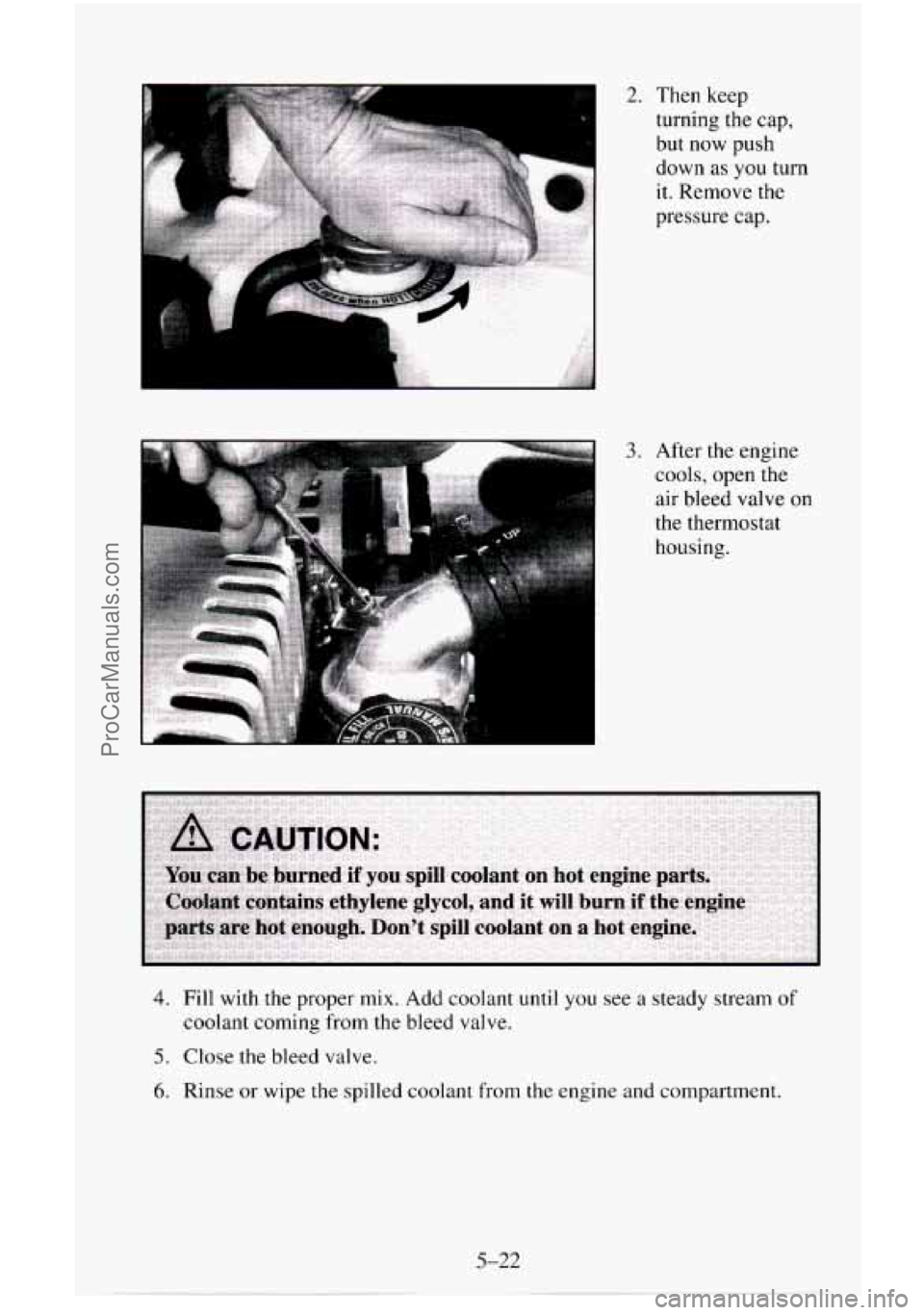
3. After the engine
cools, open the
air bleed valve on
the thermostat
housing.
4. Fill with the proper mix. Add coolant until you see a steady stream of
5. Close the bleed valve. coolant coming
from the bleed valve.
6. Rinse or wipe the spilled coolant from the engine and compartment.
ProCarManuals.com
Page 256 of 486
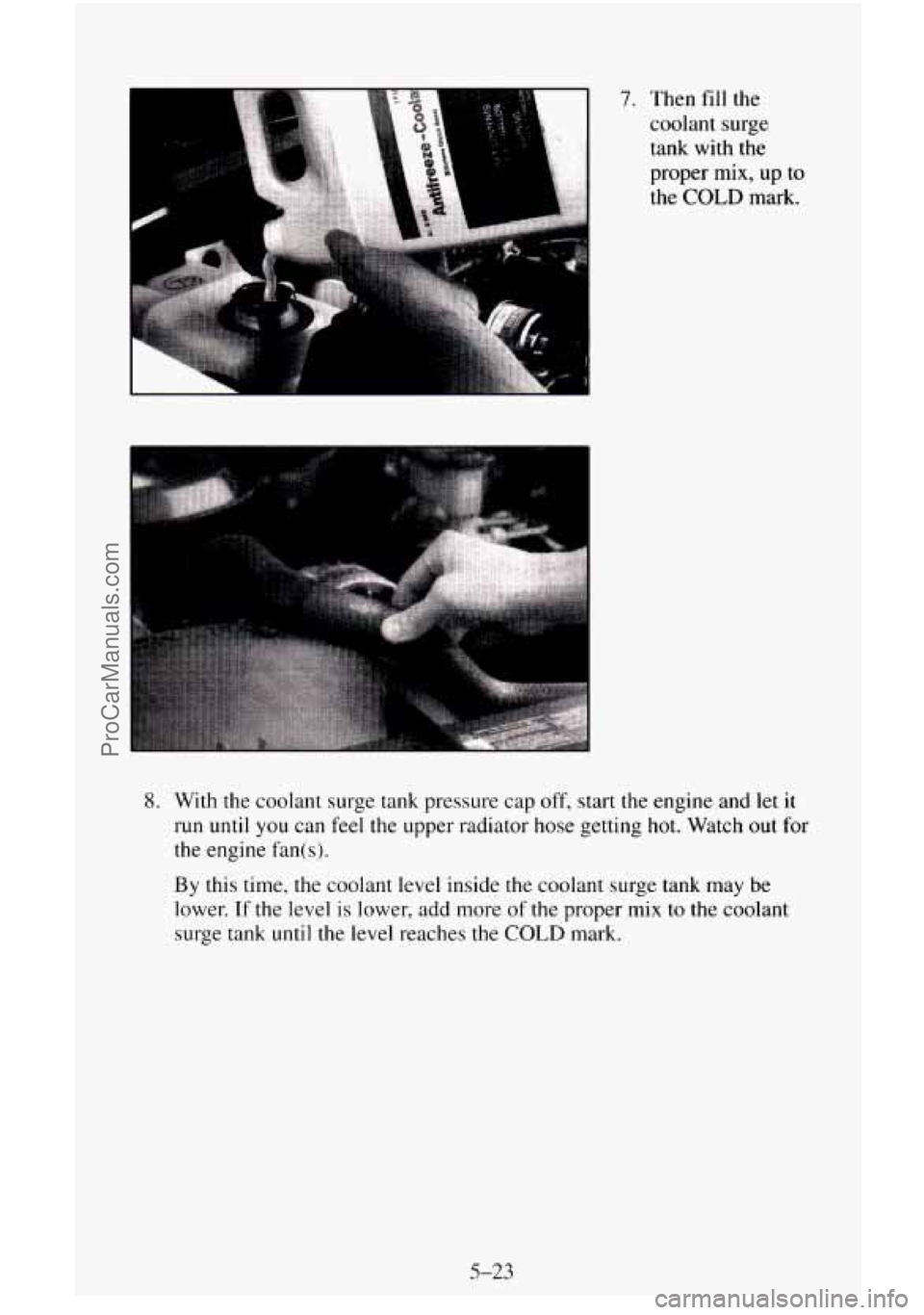
7. Then fill the coolant
surge
tank with the
proper mix, up to
the COLD mark.
8. With the coolant surge tank pressure cap off, start the engine and let it
run until you can feel the upper radiator hose getting hot. Watch out for
the engine fan(s).
By this time, the coolant level inside
the coolant surge tank may be
lower. If the level is lower, add more of the proper mix to the coolant
surge tank until the level reaches the
COLD mark.
5-23
ProCarManuals.com
Page 296 of 486

NOTICE:
Use only engine oil with the American Petroleum Institute
Certified For Gasoline Engines “Starburst” symbol. Failure \
to
use the proper oil can result in engine damage not covered by
your warranty.
GM Goodwrench@ oil (in Canada, GM Engine Oil) meets all the
requirements for your vehicle.
Engine Oil Additives
Don’t add anything to your oil. Your GM dealer is ready to advise if you
think something should be added.
When to Change Engine Oil
See if any one of these is true for you:
Most trips are less than 5 to 10 miles (8 to 16 km). This is particularly
important when outside temperatures are below freezing.
0 Most trips include extensive idling (such as frequent driving in stop and
go traffic).
Most trips are through dusty areas.
You operate your vehicle in dusty areas or off-road frequently.
0 You frequently tow a trailer or use a carrier on top of your vehicle.
If any one of these
is true for your vehicle, then you need to change your oil
and filter every 3,000 miles (5 000 km) or 3 months - whichever comes
first.
Light Duty Emissions:
If none of them is true, change the oil and filter every 7,500 miles (1 2 500
km) or 12 months - whichever comes first.
Heavy Duty Emissions:
If none of them is true, change the oil and filter every 6,000 miles (10 000
km) or 12 months - whichever comes first.
Engine Coolant Heater
An engine coolant heater can be a big help if you have to park outside in
very cold weather, 0°F (- 18OC) or colder. If your vehicle has this option,
see “Engine Coolant Heater” in the Index.
ProCarManuals.com
Page 310 of 486
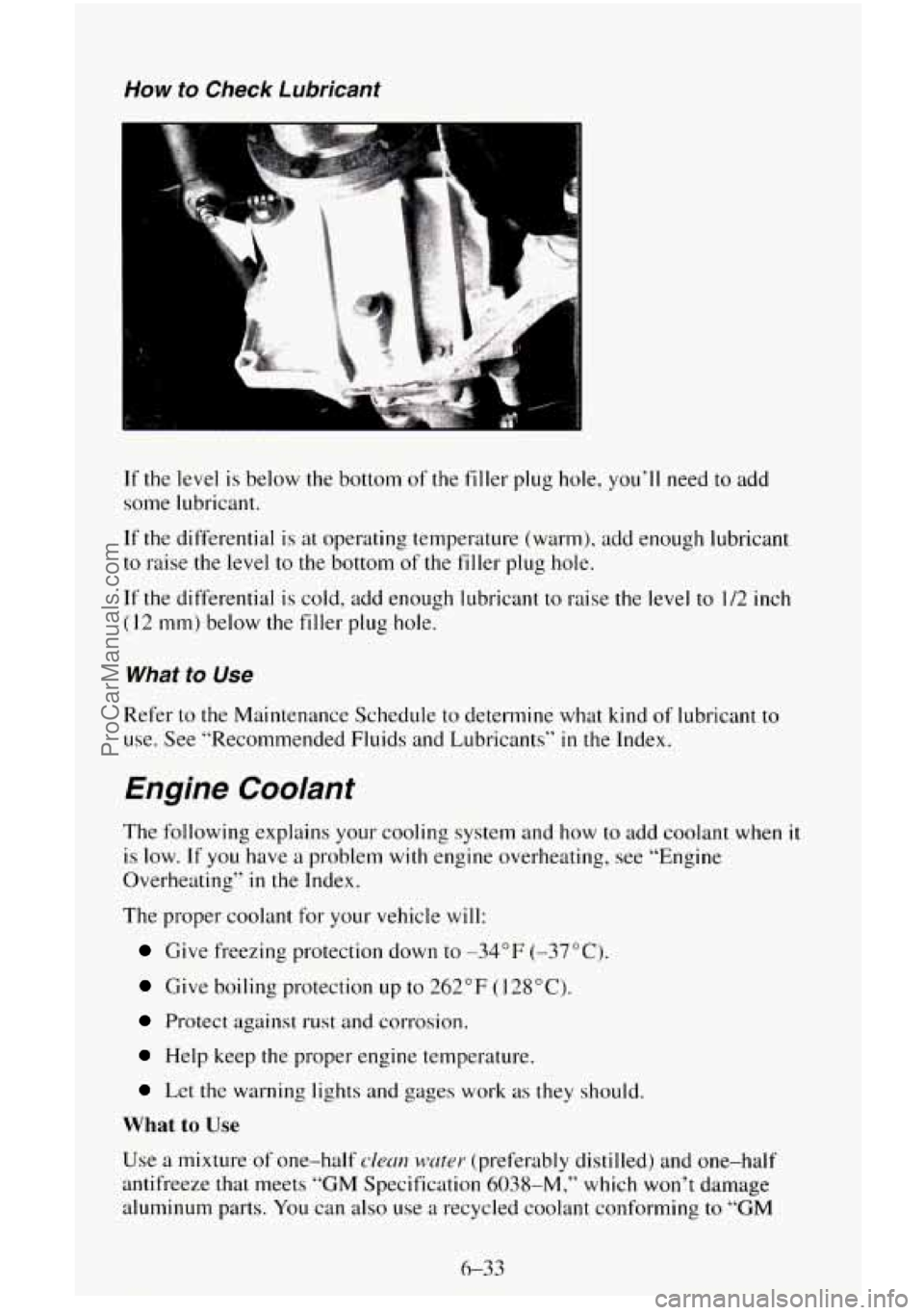
How to Check Lubricant
P
If the level is below the bottom of the filler plug hole, you’ll need to add
some lubricant.
If the differential is at operating temperature (warm), add enough lubricant
to raise the level to the bottom of the filler plug hole.
If the differential is cold, add enough lubricant to raise the level to 1/2 inch
(I 2 mm) below the filler plug hole.
What to Use
Refer to the Maintenance Schedule to determine what kind of lubricant to
use. See “Recommended Fluids and Lubricants” in the Index.
Engine Coolant
The following explains your cooling system and how to add coolant when it
is low. If you have a problem with engine overheating, see “Engine
Overheating”
in the Index.
The proper coolant for your vehicle will:
Give freezing protection down to -34°F (-37°C).
Give boiling protection up to 262°F (128°C).
Protect against rust and corrosion.
Help keep the proper engine temperature.
Let the warning lights and gages work as they should.
What to Use
Use a mixture of one-half chi? wcmr (preferably distilled) and one-half
antifreeze that meets
“GM Specification 6038-M,” which won’t damage
aluminum parts.
You can also use a recycled coolant conforming to “GM
6-33
ProCarManuals.com
Page 311 of 486
Specification 6038-M.” Use GM Coolant Supplement (Sealer) with a
complete coolant flush and refill. If
you use this mixture, you don’t need to
add anything else.
NOTICE:
If you use an improper coolant mix, your engine could overheat
and be badly damaged. The repair cost wouldn’t be covered by
your warranty.
Too much water in the mix can freeze and crack
the engine, radiator, heater core and other parts.
Some conditions, such
as air trapped in the cooling system, can affect the
coolant level
in the radiator. Check the coolant level when the engine is cold
and follow the steps under “Adding Coolant”
for the proper way to add
coolant.
If you have to add coolant more than four times
a year, have your dealer
check
your cooling system.
I NOTICE:
If you use the proper coolant, you don’t have to add extra
inhibitors or additives which claim to improve the system. These
can be harmful.
6-34
ProCarManuals.com