1995 CHEVROLET SUBURBAN FLUID
[x] Cancel search: FLUIDPage 6 of 486
Table of Contents
Introduction - How to Use this Manual
This section tells you how to use your manual and includes safety
and vehicle damage warnings and symbols.
Section 1 - Seats and Restraint Systems
This section tells you how to use your seats and safety belts
properly. It also explains the air bag system.
Section 2 - Features & Controls
This section explains how to start and operate your vehicle.
Section 3 - Comfort Controls & Audio Systems
This section tells you how to adjust the ventilation and comfort
controls and how to operate your audio system.
Section 4 - Your Driving and the Road
Here you’ll find helpful information and tips about the road and
how to drive under different conditions.
Section 5 - Problems on the Road
This section tells you what to do if you have a problem while
driving, such as a flat tire or engine overheating, etc.
Section 6 - Service & Appearance Care
Here the manual tells you how to keep your vehicle running
properly and looking good.
Section 7 - Maintenance Schedule
This section tells you when to perform vehicle maintenance and
what fluids and lubricants to use.
Section 8 - Customer Assistance Information
This section tells you how to contact GM for assistance and how to
get service publications. It also gives you information on
“Reporting Safety Defects” on page
8-4.
Index
Here’s an alphabetical listing of almost every subject in this
manual. You can use it to quickly find something you want to read.
i
ProCarManuals.com
Page 109 of 486
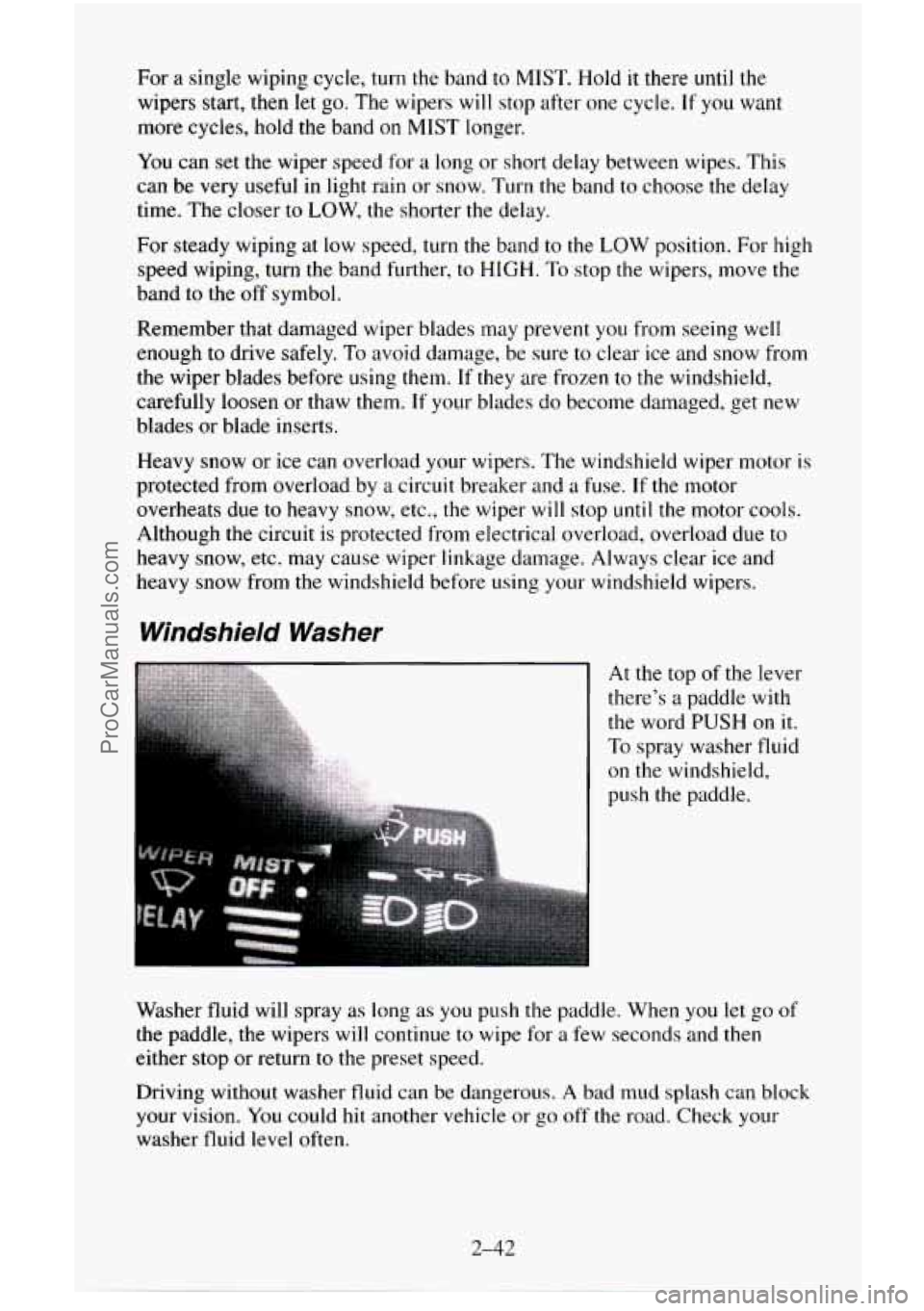
For a single wiping cycle, turn the band to MIST. Hold it there until the
wipers start, then let go. The wipers will stop after one cycle. If you want
more cycles, hold the band
on MIST longer.
You can set the wiper speed for a long or short delay between wipes. This
can be very useful in light rain or snow. Turn the band to choose the delay
time. The closer
to LOW, the shorter the delay.
For steady wiping at low speed,
turn the band to the LOW position. For high
speed wiping, turn the band further, to
HIGH. To stop the wipers, move the
band to the off symbol.
Remember that damaged wiper blades may prevent
you from seeing well
enough to drive safely.
To avoid damage, be sure to clear ice and snow from
the wiper blades before using them.
If they are frozen to the windshield,
carefully loosen or thaw them.
If your blades do become damaged, get new
blades
or blade inserts.
Heavy snow or ice can overload your wipers. The windshield wiper motor is
protected from overload by a circuit breaker and
a fuse. If the motor
overheats due to heavy snow, etc.,
the wiper will stop until the motor cools.
Although the circuit is protected from electrical overload, overload due
to
heavy snow, etc. may cause wiper linkage damage. Always clear ice and
heavy snow from the windshield before using your windshield wipers.
Windshield Washer
At the top of the lever
there’s a paddle with
the word PUSH on it.
To spray washer fluid
on the windshield,
push the paddle.
Washer fluid will spray as long as
you push the paddle. When you let go of
the paddle, the wipers will continue to wipe for a few seconds and then
either stop or return to the preset speed.
Driving without washer fluid can be dangerous.
A bad mud splash can block
your vision. You
could hit another vehicle or go off the road. Check your
washer fluid level often.
2-42
ProCarManuals.com
Page 110 of 486
NOTICE:
When using concentrated washer fluid, follow the
manufacturer’s instructions for adding water.
Don’t mix water with ready-to-use washer fluid. Water can
cause the solution to freeze and damage your washer fluid
tank and other parts of the washer system. Also, water
doesn’t clean
as well as washer fluid.
Fill your washer fluid tank only 3/4 full when it’s very cold.
This allows for expansion, which could damage the tank
if it is
completely full.
Don’t use radiator antifreeze in your windshield washer. It
can damage your washer system and paint.
Cruise Control (Option)
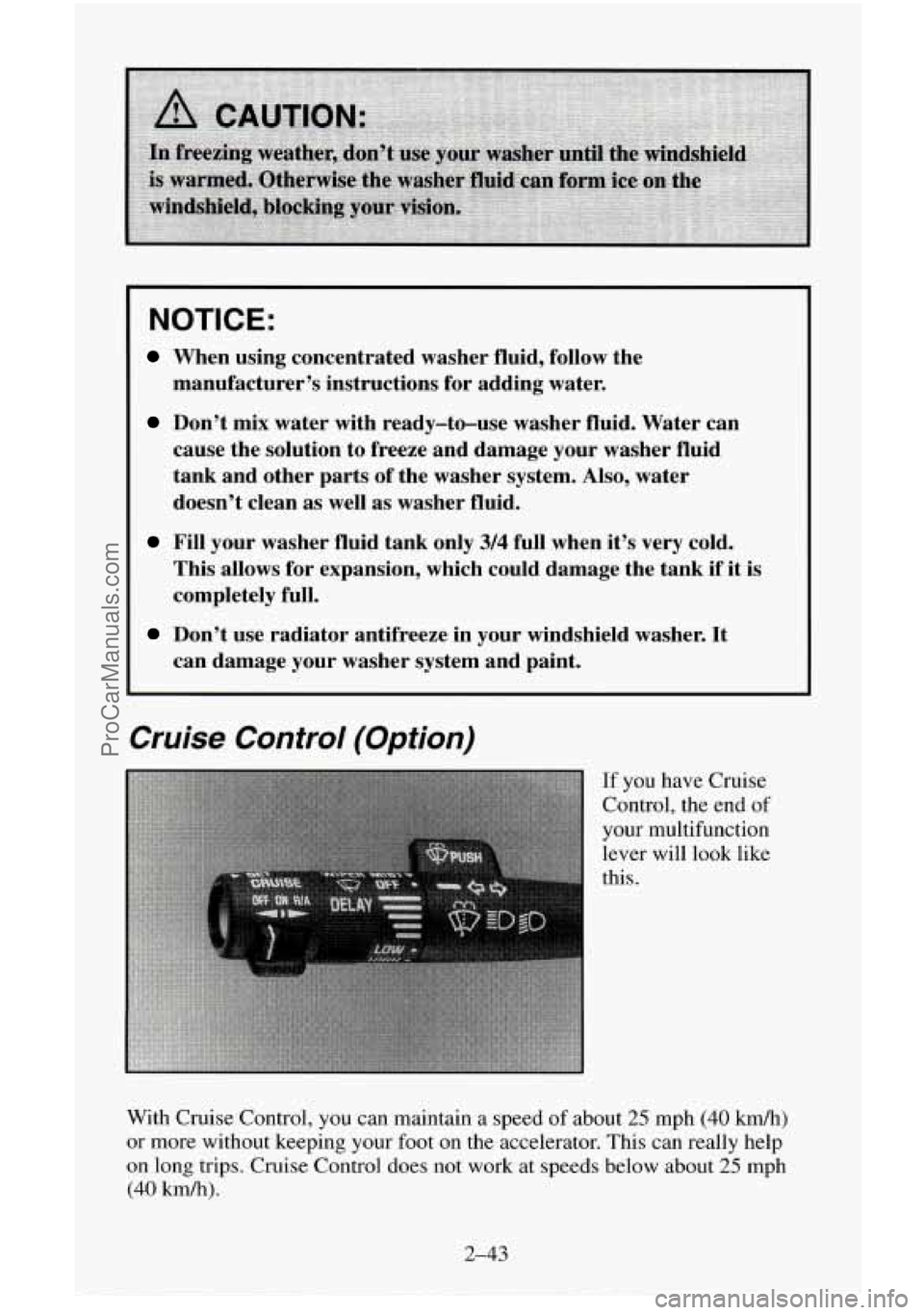
’ If you have Cruise
Control, the end
of
your multifunction lever will look like
this.
With Cruise Control, you can maintain a speed of about 25 mph (40 km/h)
or more without keeping your foot on the accelerator. This can really help
on long trips. Cruise Control does
not work at speeds below about 25 mph
(40 km/h).
2-43
ProCarManuals.com
Page 123 of 486
Rear Window Wiper and Washer
Some visors have
mirrors with lights. If
the mirror has lights,
they will come on
when
you lift the
mirror cover.
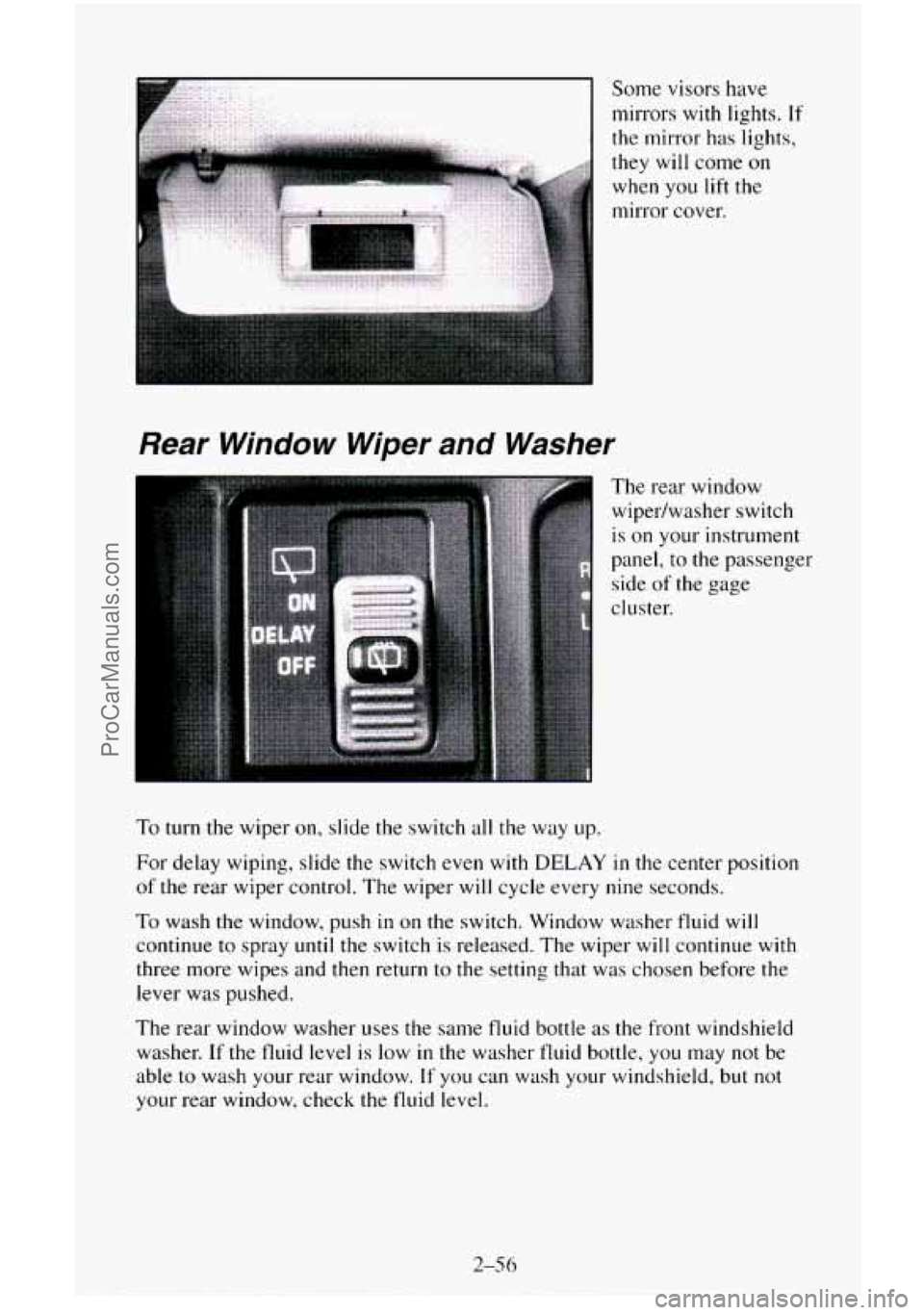
The rear window wipedwasher switch
is on your instrument
panel, to
the passenger
side
of the gage
cluster.
To turn the wiper
on, slide the switch all the way up.
For delay wiping, slide the switch even with
DELAY in the center position
of the rear wiper control. The wiper will cycle every nine seconds.
To wash the window, push in on the switch. Window washer fluid will
continue to spray until the switch is released. The wiper will continue with
three more wipes and then return
to the setting that was chosen before the
lever was pushed.
The rear window washer uses
the same fluid bottle as the front windshield
washer.
If the fluid level is low in the washer fluid bottle, you may not be
able to wash your rear window.
If you can wash your windshield, but not
your rear window, check the fluid level.
2-56
ProCarManuals.com
Page 195 of 486
Off-Road Driving with Your Four-wheel Drive
Vehicle
This off-road guide is for vehicles that have four-wheel drive.
Also, see “Anti-Lock Brakes”
in the Index.
If your vehicle doesn’t have four-wheel drive, you shouldn’t drive off-road
unless you’re on a level, solid surface.
Off-road driving can be great
fun. But it does have some definite hazards.
The greatest
of these is the terrain itself.
“Off-roading” means you’ve left the great North American road system
behind. Traffic lanes aren’t marked. Curves aren’t banked. There are no
road signs. Surfaces can be slippery, rough, uphill or downhill. In short,
you’ve gone right back to nature.
Off-road driving involves some new
skills. And that’s why it’s very
important that you read this guide. You’ll find many driving tips and
suggestions. These will help make your off-road driving safer and more
enjoyable.
Before You Go Off-Roading
There are some things to do before you go out. For example, be sure to have
all necessary maintenance and service work done. Check to make sure all
underbody shields (if
so equipped) are properly attached. Be sure you read
all
the information about your four-wheel drive vehicle in this manual. Is
there enough fuel? Is the spare tire fully inflated? Are the fluid levels up
where they should be? What are
the local laws that apply to off-roading
where you’ll be driving? If you don’t know, you should check with law
enforcement people in the area. Will you be
on someone’s private land? If
so, be sure to get the necessary permission.
Loading Your Vehicle for Off-Road Driving
There are some important things to remember about how to load your
vehicle.
0 The heaviest things should be on the load floor and forward of your
0 Be sure the load is secured properly, so driving on the off-road terrain
rear axle. Put
heavier items as far forward as you can.
doesn’t toss things around.
ProCarManuals.com
Page 211 of 486
When you want to leave the freeway, move to the proper lane well in
advance. If you miss your exit do not, under any circumstances, stop and
back up. Drive on to the next exit.
The exit ramp
can be curved, sometimes quite sharply.
The exit speed
is usually posted.
Reduce your speed according to your speedometer, not to your sense of
motion. After driving for any distance at higher speeds, you may tend
to
think you are going slower than you actually are.
Before Leaving on a Long Trip
Make sure you’re ready. Try to be well rested. If you must start when you’re
not fresh
- such as after a day’s work - don’t plan to make too many
miles that first part of the journey. Wear comfortable clothing and
shoes you
can easily drive in.
Is your vehicle ready for a long trip? If you keep it serviced and maintained,
it’s ready to go. If
it needs service, have it done before starting out. Of
course, you’ll find experienced and able service experts in
GM dealers all
across
North America. They’ll be ready and willing to help if you need it.
Here are some things you can check before
a trip:
0 Windshield Washer Fluid: Is the reservoir full? Are all windows clean
inside and outside?
Wiper Blades: Are they in good shape?
Fuel, Engine Oil, Other Fluids: Have you checked all levels?
Lamps: Are they all working? Are the lenses clean?
Tires: They are vitally important to a safe, trouble-free trip. Is the tread
good enough for long-distance driving? Are the tires all inflated to the
recommended pressure?
Should you delay your trip a short time to avoid a major
storm system?
Weather Forecasts: What’s the weather outlook along your route?
Maps: Do you have up-to-date maps?
Highway Hypnosis
Is there actually such a condition as “highway hypnosis”? Or is it just plain
falling asleep
at the wheel? Call it highway hypnosis, lack of awareness, or
whatever.
ProCarManuals.com
Page 212 of 486
There is something about an easy stretch of road with the same scenery,
along with the hum
of the tires on the road, the drone of the engine, and the
rush of the wind against the vehicle that can make you sleepy. Don’t let it
happen to
you! If it does, your vehicle can leave the road in less than a
second,
and you could crash and be injured.
What can you do about highway hypnosis? First, be aware that it can
happen.
Then here are some tips:
0 Make sure your vehicle is well ventilated, with a comfortably cool
interior.
Keep your eyes moving. Scan the road ahead and to the sides. Check
your mirrors and your instruments frequently.
and take a nap, get some exercise, or both. For safety, treat drowsiness
If you get sleepy, pull off the road into a rest, service, or parking area
on the highway
as an emergency.
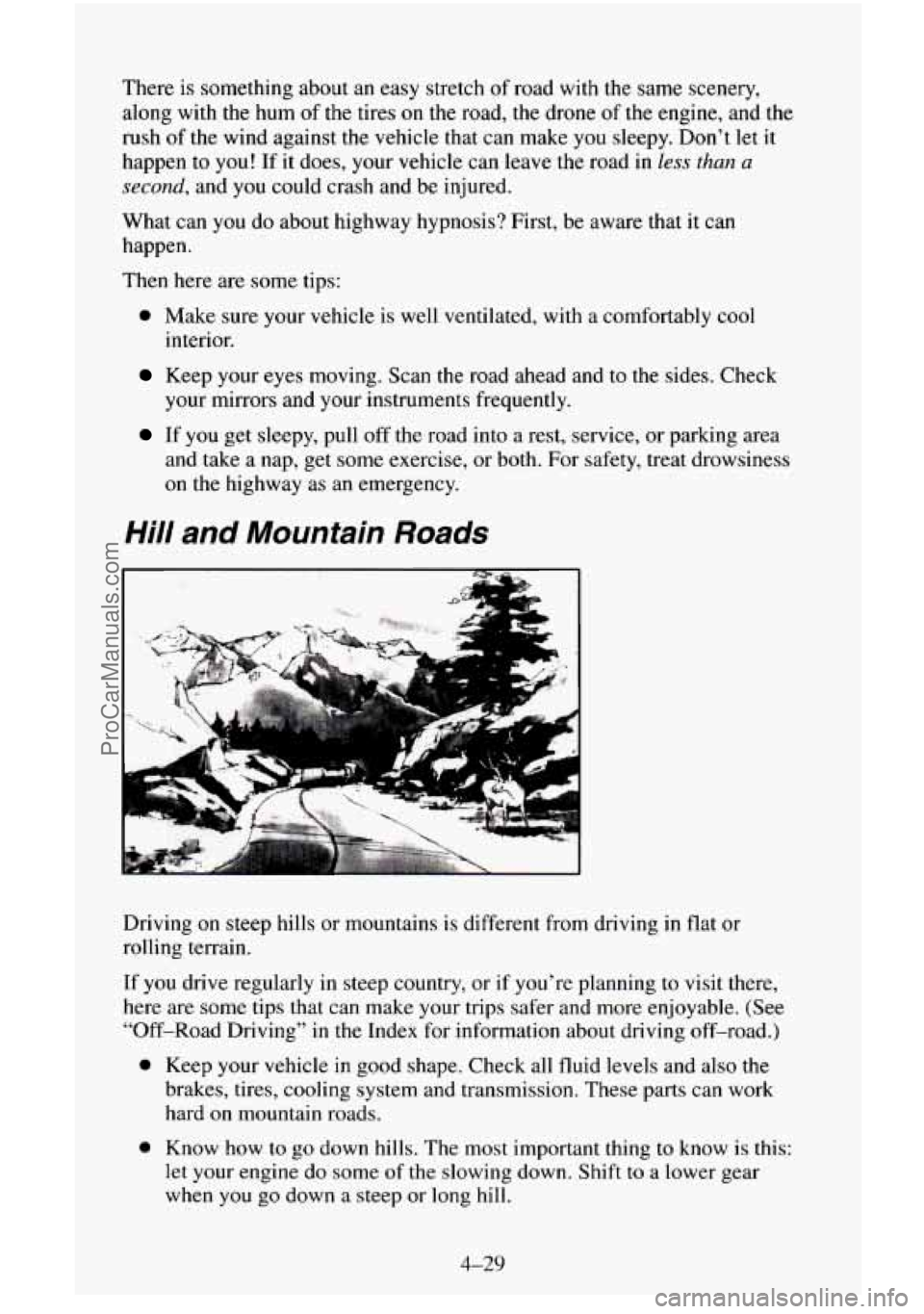
Hill and Mountain Roads
Driving on steep hills or mountains is different from driving in flat or
rolling terrain.
If you drive regularly in steep country, or if you’re planning to visit there,
here are some tips that can make your trips safer and more enjoyable. (See
“Off-Road Driving”
in the Index for information about driving off-road.)
0
0
Keep your vehicle in good shape. Check all fluid levels and also the
brakes, tires, cooling system and transmission. These parts can work
hard on mountain roads.
Know
how to go down hills. The most important thing to know is this:
let your engine
do some of the slowing down. Shift to a lower gear
when
you go down a steep or long hill.
4-29
ProCarManuals.com
Page 214 of 486
Winter Driving
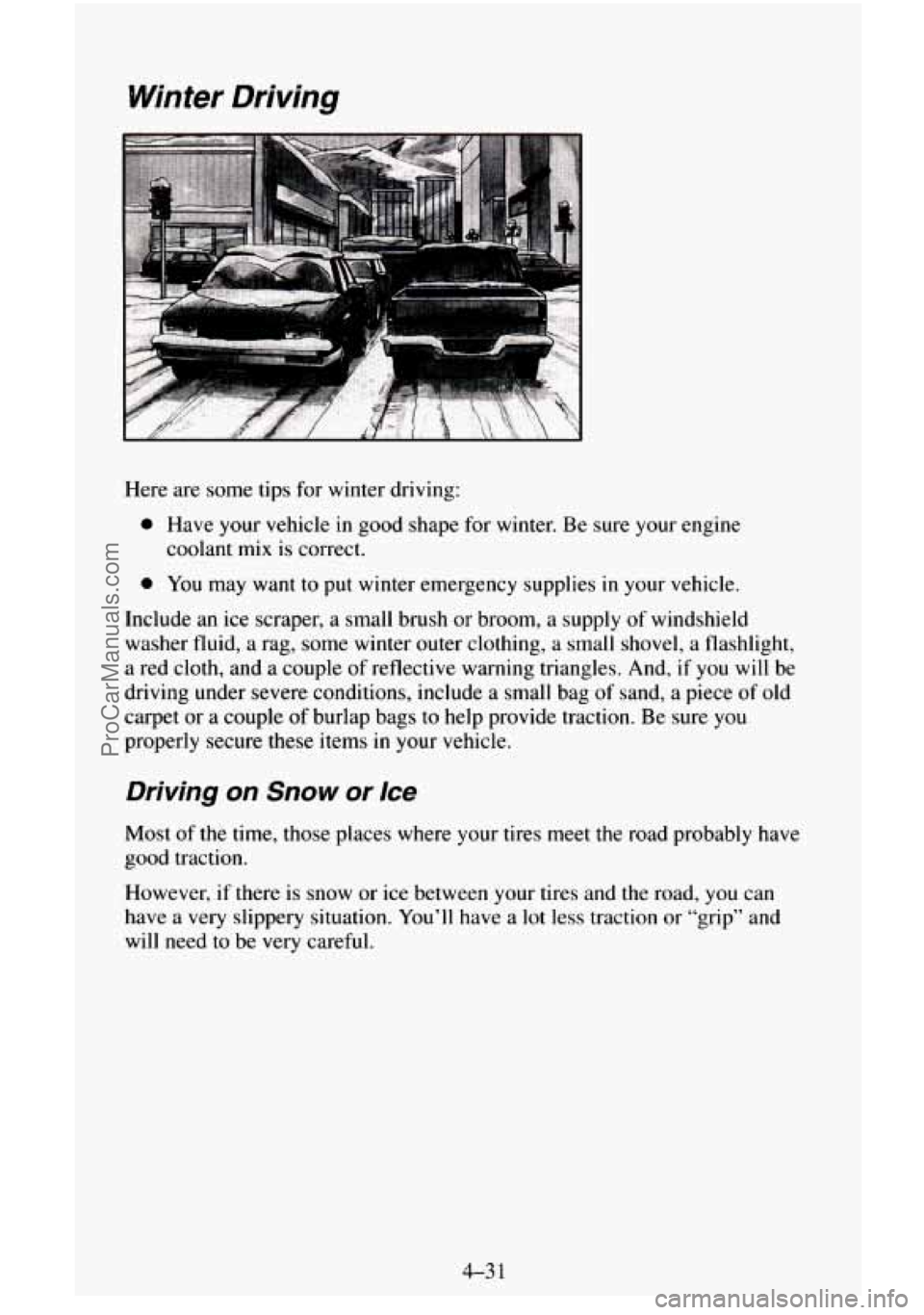
Here are some tips for winter driving:
0 Have your vehicle in good shape for winter. Be sure your engine
coolant
mix is correct.
0 You may want to put winter emergency supplies in your vehicle.
Include an ice scraper, a small brush
or broom, a supply of windshield
washer fluid, a rag, some winter outer clothing, a small shovel, a flashlight,
a red cloth, and a couple of reflective warning triangles. And,
if you will be
driving under severe conditions, include a small bag of sand, a piece of old
carpet or a couple
of burlap bags to help provide traction. Be sure you
properly secure these items
in your vehicle.
Driving on Snow or Ice
Most of the time, those places where your tires meet the road probably have
good traction.
However,
if there is snow or ice between your tires and the road, you can
have a very slippery situation. You’ll have a lot less traction or “grip” and
will need to be very careful.
4-31
ProCarManuals.com